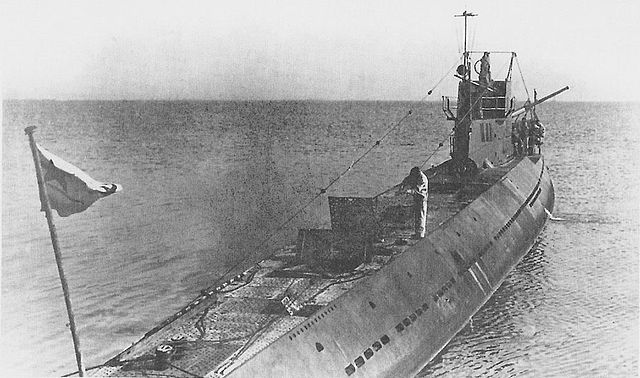
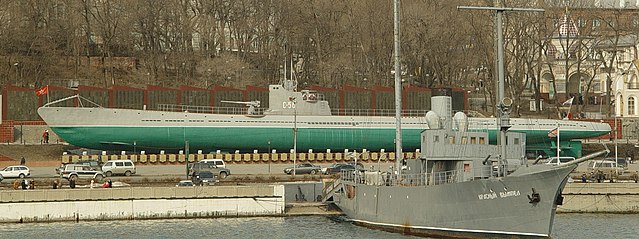
Soviet Navy Series IX, IX bis (1934-48), 40 boats, last active 1960s.
 Commonly dubbed as the S-class, for “Srednyaya” (medium), the series IX and IXbis were arguably the best Soviet submarines of WW2. They superficially looked like the German Type VII U-Boat and this was not fortuitous: Their design origins lays in the relations between Germany and USSR even before 1933. It’s the covert design bureau at the Hague, Netherlands that started working on an oceanic submarine design for the Soviet Navy from late 1933, but blueprints received and design approved in 1934 based on the Spanish E2 or Project 224 II. The end project ended nothing like the latter Type VII U-Boats, that went through the Type Ia step in between common also to the Type IX. Compared to this, the Soviet Series IX looked like an interesting in-between in size and tonnage and with an armament initially installed like Italian and British submarines, behind a sail shield.
A total of 55 S-class were built at various shipyards, 40 completed as WW2 started however and the last suspended, then completed postwar until 1948. They were oceanic models design for long range patrols in the Pacific and Arctic. Theor opertional success was real, they sank 82,770 gross register tons (GRT) of merchant shipping and seven warships, 1/3 of all tonnage sunk by all Soviet submarines and they remained operational for some in 1958 or well beyond, but there were also heavy losses. Four were also offered to the Chinese PLAN, as the foundation of its submarine force from 1954. Truly a landmark class.
Development
One could lazily describe them as “Russian Type VII U-Boats” but in reality they were closer to the Series Ia and earlier designs produced at the Hague covert design bureau in the Netherlands earlier in the interwar. Soviet submarines had very diverse origins, some derived from Italian designs, others from British ones, and lastly, German ones. Germany and USSR famously cooperated before the “great patriotic war” on many armaments program to go around the Versailles treaty limitations, which were relaxed in 1935 for Germany (Anglo-German naval treaty), but went on for tanks and aircraft. Rapprochameent started with the Treaty of Rapallo (1922) formalizing diplomatic and economic ties, with a secret military annex allowed the Reichswehr to develop weapons on Soviet soil to evade disarmament clauses and test banned hardware when USSR wanted industrial modernization and technical expertise for the Red Army.
The KAMA Tank School was opened in Kazan as well as the Lipetsk Fighter-Pilot School Operated by Junkers to train military pilots and test forbidden combat aircraft. There was also the TOMKA Gas Test Site (Volsk) for joint research, testing, and production of chemical weapons. German Firms in the USSR were welcome under Lenin’s concessionary system, German corporations modernized or managed Soviet manufacturing plants producing artillery, aviation parts, and munitions. But there was also a less well known naval aspect to this treaty.

Around 1931 the Soviet government started a massive program of general rearmament with a naval expansion. Submarines were a key point. Development of submarines started early on notably with the Dekabrist and Leninets class, but so far all designs had been disappointing to say the least. The admiralty considered existing typeswoelly unsatisfactory and estimated the technological gap to close too great in such a short time. The new Shchuka-class, copies of British L-class subs were for their part relatively satisfactory, but they were better suited to the shallow Baltic Sea. The admireakty wanted still a true ocean-going submarine to replace the D and L class (Dekabrist, Leninets) and catch up with the best tech in the west, meaning contacting willing shipyards in Europe.
The government commissioned engineers to look for a suitable design for a medium-sized ocean-going submarine. For ideological reasons, France, UK or the USA were barred from acquiring submarines or from any collaboration. This only left Italy, Germany and even Spain as possible collaborators, albeit the latter soon experienced political turmoil and their design were still based on US Holland designs. The collaboration with Fascist Italy started for surface ships and was generally good, but failed to bring anything of value as Italian shipyards refused to give up their designs.
The Italian inspired Dekabrist were not the best either. So this left Germany. Since Rapallo in 1922 as seen above, secret protocols already authorized some collaboration for tanks, aircraft and combat gas, but no for ships. Yet, historically it’s the German Empire that provided through some of its company’s Tsarist Russia’s earliest submarines like the Forel and Karp class. The also provided a destroyer design that became the foundation for Russia’s Novik class.

The Spanish Connection
The German Weimar Republic was at the same time forbidden under the terms of the Treaty of Versailles to have submarines studied or build in its own yards. This was circumvented early on by creating subsidiaries of their shipbuilding and design companies like the fampus Netherlands-based NV Ingenieurskantoor voor Scheepsbouw (IvS), working for Deutsche Schiff und Maschinenbau AG Weser. They prospected many countries for orders with a construction generally made abroad (the exception were the early Inonu class for Turkey built in the Netherlands). IvS was contacted by the Soviet delegation and created a preliminary design that matched Soviet requirements in 1932.
Well before that, the Spanish government, then under General Primo de Rivera’s dictatorship, was a potential partner for USSR. His government showed interest aready from 1925 in obtaining an IvS design, called Project Pu111 for the Spanish Navy. Several German naval officers including Wilhelm Canaris, future chief of the Abwehr also visited Spain and eventually struck a deal with Horacio Echevarrieta in the basque country for a submarine built in 1929–1930, tested at sea early in 1931. However submarino E-1 was never commissioned after a regime change. The new republic was not sympathetic to the project and eventually Echevarrieta himself ended in jail while his company was brought close to bankrupcy. The submarine was eventually resold to Turkey and became the Gür.
This design Pu111 was a classic double hull with Saddle-tank type, main ballast and fuel tanks placed in a pressure hull, no blisters, powered by MAN diesels, Siemens electric engines and batteries plus a Krupp gun under sail shield (forward of the conning tower). But The E-1 attracted the attention of the Soviet Navy and with significant modifications it became the E-2 project. Soviet engineers visited the Echevarria yard in 1932 and were generally satisfied with the design. They suggested several modifications and improvements for a future local production and more engineers arrived at IvS in The Hague by 1933 as well as the Bremen office of Deschimag with a more refined set of specifications. They were also invited to the U1’s trials in Cartagena. Echevarrieta was however later jailed due to his involvement in the October 1934 Revolution. The new Republican government lost any interest for it and turned towards britain and it ended in Turkish sevrice from 1935, active until 1947 as Gür.

Rendition of the S-class on WoW (after relocation of the deck gun).
Design E2, project 224 II
Despite several problems on these 1932 trials, the Soviet delegation considere the design satisfactory enough and the blueprints were officially purchased by the Soviet government under condition that Deschimag would design directly the suggested improvements and assist with building prototypes. Whe this was decided, Hitler just came to power and his defiance towards the Versailles treaty made this easier. The modifications resulted the E-2, Project 224 II with full sets of blueprints drafted and sent by the end of 1933. From August 14, 1934, the design was approved for production. In Soviet nomenclature it was called the IX series. But soon the program was colloquially named “Srednyaya” for Средняя, “medium”. Construction of the first two prototypes started by December 1934 at the Baltic Shipyard, Baltiysky zavod, in Leningrad. German equipment was sent, and it was hope to replicate it on the long run. By April 1935, the third prototype was laid down in the same yard. This will became the only three boats of the Series IX.
The Soviets however could only see that purchasing German equipment was indeed way too expensive. So the design was reworked to use only domestically produced equipment and for the next, alrhe production series, it was called the IX-bis series. Production started in 1936. Initially the first prototypes were named N-1, N-2, and N-3 (the N stands for “Nemetskaya” or “German”. By October 1937 these were re-named S-x (for “Srednyaya” “Medium”) as seen above, which they kept. Western intel was however confused by the design at first called the “Stalinets” with reference to earlier boats of the Leninets type, but it never was official anywhere. None of these boats was named after Stalin or any Party official unlike earlier boats. E1 was also the base for Germany’s Type I, two boats were later the inspiration for the oceanic Type IXA and made more compact, reworked as the Type VII, most produced submarine in history.
As said above the S-class by themselves remarkable in their own way. They arguabvly the best Soviet submarines overall, with the best design, and best operational records by far, despite heavy losses. They also formed the basis of the submarine force in China and some remained operational in otehr roles until the 1970s. One was preserved to this day.
Construction

Apart Leningrad for the first three, the IX bis was built at Mykolaiv (#198) and Gorky (#112) for those operating in the baltic, while those slated for the Pacific Fleet were assembled from prefabricated sections delivered by railroad in Vladivostok at plant #202. The first of the S-class prototype was completed in the beginning of December 1935, trialled soon after, and by August both first entered official trials. They were disappointing, being 0.5 knots (0.93 km/h; 0.58 mph) lower than specified and there were other technical issues but globally this was considered successful enough for their commission and reasuring about production of the series IX bis. The third boat, used also a lot of German equipments buut was the first to integrated Soviet-made diesels as the German ones were delayed.
This forced significant redesigns and thus, also helped generating final, official blueprints for then completely domestically build Series IX bis produced for all four fleets, Baltic, Black Sea, Northern, and Pacific between Leningrad, Mykolaiv and Gorky. Production went on evcen during WW2, at the riverboat production yard #638 in Astrakhan to complete several boats saved from Leningrad and Gorky. S-36, S-37 and S-38 were scuttled at Mykolaiv, which fell to the Germans but were never complete by them and scuttled. S-27 to S-30, S-45 and S-47, saw their construction stopped, but never completed postwar as the design was now considered obsolete and they were scrapped albeit S-27 was rebuilt as a workshop ship.
Design of the Series IX

In the end there were three series-produced variations with equipment differences:
Series IX: German engines and batteries (S3 with Soviet deisels): S-1 to S-3.
Series IX bis: Domestic machinery. Also called “Type IX-modified-1”. S-10, S-101, 102, S-11 to S-13, S-27 to 38, S-4, S-45, 46, S-51-56, S-5 to 9.
Series IX ter: Further improvements to lower production cost and time. None completed. Also called “Type IX-modified-2”: S-103, 104, S-14-26 and S-39.
Series IX quater: Planned, but canceled in the summer of 1941. None laid down.
Hull and general design

Based on Morozov designs.
The series IX had three ships built: S-1, S-2 and S-3, using (partially) German-supplied machinery: The third had Soviet diesels instead. Thery were, like the E1, of semi-double hull type. The outer hull was partial, only doubled amidship for the ballasts, and meeting the riveted pressure hull fore and aft. There were also welded outer hull sections as was the CT fairing and superstructure as both ends for improved seaworthiness. They were about the size of E1, mid-way between the future German type IX and VII, 840 tonnes surfaced and 1,050 tonnes submerged for a an overall length of 77.8 m (255 ft 3 in), a beam of 6.4 m (21 ft) and a draught of 4.4 m (14 ft 5 in).
The outer hull was really shape like traditional German U-Boats of the age, the stem ended with a rounded tip, and the lower “jaw” was rounded and transitioning with a slope to an almost flat underbelly, with a jettisonable underkeel, and the keel sloped upwards to the cross-shaped rudder and aft dive plane ensemble and the two propellers shafts with struts. The stern was rounded with a pointed beak. The flat deck was quite narrow, without sponson apart close to the main gun. Scoops were of the German style, with a long line going all the way along the ballasts forwrard to aft, with three two more scoop line amidship, at the largest extent of the ballasts for rapid filling. There were also series of smaller scoops just below deck for the submerged part above the pressure hull. Other crescent-shaped scoops were located at several points below deck above the mains scoop line. There were also underebelly scoops. Overall the hull looked “stretched out”.
Equipments comprised recessed anchors at the bow, the usual net-cutting saw above the bow (and teeth on the jaw), bollards fore and aft, a small backup capstan winch for the anchors, two deck hatches far apart fore and aft, but instead of barriers a simple cable anchored close to the bow and wll past the CT. There was the usual portico over the CT, close to the periscopes, to support a wireless rado cable doubling a guard cable anchored fore and aft on deck.
The sail was low, and ovals and well profule to reduce water drag but open like U-Boats, housing the conning tower, bridge, periscope fairings. At its end was platform on which was mounted the 45 mm (1.77 in) anti-aircraft gun. Internally there were seven compartments, three able to withstand 10 atm pressure and nine main ballast tanks separated into three groups, four at the bow, two at the stern, ad three midships with a balancing tank and, quick dive tank in the outer hull hull. There were also trimming tanks, but inside the pressure hull. Pressurized air or engines exhaust was used for this task, so no need for ballast pumps. This was a simplification of design wanted by the Soviets.

Detailed diagram of a Type IX, S-class
1 – net cutter; 2 – chain locker; 3 – torpedo tubes; 4 – bow diving plane housing; 5 – main ballast tanks; 6 – trim tank No. 1; 7 – trim tank No. 2; 8 – quick-dive tank; 9 – high-pressure air flask; 10 – retractable bollard; 11 – capstan; 12 – emergency telephone buoy; 13 – boat; 14 – 100mm gun; 15 – 45mm gun; 16 – anti-aircraft periscope; 17 – commander’s periscope; 18 – wire antenna; 19 – railing; 20 – upper sonar fairing “sword”; 21 – 50-ton lifting eye; 22 – torpedo loading hatch; 23 – lower conning tower hatch; 24 – upper conning tower hatch; 25 – hatch (removable plate) for battery loading; 26 – diesel air intake trunk; 27 – diesel exhaust silencer; 28 – diesel starting air flask; 29 – wake light; 30 – sealed magnetic compass with optical transmission to the conning tower; 31 – portable searchlight; 32 – surface-use head; 33 – conning tower; 34 – spare torpedoes; 35 – bunks; 36 – capstan electric drive; 37 – lockers; 38 – trim tank; 39 – torpedo compensating tank and annular gap tank; 40 – bow hydroplane actuator; 41 – sonar compartment; 42 – table; 43 – captain’s cabin; 44 – battery circuit breaker enclosure; 45 – locker; 46 – storage battery; 47 – fuel tank; 48 – attack periscope trunk; 49 – observation periscope trunk; 50 – “Amag-Hilpert” centrifugal bilge pump; 51 – piston-type bilge and trim pump; 52 – gyrocompass; 53 – underwater head; 54 – navigator’s table; 55 – manual control wheels for bow and stern hydroplanes; 56 – ammunition magazine; 57 – washbasin; 58 – radio room; 59 – potable water tank; 60 – bunk supports; 61 – galley; 62 – pantry; 63 – distilled water tank; 64 – oil cooler; 65 – M6 V49/48 diesel engine; 66 – “Bamag” coupling; 67 – diesel exhaust outlet; 68 – general ship ventilation fan; 69 – diesel cooling pump; 70 – standby oil pump; 71 – circulating oil tanks; 72 – propulsion electric motor; 73 – propulsion motor control panel; 74 – high-pressure air compressor; 75 – “Michell” thrust bearing; 76 – AC converter – a two-machine set for bow diving planes and a three-machine set for the rudder and stern diving planes; 77 – propulsion motor air cooler; 78 – potable and distilled water tanks; 79 – shower; 80 – combination lathe; 81 – oxygen cylinders; 82 – manual rudder control pedestal (operated from Compartment VII); 83 – stern diving plane actuator; 84 – rudder actuator; 85 – stern diving plane stock; 86 – rudder; 87 – rudder guard; 88 – stern diving planes; 89 – bow diving planes; 90 – propeller; 91 – docking keel; 92 – main ballast tank vent valve; 93 – main ballast tank flood valve; 94 – electric water distiller (10 l/h capacity); 95 – fresh water tank; 96 – main ballast tank flood valve actuator.
* Based on original drawings by CDB MT “Rubin”
Powerplant
The S-class were equipped by German MAN diesels, of the М6V49/48 four-stroke atmospheric reversive model, 2000 hp each at 465 rev/min, driving two fixed pitch propellers and two Electrosila PG-72/35 electric motors (550 hp at 275 rev/min) connecting by BAMAG (Berlin-Anhaltische Maschinenbau AG) type friction clutches. Delivery for the third prototype however was constantly delayed so the local yard decided to go for existing Soviet 1D diesels, which obliged to some adaptations of the design. Underwater they had a total of 124 APA 38-MAK-760 accumulators all with K-5 hydrogen burners. The batteries lacked a central walkway, and instead had service trolleys suspended from the deckhead for maintenance. This made the battery compartment much lower, freeing space above. The electrical system was considered simple and reliable with connections insulated, the bulkhead feedthroughs were designed to withstand the same pressure as the bulkheads themselves. On trials they showed their dive plans and rudders were well placed and powerful enough for a good general maneuverability, superior to Soviet standards.
Top speed was 19.5 knots (36.1 km/h) surfaced, lower than the 20 specified, and 9 knots (17 km/h) submerged. This was still way superior to previous Soviet Submarine designs. A strong top speed when surfaced was the graal of all belligerents for long-range, oceanic submarines. This was just contradictory to the performances of the diesels at that time. Only a well refined hull could provide such speed. It was excellent even compared to U-Boats of 1935, like the Type VIIA which was of 17.7 knots (32.8 km/h or 20.4 mph) surfaced and 7.6 knots (14.1 km/h or 8.7 mph) when submerged. It was also superior to the Type Ia and to the type IXA at 18.2 knots (33.7 km/h) on the surface and 7.7 knots (14.3 km/h) when submerged. For range, the S-class carried an estimated 100 tonnes of diesel oil, for, depending on the source, 7,500 nautical miles at 8.4 kts or 9,800 nmi (18,100 km) at 10.4 knots (19.3 km/h) surfaced and 148 nmi (274 km) at 3 knots (5.6 km/h) submerged or 132 nautical miles at 2.4 knots. It was better however, at 10,500 nautical miles at 10 knots for the Type IXA but the latter were more massive and carried 1/2 more fuel at 154 tonnes (152 long tons).
As how deep these could dive, the usual figure is 100 meters tested (350 ft) and 75 m operational (246 ft).
Armament
The class S or Type IX were well armed, with six torpedo tubes, four in the bow, two in the stern like for a German Type IX, all of the classic 533 mm (21 in) caliber. They could carry “only” six spare torpedoes in racks of the bow torpedo compartment only. No space available aft. The complete load was 12 torpedoes total, versus 22 for a German Type IX. These were at first 53-38 torpedoes, with only a few boats with commanders awarded medals receiving the more complex and costly 53-39 torpedo. The electric ET-80 was considered unreliable. Like German U-Boats they could also launched tube-compatible mines but there was no automation or remote contril. Boat the loading and firing was made from the torpedo rooms upon intercom instructions from the CP. The stern tubes had no doors, but instead a special rotating cylinder streamlined with the stern when not in use to further improve hydrodynamics.
On deck forward of the CT was a 100 mm (3.9 in) B-24 gun mounted on a platform and a 45 mm (1.77 in) semi-automatic 21-K anti-aircraft gun mounted on the conning tower. The installation of the 100mm recalled British models, with the 100mm/49 B-24 originally placed on a rotating platform protected by a shield that also formed the forward part of the CT fairing. Thus it was always back to axis when diving. The whole platform had a limited traverse either side when surfaced. This was changed for a classic deck gun without streamline shield.
The boats were equipped with two periscopes, observation PZ-7.5 and targeting PA-7.5, mounted close to each other. Several radios were installed. The Mars-12 microphone system was primary an underwater sensor, and an underwater communication system was also installed on all boats. No radars were installed on any series of the type.
Torpedoes
The Series IX had just four bow 533mm (21 inches) torpedo tubes, two stern ones, and six reloads. They had a 100m deck guns and 45mm AA CT gun.
21-inches type 53-27
The story of the first 21-inches Soviet torpdoes started under Imperial Russia, as a model called the pattern 1917 designed to carry a warhead of 476 lbs. (216 kg) at 3,280 yards (3,000 m) and 45 knots or 10,940 yards (10,000 m) at 30 knots thanks to its Wet-heater. It never entered service due to the Revolution but formed the basis for the first Soviet torpedo, the “53-27” project. It is interesting to point out the simple type identifier, rather than “model and the year”, precising the caliber 53 cm and year (1927) was judged more compact, precise and efficient.
The first model adopted was the 533 mm 53-27 type. It was universal, designed to be used from large surface combatants down to MTBs and submarines. Design started likely in 1923 and was accepted in 1927, about the tilme the Dekabrist class were completed, so they were obtained probably in 1928-29 as production ramped up given their urgent need in the whole fleet.
They weighted 3,770 lbs. (1,710 kg) for a body that was 22.97 feet (7.0 m) long, carrying a 584.2 lbs. (265 kg) warthead, with simple percussion cap for the detonation mechanism, and thanks to their Wet-heater they reached 3,700 m at 45 knots. The dual setting mode was abandoned as too complicated. It was produced en masse until 1935 and really became widespread.
Deck Gun: 100mm/43 B-24
Initially designed in 1932, the B-24 became the standard deck gun for Soviet submarines and smaller combatants. The Soviet Navy split the production into two distinct configurations depending on the vessel type: The B-24 Submarine Deck Gun which original design featured an open mount without a gun shield to allow fast diving times and avoid hydrodynamic drag. It was the main deck gun fitted onto large Soviet fleet submarines. There was also the B-24-BM Surface Mount modified in 1937–1939 with an armored gun shield.
Long firing range, flat ballistic trajectory, heavy high-explosive punch.
Specification: Barrel 100 mm (3.9 inches) 51 calibres (often rounded or modified to 43–56 depending on production batch)
Rate of Fire: 10 to 12 rounds per minute (manually loaded)
Breech Mechanism: Semi-automatic horizontal sliding block
Maximum Firing Range: 22,000 metres (approx. 13.6 miles)
Shell Weight: 15.8 kg (34.8 lbs) for standard High Explosive (HE)
Muzzle Velocity: 872–900 metres per second (2,860 ft/s)
Performance Characteristics: The gun used fixed ammunition (shell and propellant casing bundled together as one unit), which allowed a trained crew to maintain a steady rate of fire. Because it was designed primarily for flat-trajectory surface targets, it had limited elevation capabilities (up to +45°), making it ineffective as an anti-aircraft weapon—unlike its cousin, the dual-purpose 100mm B-34 gun found on Soviet cruisers.
AA Gun: 45mm/43 21K
 Installed at completion on the Series III. This was a navy version of the Army 45 mm Pattern 1932 anti-tank gun. The navalized mount had a semi-automatic breech. Tested in 1934, accepted in 1935 after tests with the originally intended automatic breech mechanism failed. Standard AA mount until 1941-42, replaced by the 37 mm/67 but in production until 1947. Not efficient, semi-automatic, no time fuze. Total prod. 2,799 guns. It was largely used on submarines either as AA gun or main deck gun on small Schchuka types.
Specs
Gun Weight: 107 kg, length 2.3975 m, bore 2.0725 m, rifling 1.650 m
Rounds FRAG-Tracer OT-033 2 kg, HE O-240 2.89 kg, FRAG-Tracer OR-73A 2.32 kg
Muzzle velocity: FRAG-Tracer 880 mps and OR-73A 760 mps HE O-240 335 mps and F-73 760 mps.
Rate Of Fire: 25-30 rounds per minute
Single pivot Mount 21K 507 kg, -10 / +85° at 10-20°/sec. Recoil 27-30 cm.
Range (FRAG-tracer): 45°: 9,200 m, 85° 6,000 m. With HE at 45° 5,000 m.
Rounds provision c500, barrel life 4000 rds.
Sensors
Depending on the sources the S-1 to S-3 had Merkuriy or Mars-A or Mars-DM or Mars-ShM hydrophone. The crew by the way was largely composed of officers and NCOs, with few ratings, between 45 and 46.
The Mars series was part of the 1st generation of domestic acoustic equipment developed for the Soviet Navy. They were non-powered, multi-receiver passive listening stations (hydrophones) designed to detect the propeller noises and machinery hums of enemy surface vessels or submarines.They were heavily deployed on Shchuka-class (Shch-/Series III and V) submarines, earlier Dekabrist-class (Series I) and Leninets-class (L-class) minelaying submarines. The base “Mars” system evolved into specialized modular variants:
-Mars-A: The standard early-production installation model.
-Mars-DM: A refined variant featuring modernized receiver elements and improved physical housing.
-Mars-ShM: A noise-shielded version optimized specifically to handle the structural hull vibration and hydrodynamic flow profile of the Shchuka (Shch) class.2.
Compared to contemporary British (Asdic) or German (GHG) arrays, the early Mars series was relatively basic but robust.
Detection Mechanism: Passive audio triangulation. Multiple hydrophone diaphrams were flush-mounted or arrayed along the upper hull or bow casing.
Range: Depending on sea conditions and thermal layers, it could detect a moving merchant vessel or destroyer at ranges between 2 to 5 miles (approx. 3.5 to 8 km). If the submarine itself was completely stationary (“silent running”), optimal range could slightly increase.Limitation: These systems were entirely passive. They could only determine the bearing (direction) of a noise source, leaving the operator to estimate distance based on volume and propeller blade counts.
Mars-12 Hydrophone
A locally produced version of the Atlas Werke model, which proved ineffective for speeds above 3 knots due to noise interference. It was less a problem for a submarine underwater, which could ran at 4 knots on more discreet electric engines. It would be the improved Mars-A, DM and ShM models by 1940-41.
Type 129 Sonar
An excellent British sonar, obtained for those partrolling the Arctic. Introduced between 1937 and 1938, it became a standard on T-class and U-class. Unlike earlier versions that required manual rotation, the Type 129 was designed to run in a passive listening mode where it turned continuously. This granted the operator a constant, slow-rotating sweep of all surrounding bearings. The system’s transducer array was housed in a protective cage or structural dome near the bow on the keel, allowing it to perform efficiently while the submarine was either surfaced or submerged. It was gyro-stabilized and electrically steered, significantly improving accuracy during combat maneuvers and changing seas. While engineered as a primary attack set to track targets and automatically transmit data via a range recorder, operational experience in theatres like the Mediterranean proved it was also an exceptional hydrophone for navigating minefields and tight channels.
The Point on Deep Storm

The S-class inception dates back to 1932, when a group of Soviet submarine specialists traveled to The Hague to visit the Dutch design bureau *Ingenieurkontor für Schiffbau* (often abbreviated as IvS). The bureau was directed by Blum, a former submarine commander in the Imperial German Navy, while its technical director was Dr. Hans Techel, a renowned submarine designer from the same navy.
Owned by the German firm Deschimag-Weser, the bureau specialized in designing submarines and supervising their construction for various nations. It was staffed almost entirely by top-tier German specialists with extensive experience in submarine construction from the First World War; its primary objective was to retain this valuable expertise during the period when Germany was prohibited from building its own submarine fleet under the terms of the Treaty of Versailles. The bureau had already made a name for itself by designing several submarines, notably for Finland, Japan, and Spain. The latter design, designated “E-1,” caught the attention of the Soviet delegation. The interest was mutual: the Germans needed to sell their products to fund further development, while the Soviets sought advanced submarine design expertise and cutting-edge technology.
After reviewing the documentation provided by the bureau, a contract was drafted. Under this agreement, Deschimag was to design a medium-sized submarine based on Soviet tactical and technical specifications and assist in placing orders with German firms. However, the Soviet side first required assurances that the agreed-upon design elements could actually be realized. To this end, the Soviet commission was invited to visit Cartagena, where the E-1 was undergoing trials. In May 1933, a group of leading submarine specialists—A.I. Zelting, V.N. Peregudov, S.G. Turkov, V.I. Govorukhin, V.F. Kritsky, Z.A. Deribin, A.A. Tolchinsky, and A.G. Sokolov—was sent abroad to study the E-1 submarine design in detail. The Soviet delegation first visited the Deschimag company in Bremen (which effectively owned the Dutch firm IVS) and then traveled to Cartagena, where trials of the completed E-1 took place. Despite two incidents during the trials—a fire in the bow battery compartment and a failure of the electric drive for the diving planes—the submarine’s design was generally viewed favorably.
Consequently, shortly after the delegation returned to Moscow and reported its findings to the government, a contract was signed between Soyuzverf and Deschimag. The agreement stipulated that the German side would revise the E-1 design to incorporate the comments made and provide the USSR with a complete set of blueprints. Furthermore, Deschimag undertook to assist in placing orders with German manufacturers for batteries, electrical and radio equipment, echo sounders, gyrocompasses, and other scarce equipment that the Soviet shipbuilding industry urgently required.
The main comments regarding the submarine’s tactical and technical specifications, raised by the Soviet specialists, concerned the composition of the artillery armament, speed, cruising range, and endurance. In particular, the designers were required to increase the power output of the diesel engines and electric motors, as well as the fuel and oil capacities. Naturally, all this led to an increase in displacement and changes to a number of naval architectural parameters.

Throughout 1933, the “E-2” project—the designation given to the new vessel—was developed in Bremen with the participation of several Soviet specialists. In January 1934, it was presented to the leadership of the People’s Commissariat for Heavy Industry and the Naval Command. At the same time, the Leningrad-based TsKBS-2 bureau was tasked with preparing the working documentation (a process that entailed adapting the German blueprints to Soviet manufacturing capabilities). To this end, a special unit was established within TsKBS-2, comprising designers S.G. Turkov, V.N. Peregudov, V.F. Kritsky, Z.A. Deribin, A.G. Sokolov, P.S. Savinov, and D.V. Sudravsky. B.M. Malinin provided overall leadership for TsKBS-2, while P.G. Goynkis represented Glavmorprom. Additionally, four representatives from the Deschimag firm participated in the work, signing off on all drawings and ensuring their compliance with the original German design. The working design for the **Series IX** submarine was completed in early 1935.
 The design of the new partial-double-hull submarine featured a number of distinctive structural characteristics.
It was the first submarine in Soviet shipbuilding history to employ a hybrid construction method: a riveted pressure hull combined with a welded outer hull. It was the first to feature watertight spherical bulkheads—designed to withstand a pressure of 10 atmospheres on their concave side—that separated three refuge compartments. The remaining bulkheads were lightweight, flat structures designed for a pressure of one atmosphere. In total, the submarine had seven compartments.
The first—the forward refuge compartment—was the torpedo room and also served as crew living quarters.
It housed four torpedo tubes (arranged in two vertical pairs) and six spare torpedoes on racks. Special loading and internal transfer mechanisms were provided for loading torpedoes and charging the tubes.
The second compartment was the forward battery compartment; it contained the forward battery group (62 cells) and crew quarters for the command staff.
The third compartment—a designated refuge compartment—housed the central control room. Readings from the magnetic compass, mounted within the conning tower fairing, were transmitted to the control room via a special optical system.
The fourth compartment was the aft battery compartment; it housed the aft battery group (62 cells) and served as living quarters for the petty officers.
The fifth compartment—the diesel engine room—contained two four-stroke, airless-injection, reversible diesel engines, each rated at 2,000 hp (at 465 rpm), driving two propeller shafts.
The sixth compartment—the electric motor room—housed two main double-armature electric motors, each rated at 550 hp (at 275 rpm). Connecting their armatures in series enabled the submarine to maintain an economical submerged speed.
The seventh compartment—an aft refuge compartment—served as both a torpedo room and living quarters for the crew; it contained two horizontally arranged torpedo tubes.
A free-flooding superstructure, topped by the upper deck, extended the entire length of the pressure hull. A streamlined pressure-resistant conning tower with an external fairing was installed amidships. The fairing housed air intake shafts for the diesel engines as well as intake and exhaust ventilation ducts; its upper section featured a bridge, enclosed at the bow end and fitted with a guardrail at the stern. A 45mm semi-automatic gun was mounted at the aft end of the bridge, while a 100mm gun was placed on the superstructure deck (forward of the conning tower).
A large-toothed steel saw was attached to the raked stem (following the **”D” class** design), and a second, identical saw was mounted on special supports on the upper deck at the bow. The transition from the stem to the deck was rounded, allowing the horizontal lines of anti-submarine nets and boom barriers to slide easily onto either the upper or lower saw, thereby enabling the submarine to overcome the obstacles. Bow and stern cable net-cutters would have further facilitated this process. However, practical experience demonstrated that such saws could, at best, sever only one horizontal strand (either the top or bottom) of the steel anti-submarine net’s mesh—insufficient to allow the submarine to pass through the barrier. During the Great Patriotic War, these saws began to be removed from **”S” class** submarines.
The design of the stern torpedo tube shutters was innovative: the pivoting shields common in submarine construction at the time were replaced by a rotating fairing drum. This drum rotated around a horizontal axis and featured two cutouts to allow torpedoes to exit the tubes. During transit, the cutouts were retracted into the superstructure, giving the stern section a smooth, streamlined profile. When preparing to fire a torpedo, the fairing drum rotated to align the recesses with the torpedo tube openings, effectively forming an extension of the tubes. The entire system proved more rigid and reliable than conventional wave deflectors.
The space between the inner and outer hulls was subdivided by watertight bulkheads into the following sections: the bow free-flooding section; the bow group of main ballast tanks (Nos. 1–4); the quick-dive and compensating tanks; the midship (Nos. 5–6) and stern (Nos. 7–9) groups of main ballast tanks; and the stern free-flooding section. Trim tanks were located inside the pressure hull. There were no deck tanks.
The superstructure housed the main ballast tank vent valves and piping, high-pressure air flasks, diesel engine air intake piping, and other equipment.
The submarine’s surfacing system was notable for its operational simplicity and efficiency. Main ballast tanks were blown using diesel exhaust gases or high-pressure air. Each high-pressure air flask had a capacity of 410 liters (compared to 78 liters on earlier submarine classes), reducing the total number of flasks to 14 (down from 60–90). Emergency blow controls were located in the central control room, the conning tower, and the end compartments. The submarine had a reserve buoyancy of 28%.
The design of the flood valves was also new; each consisted of a pair of flaps—one opening inward into the tank and the other outward. The flap valves were connected by an unequal-arm lever, ensuring that in the closed position, external water pressure pressed them tightly against their seats. In the open position, the outer flap projected beyond the lines of the light hull—a design drawback. Consequently, the flood valves had to be closed while underway to avoid creating excessive hydrodynamic drag that would reduce speed. Therefore, in an emergency, it was necessary to open the flood valves before admitting high-pressure air into the tanks. To prevent damage to the tanks should the submarine dive with the flood valves and vent valves closed, pipes were provided to equalize in the tanks with seawater.
The emergency diving time for the new submarine was between 60 and 70 seconds, surpassing the performance of the “D”, “L”, and “P” class submarines. The time required to surface from periscope depth to cruising position was 7–8 minutes.
The submarine featured a well-planned layout of control stations and good accessibility to machinery and equipment. Habitability in the torpedo compartments was significantly improved.
A hydraulic system was used to raise the periscopes and remotely operate the flood valves and venting valves. It offered significant advantages over pneumatic systems—including high reliability, reduced weight and dimensions, silent operation, and rapid response—and subsequently became widely adopted on submarines of various types and classes.
The design of the battery compartments proved successful. While they were sealed (like those on the “D” class), they lacked a central maintenance aisle. This allowed the upper deck—forming the compartment roof—to be lowered, with special suspended trolleys used for battery cell maintenance. By lying on such a trolley and moving along the compartment, an electrician could access any of the cells. Consequently, despite the new medium submarine having a smaller pressure hull diameter, the headroom and comfort of the living quarters located above the batteries were actually superior to those of larger submarines (such as the “D” class).
The control surfaces were equipped with both electric and manual drive mechanisms. Electric control stations were located in the Central Control Room and the conning tower; a remote control station was on the navigating bridge; manual controls for the diving planes were in the Central Control Room, while the rudder control was in the aft compartment. Emergency signal buoys, each containing a telephone, were mounted on the bow and stern sections of the upper deck. The buoy hulls were designed to withstand the submarine’s maximum diving depth. Each buoy was connected to a refuge compartment by a cable.
Design flaws included the low placement of the artillery, although this was somewhat mitigated by superior seaworthiness resulting from the sharper bow lines. The conning tower fairing proved inconvenient to use. The torpedo loading system was overly cumbersome. Periscope vibration was observed at full speed. When fuel was taken into main ballast tank No. 2—as called for by the design—the submarine would develop a bow-down trim and begin to plow into oncoming waves. Freshwater tank capacity was insufficient.
The output of a single diesel generator was inadequate for charging the batteries, necessitating the use of the second diesel engine, which resulted in increased fuel consumption. Diesel piston scuffing occurred frequently.
Without waiting for the completion of the blueprints, the keels of two submarines—and subsequently a third—were laid in December 1934. Initially, they bore a letter designation, only becoming the “S” class on October 20, 1937. Construction of the first two hulls proceeded on schedule, largely due to the disciplined delivery performance of both German and domestic contractors. They were launched in late 1935; mooring trials began shortly thereafter, and only then was it deemed possible to dispense with the representatives’ presence. It is safe to assume that the German firm did not lose out, if only because the design work on the E-2 project—funded by the USSR—largely formed the basis for the German Type VII submarine, the most widely produced submarine of World War II. At the same time, this also attests to the soundness of the technical solutions adopted. The third hull—intended to house domestically produced instruments and machinery—was not completed on schedule due to delivery delays, primarily regarding the diesel engines.
The first two Type IX submarines, built under the supervision of V.F. Kritsky and A.G. Sokolov, were fitted with foreign-made diesel engines. The third submarine in the series (**N-3**) received domestically produced diesels that outperformed the foreign ones in terms of operational characteristics.
Acceptance trials for the first two Type IX submarines concluded on September 11, 1936, with the signing of the acceptance certificate.
The State Acceptance Commission, chaired by N.I. Kyun, noted the new submarines’ high combat capabilities, as well as their excellent maneuverability, seaworthiness, and handling characteristics. Using a centralized control system for the emergency diving sequence, they could submerge to periscope depth in 68 seconds.
These new medium-sized submarines could operate on diesel power in any weather, dive and surface while underway in strong winds and rough seas, and employ their weaponry at ambient temperatures as low as -20°C. While retaining the same number of torpedo tubes and identical underwater… In terms of speed, they surpassed their predecessors (the **”Shch”-class** submarines) by 7–8 knots in surface speed, and more than doubled their cruising range at economical speed.
9,860 miles versus 4,500). Artillery armament was also upgraded: a 45mm gun was replaced with a 100mm one. However, these advantages could only be realized if the submarine operated primarily on the surface. In enclosed maritime theaters, meeting this condition proved virtually impossible.
Appareance


⚙ specifications |
|
| Displacement | 840 tonnes/1050 tonnes sub |
| Dimensions | 77.8 x 6.4 x 4.4 m (255 ft 3 in x 21 ft x 14 ft 5 in) |
| Propulsion | 2 shaft diesel 2,000 hp/1,500 kW, 2 EM 550 hp/410 kW |
| Speed | 19.5 knots (36.1 km/h) surfaced, 9 knots (17 km/h) sub |
| Range | 9,800 nmi (18,100 km) at 10.4 kts surfaced, 148 nmi (274 km) at 3 knots sub |
| Armament | 6x 533mm TTs (4+2) 100mm B-24-2, 45mm 21K AA |
| Test depth | 100m /330 ft |
| Sensors | Mars-12, Sirius com., ASDIC, see notes |
| Crew | 8 officers, 16 NCO, 21 ratings |
 S-1 (1934)
 S-2 was laid down in December 1934, launched on 7 November 1935 and commissioned on 23 September 1936. With the Soviet-Finnish War she was part of the 13th Division, 1st Submarine Brigade, under Captain 3rd Rank I. A. Moroz. On November 28, she was sent off the northern tip of Gotland, spotted no target and returned to Libau on December 6. On January 1, 1940 under command of Captain-Lieutenant I. A. Sokolov she amde a second patrol assisted by Division Commander G. N. Tutyshkin on board with the brigade’s flagship navigator, V. K. Kolesnikov. On January 3, she was in the South Kvarken Strait. She made contact a last radio contact but was never heard again. Causes of her loss remains unknown. Theories ranges from a lost on January 3-4 while attempting to pass through the South Kvarken Strait, stiking a mine from the minelayer Louhi. Another was that her shortwave transmitter failed, and she patrolled for three more weeks before striking mines back home. Indeed, the S-2 call sign was received on the 1st Submarine Brigade’s frequency by the depot ship Smolny on January 14 as well as the DL