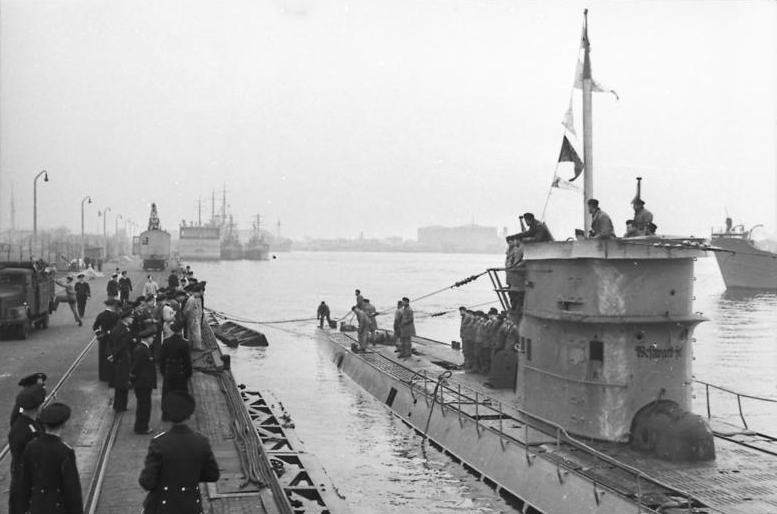
Germany (1937-39): 8 boats completed, 6 lost: U-37 to U-44
After detailing the Type VII lineage it was logical to also detail the other main U-Boat Type in service in WW2: The Type IX. Aside the already comprehensive article made back in Dec. 2019, this one will be on the birth of the type, its specifics compared to the Type VII, and career of all eight boats in class. As a reminder, the Type IX was essentially the long range U-Boat of the Kriegsmarine, complementary to the Type VII. To illustrate things, Germany wanted to replay its duo tried in the final year of the war (1918), with its “regular” types roaming around the British Isles and venturing in the mid-Atlantic, whereas its “U-Kreuzer” rampaged along the US West coast to cut the convoys westwards at the root. The Type IX that would be developed was not a “a cruiser” in the WW2 sense, as in between progresses in diesels and fuel consumption meant a smaller, cheaper type could play this role as well. In the end, the Type IX started a new lineage of some 194 U-Boats, capable of preying across the globe, providing they had far-flung support. The class comprised U-37 to U-44 (6 losses) and U-37 was the most successful in class, sinking on 11 patrols some 53 ships sunk (200,063 tons), ranking 6th for all U-Boats.

Development
From the U-Kreuzer to IVS Oceanic Projects
The “U-Kreuzer” or cruiser submarine was a new concept born from the kaiser’s unrestricted submarine warfare decided in 1917. In addition to the numerous coastal types, minelayers types and regular medium U-Boats that already savaged allied tonnage (in proportions of such scope they would be unlike those, more modest of WW2 by the way), a new type of extra long-range submarine was developed from the U-151 type, ex-Deutschland civilian blockade running cargo submarines developed in 1916 by private companies.
Fast-forward and with the arrival of Hitler to power in 1933. From there was developed the U-139 and the late war U-142 types. They left quite an impression on all belligerents, and a new type was born in the interwar, with mixed success until being capped by treaties.
Fast-forward, with the arrival of Hitler to power in 1933, it seems the Kriegsmarine would receive more support to restart its development. Meanwhile, IVS (Ingenieurskantoor voor Scheepsbouw) at The Hague, as a secret design company “kept the light running” in terms of U-Boat technology research and development for the early interwar, essentially taking the latest and best WWI design and refreshing them to be built in foreign yards for other navies. Germany, under the Versailles Treaty, was forbidden to have any submarine indeed. So the Kriegsmarine could not get access to U-Boats up front, and it need the Anglo-German naval treaty of 1935 as an appeasement measure to essentially nullify this treaty and not only authorize the German Navy a 35% global tonnage to the Royal Navy, but also place her under the Washington and London treaty limitations.
Deep roots of the Program
So no now access to submarine was granted, and strong of its experience gained at NV Ingenieurskantoor voor Scheepsbouw, the new U-Boat Types the Kriegsmarine needed were all developed for foreign Navies: Finland for example, gave the opportunity to work on coastal U-Boats (the future Type II and III), the first built after the 1935 treaty, in 1936, whereas other types like Turkish Inonu class all the way back to 1927 (they were the first IVS types) mixed aspects of the UC-II and UB-III of WW1 in a package that was at the origin of the future Type VII. Back in Germany, which still gave directions and funding to IVS in the Netherlands, there were plans for both a new cruiser submarine AND a long range oceanic submarine as an in-between. The cruiser submarine would be the Type XI, a colossus of 5,000+ tons with deck turrets, but it was judged uneconomical and never built in the end. The other was a medium, long range oceanic model that became the Type Ia ultimately in 1936.
The latter would later branch out into the Type IX, Type VII and the Type VI that was a steam-powered Type Ia essentially, never built.
IVS pioneer: Submarino E1

The Type Ia however did not come out of the blue. In 1925 the Armada, under Spain led by dictator Miguel Primo de Rivera ruling with the King’s support like Mussolini in Italy, had hopes to restore its image and position in a country which badly needed an economic boost and reforms, but under the limited budget, had to fight the rival Army and Air Force for funding. Already submarines seemed a good deterrent for its budget, but it was eventually by 1931 under the Second Spanish Republic that one Spanish shipyard agreed to a proposal from IvS for the Navy, based on a need expressed in 1929 for a commerce raider.
Back in Germany, R&D on a new type of oceanic type drove the whole move all the way back in 1925, when Businessman Guillermo Pasch sent Echevarrieta, owner the shipyard at Cadiz, plans for two submarine models for the Armada, to be proposed as a private venture, internally at IVS later developed as Project Pu111. On February 5, 1925, three German engineers arrived from IvS in Madrid, to meet with the Basque financier and technicians at Cádiz Shipyards. Long story short, On October 4, 1927 Echevarrieta signed a preliminary contract for a 650-ton submarine. Preparations went on in 1928-29 on October 22, 1930, “Submarino E1” was launched in Cádiz. Her “career” was a no-go as under the new Republic, the idea of acquiring a “German submarine” as this was a secret for nobody did not fare well. Long story short, E1 was never purchased for the Armada. Eventually Echevarrieta ended in jail and his submarine was eventually resold to Turkey, becoming “TCG Gür”.
What is important are the technical aspects present in this submarine. They mixed aspects from IVS “Birinci” and Vetehinen class, both deriving from the excellent UB III, with aspects from the larger 1917 U93 class. E-1 also attracted attention of the Soviet Navy, became the E-2 project, and from late 1934 were started at the Baltic Shipyard the S-series, arguably best Soviet Submarine design of WW2. E1 can be seen as the prototype of the Series Ia U-Boats a true forerunner. The latter were just scaled up from a 650t (light, standard, surfaced) to 755 tonnes.
The Type Ia (1936)
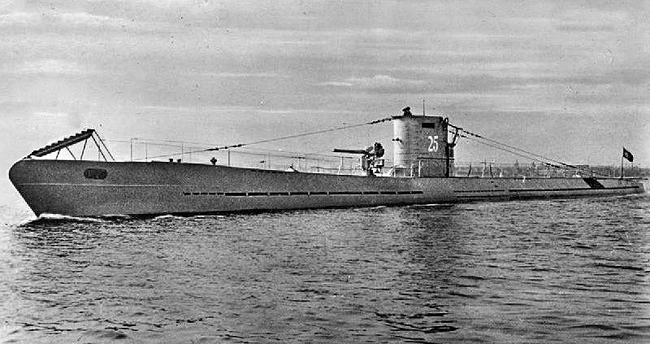
U-25 of the Type Ia as completed.
The Unterseebooten Typ I emerged in direct line from the Spanish E1 or Project Pu111 alongside various other international orders for Turkey, Finland, Holland made at The Hague. All these oceanic types were indirectly openly violating clauses of the Versailles treaty. The Type I was developed in Germany, for the Kriegsmarine in secret for the general staff, and reycled some aspects UB III with aspects from the U93, as well the Swedish Delfinen class (Three boats laid down in 1933 at Kockums Mekaniska Verkstad in Malmö). Later they would also have some common traits with the 1938 Romanian Requinul and Marsuinul.
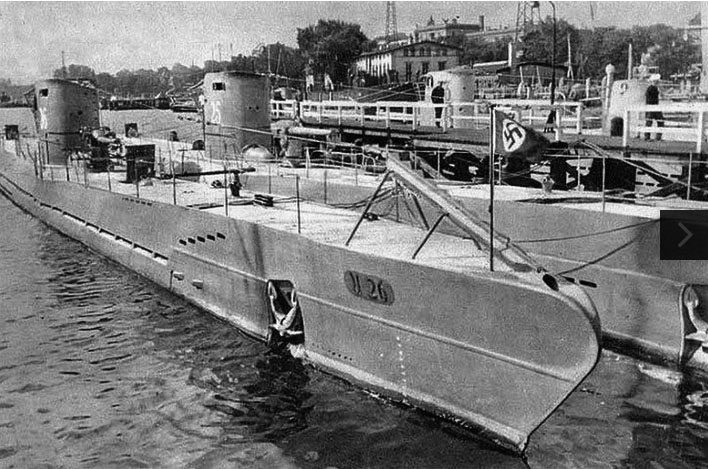
The Type Ia however was a bold gamble, as the most advanced U-Boat type planned for the Kriegsmarine and would be essentially pre-series prototypes: Two submersibles were planned, U25 and the U26, to be testbeds.
 Their start was no longer a big risk towards the Versailles Treaty, when U-25 was laid down at Deschimag in Bremen on 28 June 1935. Indeed, ten days prior on 18 June the Anglo-German Naval Agreement (AGNA)just had been signed between Hitler’s Ambassador Joachim Von Ribbentrop and a British commission at the Admiralty office. It drew from an earlier appeasement proposal from Berlin in May, speaking of a 35:100 naval ratio with Britain. It was finalized and agreed between Sir Robert Craigie, the British Foreign Office’s naval expert and chief of the Foreign Office’s American Department, and Ribbentrop’s deputy, Admiral Karlgeorg Schuster. The result was a seismic even for the Kriegsmarine as it freed it entirely from the Versailles treaty and placed it under the London Treaty limitations, itself precising the Washington treaty back in 1922 that Germany never signed but now was a retrospective signatory in June 1935.
For the surface fleet this means no cap until 35,000 tonnes (leading to the Scharnhorst class and later Bismark class) and enabling the construction of submarine, but as the following weeks in June enabled under a 45% ratio to the Royal Navy’s own submarine fleet. France protested over the treaty, but it was toned down by its own internal political division and more attention given to the German threat on the ground, notably after the Ruhr’s takeover and visible 1935 rearmament. Plus the Marine Nationale’s attention, based on a division of labor with the RN, was still Italy and the Mediterranean. In addition, this acceptance of the treaty gave later French delegates for the signing of the London 1936 naval conference, more leverage for its own gains.
Still the 1935 treaty impact was limited. British experts estimated Germany would be able to reach this 35% limit not before 1942 at best, and later within PLAN Z, even more ambitious (to equal or surpass the RN), the schedule was at best for 1946-47, based on these known industrial and resources limitations. However, disillusionment with Britain after the Munich agreements led Hitler in January 1939 to give priority to the Kriegsmarine in allocations of money, skilled workers and raw materials and accept Plan Z.
Back to The I U-Boats: Mixing technical aspects of the Spanish Type E-1 and Finnish CV707 (Vetehinen) both designed by Ingenieurskantoor voor Scheepsbouw, they were launched in February 1936, the first U25 completed on 6 April 1936, starting trials. However they appeared to be a mediocre design: Their MAN diesels proved troublesome, their seakeeping and maneuverability were poor. Goebbels however, used them extensively for propaganda and they were used in between for training. Both submersibles had a short but “productive” wartime career: The first sank 6 freighters before hitting a mine off the coast of Norway in August 1940. The second, U26, sank four freighters before being sunk by an escort in July 1940. The U1-U24 series had been attributed to the Type IIA coastal submersibles.
The Type IXA
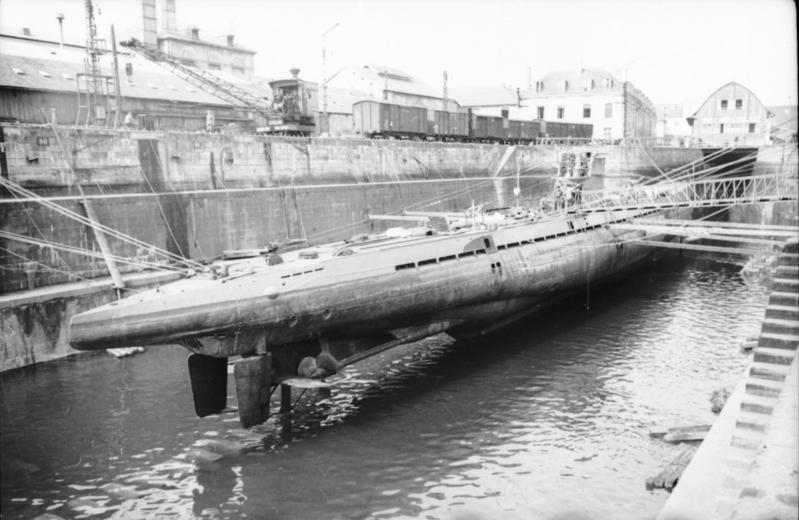
U-37 in drydock, Lorient.
Designed between 1935 and 1936 in Germany. By then, no need for the IvS which had already been exposed by the local press, forced to relocate, and now had closed doors, its staff mostly back in Germany. The next projects were intended to be fairly large ocean-going submarines based on the Type I submarine, which gave on trials, ways to improve the final design of what was called the Type IX. The new type would have similar diving depth and submerged horsepower. However, trials of U25 enabled a serie of detailed modifications. In all, eight were ordered between 29 July 1936 and 21 November 1936, barely five month after trials showed all the modifications needed to be ported on the design, so R&D was fast. All contracts for construction were indeed awarded to the same DeSchiMAG AG Weser, Bremen that were awarded already U25 and U26. This was the quickest way to improve on the design and have the boats built in a short time span, hopefully.
However, in between more submarine were built of other types, the Type IIa and Type VIIA so the first U-Boats of what later became the Type IXa retrospectively, were allocated the U-37 to U-44 range. U37 was the first laid down, on 29 July 1936, and first also completed, on 4 August 1938, and the last, U-44, laid down on 21 November 1936 and completed on 4 November 1939, so under three years time span which was quite long for submarines, and reflects on the large size, cost and complexity of the Type IX design, and the need for detailed modifications all along the series construction.
Design of the class


To compare: U37 and U25, both Author’s.
Hull and general design

The first of the original design, a total of eight Type IXAs were built. It was equipped with three periscopes, two in the conning tower and one in the control room. The Type IXA measured 76.50 m (251 ft) (overall) by 6.51 m (21 ft 4 in) in beam, and was 9.40 m (30 ft 10 in) high to the conning tower top.
As a double-hull type, the pressure hull measured 58.75 m (192 ft 9 in) by 4.40 m (14 ft 5 in).
The Type IXA had a 4.70 m (15 ft 5 in) draft.
The hull was strong enough to be capable of reaching 230 m in test depth (750-770 ft), but in reality, like the smaller Type VII, many in operations had to dive below 250 m and survived to tell the story. They were extremely rugged and resilient.
Powerplant
Propulsion-wise, it would remain essentially the same throughout the war, to the exception of the Type IXD/42. The powerplant consisted of two MAN M 9 V 40/46 supercharged 9-cylinder diesel engines, rated for 4,400 PS (4,300 shp; 3,200 kW). These were solid, usual type marine diesels that derived from a long line of proven units. They were mounted side by side at the rear of the engine section, approx. 5 meters from the conning tower. Their position allowed the mechanics to have access to every part for maintenance. The crankshafts were situated below the cylinders, one for each shaft. Batteries were situated below.
Two SSW (Siemens-Schukert) 1 GU 345/34 double-acting electric motors were installed side by side, rated for 1,000 PS (990 shp; 740 kW). They were installed in front of the diesels, approx. 2.5 meters, and below the aft “wintergarten” behind the conning tower. The power provided was enough to propel them at 18.2 knots (33.7 km/h; 20.9 mph) on surface, but 7.7 knots (14.3 km/h; 8.9 mph) when submerged. The useful range was 10,500 nautical miles (19,400 km; 12,100 mi) at 10 knots (19 km/h; 12 mph), in standard surface mode, down to just 65–78 nmi (120–144 km; 75–90 mi) at 4 knots (7.4 km/h; 4.6 mph) in attack or retreat mode underwater. As for diving, the Type IXa had a construction diving depth of 100 m (328 ft 1 in), a test diving depth of 150 m (492 ft 2 in) and a crush diving depth of 250 m (820 ft 3 in).
Armament
The Type IXA submarines were given six torpedo tubes, four in the bow as a standard, two in the stern. This was the same as any Type VII U-Boats. However the total of torpedoes carried was larger, twenty-two 53.3 cm (21 in) in all, with external storage. Their warhead could vary between 617 pounds (280 kg) and 948 pounds (430 kg) depending on the models. These models can be setup to reach 6,000 m (6,600 yd), or to speed up to 44 knots (81 km/h). Part of these torpedoes, twelve in all, were stowed internally, ten were located in topside deck containers, in the external hull, 3 external containers at the stern and 2 at the bow, with two torpedoes inside each.
G7e Torpedoes
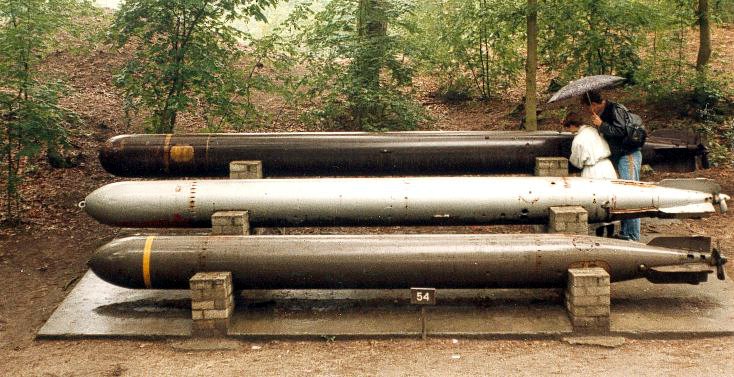
As primary armament, the Type IX possessed four bow tubes and two stern tubes all of 533 mm (21 in). They carried a total of G7e torpedoes were carried. The G7e type was electric, Electric with Lead-acid batteries. It was 7.16 m (23.5 ft) in length. The type carried was the first, called T2 and introduced in 1936. It can reach a target at 3000 m, running at 30 knots (56 km/h). This was not impressive as the submarine had no chance hitting a destroyer, cruisers or the new fast battleships.
10.5 cm (4.1 in) SK C/32
Type IXA submarines were given a 10.5 cm (4.13 in) L/45 deck gun placed on a tailored Utof mounting, forward of the conning tower. 180 rounds were carried. These rounds weighted 33.3-pound (15.1 kg), for the HE type. Muzzle velocity of 780 m/s (2,600 ft/s). Range at max elevation optimal, was 15,175 m (16,596 yd). It was able to fire on aircraft at a 10,000 m (11,000 yd) ceiling at max. elevation, manual. Rate of fire was 15 rounds per minute.
10.5 cm (4.1 in) SK C/32 naval gun, 45 calibers long, 1.8 tons, with 180 rounds in store, placed on the forward deck with a 360° traverse and 44.4° up to 80° elevation. It fired a 15.1 kilograms (33 lb) explosive (HE) shell at a 10,300-metre (33,800 ft) ceiling for AA use, while naval range was 15 kilometers (16,000 yd). The gun was enough to at least set on fire, and possibly sink a freighter. More
The Type IX in general could also be given two guns, a 2 cm FlaK 30 and a 3.7 cm (1.5 in) gun.
-The 2 cm FlaK 30 guns installed on the “wintergarten” (aft of the conning tower).
-The 3.7 cm SK C/30U when later present, was located on the aft deck.
3.7 cm/83 SK C/30

37mm FLAK on the aft deck of U-103 training. Note the partial shield, only covering the lower mount.
Unlike the Type VII, the Type IXA had on the aft deck enough space to mount a defensive 3.7 cm/83 SK C/30 straight away, providing welcome AA defensive power. This ordnance was introduced in 1934. However it was not systematically fitted and often was installed in the course of the war.
Specs:
536 lbs. (243 kg), Barrel Length 121 in (3.074 m). Mount: Ubts LC/39 -10/+90 degrees
Shells HE-T: 4.63 lbs. (2.1 kg), mv 3,281 fps (1,000 mps).
ROF about 30 rounds per minute. Probably 1,200 rounds on board.
Useful range 9,300 yards (8,500 m) at 45° up to 22,310 feet (6,800 m) ceiling.
More
2 cm/65 Flak C/30 AA
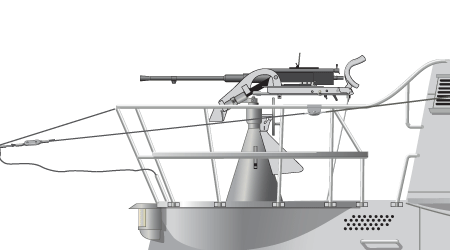 According to Conway’s, either a 2 cm Flak 30/38 or a 3.7 cm SK C/30 FLAK gun was mounted in the kiosk’s aft bathtub platform (“120 mm C30”, probably typo). They had a maximum range of 4,900 metres (5,400 yd), reduced in practice to 3,700 m against fast-moving aerial targets. Rate of fire was 280 rounds a minute at a muzzle velocity of 835 m/s (2,740 ft/s). 2cm Rounds weighed 0.71 pounds (0.32 kg). More
Mines
The Type IXa could also be fitted with 24 TMA mines, not 26 as on the Type Ia. Not all IXs boats were fitted for minelayin, not before the Type IXC.
-The German TMA was a moored mine, which floated above the surface, and could be carried and launched from each torpedo tube, so twelve total, plus 32 reloads. They were small enough to be fitted in the tubes, with a diameter of 11.1ft (3.38m)/21in (533mm), and could be moored down to a maximum Depth of 270m, and carrying a warhead of 215kg.
Sensors
Gruppenhorchgerät
In short, the GHG was the first efficient German sonar to be widespread.
Range: 20 km to individual ships, 100 km against Convoy
Search area: 2 × 140° at <1 ° at 6 kHz, 1.5° for 3 kHz, 4° for 1 kHz and 8° without filter.
It's possible the first U-Boat completed in 1939 had instead the polder Atlas hydrophones due to shortages.
For radars, none was installed before much later in the war. They will be covered on the next IX sub-variant installements.
Appearance

Author’s Type IX schemes, with U-37 and U-40.
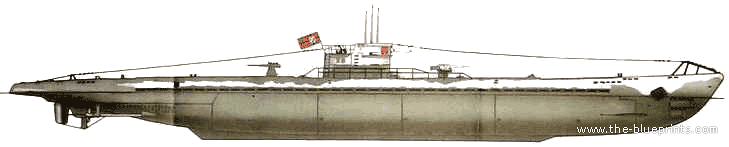
U-37, Type IXA (The blueprints)
⚙ specifications |
|
| Displacement | 1,032 t (1,016 long tons) surfaced, 1,153 t (1,135 long tons) submerged |
| Dimensions | 76.50 x 6.51 x 4.70 m (251 ft x 21 ft 4 in x 15 ft 5 in) |
| Propulsion | 2x MAN M 9 V 40/46 diesels 4,300 shp (3,200 kW), 2x SSW 2 GU 345/34 EM 986 shp (735 kW) |
| Speed | 18.2 kts surfaced, 7.7 knots submerged |
| Range | 154 tonnes fuel: 10,500 nmi/10 knots surfaced, 65–78 nmi/4 knots submerged |
| Armament | 6× TTs (4 bow, 2 stern)/22 total, 10.5 cm SK C/32 naval gun (180), AA guns |
| Max depth | As Type Ia: 150 m (492 ft 2 in) |
| Sensors | See notes, GH sonar |
| Crew | 56 |
 U37
U37