


 Türk Deniz Kuvvetleri (1932-47)
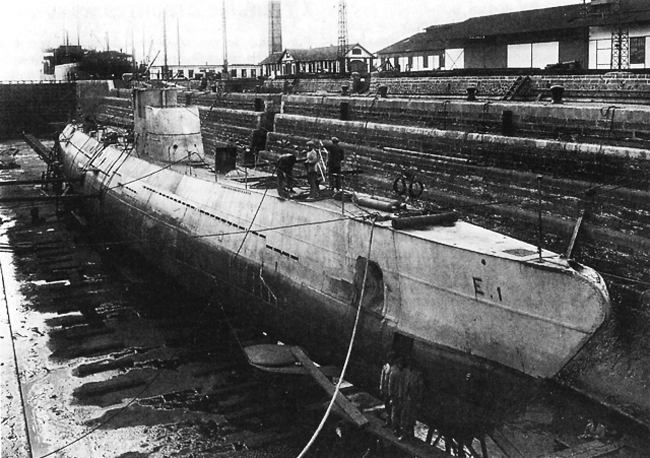
In the development of Spanish Submarines up to WW2 there were mostly Holland/Vickers Types, until Germany entered the loop. The story of E1, sole submarine of the E class never commissioned by Spain, is very much the story of IvS, NV Ingenieurskantoor voor Scheepsbouw. This covert design bureau at The Hague, operating from 1922 to 1935. This office was completely instrumental to the rebirth or German submarines despite the 1919 Versailles treaty interdiction. And “E1”, build in Cadiz, had an important part to play in this: She basically was the prototype of the Type I class, in turn the ancestors of the mass-built long range Type IX U-Boats that terrorized the US East Coast from 1942. Albeit its service was short, as the Spaniards sold it to Turkey, becoming the TCG Gür, still operational in 1947.
Development
The Role of IvS
NV Ingenieurskantoor voor Scheepsbouw was created back in 1922 by the Reichsmarine in order not to loose expertise in German submarine design. If this story is an amazing one that deserved books (several were written about it), it proved also instrumental in the genesis of Kriegsmarine’s U-Boote in WW2, despite the Versailles treaty interdiction about submarine “possession, design and construction”. So the Reichsmarine could not even acquire a foreign submarine from any nation. The way it was achieved, was through a remarkable feat of secret dealings, financing and support, all for export. There was a double safety net here: The company was created by Germans in the Netherlands, which was perfectly legal, and seen by some as a “just return” of things after then engineer that allowed the Luftstreitkräfte to punch way above its weight, Anthony Fokker, returned to his home country to resume aircraft production. And with German aviation also severely limited.
IvS as it was abbreviated as “Inkavos” (engineer-office for shipbuilding), was established thanks to Friedrich Krupp AG, based on an agreement between the German Imperial Naval Office in Berlin and Krupp’s management. This front organization had come into force as early as January 10, 1920. Its HQ at The Hague was at the crossing of Gedempte Burgwal 1 and Wagenstraa and from 1925 to 1938, had Hans Techel as director. After an article claiming German involvement in the company in 1931, it was moved to a more discreet location at Kneuterdijk 8. The bureau will work for export only, and to better mask its real purpose, submarines will be built in foreign shipyards, each time in the customer country, also exporting engineering expertise and construction know-how. These were still difficult times for civilian shipbuilding and five Dutch shipyards merged on November 21, 1934, to form the Nederlandsche Vereenigde Scheepsbouw (Nevesbu or NVSB). In 1936, they moved at the same address as INKAVOS for close cooperation with German shipbuilding engineers from INKAVOS taking leading positions in the Nevesbu shipyards. During the war, Nevesbu was integrated into INKAVOS, tasked to complete ex-Dutch and other vessels to Kriegsmarine standards in occupied Netherlands. IvS lost most of iots activity alerady from 1935 and authorization to built submarines for Germany again, and was disbanded in 1945.
INKAVOS put so much resources into R&D it was not financed only through contracts. This joint venture between Vulcan-Werke Hamburg, Stettin Actiengesellschaft (until 1929), F. Krupp Germaniawerft in Kiel, and Aktien-Gesellschaft “Weser” in Bremen as well as “Mentor Bilanz” in Berlin providing co-financing through diplomatic pouch and other covert ways with hard cash. Design and planning work was shared with all the mentioned shipyards. IvS developed construction methods and building processes after going into civilian shipbuilding and concentrated on several submarine types from 1923, with a serie of contracts.
The “submarino E1” genesis

At first IvS used the UB III and UC III boats as starting point for their new submarine designs and from there, proposed a heavily modified first model to Turkey: These were Birinci Inönü class. After completion in the Netherlands (Fijoenoord, Rotterdam) 25 May 1928 she was the first heavily tested by Kriegsmarine officers. However, her design attracted attention from naval experts in France and Britain, and being built that close to the design bureau was a way to attract attation on the latter, so it was decided for the next designs to focus domestic construction each time.
In 1929 the Armada was looking for alternating designs to is A and B classes which were classic Vickers-Holland designs. The latter were completed in the early 1920s at the Shipbuilding Society (SECN) in Cartagena. But these were still WWI designs. The naval staff wanted to test more modern designs. Through intermediaries from IvS close to all admiralties, the government of the time, the dictatorship of Miguel Primo de Rivera, ruling with the support of Alfonso XIII. This period followed the earlier Military Directory (1923–1925). The Parliament (the Cortes) had been suspended, constitutional guarantees were restricted, and censorship was imposed. There was a single official political organization, the Unión Patriótica, but also large public works programs: roads, irrigation projects, dams, and infrastructure modernization with greater state intervention in the economy. All this in the background of the Rif War. Before Primo de Rivera resigned in January 1930, replaced by General Dámaso Berenguer (“dictablanda”) and then the Second Spanish Republic from April 1931, the Navy agreed to a proposition for a single submarine from IvS to be built in Spain, importing also expertise on a modern, alternative design.
The Spanish Navy’s submarine arm expanded and modernized under the Primo de Rivera regime, partly using lessons learned from World War I and the Rif War and the new submarine, relatively large, was thought of as a commerce raider. However the whole process started much earlier, all the way back in 1924. However as it happened, she never was commissioned in the Armada but still deserves a mention in the Spanish Submarines lineage.
Contracts and Construction 1924-1930
Businessman Guillermo Pasch sent Echevarrieta, owner the shipyard at Cadiz, plans for two submarine models for the Armada, to be proposed as a private venture. On February 5, 1925, three German engineers arrived from IvS in Madrid, to meet with the Basque financier and technicians at Cádiz Shipyards. Arrangements were then made with the Spanish Navy Ministry, requesting a report on the project. Echevarrieta’s representative in Madrid, Rafael Ferrer, had reservations about the deal and waited until the Minister’s approval of the German report but refused to accept plans from Pasch until this was further developed. This went on until the first half of 1927. On October 4th, Echevarrieta signed a preliminary contract for 650-ton submarine.
IvS would supply all the materials and machinery and engineers sent to Cádiz were mobilized to handle only the final assembly. Horacio Echevarrieta provide its facilities and salaries of the Spanish employees. The rest would be German. This final contract was signed on December 13th. Preparations proceeded and by April 1928, the Ministry of Finance signed a confidential Royal Order for an exemption from import duties for its transfer. On March 25th, 1929, the keel of what became “E1” (following the previous letters until “D”) was laid down at Cadiz. Some historians argues that the letter was not in order as the D class were planned later, and it was more about “Echevarrieta”. By October 22, 1930, with Primo de Rivera already dead, E1 was launched in Cádiz, followed by a long ordeal with selling arrangements (see “career”).
Design of Project Pu111
“E1” was very different from other Spanish submarines, apart its obvious similarities later with the G-class, a Type VII delivered in 1940. E1 was indeed a more refined prototype of the UB-III copy that was the early pair of Turkish Submarines, that needed to be convertly tested, as an alternative to the Finnish Vetehinen class, minelayer submarines. As General Primo de Rivera’s showed interest for a submarine for the Spanish Navy, German naval officers (including Wilhelm Canaris) went to Spain to meet Spanish businessman Horacio Echevarrieta and the rest is history.
Now, how this design registers in the IvS lineage ?
Lesson from the design of the “Birinci” and in the Vetehinen class led to a torpedo-only submarine large enough for oceanic operations. She was not a large submarine at 650 tonnes standard, she derived from the excellent WWI UB III, with aspects from the U93. This class of large ocanic submarines were rated for 838 t (825 long tons) surfaced indeed.
But proof this design was influential, The E-1 attracted the attention of the Soviet Navy and with significant modifications it became the E-2 project, wich construction of the first two prototypes started in December 1934 at the Baltic Shipyard, Leningrad, with German diesel engines and electric batteries. This was recoignized later as perhaps the best Soviet Submarine design of WW2.
But more so, E1 can be seen more as the prototype of the Series Ia U-Boats. She is considered indeed today the true forerunner of the German Type IA submarine, just the latter were scaled up. Since the initial plan for a 650t submarine, the designed ballooned up to 755 tonnes…
Hull and general design
The Project Pu111 was a classic souble hull with Saddle-tank type, with the main ballast and fuel tanks were placed in a pressure hull. Unlike WW1 early designs, she sported no blisters, but a very smooth hull shape. She was was powered by MAN diesels, Siemens electric engines and batteries. The Krupp gun was unusually installed on a fin structure close to the conning tower, something closer to British designs and unlike any U-Boat. Thus was very atypical for a German design, but possibly made to reassure the Spanish authorities, until then accustomed to Briitsh designs, something similar to contemporarry British submarines, at least in appearance, and possibly because it was also asked for.
She measured 72.38 m (237 ft 6 in) in overall lenght, for a beam of 6.2 m (20 ft 4 in), with the pressure hull likely around 5 meters diameter and an overall draught of 3.48 m (11 ft 5 in). This made her the largest design from IvS so far. Displacement was indeed of 650 tonnes (640 long tons) surfaced and unladen, 755 tonnes submerged, unladen, and 965 tonnes fully loaded and submerged, so close to 1,000 tonnes, which was quite symbolic. Apart the unusual conning tower integrating a gn platform the latter was classic and open, with a smaller observation platform aft, but no AA armament.
She also had classic features with protected diving planes underwater and fixed, a coss style stern arrangement with propeller guards for the two shafts, a net cutter forward, a clipper prow, recesses for anchors, three hatches for the crew plus two on deck for the forwad and aft torpedo tubes. There was a wireless radio set and a portico to support the two guard cables running up and down the CT to the prow and stern, and a telescopic mast in addition of a classic attack and watch periscopes, the latter to support cables running to the forward net cutter saw ridge.
Powerplant
She had two shafts with fixed pitch 3-bladed brone propellers, driven by two 2 MAN diesels for surface running, both rated for 1440 bhp, for a total of 2880 bhp and for underwwater runs, she had two Siemens electric motors rated fopr 500 hp each, 1,000 hp total. This wa s enough for a top speed surfaced on trials of 19.7 knots and 8.5 knots in underwater trials. Her fuel oil capacity is unknown but this was enough for a range stated as 6400 nautical miles at 9.5 knots cruise speed surfaced and 101 nautical miles at 4 knots underwater. Her service depth was at the level of earl interwar submarines, 100 meters (300 feet), and likely 150-200 for the crush depth.
Armament
105mm/42 Ubts L/45 C/16
Classic WWI Krupp deck gun of WWI, still in inventory. It was installed on a platform forward of the coning tower, elevated over the deck but with limited space for the guns servants.
This gun also equipped some Type VII submarines as refitted. It weighted 3,200 lbs. (1,450 kg) for an overall lenght of 186 in (4.725 m) and capable of 15 rounds per minute, firing a SAP L/3,8 or HE L/3,4 nose fuze or more likely later a HE L/3,6 with nose fuze. Capacity was between 100 and 250 rounds.
Full specs on navweaps
Torpedoes
Since it was all of German origin, its likely they were equipped by the new 533 mm or 21 inches torpedoes manufactured at the same yard in cadiz, of the G7 type, likely G7E. The bow had four tubes, and two at the stern, thanks to the large size of the hull.
Sensors
Albeit this is not certain, it is very likely she had an Atlas Werke, or a GHG hydrophone.
Profiles Awaited
In terms of appearance, she started her career for the Atlantic, so with a light grey livery, and red primer hull. Then after 1935 when sold to Turkey her hull was repainted in Mediterranean Green and very pale grey-blue. In 1944 from photos, her light upper surfaces were painted dark grey. The name was written at the prow. The deck remained dark grey since the start.
⚙ specifications |
|
| Displacement | 650/755/965t FL |
| Dimensions | 72.38 x 6.2 x 3.48m (237 ft 6 in x 20 ft 4 in x 11 ft 5 in) |
| Propulsion | 2 MAN diesels + 2 electric motors 2880/1000 hp |
| Speed | 19.7 kts surfaced, 8.5 kts underwater |
| Range | 6,400 nm at 9.5 kts or 101 nm at 4 kts |
| Armament | 1x 105mm/42 Ubts L.45 C/16, 6x 533mm TTs |
| Sensors | Atlas Werke/GHG hydophone |
| Crew | 42 |
| Operational depth | 100m |
From E1 to TCG Gür
E1 (1930), tested, not commissioned

E1 just about to leave the berth for her 1933 sea trials at Cadiz
At first, it seemed the Spanish Navy was indeed still interested, despite the political changes in Spain. A few days after launch, Echevarrieta offered her for 8,883,750 pesetas. This price was then reduced to 7,725,000 pesetas but nothing was signed yet. So E1 underwent sea trials in 1931 at the Cartagena Naval base. Needless to say the trials of May 1931 were performed with a German crew, under command of no other but submarine ace of WW1, Lothar Von Arnauld de la Perriere.
Echevarrieta requested from the Armada a Technical Inspection Commission to write a hpefully favourable report. This was agreed, but the officers were sent merely as observers. They could report back to the Navy that this prototype had achieved very favorable results. As time passed, the new Republican authorities were far more suspicious of the German origins of the submarine and more receptive to British designs.
Then, Horacio Echevarrieta started negotiations to sell her abroad, desperate to recoup the assembly and R&D costs. Contacts were made. There was a French group that was willing to buy the submarine for $1.5 million and create a company around. Echevarrieta would then create a torpedo factory in Cádiz to build a thousand torpedoes for 15 million pesetas in shares. The Spanish Ministry of the Navy then returned the submarine’s plans to Echevarrieta, underlining theu were were no longer interested. That freed negociations with the French. However, poltical changed in France too made the acquisition of such submarine by the Marine Nationale impossible, so negociations failed. The submarine was then negociated with Poland and to Yugoslavia in the first quarter of 1933. By late March 1933, she was mothballed at the yard, still waiting for a potetual customers.
By April, the Poles seemed interested, but negotiations collapsed the next summer under French pressure, to purchase French submarines instead. Bilbao’s yard then made another attempt to seel her to Spain. He requested again a commission for “final trials”planned in Valencia in July 1933. Eventually this was agreed… in the last days of June 1934. The Naval Committee was impressed, and requested to the Cortes a law authorizing the purchase for 13,000,000 pesetas (inflation went there in between). Deputies were unable to find an agreement. It was rejected for a few voices. Then sessions were suspended and by October 1934, the political situation became tense again… with the October 1934 Revolution. It seems the submarine would end scrapped at that stage. Yugoslavia also rejected the offer as too costly. It seems Soviet engineers took part in the second stage of sea trials.
TGC Gür (1935-1947)

However by September 1934, on contact with the Turkish government proved more successful. The Turkish Navy had been quite happy with its first IvS submarines, the Birinci Inönü class cited above, and by the end of the year, representatives of the shipyard, which director had been imprisoned in Madrid after the events in Asturias, signed an agreement. The sale was finalized by IvS, which agreed to supply all associated materials by July 1935. “E1”, a name that never went truly official, was sold for 8,932,100 pesetas. 2,877,960 pesetas were deduced for assembly, for a net amount of 6,054,139 pesetas. Cadiz commission was 18.6% or 1,126,069 pesetas. It needed the authorization from the Ministry of Finance for E1 to leave Valencia in July 1935 for Istanbul. Before that and 1933, there are uncertainties about the date, Soviet engineers tested the E-1 and, and created an improved E-2 class, known as the Soviet S class ai IvS.
The submarine was accepted by the Turkish crew in Spain before departure on 27 December 1934 and arrived Istanbul in January 1935. TCG Gür was not however commissioned officially by the Turkish Navy before 29 December 1936. She joined the TCG SAKARYA and TCG DUMLUPINAR, both ordered from Montfalcone in Italy and launched on 1931. Together with the Pair of “Inönü” she made the bulk of the Turkish submarine force at the eve of ww2 and was deployed in fleet exercises. She was the largest of them, until the arrival of the Saldıray class in 1939, which the first was made at Germaniaweft and the others locally at Valde & Gölcük in Istanbul. Ironically, they came from the same 1936 programme seeing the acquisition of the former E1. Project 280 was developed by IvS on the basis of German submarine of IX series, so this came back full circle.

Gür in Malta in december 1936
TGC Gür saw no action in WW2 as Turkey remained neutral, and was maintained in service as far as 1947. In 1945 she was rearmed with a single 20mm/70 Oerlikon Mark V for AA defence. From there, Turkey’s participation in NATO meant new submarines would be obtained through MDAP funding. The name was resurrected immediately, as TCG Gür (S 334), the ex-USS Chub, a Balao-class submarine, was acquired by Turkey in 1948, and stayed active un decommissioned in 1975. The name was not reused since. The name itself, “Gür” is loosely translated as “Bushy” and use as a surname. Unfortunately at the moment there is little additional information to draw for on her career.

Gür in 1944 or 1945 with her final dark grey livery.
Read More/Src
Books
van Dijk, Anthony (1986). “The Fijenoord-built Submarines for Turkey”. Warship International. XXIII (4): 335–339.
Links
http://astilleroscadiz.buques.org/Construcciones/Echevarrieta/Submarino.htm
https://web.archive.org/web/20240418163959/http://www.navypedia.org/ships/turkey/tu_ss_gur.htm
https://de.wikipedia.org/wiki/Ingenieurskantoor_voor_Scheepsbouw
https://commons.wikimedia.org/wiki/Category:G%C3%BCr_(submarine,_1936)
http://www.denizaltici.com/submarine-service.htm
https://en.wikipedia.org/wiki/TCG_G%C3%BCr_(1936)
https://emuseum.heritagemalta.mt/objects/4904/turkish-submarine-tcg-gur-1936-formerly-cn-21-submarino
Model Kits/3D
None. Wants one ?