

 Soviet Navy Lead Destroyer, Project 1/48: Kiev, Yerevan, Petrozavods, Ochakov, Perekop, Stalinabad, Ashkhaba, Alma-Ata
The Kiev class, officially Project 48, were designed in 1939 in order to provide the Soviet Navy with a small class of destroyer leaders after the cancellation of the Tashkent-class, juged way too expensive.
Only three were started, one cancelled and scrapped by mid-1941, construction of the other suspended.
The navy considered completion under the new Project 48-K but decided against eventually for a more modern design, as it was suspected the 48K lacked stability. They were used as targets postwar.
Thus, this is in part a “what-if”. Where these destroyers any good, did they had some influence on other designs ? Let’s find out.
#sovietskyflot #russiannavy #kievclass #project48 #flotillaleader #ww2destroyer
Development
Intro
The Project 48 destroyer leaders also known as the “Kyiv” class even in most Rusian sources, after the lead ship were built between 1939 and 1941 for the Soviet Navy but twenty ships were planned to be delivered by all shipyards as part of new “Big Fleet” program. Records indicate keels of eight of these had been laid by the autumn of 1940. Construction of three, as well as preparation work to lay down another three was halted in October 1940, in favor of Project 47 leaders*, featuring a more promising dual-purpose main armament. Two additional leaders, scheduled for Shipyard No. 402 Molotovsk were never started. From 1944 to 1950, TsKB-17 and Shipyard No. 444 design office worked on a revised design, “Project 48-K” a revision of the original design for the Kyev and Erevan hulls, already launched. But in 1950, it was decided against resuming construciton under this scheme as new projects were more promising. Both were converted into target ships (see below).
*Project 47 “armoured destroyers” had been recreated in World of Warships. They were claimed to be derived from the Project 24 Destroyer leaders. They were never built.

Project 48 destroyer leaders on the slipway at Shipyard No. 198 in Nikolayev, 1939.
Background: Stalin’s “Big Fleet”
Between 1935 and 1936, the People’s Commissariat for Defense of the USSR developed an ambitious 10-year naval construction program. Its primary objective was the creation of a “Big Fleet” (“Большой флот”) comprising 533 ships of major classes, capable of rivalling any fleet of the time or even in coalition. Basically this was the USSR will to rebuild the Royal Navy at the peak of its power in 1914. Under this grand program, the projected “large-scale sea and ocean-going fleet” reminiscent of the german Hochseeflotte or British Grand Fleet, was to “fight individual enemy formations and main forces, operating far from home bases and close to enemy shores”. A very large, blue water navy. Optimistic economical prospects ensured funding, and there was now eneough shipyards and experience across USSR to make it happen. We already saw some of these programmes like the Sovietsky Soyuz class battleships, made to best any foreign battleship at the time and described by some author’s as “Stalin’s Yamatos”. There were also the Kronstadt class battlecruisers and later the Moskva class. All were started, none completed, but they showed the ambition. Staling was keen on these “big bad battleships” just as Hitler did, and insisted on this fleet being built until his death in 1953.
According to the “1936 Major Naval Shipbuilding Program” approved on June 26, 1936, plans called for the construction of eleven new “I”-class destroyer leaders. They were based on the design of the Tashkent (the “blue beauty” fresh from Italian yards) in addition to completing the six Leningrad-class leaders called Projects 1 and 38 already under construction. However, political purges on the Soviet Navy’s command as well as the commissariat thinking heads to coordinat industrial actors and design bureaus by May-July 1937 gutted prospects for this long-term fleet development program. The white paper “On the Major Naval Shipbuilding Program” of June 26, 1936 was based on an analysis of the Spanish Civil War and emergence of conflict hotspots in Europe and the Far East. There was an updated “Plan for the Construction of Combat Ships for the Red Army Naval Forces”, reported to a commission chaired by K. E. Voroshilov. Section VI “On the Construction of Combat Ships for the Naval Forces of the Workers’ and Peasants’ Red Army (RRKA) dated August 13/15, 1937 stated that:
It is acknowledged that the *Leningrad*-class destroyer leaders possess good tactical and technical characteristics. Construction is to continue, pending the design of leaders with an improved configuration. When laying down further leaders of this class, the following modifications are to be incorporated:
a) Install six 130mm guns in three twin-gun turrets (two forward and one aft) and one twin-gun 76mm anti-aircraft battery;
b) Increase the cruising range to 4,000 nautical miles;
c) Provide armour protection for personnel and machinery on the upper deck against aircraft attacks
d) Install a new fire-control system for AA artillery;
e) Increase hull strength and study the feasibility of an ice-protected belt and structural reinforcements for northern transits or winter operations
f) Decided about the “I”-class leader if offering significant tactical advantages over the improved Leningrad-class leader pending trials of Tashkent in Italy. Refrain from their planned constructio until trial results are received. Prepare a backup plan for two improved Leningrad-class leaders.
g) NKOP are to resolve the issue of a unified artillery caliber for destroyer leaders and destroyers for a leaner training, supply and maintenance.
Thus, the initial plan was not a modification of the original design, which designated Project 48. Under the new ten-year naval shipbuilding program of 1937, twenty of these were planned.
Tactical and Technical Specifications
The TTZ for Project 48 were developed by RKKF staff, Naval Forces, in collaboration with institutes of the RKKF Directorate starting in intro the new design was to be an improvement of the Leningrad-class or Project 1. It was approved on December 13, 1937, by 1st Rank fleet admiral M. V. Viktorov. Specifications called for:
1-for reinforcing the main battery
2-Enhancing combat survivability (superstructure armour)
3-Improve seaworthiness, increasing the general structural strength for ice operations.
4-Improve AA: Replacing the five shielded deck-mounted 130mm B-13 with three twin-gun B2-LM, the two open 76mm 34-K AA mounts for a single twin-barrel 76mm under turret. It was planned also to go from 4 to 5 shielded 45mm (or 37mm) automatic AA guns and as much 12.7mm DsHk AA HMGs
5-Setup the torpedo armament to three triple-tube 533mm torpedo launchers, as an answer to IJN “special type” destroyers.
Several points above stressed top-heavy concerns, especially with light armor protecting the torpedo aiming stations, rangefinder control post, main command post and all AA shieldinh. To improve AA effectiveness, there was a new type of naval anti-aircraft fire control systems featuring a stabilized director, to replace the auxiliary central fire control system of the previous class. The compartments were revised as well to feature enhanced thermal insulation for the winter, superstructures and bridges were built on a streamlined design to also improved both water flow (and prevent sticking ice in winter) and improved speed.
Project 48 ships were also designed with a more powerful propulsion system consisting of three-shaft, with boiler and steam turbine for a total of 27,000 hp per shaft, 81,000 hp overall which was an ambitious target. The main turbines were standardized with those used on Project 30 destroyers (Orgnevoy class). The boilers worked at 27 atmospheres (compared to 22 on the Leningrad-class) and 350°C, following the general trend, both in Europe and the US for superheated boilers to gain more output from the same weight and size. The target, with all above, was to gain a speed of 43 knots, cruising range of c4,000 nautical miles with 600-ton fuel in normal conditions. The high-pressure stages of the steam turbines and main geared turbine units had indeed cruising stages. The hull, in part fo ice protection, and also to compesnate for the top-weight, was designed to be stronger compared to the Project 1 ships, and received structural reinforcements incorporated along the waterline, between frames 0 and 90 to deal with ice. The bow chin was also reinforced and allowed the ship to “climb and break” ice.
The TTZ were based on the Project 20I leader and after a review for approval phase at the People’s Commissariat for the Defense Industry it was decided to standardize the armament, the main and auxiliary machinery and other equipment between the Pr.48, Pr.30 for a 1.5:1 ratio. Standard displacement was defined to 1,937 tons for the first. This was still little compared to the latest German destroyers planned , IJN latest special types, or the British Tribal class, or even French destroyers. The Mogador for example way twice as heavy.
Preliminary Design
Initial Design
Design work for these was carried out at A. Marti Shipbuilding No. 198 design bureau, Mykolaiv, Ukraine. 30 engineers worked under Ya. I. Kupensky, Head of the Hull Department, Chief Designer V. A. Rybalko. Engineers obtained a large quantity of foreign design publications professional reviews like Janes were translated so the new design was to incorporate lessons of global shipbuilding practices, looking at France, Italy, Germany, and the USA. Certain structural features from the Tashkent (Project 20I) were kept for example, with the preliminary design executed to a high technical standard compared to previous practices. The People’s Commissariat of the Navy and Second Main Directorate of the People’s Commissariat of the Defense Industry approved it.
Then by July 17, 1938, Project 48 preliminary design was submitted to I. V. Stalin in person, and approved two days later for further development by I. S. Isakov, Deputy People’s Commissar of the Navy and Flag Officer 1st Class, also reviewing comments from the Shipbuilding Directorate of the RKKF. Project 48 wa splanned as an interim class. The planned operational range of 4,000 nautical miles was deemed insufficient for ocean-going operations, and the minimal was setup to 6,000 miles. Naval technology progressed meanwhile and after the purges, by late 1937 and early 1938 there was a shift in the official perspective. It was no longer seen as an improved version of the Project 1 but a brand new type meeting modern TTZ. They were to integrate Project 1 high speed, maneuverability, mechanical reliability, and ease of operation with modern weaponry, the new turret-mounted artillery and fire-control systems. The preliminary design process indeed was seen as failed to meet the Navy’s requirements of stability over the Leningrad-class and the standard displacement was increased to a more realistic 2,220 tons. Cruising range was still deemed insufficient, the armament lacked uniformity with its 130mm, 76mm, 45mm, 12.7mm and 7.62mm, attributed to designers’ lack of experience at the time.
Revision of the Preliminary Design
Commissar of the Navy I. S. Isakov and the RKKF Shipbuilding Directorate confered with Shipyard No. 198’s bureau to incorporate changes. For the required stability, top weight was removed, to reach a speed at least equal to the Leningrad class, plus a cruising range of 3,500 nautical miles at 15 knots. The three triple torpedo launchers were replaced by two quintuple, the 12.7 mm machine guns were in enclosed twin mounts. Spare torpedoes were eliminated as well as the 45 mm semi-auto AA guns, light machine guns, and the 1.5-meter rangefinder plus the auxiliary refrigerator. The 90 cm searchlights were to replaced ny lighter 60 cm models. The second auxiliary diesel for fire-control and second gyrocompass was also dropped. The ammunition load was reduced, a 220 V electrical system adopted with two 100 kW turbogenerators and one 50 kW diesel generator.
This was to achieve overall the lowest possible displacement with a new metacentric height of at least 0.85 m. There were to be new observation stations on the top bridge and better protection from the elements on the enclosed navigation bridge with 8 mm armor. No. 198 yard design bureau and the 2nd Main Directorate accepted these comments and proposals, sanctioned on September 7, 1938, by People’s defence Commissar M. M. Kaganovich and Navy commissar P. I. Smirnov-Svetlovsky. The report was sent to V. M. Molotov, at the Defense Committee to complete the design for Project 48 and approve the key specifications. The final displacement was now 2,150 tons, cruising range now down to 20 knots for 2,500 nautical miles. In the spring of 1939, the Navy staff changed and N. G. Kuznetsov assumed the post of People’s Commissar of the Navy in place of M. P. Frinovsky, discredited after his active role in the purges within the flee. The key specifications were refined with a top speed capped at 42 knots, range now at 3,500 nautical miles at 15 knots.
In March 1939, the technical design for Project 48 by Shipyard bureau No. 198 was submitted for review to the Commissariat of Shipbuilding and Navy, assisted by the Navy’s Scientific and Technical Committee reporting to the Shipbuilding Directorate. It was criticized as being incomplete and poorly defined still. They highlighted a “degradation in key naval architectural characteristics, buoyancy, stability, unsinkability, speed, and cruising range”. The machinery was now to comprise the geared turbine from TsKB-17 for the Project 7-U destroyers (Storozhevoy-class). The design bureau of Shipyard No. 198 was tasked to revise the project and by August 1, 1939, a new preliminary design was approved on July 13, 1939, by decree. The displmacement was raised again to 2,350 tons, the range to 3,200 nautical miles, minimum metacentric height at 1.19 meters at normal displacement. The new hull lines made by TsNII-45 were also integrated, and featuring a new main propulsion plant. A great change was keep the three-shaft arrangement with nominal output of 27,000 hp per turbines, all to be built at the Kirov Plant but in a new echeloned placement to reduce weight and dimensions associated with the powerplant.
Project 48 final Technical Design (1939)
The final technical design was submitted for review on September 20, 1939. Bt late October, it was reviewed at a meeting of the Defense Committee alongside Project 30 and the new proposed geared steam turbine assembly for both. The meeting took place in the Oval Hall, attended by I. V. Stalin. V. A. Rybalko presented Project 48 and L. A. Shubeyko-Shubin the machinery. N. V. Isachenkov for the Navy and A. M. Redkin for the defense Industry approved and N. G. Kuznetsov, I. I. Nosenko outlined their views, added proposals regarding the construction schedule. Stalin closely examined presentation drawings and tables comparing their key specifications with the older Projects 1 and 38, questioned the designers about reliability and survivability, combat capabilities relative to foreign destroyers and eventually approved the designs. By decree of November 21 the final design was approved.
The new destroyer leader to be built were to have a standard displacement of 2,350 tonnes, full-load 3,045 tonnes, armed with three twin B-2-LM 130 mm, a twin 39-K 76 mm, four twin 12.7 mm, two five-tube TTs, new fire-control systems with the “Mina” main-battery fire-control system, KDP2-4l-I director, two 1-N scopes and the “Soyuz” long-range anti-aircraft fire-control system with a SVP-29 unit, two sets of DM-3 and ZD open-mounted rangefinders and the “Mina” (Phase II) torpedo fire-control system with two PMR-21 inclinometers. For three steam turbines and shafts the total power output was now 81,000 hp for 42.5 knots and 4,100 nautical miles at 15.2 knots with the final cruising range to be determined in state trials. They will have three-bladed propellers plus a single semi-balanced rudder on the centerline, then steering control stations in the wheelhouse, aft bridge, and steering gear compartment for combat redundancy. The crew was estimated to 269 inc. 21 officers, 50 petty officers, 198 enlisted men.
Construction under Project 48
According to the Navy’s procurement plans for 1939–1940, three were to be laid down annually under the five-year military shipbuilding plan (1938–1942) which planned a total of six Project 48 leaders for 1942. Based on the Resolution No. 21ss dated January 9, 1940, this plan was revised to twelve leaders Projects 47 and 48 for 1940. On October 19, 1940 however, under resolution No. 2073–877ss, Point 8, cancelled the laying down of new destroyer leaders and required to cease preparation work for Stalinabad at Shipyard No. 190. On Point 10 it was specific to concentrate on Kiev and Yerevan built at No. 198, to completed them for the third quarter and fourth quarter of 1942 respectively, concentrating efforts on small and medium-sized ships or completion of large ships in an advanced stage of construction. Three more shops, Petrozavodsk, Ochakov, and Perekop were laid down in Nikolaev, Ashkhabad and Alma-Ata at Plant No. 190 Leningrad but cancelled by late 1940. Arkhangelsk and Murmansk planned at Plant No. 402 in Molotovsk, were never laid down and preparatory work cancelled.
This decision was significantly influenced by the new Project 35 large destroyer, replacements for the Kiev class, featuring a new dual-purpose main armament and approved in November 1940. A major critic was that the Project 48 destroyers had the initial med-angle dual purpose 130 mm gun turrets, and lacked main battery AA capabilities, which was considered archaic. See fore the fat of the first two ships below.
Design of the class
Hull and general design
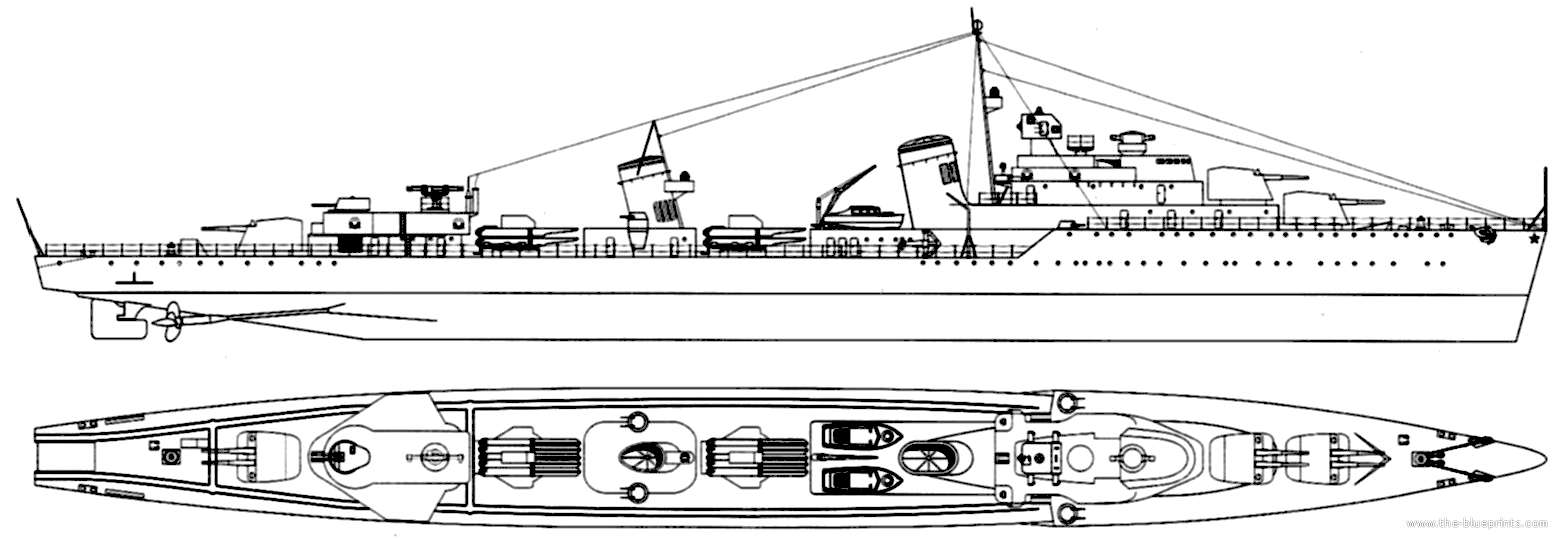
The Kiev class displaced 2,350 t standard (2,390 t), 2,697 t normal, and 3,045 t full load (3,094 t). She had a lenght of 126 m at designed waterline and 127.8 meters overall or 419 ft 3 in, for a max beam of 11.7 m (maximum at midships) or 38 ft 5 in and a draft of 4.2 m (13 ft 9 in). The prow was streight down to the angular chin, the flanks were very narrow, with little flare, making for a narrow deck forward, a constant beam for a short distance amidships, where the first TT bank was located, and two raked funnels, a single pole raked mainmast. The bridge was low and narrow, with the same type of stramlined bridge as the tashkent, with the navigation windows barely above the roof of “B” superfiring turret. The two forward turrets were pretty close to the bow, making an impression, combined with the narrow flanks forward of a ship cruelly lacking buoyancy reserve forward. If completed, at sea they whould have plough deep even in moderate seas…
The bridge was otherwise low, a good point for a low visibility silhouette, but it was way too long, ending well past the forecastle break. The forefunnel was raked, capped and fuse dinto the tail of the bridge, in the Italian style. There was no proper open bridge above however, unlike for the Leningrad class. The second, smaller funnel emerged from an intermediate structure and supported an aft searchlight. The first one placed on the foremast, barely clearing out the roof of the FCS bridge. The torpedo tube banks were peculiar with their 3+2 arrangement, three tubes below, two above, but with gaps allowing the upper ones to be lowered. They had a transom stern, with provisions for DCs and paravanes, and long mine rails running all the way to the forecastle cut.
Powerplant
The Kiev class had a Steam turbine propulsion plant, with three geared turbine units, fed in turn by three main boilers with superheated steam as seen above, all for a combined power of 81,000 hp full load, and 90,000 hp maximum when superhearting. Each of the three propellers were bronze, 3-bladed, fixed pitch. Single axial rudder, for a cruising speed of 20 knots (economical) or 15 knots (28 km/h; 17 mph) for their best range at 4,100 nmi (7,600 km; 4,700 mi) or 4,100 miles at 15.2 knots, if not 2,500 miles at 20 knots and 910 nautical miles at 42 knots. Top speed in normal conditions was 42 knots (78 km/h; 48 mph) but based on 90K hp, it was up to 43 knots.
Protection
The ship originally had 8mm protection for the main gun turrets, AA gun shields, main fire control tower, secondary FC towers, and CC below. During the 1947 revision it was purched to 20mm, which was a concern for stability. The hull was compartimentalized by 13 bulkheads and there was a double hull for most of their lenght.
Armament
Three twin 130mm B-2-LM gun mounts
 The 130 mm/50 B13 guns became the standard armament of the new 1937 planned destroyers and still until 1954. The Leningrad-class and project 38 Minsk class, Tashkent, Gnevny class, Soobrazitelny class, Opytny, Ognevoy class and Skoryy class all had them. Mass production of the gun resulted in more than 1,000 manufactured so they were also widespread on smaller ships or as coastal guns, used until the fall of USSR. 20 batteries were also installed in Muravyov-Amursky Peninsula in protection of Vladivostok against the Chinese.
Specs
Mass 5,180 kg (11,420 lb) for 6,581 mm (21 ft 7 in) oa, barrel 6,450 mm (21 ft 2 in).
Crew 1+10 (B-13), Shell 130 x 846 mm R 130 mm (5.1 in), Screw breech
Elevation: -5° — +45°, for 5-13 rpm, at 820–870 m/s (2,700–2,900 ft/s), M range 25,597 m (27,993 yd)
Twin 76mm/55 34-K gun mounts
 Located at the extreme aft, on the roof of the quartedeck house, just superfiring above “X” deck turret. Derived from a German weapon licensed in 1930 but the first naval mount was a failure. The Kalinin factory in 1934 worked on a new design accepted in late 1936, entering production as the 34-K with 285 built before late 1941. The single mount weighed 4.95 metric tons (4.87 long tons) and the twin mount and the twin one probably twice that.
Specs
Mass: 1,243 kg (2,740 lb), 4.223 m (13 ft 10 in) oa, Barrel 3.971 m (13 ft) 55 cal.
Shell 11.5–11.9 kg (25 lb 6 oz – 26 lb 4 oz) 76.2 mm (3 in).
Semi-automatic vertical sliding-block, Hydro-pneumatic recoil for 15–18 rpm at 801–816 m/s (2,630–2,680 ft/s)
Elevation +85° for 6,500 m (21,300 ft) vertical, 8,970 m (9,810 yd) A/S
4×2 12.7mm DShKM-2B machine guns
These twin mounts for the “Dushka” were proper to the Navy. Performances equivalent to the US M2 browning 0.5 inches. They were deployed from 1938, and became widespread in all three arms, navy, army and air force, widely exported as well, as much as the Browning for the West, and like it, still in use today. Mass 34 kg (74 lb 15 oz) per barrel, 1,625 mm (5 ft 4 in) long, with a 12.7×108mm HE shell and Gas-operated, with flapper locking for 600 rounds/min at 850 m/s (2,800 ft/s). Effective firing range 2,000 m (2,200 yd), using 50 round belts.
2 depth charge racks
The Kiev class mounted two depth charge racks aft for either 10 B-1 and 20 M-1 depth charges, or up to 36 M-1 depth charges.
Torpedo Tubes
These were two quintuple 533mm torpedo tubes with some reload, six, for 16 torpedoes total, either the 53-F, 53-36, or 53-38. See the Leningrad class for more.
Mines
They could carry up to 68 KB naval mines, or up to 76–84 (varying by ship) Model 1926 barrier mines and up to 124 mines Models 1908–1939.
Sensors
Mars Hydrophones. Later the project evolved as 48K and new radars types installed, see notes.
Revised Project 48-K
Development of the revised design

In January 1944, decision was made to revise Project 48 in light of new technological advance and combat experience, in order to complete them after launch and evacuation. TsKB-17 was tasked of the work, taking in account new requirements to replace the DsHk for 37mm 70-K automatic guns, two depth-charge throwers, a “Tamir-5” sonar system and replacing the quintuple by triple TT banks. By November this was cancelled. New Navy specifications were published, under which there woould be a 85mm 92-K AA mount replacing the 76mm 39-K, five twin 37mm V-11 autocannons replacing the 70-K with armored shields, but two single-tier, 5-tube torpedo launchers again. The fire-control system was adopted from Project 30-K destroyers and two BMB-1 depth-charge throwers with 40 depth charges at the stern. The radar suite was expanded to the “Gyuis-1,” “Mars-2”, “Jupiter-2,” “Sirius-5,” and “Sirius-B4” and still the “Tamir” sonar. On December 19, 1944, I. I. Nosenko, Commissar for the Shipbuilding Industry, accepted this revision under Project 48K and production of technical drawings for the completion of Kyiv and Yerevan at A. Marti Shipyard No. 444 with the reactivation of its design bureau. under M. I. Zhulai.


In the autumn of 1945, both ships were returned to Nikolaev, but the preliminary design study conducted in 1945 at Shipyard No. 444 design bureau revealed that the Navy requirements were unrealistic, ushing the displacement to 2,740 tons, with huge instability planned, top speed falling to 37.5 knots, seaworthiness and protection compromised with a waterline too low. By late 1945, this was postponed, the hulls mothballed. In between indeed the shipyard was just out of occupation and in shambled. There was a lack of a components, like the B-2-LM gun turrets, albveit Project 30 destroyer hulls were under construction, turret production was expected to be re-organized on the long run. However for many in the staff, they were already hopelessly obsolete.
In August 1946, during Black Sea Fleet exercises, Kyiv was scuttled at sea, Yerevan used as a floating barracks. On March 24, 1947 it was decided to resume construction based yet on a revised design so Kiev was raised, sent back to Mykolaiv for repairs and refections while moored at the drydock of A. Marti Shipyard.
With the construction rebooted by 1947, there would be a radical redesign. The main B-2LM mounts were to be replaced by BL-109 DP mounts, three quadruple 45mm and two quadruple 25mm autocannon installed, fire control system changed to the radar-assisted “Zenit” system, torpedo tubes replaced by quintuple PTA-533 launchers. The new “Zalp” main-battery fire-control radar and torpedo fire-control systems were also envisioned, with armor protection for the main command post, gun mounts, torpedo banks going from 8mm to 20mm (0.8 to 1.1 in) which added a lot of weight, for an eccepted speed of 36 knots and 3,500 nautical miles range at 13 knots. A. V. Platonov later reported this was tantamount to create a radically new design on a 1936 hull. However neither the new BL-109 gun mounts or 45mm autocannons had been manufactured yet. This it was suggested to revert to the original armament configuration. Under this, the final TTS for completion was signed by Captain A. K. Usyskin approved by I. S. Yumashev and Industry minister B. G. Chilikin in 1948. Nikolayev Shipyard No. 444. M. I. Zhulai as chief designer was appointed, with specifications for the second revised Project 48-K jkeeping its 130mm B-2LM and 37mm automatic AA guns in six stabilized twin mounts.
Design of the Revised Project
Under drawing 48K A-100-304 the hull retained the same, but raised forecastle configuration and now had a substantial forward superstructure, yet still two raked funnels, a small aft superstructure but lacked other large-volume structures, for a silhouette “unobtrusive and uncluttered, despite its relatively high freeboard”. The hull was divided into fourteen compartments by thirteen watertight bulkheads. The Three decks below the upper deck were resvied, with the lower deck and first platform stopped at the area of the machinery spaces, boiler and engine rooms. The double bottom extended full length from frame 10 to frame 158 and to both ends. The Twin-gun B-2LM turrets were on the centerline, the second, B, superfiring. They could be operated locally or remotely from the central control station. Two triple torpedo tube mounts were also along the centerline, forward and aft of the second funnel and at the stern were depth charge racks and paravanes.
Stations for the weapon control systems, detection and communication equipment were housed within the three-tiered forward bridge structure. The crew was accommodated between decks in the forward section and, to a lesser extent, aft section. There was a single commander’s launch starboard near the first funnel, large motor barge port side, two six-oared cutters either side near the aft superstructure.
The main propulsion systemused boiler-turbine type with three geared turbine units for 90,000 hp, three main boilers at 27 kg/cm² and 350°C. The steering system was the same single semi-balanced rudder, three three-bladed propellers. The boiler feed water reserve was 65 tonnes, the normal fuel supply 600 tonnes.
⚙ 48K specifications |
|
| Displacement | 2,350 t standard, 2,697 t normal, 3,045 t full load |
| Dimensions | 126 m waterline/127.8 m overall x 11.7 m x 4.2 m |
| Propulsion | 3 shafts geared turbine units, 3 boilers: 81,000 hp FL, 90,000 hp max |
| Speed | 43 knots max, 20 knot cruiser |
| Range | 910 nautical miles at 42 knots, 2,500 miles/20 knots, 4,100 miles/15.2 knots |
| Armament | 3×2 130mm B-2-LM, 2×1 76mm/55 34-K, 4×2 12.7mm DShKM-2B, 2 DCR, 2×5 533mm TTs, mines |
| Protection | 8 mm shielding, see notes |
| Sensors | Mars Hydrophones, see notes |
| Crew | 264 (269 flag), 16+5 officers, 50 petty officers, 198 enlisted personnel |
Ships in class
 Kiev (1941)
“Kyiv” was ordered and laid down at No. 198 under the hull number S-357 on September 29, 1939. By December 11, 1940 she was launched, but construction was suspended at 48.9%. She planned for completion for the 3rd quarter of 1942.
On August 8, 1952, by Order No. 7784/s of the Minister of the Navy, construction of the Kiev was halted, she remained laid-up for three years. Kiev was still launched on December 11, 1940, underwent fitting-out afloat at Plant No. 198 Nikolaev, until July 1941. Her sistert Yerevan was launched on June 29, 1941, 8 days into Operation Barbarossa. Construction effectively ceased after July 10, 1941. Before the Wehrmacht captured Mykolaiv in August 1941, both destoryer leder, along with several other unfinished ships were towed to Sevastopol under escort of Boykiy. On August 6, Yerevan was towed to Kerch, Kyiv was towed to Kamysh-Burun on August 12. Due to the German rapid advance they were towed again to new bases: By September 18, Yerevan was moored at Yeysk, by October 6, Kyiv moved to Poti. Between October 15 and 17, Yerevan was evacuated from Yeysk, Kerch under escort of the minesweeper Shturman and cutters Tsiklon and Shkval of the Azov Military Flotilla. By January 4, 1942, both were transferred again to Batumi where they remained until the autumn of 1945. After the campaign ended, they were moved westwards again to Mykolaiv, to be completed now under the Project 48K design. However, this too was cancelled. It was decided to have both used as target ships.
In 1955, Kiev was transferred via the Volga-Don Canal to the Caspian Sea, assigned to the Caspian Flotilla for experimental purposes. In the early 1960s she was transferred back to the Black Sea, but soon moved back to the Caspian. By late 1962, she became a final target ship for trials of the P-35 cruise missile (SS-N-3 Shaddock) near Baku. One P-35 launched from the experimental cargo OS-15 converted in 1959, equipped with an inert warhead struck Kiev’s port bow, tearing open the deck over 50 meters before disintegrating, the engine punching through decks and even piercing her hull bottom, so she sank three minutes later, which was not expected as the missile was inert. But it proved that even if the warhead malfunctioned, the bulk and speed of the missile alone, equivalent to WW2 kamikaze would be enough to cause untold damage to any warship afloat.
Yerevan (1941)
 “Yerevan” was ordered from No. 198 yard under the hull number S-358 and laid down on December 30, 1939. She was cancelled, but launched still on June 30, 1941 at 25.4% completion, planned for the 4th quarter of 1942 to clear the slipway. She was planned like her sister to be completed under the new design 48K and evacuated during the war to the eastn endng at Batumi (see above). But this was cancelled by late 1945 and instead she was scheduled to serve as a trials and target ship.
In 1953, Yerevan was transferred to the Caspian Sea, Caspian Flotilla and under CiC order of May 8, 1954, she was reclassified as a target ship for combat training exercises and experimental missile tests, subsequently transferred to the Black Sea Fleet. By March-April 1957, with the captured German landing barge BSN-20, she took part in airborne and ship-born launch tests of the KSShch anti-ship missile (the “Shchuka” ship-launched missile, NATO “Pike”). She was targeted by a Project 56M destroyer Bedovyy at the Peschanaya Balka test range near Feodosia, close to Cape Opuk and Cape Chauda. Seven launched were performed between March 1 and April 29, 1957. Yerevan was modified to simulate the radar reflectivity of a Cleveland-class cruiser.
For this she was equipped with K-1.25 type corner reflectors mounted on a special 6-meter-high truss above the deck and a mesh screen spanning the entire length, suspended from masts 6 to 9.5 meters high, with a mesh of 0.35 × 0.35 meters. The underwater net spanning the entire length down to 10 m, with a mesh size of 0.1 × 0.1 m. On the launched 3, 4, and 5, Yerevan had underwater cameras to capture the warhead submerged. In the 3, 4, 5, 6, and 7 launches by air, the missile was filmed by an Antonov An-2 loitering above from 1,500 m, using AFA-2 cameras to catch the final approach. Launched were made from 25 km, 30 km and it was determined the underwater travel of the warhead was estimated from 8 to 40 m. At launch No. 6, it bounced the surface and made a direct hit on the corner reflector’s framework, 1.7 m above her deck.
On August 30, 1957, in state trials of the Pike SSN in the same area, it was launched witn an inert warhead and scored a hit on Yerevan opening a 2 × 2.2 m gash in the hull extending 0.3 m below the waterline. Thus, seawater poured in and she sank, only to be raised by the Black Sea Fleet’s emergency rescue service and sent for scrap to clear the test area as it was in shallow waters.
Stalinabad
Stalinabad was ordered as hull N°190 and pennant S-542, laid down on 27 December 1939, but never launched and dismantled on the slipway.
Petrozavodsk
Petrozavodsk was ordered as hull N°198 and pennant S-359, never laid down, cancelled 1940.
Ochakov
Ochakov was ordered as hull No. 198 and pennant S-360, never laid down, cancelled 1940.
Perekop
Perekop was ordered as hull No. 198 and pennant S-361 , never laid down, cancelled 1940.
Ashkhabad
Ashkhabad was ordered as hull No. 190 and pennant S-545 in 1940, laid down on 19 October 1940, construction suspended, dismantled on the slipway.
Alma-Ata
Alma-Ata was ordered as hull No. 190 and pennant S-546 in 1940, laid down on 19 October 1940: construction suspended, dismantled on the slipway.
Arkhangelsk
Arkhangelsk was ordered as hull No. 402 and pennant not assigned, not laid down.
Murmansk
Murmansk was ordered as hull No. 402 and pennant not assigned, not laid down.
Final Considerations
The project suffered delays also due to the arrest and emprisonment of lead designed M. V. Viktorov on December 30, 1937. On January 15, 1938, Army Commissar 1st Rank P. A. Smirnov was the new Commissar of the Navy but he was removed on June 22, 1938, arrested on June 30 as an “enemy of the people”. P. I. Smirnov-Svetlovsky became People’s Commissar until September 8, 1938. In Russian publications, the Kiev class is often translated as “Explorers” which is traditionally intepreted as destroyer leader(scout), like the Italian Navigatori-class which was aan inspiration for them. The Italians themselves made also that distinction prior to 1938 and Tashkent was definitely “scout” in Italian documentation. Italian technical documentation referred the term *Esploratori* at any levels so by “contamination”, the Project 48 ships became “scouts” in 1937 as well.
Read More/Src
Books
Kachur P. I., Morin A. B. *Destroyer Leaders of the USSR Navy*. — St. Petersburg: Ostrov, 2003
Kachur P. I. *The “Hounds” of the Red Fleet: “Tashkent”, “Baku”, “Leningrad”*. — Moscow: Yauza, Kollektsiya, Eksmo, 2008.
Krasnov V. N. Shipbuilding and Ship Repair on the Black Sea, 1941–1945 // *Gangut*. — St. Petersburg: Gangut Publishing House, 1995.
Krasnov V. N. *Naval Shipbuilding on the Eve of the Great Patriotic War*. — Moscow: Nauka, 2005. — 215 p.
Platonov A. V. *Encyclopedia of Soviet Surface Ships, 1941–1945*. — St. Petersburg: Polygon, 2002. — 640 p.
Platonov A. V. *Soviet Destroyers*. — St. Petersburg: Galeya-Print, 2003. — Vol. 1. — 90 p.
Shirokorad A. B. *The Fiery Sword of the Russian Navy*. — Moscow: Yauza, EKSMO, 2004. — 416 p.
Kofman V. L. *Mogador*-class destroyer leaders. — 2008. — Issue 8 (107). — ISBN 5-94500-19-1.
Litinsky D. Yu. Super-destroyers of the Soviet Navy. — Special issue of the *Taifun* almanac. St. Petersburg, 1998.
Patyanin S. V. French destroyer leaders, destroyers, and torpedo boats in World War II. — St. Petersburg: Korabli i srazheniya, 2003.
Rubanov O. A. British destroyers in World War II. Part 1 (1925–1939). — St. Petersburg: Korabli i srazheniya, 2004
Trubitsyn S. B. *Navigatori*-class destroyers. — St. Petersburg: Korabli i srazheniya, 2002.
Campbell J. Naval weapons of World War Two. — Annapolis, Maryland: Naval Institute Press, 1985.
Conway’s All the World’s Fighting Ships, 1922—1946. — London: Conway Maritime Press, 1980.
Fraccaroli A. Italian warships of World War II. — London: Ian Allan Ltd, 1968.
Friedman N. The U.S. Destroyers: An Illustrated Design History. NIP.
Hodges P., Friednan N. Destroyer weapons of World War Two. Conway Maritime Press, 1985.
McComb, Dave. U.S. destroyers 1934-1945. Pre war classes. Osprey Publishing, 2010.
Links
web.archive.org/ http://xn--80aejgga1bqhq2b.xn%5B%C2%AB%D0%A4%D0%BB%D0%B0%D0%B3%20%D0%A0%D0%BE%D0%B4%D0%B8%D0%BD%D1%8B%C2%BB%5D%5B2013-04-27%5D.pdf
web.archive.org/ navypedia.org/
en.wikipedia.org/
on ru.wikipedia.org/