
 UK, Royal Navy: HMS Brecon, Bissenden.
The Hunt class Type IV were the very last destroyer escorts made for the Royal Navy, after the Type III and the lend-lease Captain class. They were by far the largest, best armed and refined of the series, but proceeded from a private venture by Thornycroft, not from an official admiralty request. Only two, HMS Brecon and HMS Brissenden were built however. Thornycroft created for them an extended forecastle for better crew shelter and structural strength, yet they suffered from poor handling and no further were built. Plus compared to earlier Hunt variants, they were much costier and really were a developmental dead-end. In addition that late into the war, the need for new escorts had been largely reached and the allies were clearly winning the battle of the Atlantic. The cheaper River class frigates as a base platform for derivatives showed more promises.

HMS Brissenden
Development
After the disastrous Hunt Type I, woefully top-heavy and unstable after calculation errors, then modified, and the beamier Hunt Type II and III, the Royal Navy by 1943 had a fine escort ship built to Navy standards and not from civilian yards, that could fill the role of a dedicated escort arguably better than more versatile, but costly and complex fleet destroyers. The emergency flotilla destroyers built until the X-Y-Z classes and Co-Ch-Cr classes were needed elesewhere. In addition to the Hunt class, the Royal Navy had received plenty of lend-lease destroyer escorts, the Captain class.
So why the Hunt Type IV ? It all came back from an initiative of John.I.Thornycroft Shipyard at Southampton in early 1940 as far as the Hunt Type I was being completed. The chief designer thought he could bring on the table a far better design, much more stable than the Hunt I, plus a ship were better seaworthiness and better protection to the crew. So the company made one of its most notable ship, HMS Bissenden and HMS Brecon, retrospectively called the Type IV, marketed to the admiralty as having also better stability than the Hunt Type I.
It was proposed to the admiralty which accepted the construction of two prototypes ordered on 28 July 1940. Thornycroft hoped to have a whole serie built after these two. The ships weere also named after hunting domains, HMS Bissenden and HMS Brecon and laid down on February 1941, launched ion June and September 1942, completed on 18 December 1942 and February 1943 respectively. Then came sea trials. They were not brilliant. Yes, it was recoignized the hull was far less “wet” than the usual short forecastle Hunts, the crew appreciated the extra space offered by the long forecastle, but the ship had a long turning circle, inadapted rudder, bled speed, and thus lacked any agility, which was crucial to doged possible torpedoes and turn on a dime when on the hunt. Plus they were just much larger, heavier, and especially costier to build compared top standard Hunt III, so the admiralty was not willing to make another order. The sub-class remained at these two ships, active until 1962-65. But the long forecastle idea percolated on the Flower and Hunt class anyway and seemed the way forward anyway. It’s just Thornycroft was not used to these large vessels (yet) and made some design errors.
Design of the class
Hull and general design

The Hunt class were the largest of the Hunt class escorts by far: Compared to the Type III for example, the best of the entire class, they displaced 1,175 long tons (1,194 t) standard
and 1,561 long tons (1,586 t)* full load versus 1,050/1,435 long tons so about 150 tonnes more, mostly due to the longer forecastle. In size, they were also longer at 90.22 m (296 ft) overall versus 85.3 m (279 ft 10 in) beamier than the Type I, and yet narrower than the Type III at 9.6 m (31 ft 6 in)** versus 10.16 m (33 ft 4 in) for a same draught at 3.51 m (11 ft 6 in).
*Note that both diverged bewteen them with Brecon rated at 1700 tonnes FL and Brissenden at 1750 tonnes.
**Other sources like Conways reports instead a beam of 10.2 meters (33.4 feet)
Now for the general outlook, the Brecon class was structured like the standard Type III, with a forward twin mount and two aft, superfiring. The bridge had the same general shape, the single funnel was still located the same way aft, there was a single tripod/pole mast forward of it and a pretty bare aft section mast the AA platform; freed for a single triple torpedo tubes bank. Only the hull was the true difference, with a raised foredeck up to the clipper stem, a double knuckle, and a rounded transom stern. The forecastle extended all the way to “X” mount. The crew amounted to 170 for two cutters under davits abaft the funnel and a few inflatable rafts. As said above, the longer forecastle, making for an amidship upper section dotted with portholes, created new living quarters so they were quite popular in addition of being much “drier”.
Powerplant
The Hunt Type IV were to be powered by the same style of powerplant preconized by the admiralty, but these Thornycroft ships were designed for 15,000 hp machinery, and the Admiralty forced builder the builder to raise output to a more standard 19,000hp. As a result, they had the same 2 Admiralty 3-drum boilers feeding in turn two shaft Parsons geared turbines for an output of 19,000 shp (14,000 kW), driving two 3-bladed fixed pitch bronze propellers. This was for a top speed of 26 kn (30 mph; 48 km/h) on trials and 25.5 knots (29.3 mph; 47.2 km/h) at full load in service.
As for stability, they had counterkeels and also one of the two, the lead ship Brecon had anti-rolling tanks. Her sister instead replaced them by additional fuel tanks, so they diverged in fuel bunkerage and thus range: Brecon was limited to 286 tonnes when Brissenden was rated at 357 tonnes. Their declared range was however the same, 2,350 nautical miles at 20 knots, 950 nmi (1,760 km) at 25 kn (46 km/h) for Brecon and 1,175 nmi (2,176 km) at 25 knots (46 km/h) for Brissenden.
Armament
The Hunt class Type IV had three twin QF 4-inch (102 mm) Mark XVI guns in twin mounts Mk. XIX fore and aft. “A” was on deck, the second and third, X and Y, super firing over the aft deck in a structure. There were also two QF 2-pounder (40 mm) quadruple Mk. VIII “pompom” mounts on a bandstand past the funnel. This was completed by four twin mounts Mk. V for 0.5 in (12.7 mm) Vickers heavy AA machine guns originally, but at completion they were replaced by twp × 20 mm Oerlikons and then four in twin mounts Mk. V
The two 20 mm Oerlikon AA guns were on single mounts P Mk. III. More were installed in wartime (see below). As for ASW armament, they had now in standard 40 depth charges, with two throwers instead and one rack. Later two racks were installed.
QF 4-inch (102 mm) Mark XVI guns
The QF 4-inch Mark XVI gun (also written as QF 4-inch Mk. XVI) was a British dual-purpose naval gun widely used by the Royal Navy and Commonwealth navies during and after World War II.
This Naval artillery was dual-purpose, anti-ship and anti-aircraft. After design modifications, notably by giving them a greater beam and reworked bridge, the Type II, III and IV all had twin mounts.
Specs:
2,495 kg (barrel and breech), 4 inches (102 mm) 45 calibers (180 inches/4.57 m)
Shell weight: 35 lb (15.9 kg)
Rate of fire: 15–20 rounds per minute
Muzzle velocity: 2,660 ft/s (810 m/s)
Effective range: 18,150 yards (16,600 m) at 45° elevation
Maximum ceiling: 39,000 ft (11,900 m) against aircraft
Elevation range: -10° to +80°
Traverse: 360° on suitable mounts
Crew: 9 on average.
Mounts used: Twin mounts (Mark XIX), shielded (no fully enclose turret).
The Mk XVI was also used as standard secondary armament for many British and Commonwealth warships during WWII, notably the Canadian Tribal-class and J-K-N-class.
The twin HA/LA (High Angle/Low Angle) mounts Mark XIX were powered and allowed quick traverse and elevation, essential for anti-aircraft use. They director-controlled, especially on larger ships, integrating radar and fire-control systems, but not on the Hunt class due to weight issues.
QF 2-pounder (40 mm) Mk. VIII AA guns

The QF 2-pounder “pompom” was the emblematic British naval anti-aircraft (AA) autocannon of WW2 which needs no further introduction. It was seen virtually on all RN ships from the smallest coastal vessels to the largest aircraft carrier and battleship, declined into single, twin, quad and octuple mounts. On the Type I they replaced the “X” twin 4-in mount, being lighter and still having an excellent arc of fire to offer an almost unobstructed 360° coverage. It was tasked on the Hunt Type I of short- to medium-range air defence after the DP 4-in guns which were slower firing.
The Quadruple mount needed a crew of six, but can be limited to just 4 if needed.
The 40 mm (1.575 in) in latter models fired in Automatic mode with belts for no interruption at 240 rounds a min, but the usual rate was 115 rounds per minute per barrel at a practical rate with 14 or 28-round hopper-fed magazines.
Each shell weighted 2 lb (0.91 kg) — hence the name “2-pounder” at a Muzzle Velocity: 2,040 ft/s (622 m/s).
Effective Range was c3,800 meters (AA)/5,500 meters (surface)
It became less effective against faster aircraft as WWII progressed, leading to gradual replacement by Bofors 40 mm.
However, it was active until 1945 as being reliable and easy to maintain, with a high rate of fire for its quadruple mount, but had a low velocity, limited hitting power and range compared to the Bofors with an accuracy and lethality diminished against high-speed aircraft in 1944-45.
20 mm Oerlikon AA guns
The 20 mm Oerlikon anti-aircraft (AA) gun needs no presentation. It was one of the most widely used light automatic cannons during World War II, a staple on Allied warships, merchant vessels, and land-based platforms due to its simplicity, reliability, and effectiveness at close-range air defense. However, it was not present of course in the original design, only installed with modernizations in 1942-43.
The 20 mm (0.787 in) Automatic anti-aircraft gun was Blowback-operated (open bolt) and fed by 60-round drum magazine (top-mounted), needed only a single gunner and a couple of loaders/spotters. Simple, robust, light, compact, it could be operated by minimally trained crews and placed on tight spot on a ship. The Hunt class were given two single Mk. II/IV models at first.
Performance:
Muzzle Velocity: 830 m/s (2,723 ft/s), with 123 g (High-Explosive) shells.
Rate of Fire: ~250–320 rounds/min (cyclic)
Effective Range: 1,000–1,500 m (air targets), 4,800 m surface
The Single mount was manually aimed with shoulder supports and ring sights. Its mount included walls lined internally with ammunition holders, but full cheese box magazines were carried from a secured, armoured locker by the loaders. It became the shorter ranges AA defensive layer on the Hunt class, but they only carried two in their career.
depth charges
The Hunt class were given a single Roll-off depth charge rack at the stern at first (capacity ten DCs) and just two depth charge projectors (Y-Gun) for a global provision of 40 depth charges at the stern for th Type IV. This was less than the Group II 60 depht charge and three racks, Group III 110 charges, four throwers plus three racks. They used these:
Standard Mark VII: Entered service in 1939, weighted 420 lbs. (191 kg) and carried 290 lbs. (132 kg) TNT with a sink Rate or Terminal Velocity of 9.9 fps (3.0 mps) with a max setting at 300 feet (91 m) later 500 feet (182 m).
Mark X (introduced 1944) and Mark X*:
Wartime Modifications
The depth charge load was raised to two racks. In 1943, Brecon received two extra 20 mm/70 Oerlikon AA guns MkII/IV. Brissenden however received a single 40mm/39 2-pdr pompom AA Mark VII and rour twin oerlikon AA instead. In 1945 Brecon was rearmed with two twin Oerlikon as well and two single 40mm/56 1944 pattern Bofors guns instead. They had 50 depth charges and jept their torpedo tubes until 1947 when reclassified as frigates, and likely lost them afterwards.
Sensors
The Brecon class completed in 1943 with the type 285, 291 radars, and the type 128 sonar.
Type 285 radar
25 kW Gunnery radar for surface and AA ranging, coupled with the twin 4-in HA mounts.
Frequency 600 MHz, Beamwidth 18° (horizontal) 43° (vertical). Pulsewidth 2 μs
Range 18,000 yd (16,000 m), Altitude 15,000 ft (4,600 m), Precision 150 yd (140 m)
Type 291 radar
This small Search radar had a frequency of 214 MHz, a PRF of 500 per second, a Beamwidth of 40°, a Pulsewidth of 1.1 μs for a Range of 9 nmi (17 km; 10 mi) and a peak power of 100 kW.
Type 128 sonar
Typical British destroyer sonar, retractable, installed from 1937, last prewar set. Equipped with a range recorder and controlled from the bridge if needed.
It had a retractable Dome beneath the ship’s hull to lower self-generated flow noise when deployed.
It had Gyro Compass Integration: Unlike earlier sets (like the Type 123) that relied on magnetic compasses, the Type 128 utilized a gyro compass for much more reliable and accurate target bearing indications.
It had a Range Recorder: Included an integrated mechanical range recorder to log target distance profiles over time.Variants: Later variations like the Type 128A and modified versions were adapted for specialized escort and minesweeping vessels (such as the Bathurst-class).
Operational Legacy: The Type 128 represented the culmination of pre-war British ASDIC design. While effective in early World War II, its operational limitations—such as manual target tracking—led to its eventual supplementation and replacement mid-war by advanced systems like the Type 144 Asdic, which featured automated step-training and better integration with weapons like the Hedgehog spigot mortar.
Appearance
The Hunt class camouflage for Type IV mixed the usual western approach patterns of base light gray, light blue, dark blue mostly in straight shapes. The same as for the River class frigates, especially in 1942-43. In 1943 as they entered service, the usual pattern was medium gray for the hull, lighter structures, and a fake wave painted at the bow creating the illusion of a greater speed to break target calculation accuracy by submariners. In 1945, this reverted with a simple dark band amidship.
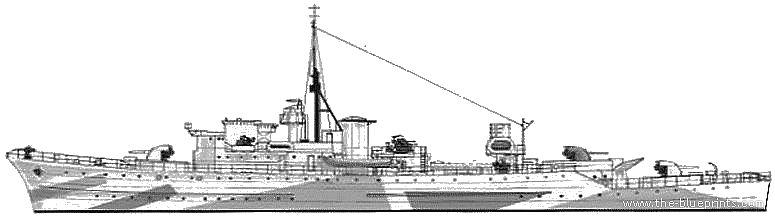
HMS Brissenden in 1944.
⚙ specifications |
|
| Displacement | 1,171 long tons standard, 1,561 long tons full load |
| Dimensions | 90.22 x 10.2 x 3.51m (296 ft x 34 ft x 11 ft 6 in) |
| Propulsion | 2 shaft Parsons geared turbines, 2 Admiralty 3-drum boilers, 19,000 shp (14,170 kW) |
| Speed | 26knots (30 mph; 48 km/h) top, 25.5 knots (29.3 mph; 47.2 km/h) FL. |
| Range | 1,175 nmi (2,176 km) at 25 knots (46 km/h) for Brissenden, see notes |
| Armament | 3×2 QF 4-inch Mark XVI guns, 2×4 QF 2-pdr pompom Mk. VIII, 2x20mm AA, 1×3 21-in TTs, 40 DCS (2 DCT, 1 DCR) |
| Protection | Usual ASW compartments and double bottom |
| Sensors | Type 285, 291 radar, Type 128 sonar |
| Crew | 170 |
Career of the Hunt Group IV class
Both were ordered as part of the 1940 War Emergency Programme, and built at the Thornycroft Woolston Yard.
 HMS Brecon (1942)

HMS Brecon was laid down on 27 February 1941, launched on 27 June 1942 and completed on 18 December 1942. After training she joined the Home Fleet at Scapa Flow in January 1943 for completing working up until assigned to engaged to convoy escort, North Western Approaches/North Sea. In June 1943 she was sent to the Mediterranean for Operation Husky, the landings in Sicily, escorting the joint military Convoy WS31 to Gibraltar. Next she escorted Convoy KMF17. In July 1943 she escorted the assaulting forces of Convoy KMF18 to the beach head.
Next she was transferred to Destroyer Division 58, joined Task Force 85 for Operation Avalanche, the landings at Salerno. In September 1943 she left Bizerta in escort for assault Convoy FSS2. On arrival she stayed to provide gunfire support and after the beachhead was escured returned to escort and patorl, but had a minor collision with HMS Laforey. She remained until late 1942 in the central and western Mediterranean. From 23 January 1944 she provided fire support for Operation Shingle, the Allied landings at Anzio. She then returned to patrol duties in February-March. She was detached in one of these missions, with HMS Blankney, Exmoor and Blencathra hunting down and sinking U-450.
In April 1944 she was transferred to 18th Destroyer Flotilla. In July 1944 she started preparations for Operation Dragoon (southern France landingsà and by August escorted Convoy SM3 to the beachhead, under USN surpervision. She then returned under Royal Navy command and returned to regular convoy escort in the eastern Mediterranean. On 19 September 1944 she joined a group with HMS Terpsichore, Troubridge, Zetland and ORP Garland that claimed U-407 south of Melos. On 28 September she shelled Pegadio and Karpathos for the Aegean Islands campaign, the last holdout of the Germans in the Mediterranean. In October 1944 as the latter withdrawal, as well from Greece she joined the British Aegean Force in order to intercept German evacuation craft. She also brought gunfire support for the landings and by December was back home for a modernization, refit and preparation for service in the East Indies.
By January 1945 Brecon was reassigned to the 21st Destroyer Flotilla at Sheerness. She was trained to hunt down snorkel fitted U-boats going to the South Western Approaches. In April 1944 she sailed to Malta for her final preparation to join the Eastern Fleet, but returned to the UK for leave. In June 1944 she joined the 18th Destroyer Flotilla at Colombo. She was undergoing preparations for Operation Zipper, the planned British re-occupation of Malaya when the war ended. In August she was in escort and ended in Singapore in September, present for the surrender. She was back to Portsmouth on 12 December 1945, paid-off into Reserve, remaining there until 1956, placed on the Disposal, sold to BISCO in August 1961, towed to Faslane in September 1962 and BU. In all her wartime service lasted from December 1942 to December 1945, just four years.
HMS Brissenden (1942)
Brissenden was laid down on 28 February 1941, launched on 15 September 1942 and completed on 12 February 1943. In late February/early March 1943 after trials, fitting out and training, Brissenden sailed to Scapa Flow to complete work-up training and started patrols in the Western Approaches. On 21 April she joined Convoy WS 29A with HMS Anthony and Lewes. On 26 April, she was relieved by Boreas and bac to the Home Fleet to complete training. In May 1943 like her sister she was selected for Operation Husky in Sicily. On 21 June, she joined Convoy WS 31/KMF 17 to Gibraltar, and remained there until it split, cand escorted the cruiser Uganda with WS 31 going via the Cape of Good Hope.
In July 1943, Brissenden joined the 58th Destroyer Flotilla to the Bône Peninsula for the eastern flank of the landings and on 7 July, escorted Convoy KMF 18, Escort Group V (with Blankney, Blencathra, Brecon and Brocklesby), refuelling on 9 July. A day later she arrived off the Bark West landing zone and provided naval gunfire and patrolled the landing area, then secured the port of Pozzallo.
On 13 July she collided with Blankney (port bow mushed). She was repaired in Malta and then home at Liverpool from 21 August and on 2 October at completion she joined the 15th Destroyer Flotilla at Plymouth for escort duties and patrolled Channel and back to the Home Fleet in November. On 10 November, she joined Convoy RA 54A from the Kola Peninsula with Middleton and Halcyon to Loch Ewe. On 13 November she joined Convoy JW 54A to Murmansk with HMS Termagant and Polish ORP Burza to Iceland but left on 18 November for Plymouth. By January 1944, Brissenden was still in Plymouth by by February, she joined Operation Tunnel, against S-boats from the French coast. On 5 February she was in the action off the north coast of Brittany with HMS Tanatside, Talybont and Wensleydale fighting T29 and minesweepers M-156 and M-206. On 15 March, with Convoy WP 492 noth of Land’s End she repelled a German TB attack, badly damaging S143. In May 1944 she joined Force B, Normandy landings in preparatory exercises and in June she was in Milford Haven with HMS Wensleydale.
On 5 June, she was in the Channel ready to intercept German naval forces attempting to disrupt landings, western sector. On 12 June with Wensleydale she repelled an S-boat attack. On 22 June, she came under air attack. In July she resumed convoy escort operations, Channel and entered drydock for refit and maintenance at Pembroke Dock in December 1944 until February 1945 and after post-overhaul sea trials she was assigned to the 21st Destroyer Flotilla at Sheerness, Channel and Nore Command. In June 1945 she was transferred to the Mediterranean (reserve vessel) to depart to join the Eastern Fleet which she never did. Instead she remained there until 1947, continuing coastal patrols, notably off Palestine to deter incoming ships loaded with Jewish emigrants. In 1948 she was back home and then decommissioned in reserve at Portsmouth from 19 June. Kuwait expressed interest in her, to be reconverted as a royal yacht, but this was abandoned. In 1962, she was on the disposal, sold on 18 February 1965 to BISCO, then towed to W. H. Arnott, Young and Company, Dalmuir on 3 March 1965 and BU.
Read More/Src
Books
HMS Badsworth: The British Hunt-class Escort Destroyer, Waldemar Góralski – Topdrawings Nr. 69 (Kagero pub)
Brown, D. K. Nelson to Vanguard, Chatham Publishing, 2000
Cocker, Maurice. Destroyers of the Royal Navy, 1893–1981, Ian Allan
Colledge, J. J.; Warlow, Ben (2006) [1969]. Ships of the Royal Navy: The Complete Record of all Fighting Ships of the Royal Navy (Rev. ed.). London: Chatham Publishing.
English, John. The Hunts: A History of the Design, Development and Careers of the 86 Destroyers of This Class Built for the Royal and Allied Navies During World War II, World Ship Society, 1987
Gardiner, Robert (ed.) Conway’s All the World’s Fighting Ships 1922–1946, Naval Institute Press
Ireland, Bernard (2003). Battle of the Atlantic. Barnsley: Naval Institute Press.
Lenton, H. T. British and Empire Warships of the Second World War, Greenhill Books
Marriott, Leo. Royal Navy Destroyers Since 1945, Ian Allan
M. J. Whitley, Destroyers of World War Two: An International Encyclopaedia, Arms and Armour Press, 1999
English, John (1987). The Hunts: a history of the design, development and careers of the 86 destroyers of this class…
Brown, David (1995) [1990]. Warship Losses of World War Two (2nd rev. ed.). London: Arms and Armour Press.
Links
coatneyhistory.com/Hunts
naval-history.net
navypedia.org/
coatneyhistory.com Hunts.htm
uboat.net
https://www.naval-history.net/xGM-Chrono-10DE-Brecon.htm
worldnavalships.com/
commons.wikimedia.org
ONI drawings
Model Kits
https://bob.plord.net/Ships/Period3/GreatBritain/Escorts/Brissenden.html
all kits on scalemates.com/