
 Germany (1938-40): 14 boats completed, 12 lost: U-64, U-65, U-103, U-104, U-105, U-106, U-107, U-108, U-109, U-110, U-111, U-122, U-123, U-124
The Type IXB: The class comprised U-64 to U-124 and this was the most successful of the whole IX series, with 12 out of 14 U-Boat having ace captains, Viktor Schütze in 7 sorties sinking 35 ships for 180,073 tons on U-103. In fact the Type IXB was the most successful class of submarine in the war in terms of average 100,000 gross register tons (GRT) sunk in each career. They also proved instrumental in Operation Drumbeat… Design and career. https://navistory.com/ww2/germany/type-ixb-uboat.php #kriegsmarine #germannavy #uboat #uboote #typeix #operationdrumbeat
The The Type IX. Aside the already comprehensive article made back in Dec. 2019, this one will be on the birth of the type, its specifics compared to the Type VII, and career of all eight boats in class. As a reminder, the Type IX was essentially the long range U-Boat of the Kriegsmarine, complementary to the Type VII. To illustrate things, Germany wanted to replay its duo tried in the final year of the war (1918), with its “regular” types roaming around the British Isles and venturing in the mid-Atlantic, whereas its “U-Kreuzer” rampaged along the US West coast to cut the convoys westwards at the root. The Type IX that would be developed was not a “a cruiser” in the WW2 sense, as in between progresses in diesels and fuel consumption meant a smaller, cheaper type could play this role as well. In the end, the Type IX started a new lineage of some 194 U-Boats, capable of preying across the globe, providing they had far-flung support. The IXA were already successful, with U-37 sinking on 11 patrols some 53 ships sunk (200,063 tons), ranking 6th for all U-Boats. But the longer range IXB did even better…

U-107 at Lorient in November 1941
Development
Since the genesis of the Type IXA was seen in detail in the previous post, we sill keep it short here. In short, the development of the Type IX as a whole could be traced all the way back to the first world war, and the late rampage of the “U-Kreuzer” or cruiser submarines from 1917. This type of extra long-range submarine developed from the U-151 type blockade running cargo submarines for 1916 they were further developed as the U-139 and U-142 types, leaving a strong impression on all belligerents and a fad of large cruiser submarines in the interwar until capped by treaties.
From 1933, the Kriegsmarine restarted its development helped by the long-established IVS (Ingenieurskantoor voor Scheepsbouw) at The Hague a front company to design new U-Boat technology and sell the designed to be built for other navies. For the Type IX the start was the Spanish-built Submarino E1 or Project Pu111 built in 1931 but never purchased for the Armada and resold by Echevarrieta to Turkey.
From there, the Kriegsmarine obtained two large prototype submarines of the Type Ia in 1936
They had been authorized as the Anglo-German Naval Agreement was signed in June 1935 aligning the Kriegsmarine on the Washington and London treaty limits and nullifying Versailles.
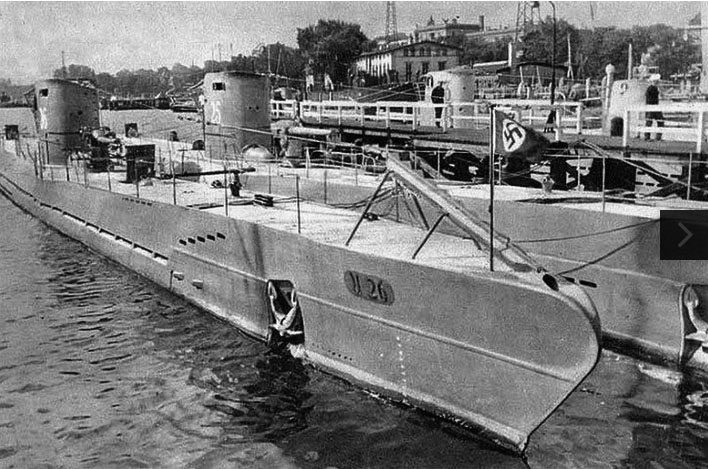
U26 of the Type Ia, ancestor of the Type IXA.
Integrating aspects of the Spanish Type E-1 and Finnish CV707 (Vetehinen) and launched in February 1936, U25 being trialled from April 1936 appeared to be a mediocre design with troublesome MAN diesels, poor seakeeping and maneuverability. They were used still for propaganda and later training. They also were a good lesson to design the next Type IXA, first of the long Type IX lineage, most important model of U-Boat with the Type VII in world war two.
The Type IXB in short
The previous Type IXA were designed between 1935 and 1936 internally and no longer by the IvS exposed by the local press and forced to relocate, then to close doors, staff back in Germany. The trials of U25 enabled a serie of detailed modifications and the result were eight improved U-Boats were ordered between 29 July 1936 and 21 November 1936, five month after trials with contracts awarded to DeSchiMAG AG Weser,
and they were allocated the U-37 to U-44 range. The last, U-44, was completed on 4 November 1939 under a long construction time for submarines, reflecting on the large size, cost and complexity. The next iteration was studied as soon as the Type IXA were ordered.
The Kriegsmaine staff and in particular Karl Dönitz estimated the Tupe IXA still lacked range so the next improvement would be center around extra ocean-going capabilities, and thus the Type IXA design had to incorporate large fuel oil tanks for this increased range, for a slightly heavier overall tonnage. For this, the beam was slightly enlarged when the pressure hull remained the same, so that the new fuel tanks could hold more. The design was also improved further on the later Type IXC. The new boats were ordered when the design was still ongoing, between 16 July 1937 and 8 August 1939 as part of the overall German rearmament plan Z with all contracts awarded again to DeSchiMAG AG Weser, Bremen, in charge of procuring detailed plans.

U-123 and U-201 inb the background (a Type VII) both camouflaged, back to Lorient in 1941
The first was to be laid down as U-65 on 6 December 1938. The last, U-111, was started on 20 February 1940. By the end of 1940, all Type IXB were in commission: U-64, U-65, U-103, U-104, U-105, U-106, U-107, U-108, U-109, U-110, U-111, U-122, U-123, and U-124, fourteen in all, with twelve sunk during the war, two scuttled by their crews in 1945. They were became also the most successful for average tonnage sunk, each claiming an average of over 100,000 gross register tons (GRT) to compare to their own 1050 tonnes standard, making them claiming a 1/100 tonnage kill ratio, better even than the Type VII.
Design of the class
Hull and general design

A total of fourteen Type IXBs were built versus eight Type IXA. All came with the same three periscopes, two in the conning tower and one in the control room. The Type IXB measured the same as the Type IXA at 76.50 m (251 ft) overall but were slightly wider at 6.76 m (22 ft 2 in) overall versus 6.51 m (21 ft 4 in) for a similar pressure hull or 4.40 m (14 ft 5 in) diameter in order to accomodate more fuel oil.
They were also still 9.40 m (30 ft 10 in) high to the conning tower top. The pressure hull measured stil the same 58.75 m (192 ft 9 in) overall. Like the IXA they had the same 4.70 m (15 ft 5 in) draft.
The hull was strong enough to be capable of reaching 230 m in test depth (750-770 ft), but in operations they survived below 250 m, being extremely rugged and resilient.
All Type IXB hold up to 56 crew members but it was usually reduced to 45–48 in practice.
Powerplant
Propulsion-wise, they had the same two MAN M 9 V 40/46 supercharged and improved 9-cylinder diesel engines, rated for 4,400 PS (4,340 shp; 3,236 kW) compared to the slightly less powerful models of the IXA.
They were mounted side by side at the rear of the engine section, approx. 5 meters from the conning tower. Their position allowed the mechanics to have access to every part for maintenance. The crankshafts were situated below the cylinders, one for each shaft. Batteries were situated below.
They also had two SSW (Siemens-Schukert) 1 GU 345/34 double-acting electric motors were installed side by side, rated for 1,000 PS (990 shp; 740 kW), installed in front of the diesels, approx. 2.5 meters, and below the aft “wintergarten” behind the conning tower.
Performances wise, they were no faster than the IXA and could travel at 18.2 knots (33.7 km/h; 20.9 mph) while surfaced but a bit slower at 7.3 knots (13.5 km/h; 8.4 mph) submerged versus 7.7 knots (14.3 km/h; 8.9 mph) on the Tpe IXA. But more importantly they had a range of 12,000 nmi (22,000 km; 14,000 mi) at 10 knots (19 km/h; 12 mph) while on the surface and 64 nmi (119 km; 74 mi) at 4 knots (7.4 km/h; 4.6 mph) while submerged. The Type IXA to compare had a range of 10,500 nautical miles (19,400 km; 12,100 mi) at 10 knots in standard surface mode. They were a bit more capable underwater at 65–78 nmi (120–144 km; 75–90 mi) at 4 knots. No change was made in the construction of the pressure hull, which had the same thick steel allowing for a diving depth of 100 m (328 ft 1 in), test diving depth of 150 m (492 ft 2 in) and crush diving depth of 250 m (820 ft 3 in).
Armament
The Type IXB submarines were given the exact same armament as the Type IXA, with six torpedo tubes, four in the bow as a standard, two in the stern. This was the same as any Type VII U-Boats as well. But they carried mire torpedoes of course, some twenty-two 53.3 cm (21 in) with some in external storage (under deck). Their warhead could vary between 617 pounds (280 kg) and 948 pounds (430 kg) depending on the models. These models can be setup to reach 6,000 m (6,600 yd), or to speed up to 44 knots (81 km/h). Part of these torpedoes, twelve in all, were stowed internally, ten were located in topside deck containers, in the external hull, 3 external containers at the stern and 2 at the bow, with two torpedoes inside each. However unlike the earlier Type IXAs, they were equipped with 44 TMA mines as well.
G7e Torpedoes
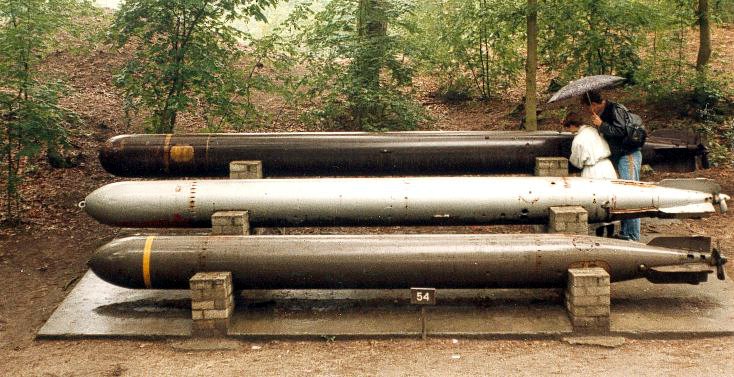
As primary armament, the Type IX possessed four bow tubes and two stern tubes all of 533 mm (21 in). They carried a total of G7e torpedoes were carried. The G7e type was electric, Electric with Lead-acid batteries. It was 7.16 m (23.5 ft) in length. The type carried was the first, called T2 and introduced in 1936. It can reach a target at 3000 m, running at 30 knots (56 km/h). This was not impressive as the submarine had no chance hitting a destroyer, cruisers or the new fast battleships.
10.5 cm (4.1 in) SK C/32
Type IXA submarines were given a 10.5 cm (4.13 in) L/45 deck gun placed on a tailored Utof mounting, forward of the conning tower. 180 rounds were carried. These rounds weighted 33.3-pound (15.1 kg), for the HE type. Muzzle velocity of 780 m/s (2,600 ft/s). Range at max elevation optimal, was 15,175 m (16,596 yd). It was able to fire on aircraft at a 10,000 m (11,000 yd) ceiling at max. elevation, manual. Rate of fire was 15 rounds per minute.
10.5 cm (4.1 in) SK C/32 naval gun, 45 calibers long, 1.8 tons, with 180 rounds in store, placed on the forward deck with a 360° traverse and 44.4° up to 80° elevation. It fired a 15.1 kilograms (33 lb) explosive (HE) shell at a 10,300-metre (33,800 ft) ceiling for AA use, while naval range was 15 kilometers (16,000 yd). The gun was enough to at least set on fire, and possibly sink a freighter. More
The Type IX in general could also be given two guns, a 2 cm FlaK 30 and a 3.7 cm (1.5 in) gun.
-The 2 cm FlaK 30 guns installed on the “wintergarten” (aft of the conning tower).
-The 3.7 cm SK C/30U when later present, was located on the aft deck.
3.7 cm/83 SK C/30

37mm FLAK on the aft deck of U-103 training. Note the partial shield, only covering the lower mount.
Unlike the Type VII, the Type IXA had on the aft deck enough space to mount a defensive 3.7 cm/83 SK C/30 straight away, providing welcome AA defensive power. This ordnance was introduced in 1934. However it was not systematically fitted and often was installed in the course of the war.
Specs:
536 lbs. (243 kg), Barrel Length 121 in (3.074 m). Mount: Ubts LC/39 -10/+90 degrees
Shells HE-T: 4.63 lbs. (2.1 kg), mv 3,281 fps (1,000 mps).
ROF about 30 rounds per minute. Probably 1,200 rounds on board.
Useful range 9,300 yards (8,500 m) at 45° up to 22,310 feet (6,800 m) ceiling.
More
2 cm/65 Flak C/30 AA
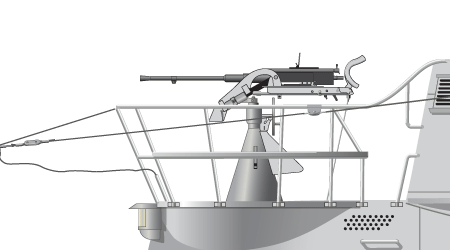 According to Conway’s, either a 2 cm Flak 30/38 or a 3.7 cm SK C/30 FLAK gun was mounted in the kiosk’s aft bathtub platform (“120 mm C30”, probably typo). They had a maximum range of 4,900 metres (5,400 yd), reduced in practice to 3,700 m against fast-moving aerial targets. Rate of fire was 280 rounds a minute at a muzzle velocity of 835 m/s (2,740 ft/s). 2cm Rounds weighed 0.71 pounds (0.32 kg). More
Mines
The Type IXa could also be fitted with 44 instead of 24 TMA mines as in the Type IXA. Not all IXs boats were fitted for minelaying with the Type IXC being the first really optimized for these missions.
-The German TMA was a moored mine, which floated above the surface, and could be carried and launched from each torpedo tube, so twelve total, plus 32 reloads. They were small enough to be fitted in the tubes, with a diameter of 11.1ft (3.38m)/21in (533mm), and could be moored down to a maximum Depth of 270m, and carrying a warhead of 215kg.
Sensors
Gruppenhorchgerät
In short, the GHG was the first efficient German sonar to be widespread.
Range: 20 km to individual ships, 100 km against Convoy
Search area: 2 × 140° at <1 ° at 6 kHz, 1.5° for 3 kHz, 4° for 1 kHz and 8° without filter.
It's possible the first U-Boat completed in 1939 had instead the polder Atlas hydrophones due to shortages.
For radars, none was installed before much later in the war. They will be covered on the next IX sub-variant installements.
Appearance

Author’s Type IXB schemes, U-106, 123 and 124.

Russian src, from pinterest: U123 and U124
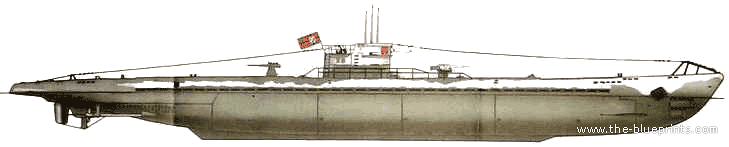
U-37, Type IXA (The blueprints)
⚙ Type IXB specifications |
|
| Displacement | 1,051 t (1,034 long tons) surfaced, 1,178 t (1,159 long tons) submerged |
| Dimensions | 76.50 x 6.76 x 4.70 m (251 ft x 22 ft 2 in x 15 ft 5 in) |
| Propulsion | 2x MAN M 9 V 40/46 diesels 4,300 shp (3,200 kW), 2x SSW 2 GU 345/34 EM 986 shp (735 kW) |
| Speed | 18.2 kts surfaced, 7.3 knots submerged |
| Range | 200 tonnes fuel: 12,000 nmi/10 knots surfaced, 64 nmi/4 knots submerged |
| Armament | 6× TTs (4 bow, 2 stern)/22 total, 10.5 cm SK C/32 naval gun (180), AA guns |
| Max depth | As Type IXA: 150 m (492 ft 2 in) |
| Sensors | See notes, GH sonar |
| Crew | 56 |
Career of the Type IXB
After being commissioned the Type IXB submarines built prior to the fall of France operated from Wilhelmshaven. Afterwards all were gradually moved to Lorient. They would be later housed in giant bunker pens built large enough for them and the new Type XXI being developed. The success of these submarines in wartime could be explained by their longer range and extra torpedoes. They could just operate much further and longer than the Type VII, giving them real chances in each sortie. The commanders were chosen by Dönitz for them as more “elite” than those on type VIIs, hand-picked based on competence and merit, so between the better boat, and Lorient as an operating base, plus their commission early into the war, with the British RN just started organizing its ASW defence, this proved a perfect combination for a rampage.

U-107 being resupplied in the South Atlantic
Let’s cite some Type IXB aces:
–Viktor Schütze: 7 sorties, 35 ships for 180,073 tons on U-103.
–Heinrich Bleichrodt: 8 sorties, 24 ships (151,260 tons) part on the U-107, 13 ships.
–Johann Mohr: 6 sorties, 27 ships for 129,292 tons on U-124
–Klaus Scholtz: 8 sorties, 25 ships for 128,190 tons on U-108
–Günther Hessler: 3 sorties for 21 ships and 118,822 tons on U-107
–Jürgen Oesten: 13 sorties, 19 ships (101,744 tons) partly on U-106)
–Harald Gelhaus: 11 sorties, 19 ships on 100,373 tons on U-107
–Fritz-Julius Lemp: 10 sorties, 20 ships for 96,639 tons on U-110
–Georg-Wilhelm Schulz: 8 sorties, 19 ships 89,886 tons partly on U-124
–Georg Schewe: 10 sorties and 16 ships for 85,779 tons partly on U-105
–Werner Winter: 5 sorties and 15 ships for 79,302 tons partly on U-103
Note that 12 out of 14 U-Boat had ace captains. No other class of sub-class in the Kriegsmarine equalled that.
 U-64
U-64
U-64 was ordered from AG Weser, Bremen on 16 July 1937, laid down on 15 December 1938, launched on 20 September 1939 and commissioned on 16 December 1939. U-64 went to sea on 6 April 1940. For eight days, she roamed the North Sea in search for Allied convoys underway to Norway for the campaign, spot none. On 13 April she was off Herjangsfjord 50 yards from the shore =when experiencing issues with the periscope just as a strong British force closing the the area led by the battleship HMS Warspite and nine destroyers. This soon developed into the Second Battle of Narvik. Warspite launched however a Fairey Swordfish float-plane in order to recon the fjord, and to bomb any targets of opportunity with two 250 Ib (110 kg) bombs but it also had two 100 Ib (45 kg) ASW grenades plus eight 40 Ib (18 kg) anti-personnel frag bombs. After reporting the German DDs, it also spotted U-64 and attacked. The latter had to crash dive down to 200 feet (60 m). The Swordsfih saw her starting to dive, dropped its two DCs, one being a near-miss, but one detonating just behind her conning-tower. AA fire caused minor damage but U-64 her her pressure hull ruptured just aft and she flooded and sank to the bottom of the fjord, slowly enough for all the men on deck and CT to jumped out and all bu eight to made it to the deck before she sank. 38 were picked up by German mountain troops. They would later formed part of the crew of U-124 of the same class. The wreck was raised in August 1957 and scrapped at Sandnessjøen.
U-65
U-65 was ordered from AG Weser, Bremen on 16 July 1937, laid down on 6 December 1938, launched on 6 November 1939 and commissioned on 15 February 1940. U-65’s first war patrol began on 9 April 1940 when she left her home port of Wilhelmshaven. For 36 days she between the North Sea and Norwegian Coast for the campaign, no spot. On 13 April, she attack British destroyers north of Bergen. Her torpedoes were accurate but duds. The destroyers counter-attacked but U-65 devaded them and was back to Wilhelmshaven on 14 May.
For her second patrol from 8 June 1940 and opver 30 days she crossed the North Sea, rounded the British Isles northwards crossed the Celtic Sea to the Bay of Biscay. At 08:17 on 21 June she spotted the isolated 1,177 GRT Dutch steam merchant ship Berenice from Bordeaux (loaded with 1,000 tons of manganese ore and 22 passengers). She was dispatched by a single torpedo amidships in three minutes (9 survivors).
At 18:04 next day she spotted an unescorted tanker in the Bay of Biscay.believed to be the 7,011 GRT French steam tanker Monique (no survivors). On 30 June she spotted the convoy SL-36 and reported then attacked it, but only hit the 5,802 GRT British steam merchantman Clan Ogilvy, which survived, helped by HMS Vesper and Gladiolus. On 1 July she attacked convoy OA-175 an at 13:51 fired her remaining torpedo at the Dutch steam merchant vessel Amstelland. This happened at 380 nmi (700 km; 440 mi) SW of Lands End. Kptlt. Stockhausen claimed her sunk but she survived later taken in tow by HMS Marauder ande scorted back by HMS Calendula to Falmouth. U65 was back at Wilhelmshaven on 7 July.
In her third patrol she departed Wilhelmshaven on 8 August for the same trip as before instead of through the channel to the newly captured Lorient South of Britanny in 12 days. She arrived on 19 August without kills. She hosted the IRA Chief of Staff Seán Russell and Frank Ryan, an ex-Republican Spanish Civil War fighter captured by Franco and handed over to the Abwehr, to be landed back in Ireland for Operation Dove, a sabotage. Russell became ill with stomach pains and U-65 lacked a doctor so he died on 14 August, 100 miles short of Galway, buried at sea, the mission aborted. There was an inquiry by the Abwehr included the interrogation of Frank Ryan concluding to a burst gastric ulcer.
In her fourth patrol U-65 departed Lorient on 21 August stopped six days at Brest, before her trip to the North Atlantic. No targets but at 20:00 on 14 September she spotted and reported convoy HX 70 some 180 nmi (330 km; 210 mi) off Barra Head, Scotland. She fired and missed the Norwegian MV Hird’s bow. She spotted the trail, started zigzagging at full speed, and U65 took 9 hours to reach a new firing position, until 06:05 launching a single torpedo from her stern tube struck on her starboard side, between the bridge and foremast. All survived in a small boat that was picked up by a nearby trawler, the Icelandic Þórólfur which signalled the attack and landed the survivors at Fleetwood. U65 attacked again on 17 September, against the British steam merchant ship Treganna with the convoy HX 71. She sank 78 nmi (144 km; 90 mi) northwest of Rockall (4 survived). She was back to Lorient on 25 September.
For her 5th patrol on 15 October, she left Lorient with orders to hunt off the west coast of Africa and South Atlantic, her longest and most successful patrol. Only on the 15 November she spotted and sank the 5,168 GRT British steam merchant vessel Kohinur detached from convoy OB 235 at 15:11, 250 nmi (460 km; 290 mi) north of the Equator (68 survived). They were picked up by the 7,614 GRT Norwegian motor tanker Havbør which was sunk in turn. British sailors on their raft tried to warn Havbør an U-Boat was in the area but they closed and llaid down boats to assist anyhow. The hit was on her port side. She caught fire, burning oil spread over the surface, engulfed boats of the rescue and in all, 28 members of her crew and all 31 in the water died ion flames. The tanker took 7 hours to go down. They were still 4 survivors rescued on 24 November at Freetown.
On 16 November, U65 spotted and sank 3,059 GRT British steam merchant ship Fabian, 350 nmi (650 km; 400 mi) west of Freetown. Single torpedo at 14:29. U65 surfaced and finished her out with her deck gun. 33 survivors were questioned by the Germans, but they were well treated before release. At 18:02 on 18 November, U-65 spotted the motor tanker Congonian, hit in the engine compartment, then a second hit near the stern (35 survivors later picked up by HMS Devonshire). Thanks to her range, U65 became the U-Boat to cross the Equator on 11 December but many weeks passed before she spotted and attacked on 16:05 on 21 December, the Panamanian steam tanker Charles Pratt. She was hit amidships by a single torpedo. Despite neutral she looked she was heading to a an enemy port. She was abandoned in lifeboats when hit by a second torpedo on the starboard 20 minutes later, which extinguished the fire but sank her. The survivors were rescued later by the merchantmen Gascony and Langleegorse.
Before Xmas, U-65 spotted the steam tanker British Premier, straggler from SLS-60, dispatched by two torpedoes at 16:41 some 200 nmi (370 km; 230 mi) southwest of Freetown. 30 crew lost, 13 survivors, 9 picked up on 3 January 1941 by HMS Hawkins but 4 others drifted for 41 days before being rescued by HMS Faulknor. 3 days later she sank the Norwegian steam merchant vessel Risanger (5,455 GRT) at 11:31 with her stern torpedo amidships. She then surfaced and fired 70 rounds to finish her off. 29 men esscaped and were picked up later by Belinda and landed at Cape Town on 10 January 1941.
On 31 December, U-65 spotted and attacked the 8,532 GRT motor tanker British Zeal east of the Cape Verde as she was on her way back home. She fired two torpedoes at 17:52. But one became stuck and became hot in the tube, launched manually, both missing. At 23:00 she attacked the tanker again, landed a hit on her starboard side under the bridge. The crew escaped in lifeboats. Another hit her on her starboard side 30 minutes after but she could not surface and finish her off due to bad weather with her deck gun, assuming her sunk when they departed the scene. But at daw she was still afloat and her crew, keeping tabs close, re-boarded her. They tested the engines and steering, but abandoned her again, fearing U65 was still nearby. At dawn the next da they re-boarded her a second time, now certain U65 was awya, raised steam and headed toward Bathurst, escorted back by HMS Encounter, and the tug HMS Hudson on 4 January, arriving at Freetown on 8 January. She was patched up and crossed the Atlantic to Baltimore for full repairs and back in service by February 1942. It was certainly not the first not the last time a tanker burned and was hut by five torpedoes or more and survived thanks to their thick bulkheads and large holds well compartimented.
On 2 January 1941 at 22:07 U65 landed a single torpedo on the steam merchant ship Nalgora (6,579 GRT), 350 nmi (650 km; 400 mi) north of the Cape Verde Islands. 20 minutes later she surfaced and finished off her with the deck gun. All 105 survived. 86 were picked up by Nolisement and Umgeni and 19 landed in the Cape Verde Islands. U65 arrived to enter the brand new pens at Lorient on 10 January 1941. Congratulated by Dönitz in person, Stockhausen was promoted to Korvettenkapitän (Knight’s Cross of the Iron Cross) and took command of the 26th U-boat Flotilla.
She had thus a new skipper for her 6th adnd last patrol, leaving Lorient on 12 April 1941 under command of Kptlt. Joachim Hoppe for a North Atlantic cruiser. She made no kills but when closing on a convoy on 28 April she was spotted, attacked and sunk by depth charges from the British destroyer HMS Douglas (no survivors).
U-103
U-103 was ordered from AG Weser, Bremen on 24 May 1938, laid down on 6 September 1939, launched on 12 April 1940 and commissioned on 5 July 1940. In her first patrol she entered the Atlantic via the gap between the Faroe and Shetland Islands and her first kill was Nina Borthen on 6 October. But she needed two more torpedoes until she broke in two and sank with all hands. On 9 October, U-103 sank Zanes Gounaris, damaged Graigwen and Delphin. She sank Nora on 13 October and Thistlegarth, 45 nmi west northwest of Rockall on 15 October. She ended her patrolled by being transferred to Lorient on 19 October.
In her second patrol she was attacked by the Flower-class HMS Rhododendron northwest of Ireland on 11 November 1940.
She sank Daydawn and Victoria on 21 November, Glenmoor on the 27th, Mount Athos and St. Elwyn on the 28th, Calabria on 8 December, Empire Jaguar the next day and back to Lorient on 12 December.
In her third patrol on 13 February 1941 she damaged Arthur F. Corwin, ater sunk by U-96. On 19 February she sank the Norwegian motor ship Benjamin Franklin (survivors rescued by HMS Pimpernel). Some were later rescued by the Egyptian steamship Memphis which herself sank on 28 February with all hands.
In her Fourth patrol U-103 was sent off the coast of West Africa and spent there 103 days at sea, her longest patrol, fully exploiting the range of the class. She sank Polyana 41 nmi (76 km; 47 mi) SW of the Cape Verde on 24 April 1941 (no survivors). She sank then Samsø, Wray Castle, Surat and Dunkwa in May. For Dunkwa she surfaced and helped the crew to right one lifeboat and provided drinking water, food and instructions. On 25 May, she sank the cargo ship Radames off Liberia, which was was filmed by the crew for the German propaganda, now a staple footage of documentaries about the battle of the Atlantic.
U-103 sank seven more ships off the African coast and went back to Lorient on 12 July.
In her 5th patrol in the North Atlantic she sank Niceto de Larrinaga, Edward Blyden and Lapwing west of the Canary Islands, on 22 September 1941. Her crew went onto a well deserved leave for December back in Germany. When they returned the US were at war with Japan and Germany after Pearl Harbour. The strategy was now to attack directly convoys at the root, back on the US coast. In her 6th patrol she thus became part of Dönitz’s Operation Drumbeat, a first rampage campaign off the US west coast. At the time, the US was no longer neutral and yet Admiral King still did not applied full ASW wartime rules, with the cities having no blackout ordered, no specific British-style ASW escort measures, no convoy formed back in harbour, shipping moving freely, etc. This was a first “happy time”. W. L. Stead was sunk by U103 some 90 nmi (170 km; 100 mi) off the Delaware River on 2 February 1942. She was finished off by deck gun and 83 rounds, 17 hits, then two more torpedoes (1 missed). Her ammunition cargo detonating, sending flames 500 ft (150 m) into the air. She later sank San Gil on 4 February, then India Arrow and China Arrow a day later. She was then back to Lorient.
On her 7th patrol she departed on 15 April 1942, sank Stanbank northeast of Bermuda on 5 May then rampaged the Caribbean and Gulf of Mexico, sinking another 8 merchant ships and back to Lorient on 22 June.
In her 8th patrol she sank Tasmania north of Madeira on 31 October 1942, Henry Stanley in mid-Atlantic, northwest of the Azores on 6 December. She captured Henry Stanley’s Master and was eventually sent to the Milag Nord internment camp. U-103 damaged Horata north of the Azores on 13 December and was back home.
In her 9th and 10th patrols made in a row, the first she left Lorient on 7 February 1943, it brought no kill, despite she searched the Atlantic off Spain to the Azores and Morocco. She was back also without kill on 26 March. For her 10th on 27 April she was attacked by a Vickers Wellington of No. 172 Squadron RAF while underway suyrfaced by night, spotted by radar and then illuminated by a Leigh Light. 6 depth charges were dropped but no damage. Then an Arsmstrong Whitley bomber of No. 10 OTU (Operational Training Unit) attacked her also on 22 May. AA fire drove her out.
For her 11th patrol, last operational one, she was to be sent to Brest and then return to the west African coast. After no chance she was bback norrht for a second patrol off Norway and entered Bergen on 1 January 1944, left on 3 January 1944 for Kiel on the 7th and by March she was used as a Schulboot, sent to Gotenhafen, Hamburg to perform as such until January 1945. By April she left Hamburg back to Kiel and on 3 May 1945 she was scuttled at Kiel to avoid caoture.
U-104
U-104 was ordered from AG Weser, Bremen on 24 May 1938, laid down on 10 November 1939, launched on 25 May 1940 and commissioned on 19 August 1940. She had a short career under Kptlt. Harald Jürst, but sank a merchant, damaged another on her first and only war patrol in the North Sea. All happened off the northern coast of Ireland. She departed on 12 November 1940, made no spot for 17 days, across the North Sea and up to the northern coast of Scotland and Ireland. She spotted then sang one and damaged another merchant and by 27 November 1940: They were sank the merchant vessel Diplomat, straggler from convoy HX 88, (14 lost) then hit the British motor tanker Charles F. Meyer from convoy HX 87 (she survived the attack). She was unable to make a report and maeked overdue, presumed lost off the north of neutral Ireland, likely stricking a mine from the SN 44 minefield laid on 8 November 1940. No survivors.
U-105
U-105 was ordered from AG Weser, Bremen on 24 May 1938, laid down on 16 November 1939, launched on 15 June 1940 and commissioned on 10 September 1940. Under command of Kapitänleutnant Georg Schewe (knight cross), she left Kiel on 24 December 1940 for a patrol lasting 39 days in the North Sea. There, she sank the British ship Bassano on 9 January 1941, Lurigethan (Convoy SL-61) on 26 January 1941 for 8,407 GRT but 5 days later, on 31 January, she proceeded back to Lorient, her home port until she was lost. Her second patrol started on 22 February 1941 for a 112-dayin the Atlantic, sailing with U-124 under the Oberkommando der Marine on Convoy SL-67. There, she sank Harmodius on 8 March. She stalked Convoy SL-68, sinking Medjerda on 18 March, Mandalika on 19 March, Clan Ogilvy, Benwyvis and Jhelum on the 21st. U-105 sailed to South America and sank Ena de Larrinaga on 5 April 1941 and Oakdene (Convoy OG 59) on 6 May as well as Benvrackie (Convoy OB 312) on the 13th, then Benvenue from Convoy OB 314 on the 15th. She sank Rodney Star on 16 May and Scottish Monarch on 1 June (Convoy OB 319). She returned to Lorient after the second most successful U-boat patrol of WW2, 12 ships sunk for 71,450 GRT.
On 5 May 1941 her main deck gun exploded, wounding all gunners. U-105 was back to Lorient on 13 June, repaired until 3 August, and at sea for a 3rd war patrol. Still under strick direction she was vectored in on 5 August to the wolfpack “Hammer” until disbanded on 12 August, then wolfpack “Grönland” until 27 August. She was then assigned to wolfpack “Margrave”, sank the Panamanian Montana (Convoy SC 42) on 11 September and back to Lorient. On her 4th patrol on 8 November 1941 for 36 days in the North Atlantic she was reassigned on 14 November to wolfpack ‘Steuben’until 2 December (no kill) and back to Lorient on 13 December 1941. Schewe was replaced by Heinrich Schuch. On 25 January 1942 she departed for her 5th patrol and on 31 January sank the HMS Culver, protecting Convoy SL 98 SW of Ireland. On 5 February 1942, she rescued 7 men from a crashed Dornier Do 24, 350 miles off France. She was back to Lorient on 8 February. On 25 February she departed again and between 25 and 27 March, sank the the British merchant Narragansett and Norwegian merchant Svenør off the US east coast. She was back to Lorient on 15 April (50 days in the North Atlantic). She left on another patrol on 7 June and combed the Bay of Biscay, when spotted and attacked by an Australian Short Sunderland aircraft from No. 10 Squadron RAAF.

The Potez-CAMS 141 that ended the career of U105 off Dakar (pinterest).
U-105, damaged, took shelter in Ferrol, Spain and only left on 28 June for Lorient, to the 30th. She was repaired until 23 November and Oberleutnant zur See Hans-Adolf Schweichel took command, then Oberleutnant zur See Jürgen Nissen, she left Lorient for the North Atlantic and sank three British merchant ships: Orfor (14 December 1942), CS. Flight (12 January 1943), British Vigilance (Convoy TM 1) on 24 January and the US freighter “Cape Decision” on the 27th, back to Lorient on 14 February, there until 16 March. On 1 April Jürgen Nissen, was promoted Kapitänleutnant by radio. On 15 May 1943 she sank the Greek merchant ship Maroussio Logothetis southwest of Freetown. On 2 June 1943 while off Dakar, she was attacked and sunk by the Potez-CAMS 141 flying boat “Antarés” (Free French Squadron 141). She dropped depth charges on point and U105 broke in two and sank with all hands.
U-106
 U-106 was ordered from AG Weser, Bremen on 24 May 1938, laid down on 26 November 1939, launched on 17 June 1940 and commissioned on 24 September 1940. In her 1st patrol from Kiel on 4 January 1941 U-106 sailed to the Atlantic Ocean. She took the infamous GIUK gape between the Faroe and Shetland Islands and cruised north-west of Rockall, sinking Zealandic (17th) and Sesostris (29th) then docked in Lorient on 10 February. For her 2nd patrol she departed Lorient on 26 February 1941 and spend 112 days at sean not back before 17 June, off west Africa, sinking Memnon, 200 nmi west of Cape Blanco (11 March) and 7 more ships, damaged 2. But her bigger success was the battleship HMS Malaya. Her rampage led to Senegal and the Cape Verde. For Malaya, the latter in March was escorting the convoy SL 68 and was spotted against the sunset in the evening of 20 March 250 miles WNW of the Cape Verde. U106 launched a full salvo, all missed but a single torpedo on her port side. Her ASW bulg did its job but she still started to take a 7 degree list, forced to leave the convoy and limping back under escort by HMS Crocus to Trinidad after 9 days with the crew stemming the flood. Temporary repairs done, she proceeded to New York and one drydock for repairs lasting 4 months.
In her 3rd patrol, U106 was a black one, from Lorient on 11 August 1941, back on 11 September, west of Ireland and of the Azores and the Portuguese coast. On 2 Sept., she met the German freighter/blockade runner Anneliese Essberger as vectored in to escort her until 8 Sept. to the western cape, Spanish north coast and then to Bordeaux. In her 4th patrol from Lorient on 23 October 1941 it was discobvered by the skipped that a rogue wave wiped off her entire watch overboard in heavy seas while in the Bay of Biscay. U-106 sank King Malcolm on the 28th, damaged USS Salinas on the 30th but was hunted for 9 hours and damaged by escorts of convoy ON 28.
In her 5th patrol from 3 January 1942, U-106 proceeded to the eastern coast of the US, sinking 5 ships, in the “Second Happy Time”, sinking SS Empire Wildebeeste and tanker SS Rochester, finished off ablaze by her deck gun. She was back to Lorient on 22 February.
For her 6th patrol she was sent to the Gulf of Mexico sinking 5 ships, damaging a 6th. One of these was fateful as this was the tanker Faja de Oro on 21 May 1942. The public outrage in Mexixo facilitated the country’s declaration of war on Germany on 1 June. For her 7th and 8th patrols she was attacked by a Vickers Wellington of No. 311 Squadron RAF in the Bay of Biscay on 27 July 1942. The first watch officer was killed, commander wounded. She was also damaged but saved by her AA. She returned to Lorient on the 29th. In her 8th patrol she sank Waterton in the Gulf of St. Lawrence on 11 October 1942.
For her 9th patrol she made a spotless foray from 17 February 1943 to 4 April. For her 10th patrol (final patrol) from 28 July 1943, she was sunk on 2 August off northern Spain, after being damaged by a Wellington of No. 407 Squadron RCAF which rendered her helpless. The Wellington vectored in escort ships to finish the job.
But this went after a last attempt to escape. While trying to S-boats from a nearby base, she was spotted by a Sunderland of 228 Squadron (FO Reader Hanbury). A duel started, in which her AA tried to deter U-106 but she was hit later by another Sunderland from No. 461 Squadron RAAF (FFL A. F. Clarke) and photographed during the attack, partially exploding after a direct hit before sinking vertically. 26 managed to escape, and were later picked up by nearby S-boats.
U-107
 U-107 was ordered from AG Weser, Bremen on 24 May 1938, laid down on 6 December 1939, launched on 2 July 1940 and commissioned on 8 October 1940 under command of Kptlt. Günther Hessler. It’s only on December 1941 she was declared ready for her first patrol, which started after a change of command to Harald Gelhaus (Knights Cross) from 1 December 1941. She was assigned to the 2. flotille and on her 1st patrol from Lorient she sank on 3 February 1941 the Empire Citizen (4,683 GRT) from Convoy OB 279 and later that day the AMC HMS Crispin (5,051) defending Convoy OB 280. Three days later she sank the Canadian Maplecourt (3,388 GRT) from Convoy SC 20. On the 23rd she sank the AMC Manistee (5,360 t)defending Convoy OB 288.
But her Second patrol was by far the most successful: On 8 April 1941 she sank the Helena Margareta (3,316 GRT) part of Convoy OG 57 and later that day the Eskdene (3,829 GRT). A day later, still preying on the same, she sank the Harpathian (4,671 GRT) and Duffield (8,516 GRT). On 21 April she sank the SS liner/cargo Calchas (10,305 GRT) and on the 30th the Lassell (7,417 GRT) this time from Convoy OB 309.
Her patrol went on for May and June. On 17 May she sank the Dutch Marisa (8,029 GRT) and on 18 May 1941 she British Piako (8,286 GRT), on the 27th the Colonial (5,108 GRT) this time belong from Convoy OB 318 and on 28 May the Greek Papalemos (3,748 GRT) then on 31 May the British Sire (5,664). On 1 June she sank the Alfred Jones (5,013 GRT) from Convoy OB 320 and on the 8th the Adda (7,816 GRT) from Convoy OB 323. On the 13th she sank the Greek Pandias (4,981 GRT).
In her 3rd patrol on 24 September she sank the Dixcove (3,790 GRT) from Convoy SL 87, Lafian (4,876 GRT), John Holt (4,975 GRT).
In her 5th patrol she was sent to the US east coast (No kill in her 4th) and on 31 January 1942 she sank the San Arcadio (7,419 GRT), on 6 February the US “Major Wheeler” (3,431 GRT) East of Cape Hatteras and on the 21st damaged badly the Norwegian Egda (10,068 GRT) from Convoy ON 65. She survived and was repaired. For her 6th patrol she was sent to the South Atlantic and was reuspplied on a predetermined point. On 29 May she sank the Western Head (2,599 GRT) and on 1st June the Bushranger (Panama) 4,536 GRT, then on 7 June 1942 the Castilla (Honduras flagged, 3,910 GRT). On 8 June she sank the US Suwied (3,249 GRT),
and on 10 June the US Merrimack (2,606 GRT). On 19 June she sank the tug US Cheerio (35t) and on 26 June the Dutch Jagersfontein (10,083 GRT). For her 8th patrol on 3 September 1942 she sank the Hollinside (4,172 GRT) and on 3 September the Penrose (4,393 GRT) and on 7 October the Andalucia Star (14,943 GRT).
For her 9th patrol on 4 March 1943, still under Harald Gelhaus (Knights Cross) she came under attack from an unidentified Allied aircraft but lightly damaged. This happened again on 22 March at 14:35. Her AA did her job this did the job and she was undamaged.

Still she managed on 22 February to sink the Roxborough Castle (7,801 GRT), and was “on fire” as on 13 March she rampaged Convoy OS 44 sinking Oporto (2,352 GRT), Marcella (4,592 GRT), Sembilangan (4,990 GRT), SS Clan Alpine (5,442 GRT). Gor her 10th patrol on 1st May 1943 she sank only Port Victor (12,411 GRT).
For her 11th patrol her new skipper was since July Kptlt. Volker Simmermacher and apparently her crew was partly composed of rookies and retrained, she was sent to the US East coast. She was at sea and only by 28 August 1943 she damaged the US Albert Gallatin (7,176 GRT) Off Savannah, Georgia. On 11 September she damaged the USS Rapidan (8,246t) protecting Convoy NG 385. No sucess for her 12th, 13th, and 14th patrols. In her 15th patrol she only damaged on 13 June 1944 the US freighter Lark (148 t). 16th and final patrol: Volker Simmermacher was dismissed and replaced by Ltn. (R) Karl-Heinz Fritz. On 16 August 1944, U-107 left Lorient for La Pallice base when intercepted on 18 August in the Bay of Biscay, west of La Rochelle and sunk by a Short Sunderland from No. 201 Squadron RAF, with all hands.
U-108
 U-108 was ordered from AG Weser, Bremen on 24 May 1938, laid down on 27 December 1939, launched on 15 July 1940 and commissioned on 22 October 1940 under her first skipped Kptlt. Klaus Scholtz (Knights Cross/Oak Leaves). U-108 made 11 war patrols, sank 25 ships for 118,722 GRT, sinking a 16,644 GRT AMC as one of her biggest kill and joined seven wolfpacks.
For her 1st, 2nd and 3rd patrols she left Wilhelmshaven in her first trip on 15 February 1941. She proceeded to the North Sea, entered the Atlantic via the GIUK gap and sank her first ship, the Texelstroom on 22 February, Effna on the 28th south of Iceland. She docked at Lorient on 12 March and prepared for her 2nd carrer. There, she sank the AMC HMS Rajputana west of Reykjavík on 13 April 1941 including with the Convoy Commodore and his staff (convoy flagship). Back home she had a polar bear painted on her conning tower.
U-108 sank next in her 3rd patrol the CAM ship Michael E. in her 3rd patrol on 2 June. She later on the 8th sank Baron Nairn west of Cape Race, Greek ship Dirphys east of Newfoundland the same day and 2 days later she sank the Christian Krohg, Ellinco, Nicholas Pateras (both the 25th), Toronto on 1 July a weather ship 500 nmi (930 km; 580 mi) north of the Azores, precious to the allies as meteo also was took in account to plan convoy routes.
For her 4th patrol she went through the GIUK gap between South America and Africa from Lorient on 19 August 1941 but back on 21 October without kill but the neutral Cassequel on 14 December some 160 nmi (300 km; 180 mi) southwest of Cape St. Vincent in Portugal
For her 5th sortie she only sank Ruckinge (convoy HG 76) on the 19th, west of Lisbon.
For her 6th patrol she was included in Operation Drumbeat (Paukenschlag) to be sent to the east coast of North America. She sank Ocean Venture on 8 February 1942, Tolosa (9th), Blink (12th). The U-boat had chased Blink, which had been hit by a non-detonating torpedo, the two vessels almost collided; which was only avoided by U-108 diving underneath the merchant ship.
She sank Ramapo NW of Bermuda on 16 February, Somme on the 18th.
For her 7th patrol she sank Modesta on 25 April 1942, Mobiloil on the 29th (as a tanker she needed 6 torpedoes and was finished off by all her deck guns, 105, 37mm and 20mm). She sank Afoundria on 5 May, Abgara on the 6th and while back, met and sank Norland on the 25th. For her 8th patrol she was vectored in to the northern South American coast, sank Tricula on 3 August 1942, Breňas on the 7th, Louisiana on the 17th.
TIn her 9th patrol she was sent to attack the convoys for Operation Torch. However the allied superiority was huge and while off Morocco she was detected and attacked by a destroyer and badly damaged, forced back to France for long repairs. Meanwhile a new skipper took command to supervise work and keep crews trained in October 1942, Oblt. Erich Hilsenitz, then KrvKpt. Ralf-Reimar Wolfram.
For her 10th patrol from Lorient under KrvKpt. Ralf-Reimar Wolfram she was underway back to the Mediterranean when on 10 February she was attacked by a Catalina of 202 Squadron RAF west of Morocco. One DC hit close to her forward torpedo tubes which were damaged enough to force her back to Lorient for repairs.
In her last and 11th patrol started on 1 April 1943. On 19 April she sank the US freighter Robert Gray from Convoy HX 234, a Liberty ship which straggled behind the convoy in the Atlantic Ocean (all 62 crew lost). She was attacked by a destroyer on the 22nd but shadowed back the Convoy ON (S) 4 southeast of Greenland. She made no kill. Back underway she was recalled and ordered to be sent to Stettin (now Szczecin, Poland) on 16 May. She was stranded there, until bombed and sunk on 11 April 1944, while under commad of Oblt. Matthias Brünig since 17 October. She was eventually raised and decommissioned on 17 July, scuttled again on 24 April 1945.
U-109
U-109 was ordered from AG Weser, Bremen on 24 May 1938, laid down on 9 March 1940, launched on 14 September 1940 and commissioned on 5 December 1940. U-109 conducted a total of nine war patrols in her career and sank twelve enemy vessels with a total of 79,969 gross register tons (GRT). She also damaged one other of 6,548 GRT. She was assigned to the 2nd U-boat Flotilla based at Kiel and from 20 December, Danzig, in March she took part in tactical exercises simulating convoy attacks however her skipper Korvettenkapitän Hans-Georg Fischer was graded as “insufficient” and he had to repeat the exercise. Then she joined the 2. Unterseebootsflottille on 1 May and left kiel for her first patrol on 6 May for the North Sea, and for 24 days roamed the North Sea and North Atlantic looking for Allied convoys. On 13 May she joined Wolfpack West SSE of Cape Farewell in Greenland but she aborted an attack on a neutral ship. On 19 May she was vectored in on convoy HX 126 spotted by U-94.
U-109 closed by was was driven off by escorts and lost contact, later sinking a straggler, the British Harpagus. She retried an attack but was depth charged and forced back to base, this time Lorient in France. Underway she crossed path with the pursuers of Bismarck underway to France. Close to France she spotted a periscope, a British submarine that later tried to sink U-74 but missed.
On 29 May she entered Lorient. Her skipper was dismissed by his own watch officers Keller and Schartzkopff. Kptlt. Heinrich Bleichrodt took command.
For her 2nd patrol from 28 June she left Lorient for Freetown, West Africa, in a wolfpack of 4, with underway refuelling with the German tanker Corrientes interned in the Canary Isles. However the British managed to forbade the Spanish authorize this resupplying so this was cancelled. U-109 patrolled West of the Canaries and on 6 July shadowed the SS City of Auckland, fired and missed. She surfaced to use her deck gun, but SS City of Auckland laid a smokescreen, returned fire and managed to escape.
In the night of 21-22 July U-109 she managed to enter Cadiz by night to refuel from the tanker Thalia. Then she joined the Wolfpack Süd en route to the Canary Isles. On 30 July she was ordered to Gibraltar to ambush HG convoy. She spotted convoy HG 70 from Girbralter on 9 August, but failed to make contact and was depth charges and damaged on 13 August, forced back to base, arriving on the 17th.
After leaving Lorient on 21 September for her 3rd patrl a diving trials showed issues, so she returned for fixes to Lorient and departed again on 5 October, southeast of Greenland to join Wolfpack Mordbrenner. U-553 spotted convoy SC 48 but U-109 was sent further northwest (Strait of Belle Isle) by Hitler to avoid conflict with US and respect the neutrality zone. She found no target (ULTRA decrypts helped this). Next she joined Wolfpack Reisswolf attacking convoy ON 28 and on 1 November she spotted two escorts but botched an attack. She followed them to Cabot strait. On 2 November she was detached to act independently. On 5 November she was ordered to escort the blockade runner/prize ship Silvaplana back to France, arrived at Lorient on 18 November (45 days, no kill).
For her 4th patrol she left Lorient on 27 December (now the US were at war) for the eastern seaboard (Operation Paukenschlag/Drumbeat) and sent to Nova Scotia, orered to patrol and act independently from Halifax to New York. On 13 January 1942 she made a first attack, but missed five times. She Cape Sable, made another attack and missed again. Eventually she sank the British merchant vessel Thirlby on 23 January but anither attack 2 days later was aborted due to escorts showing up. Her skipper decided to go for New York and requested fuel from U-130, short of torpedoes. On 31 January she spitted the merchantman Tacoma Star, gave chase, sank her the next day. Due to bad weather and navigational errors her rendezvous was not possible before 4 February, and a day later she also spotted and sank the Canadian tanker Montrolite, then spotted the Panamanian Halcyon on 6 February, using her last two torpedoes (missed) and tried her deck guns (damaged, escaped). She met U-130 to refiel on 6 Februaryand sailed back to France. On 16 February in heavy fog she entered in a convoy but did not reported it as he knew U-82 did the same and was lost. She was back in port on 23 February 1942, mistakenly reported by the BBC sunk after the SS Empire Kingfisher attack. She struck an uncharted rock and believed it to be torpedo impact.
Her 5th patrol saw her departing on 25 March for the southern US coast and on 20 April sank the British merchant Harpagon, damaged La Paz off Florida on 1 May and on 3 May, sank the Dutch Laertes. She was back to Lorient on 3 June (72 days). For her 6th patrol she was sent to the coast of Africa, roamed ot for 81 days, down to the Gold Coast for 5 kills: Norwegian Arthur W. Sewall (7 August) and the British Vimeira (11), Ocean Might (3 September), Tuscan Star (6 th), Peterton (17th) and back home on 6 October.
For her 7th patrol she departed on 28 November to the northern coast of South America and crossed a connvoy but came under heavy depth charge attack. Off Trinidad on 26 December, U-109 she attack a ship also equipped with grenades and was damaged. Captain Bleichrodt then had a nervous breakdown and on 30 December the 1st Watch Officer took charge and returned the U-Boat to Lorient. U-558 transferred a backup officer to her. On 23 January 1943 she was back to Lorient and Bleichrodt ended in an hospital.
For her 8th patrol she left on 3 March for the Azores, circled them and back to Lorient on 1 April, 30 days, no kill.
Her 9th patrol was her last. She departed on 28 April 1943, sailed until 4 May, and her report was awaited but never came. She was sunk by 4 depth charges from an Coastal Command B-24 Liberator of 89 Squadron, south of Ireland, intercepted en route to a convoy north-east of the Azores. The Liberator reported picking up on her H2S radar. After the attack, U-109 was spotted surfacing to sink again and the crew did not crew managed to abandon her, so she as assumed down with all hands.
U-110 (1940)
 U-110 was ordered from AG Weser, Bremen on 24 May 1938, laid down on 1 February 1940, launched on 25 August 1940 and commissioned on 21 November 1940 under command of Kapitänleutnant Fritz-Julius Lemp. Her first patrol started from Kiel on 9 March 1941 to the Atlantic Ocean took via the Faroe-Shetland Islands gap and she soon found a first victim, the vessel, Erodona damaged south of Iceland, on 16 March. She did the same to “Siremalm” on the 23rd. Both survived torpedo hits and in the second case she did surface to gun her down. It seems there there was a torpedo hit, but a dud as the later ship returned with a large dent where it struck. To add insult to injury, the crew of U-110 forgot to remove the tampion when surfaced and so the first shot was trapped into the muzzle which exploded. This wounded three men and disabled the gun permanentlmy so the crew reverted to the 37mm and 20 mm FLAK and only kept the ship’s crew down. Siremalm fled the scene while zig-zagging as she went. U-110 arrived in Lorient on 29 March, her new base, and she needed a new gun, presenting a pitiful “flower” barrel. It should be started that at that stage the new G7E torpedo used by U-Boat was as much problematic as was the US Type XIV for its own Submarines. Lost of ships went back with such dents. Lots of good opportunity wasted by faulty exploders.
For her second patrol from Lorient on 15 April 1941 she returned to the same path and on the 27th, sank Henri Mory 330 nautical miles west northwest of Blasket Islands in Ireland. Next she was vectored in to convoy OB 318 east of Cape Farewell, Greenland and successfully torpedoed Esmond and Bengore Head, but the escorts went streight for her, following the torpedo trails. The flower class HMS Aubrietia located her by ASDIC (sonar) and with the destroyer Broadway depth charged her, causing so much damage U-110 had to ge deeper and stay down for a while. She later eventually resurfaced, surviving the attack. HMS Bulldog and Broadway remained close and managed to regain contact after she surfaced, made a run for her and dropped depth charges beneath her as a warning to surrender. Lemp apparently shout out to his men “Last stop, everybody out”. But when it seems the crew started to run to their guns, both ships opened fire and only stopped after they realized the U-Boat was being abandoned and the crew were actually surrendering. This has been a carnage.
Commander Lemp realised that U-110 was not sinking even after charges had been setup and cocks open so he tried to swim back to destroy secret material and documents (critical enigma machine and code books), never seen again. He died underway (likely shot dead by marksmen on Bulldog) with 15 other men killed in action on deck, while 32 were captured. They ended as POWs in Ontario, Canada. U-110 did not sink idneed. HMS Bulldog’s boarding party under Sub-Lieutenant David Balme managed to get inside, pistol in hand, stripping her of anything portable like her Kurzsignale code book and Enigma machine and U-110 was taken in tow back but in between orders came to sink her in order to avoid her captured to revealed and all this went to considerably help Bletchley Park codebreakers. They manage to break up the Reservehandverfahren, reserve German hand cipher. This was in May 1941, so early in this war. With the sinking of Bismarck, this was a string of successes for the RN.
U-111
 U-111 was ordered from AG Weser, Bremen on 8 August 1939, laid down on 20 February 1940, launched on 15 September 1940 and commissioned on 19 December 1940. For her first patrol under command of Kptlt. Wilhelm Kleinschmidt she departed Wilhelmshaven on 5 May 1941 and for 64 days, patrolled the North Sea, North Atlantic up to Nova Scotia, spotting three ships. The first was on the 13th, with the merchant SS Somersby, sank south of Iceland. On 20 May close to convoy HX 126, the tanker San Felix. A torpedo hit failed to sink her. 2 days later she sank the Barnby south of Greenland. She was then ordered to broadcast decoy signals. On 25 May she resupplied from the Belchen but took no torpedoes and eventually came back to Lorient on 7 July. For her second patrol she left on 14 August down to the west coast of Africa and South Atlantic, then eastern coast of Brazil, sinking there the Dutch Motor merchant vessel Marken on 10 September off Ceará and 10 days later, the British motor merchant “Cingalese Prince”. On 28 September she was caught at Tarrafal Bay, Cape Verde islands underway to meet U-67 and U-68. She was rammed by HMS Clyde (they collided when the first accidentally dived onto her) and so badly damaged she she could not dive anymore, being forced back to Lorient for repairs, but she never get there.
Instead on 4 October 1941, as Clyde signalled her, she was now hunted down, eventually found and sunk by depth charges by the trawler HMS Lady Shirley southwest of Tenerife. 52 men surrendered (8 died) and they were all interrogated. They surrendered after their Captain was killed. Wilhelm Kleinschmidt indeed had been killed in the initial action with Lady Shirley, the junior officer and five ratings.
U-122
U-122 was ordered from AG Weser, Bremen on 15 December 1937, laid down on 5 March 1939, launched on 20 December 1939 and commissioned on 30 March 1940, under command of K.Kapt. Hans-Günther Looff in the 2nd U-boat Flotilla. For her first patrol from May 1940, she carried a 88 mm Flak with ammunition, bombs, 750 barrels of avgas, and oil to Trondheim as per the Norwegian campaign. On 23 May she detected a British submarine in the North Atlantic but none engaged each other. She sank only SS Empire Conveyor (5911 GRT) on 20 June 1940 and was declared missing with all hands after 22 June 1940 (second patrol) between the North Sea and Bay of Biscay. Hypothesis: Collided with the San Felipe on 22 June; Sunk by depth charges from HMS Arabis on 23 June; rammed by ORP Wilk on 20 June after midnight but this was a day before the sinking of SS Empire Conveyor. Her last report was on 21 June.
U-123
U-123 was ordered from AG Weser, Bremen on 15 December 1937, laid down on 15 April 1939, launched on 2 March 1940 and commissioned on 30 May 1940 under command of Kptlt. Karl-Heinz Moehle. Her career consisted of 12 war patrols, 45 kills for 223,367 GRT, one 650t warship, plus 6 ships damaged (53,568 GRT) but that included the neutral Swedish SS Anten, MV Korsholm, SS Nanking and MV Venezuela.
In her first patrol she left Kiel on 21 September 1940 for the North Sea,the GIUK gap, and an area west of Ireland to sink 6 ships by October. Howezver one was not cheap: The tanker Shekatika which needed five torpedoes, partly because she was loaded with pit-props. She went back to Lorient on 23 October.
Second patrol was on the same route by on 17 November Mechanikergefreiter Fritz Pfeifer was lost overboard. She sank the straggler ore-carrier SS Cree but on 3 November herself was damaged in a collision with an unknown mass, likely one of the convoy’s ships. She was back on 28 November.
For her 3rd patrol from 10 April, she sank 4 ships including Grootekerk, after a 9-hour chase 330 nmi (610 km; 380 mi) west of Rockall. In her 4th patrol west of Ireland she sank the SS Venezuela on 17 April 1941, also requiring five torpedoes and she was back on 11 May. In her 5th patrol she was sent to the Azores and Canary Islands, sinking the Ganda (4,333 GRT, Portugal) on 20 June and had to falsify her logbook back in Lorient by HQ order. She also sank ships on 27 June and 4 July, but was depth charged for 11 hours on 27 June, diving at some point to 199 m (654 ft) in an attack off Portugal on 12 August.
In her 6th patrol in the Atlantic, now under Kptlt. Reinhard Hardegen, she damaged the auxiliary warship, armed merchant cruiser HMS Aurania on 21 October, protecting the tail of Convoy SL-89 with five other AMCs. Torpedoes hits but she remained afloat due to her load of empty drums and abandoned prematurely until the crew reboarded her and she went on at reduced speed back home.

For her 7th patrol she took part in Unternehmen Paukenschlag (“Operation Drumbeat”) part of the “Second Happy Time” from January 1942 off the US east coast, sinking first the cargo ship Cyclops 125 nmi SE of Cape Sable, Nova Scotia on the 12th, then Norness, Coimbra, Octavian, Norvana, City of Atlanta and Ciltvaira and started ambush vessels off New York’s Lower Bay from 14 January, helped by city illuminated coastline for guidance. She sank San Jose on 17 January (postwar rectified as lost in collision), only damaged because Commander Hardegen under-estimated her size and attacked her with the deck gun. She later snak Norvana but was spotted and attacked by an aircraft, dived. Same on 19 January when the Norwegian Kosmos II (Captain Einar Gleditsch) tried to ram her off Oregon Inlet. It nearly succeeded as she had an inoperable diesel engine, restarted at the last minute. The crew in the CT fired flares at her bridge to blind them. While back off Bermuda she sank Culebra and Pan Norway but was out of torpedoes and in the latter case used her deck guns.
For her 8th patrol also under Paukenschlag mission she sank Muskogee and Empire Steel on 22 and 23 March 1942 near Bermuda and arrived at the east coas to attack what was revealed as a Q ship, USS Atik, AK-101 ex SS caroline. She was hit on her port side, prepared on starboard and as U-123 moved closer, Atik dropped all panels and opened fire. U-123 submerged (1 killed) and later returned and sank her with a torpedo, no survivors. She then sank or damaged eight ships. One survivor was Oklahoma which, that sank in 40 ft (12 m) of water on 8 April but was later was re-floated, repaired and back in service by December 1942. The tanker Gulfamerica was hit off Jacksonville, on 11 April but did not sink until the 16th. Alcoa Guide was engaged by gunfire from 400 m (440 yd) as she ran out of torpedoes on 17 April and survived. he was back to Lorient on 2 May 1942, but was ordered to Bergen and made patrols between to Kristiansand, Aarhus, Kiel and Stettin.
In her 9th patrol she left Kiel under under Oblt.z.S. Horst von Schroeter on 5 December for the Atlantic, sank Baron Cochrane on the 29th, damaged Empire Shackleton (CAT-ship) north of the Azores and was back on 6 February 1943. In her 10th patrol she roamed the West African coast, sank the Castillo Montealegre on 8 April 1943 west of Conakry (neutral, with the Spanish flag painted in both sides), surfaced, interrogated the survivors and left them adrift, 29 saved later by the trawler HMS Inkpen and this was hushed-up by Franco with the survivors ordered to shut-up. Commander Horst von Schroeter was never blamed for this. Her managed to sink HMS P-615 some 100 nmi (190 km; 120 mi) southwest of Freetown, Sierra Leone on 18 April. Later U-123 sank Empire Bruce and three more ships off Monrovia on 29 April, 5 May and 9 May. In her 11th patrol she was depth charged off Cape Finisterre by Allied escorts on 25 August 1943 and later attacked by a British De Havilland Mosquito of No. 618 Squadron RAF on 7 November (FO A.J.L. Bonnett RCAF), in the first attack with the 6-pounder (57 mm) Molins gun. U123 took several hits and became unable to dive, pressure hull holed (1 killed, 2 wounded). She was repaired in Lorient. In her 12th patrol, her last, she was at sea of 107 days, but returned to Lorient on 24 April 1944 without a single kill. She was decommissioned on 17 June, scuttled on 19 August, raised by the French in 1945, becoming the Blaison (Q165) for training until decommissioned on 18 August 1959.
U-124
 U-124 was ordered from AG Weser, Bremen on 15 December 1937, laid down on 11 August 1939, launched on 9 March 1940 and commissioned on 11 June 1940 under Kapitänleutnant Georg-Wilhelm Schulz for the 2nd U-boat Flotilla. He transited there with the same crew from U-64, sunk during the Norwegian campaign (survivors rescued by gebirgsjager, so an Edelweiss was painted on her conning tower in appreciation). On 8 September 1941 Korvettenkapitän Johann Mohr took command under her loss in 1943. In all she performed 11 patrols, for 46 ships (219,862 GRT), two warships (5,775 long tons), 4 damaged (30,067 GRT) and joining two wolfpacks.
In her 1st patrol she departed Wilhelmshaven on 19 August for the North Sea, Faroe gap and torpedoed northwest of Scotland the Stakesby, Harpalyce and Firecrest (25th) but spotted HMS Godetia coming for her so she dived to 90 m (300 ft), under 12 depth charges, scrapping rocks on the sea-bed and laying down for an hour until the corvette lost contact. Three torpedo tubes were inoperative so she remained in the area only to report on the weather. She was repaired back at Lorient from 16 September.
For her second patrol she was sent northwest of Scotland, sinking Trevisa on 16 October 1940 west of Rockall and a day later the sub HMS Clyde ambished her by night, fired three torpedoes but missed. She reported this bu U-124 remained unaware of the attack. She sank later Cubano, Sulaco on 20 October, Rutland on the 31st, Empire Bison on 1 November. In her 3rd patrol she sank Empire Thunder NE of Rockall on 6 January 1941 and in her 4th patrol she roamed the Central Atlantic, refueled on 4 March in Las Palmas, Canary Islands and on 6 March met the battleships Scharnhorst and Gneisenau (Günther Lütjens) in their raid attempt. She remained close for the attack of convoy SL 67 escorted by HMS Malaya. Lütjens wanted U-124 to close and sink Malaya and she tried, north of the Cape Verde Islands on 7/8 March but instead never spotted her and snak Nardana, Hindpool, Tielbank and Lahore. Malaya escaped unharmed and the attack was aborted. Next while roaming off Africa to the South she met and sank 7 ships southwest of Freetown (Sierra Leone), Umona, Marlene, Portadoc, Tweed, Aegeon, St. Helena, and SS Corinthic on the 13th of April. She also met the KMS Admiral Scheer underway to give her a Quartz spare part for her defective Seetakt radar.
For her 5th patrol she found no target in the central Atlantic and notably after patrolling southwest of Gibraltar. For her 6th patrol under her new skipper, Mohr, she sank two ships (noted in the logbook as 15,000 tons) and 3rd damaged (8,000 tons) but in reality they were around 1,303 GRT for Baltallin on 20 September 1941 and 2,922 GRT for Empire Moat from Convoy OG 74 northeast of the Azores. Empire Stream was sunk on 25 September and on 26 September she sank the Petrel, Cortes, and Siremalm. She was back to Lorient on 1 October.
Her 7th patrol started on 30 October 1941. On 24 November she was attacked by HMS Dunedin looking instead for KMS Atlantis and her supply ship Python. Hit by two torpedoes, she sank 17 minutes later with 419 dow, 67 survivors. Deeper in the the South Atlantic U-124 sank the US flagged Sagadahoc on 3 December, 4th and last US ship prior to their entry into the war, after a 6-hour chase. She finished her off by gunfire but was soon shelled herself by the coastal battery at Fort Bedford in Georgetown (Ascension Island) on 9 December (all missed).
For her 8th patrol she was sent for Operation Drumbeat from Lorient on 21 February 1942. She sank the British Resource 230 nautical miles north of Bermuda on 14 March and damaged two more. Esso Nashville was hit by a dud but the second one was setup with a magnetic exploder that worked and broke her back albeit she held together until both sections separated. The stern was towed to Baltimore and matched with a fore-part so she was back at sea in March 1943. She sank 2 more and returned to Lorient sinking 68,215 GRT.
For her 9h patrol to the mid-Atlantic (Wolfpack Hecht) from 4 May 1942 she sank 4 ships from Convoy ON 92 on the 12th alone. She also sank an escort, the Free French corvette Mimosa on 9 June and was back on 26 June.
For her 10th patrol she was sent to the northern coast of South America from 25 November 1942, sank Trewloras 50 nm east of Port of Spain, Trinidad on 28 December but was spotted and attacked by a US PBY Catalina on 1 January 1943 (no damage she dived). She sank 4 more ships: Broad Arrow, Birmingham City, Collingsworth and Minotaur on the 9th. Collingsworth’s helmsman managed to dodge one torpedo, missing by just 10 feet (3 m) but was eventually hit.
Her last patrol was also the 11th from Lorient on 27 March 1943 and she was heading southwest but underway in the Bay of Biscay two ships cornered her: The Flower class corvette HMS Stonecrop and Black Swan-class sloop lead vessel. She was depht charged for hours until betrating her loss by a pool of fuel oil and debris west of Porto on 2 April 1943. The ships were escorting Convoy OS 45 from Liverpool to Freetown, detached for the hunt.
Read More/Src
Books
Bishop, Chris (2002). The Encyclopedia of Weapons of WWII: The Comprehensive Guide to Over 1,500 Weapons System… Sterling Publishing Co.
Busch, Rainer & Röll, Hans-Joachim (1997). Der U-Bootbau auf deutschen Werften. Der U-Boot-Krieg (in German). Vol. II. Mittler.
Gröner, Erich; Jung, Dieter & Maass, Martin (1991). U-boats and mine warfare vessels. German Warships 1815–1945. Vol. 2. Conway Maritime Press.
John Gardiner, Conways’s all the world’s fighting ships 1922-47
Links
uboat.net/ u45.htm
uboat.net forums/
on navweaps.com/
en.wikipedia.org Type_IXB_submarine
de.wikipedia.org U-Boot-Klasse_IX
uboataces.com uboat-type-ix.shtml
kbismarck.com utypen.htm#ixb
scribd.com German-U-Boat-Colors-Markings
web.archive.org navypedia.org ger_ss_ixb.htm
uboat.net/ /ix.htm
uboat.net/ hall of fame