
 Germany (1938-40): 54 boats completed U-66 to U-68, U-125 to U-131, U-153 to U-166, U-171 to U-176, U-501 to 524. 49 lost
The Type IXC was a revised Type IXB with essentially a slightly wider outer hull in order to maximize fuel storage, taking an extra 43 tonnes (208 total) for an unprecedented range of 13,450 nautical miles at 10 knots. Production simplifications also started with the loss of the third control room periscope and on the total of 54 ordered from Deschimag Bremen and Deutsche Werft in Hamburg, 35 omitted the optional equipment to lay mines. The first ten of these were ordered on 7 August 1939 and they were commissioned in 1941-42 with all but six lost during the war. Including those scuttled in French ports after D-Day, unable to depart. Hitler donated one to Japan as a gift, another surrendered underway, U-505 was captured at sea, now a centerpiece in the underground level at the Museum of Science and Industry in Chicago.

A US Navy boarding party working to secure a tow line to the bow of the captured German_submarine U-505 on 4 June 1944.
The Type IXC was a further improvement down the line of the Type IX, the large oceanic model of the Kriegsmarine. This was numerically the second most important submarine type in WW2 after the Type VII, and had a long range that provided it the “legs” to go patrolling off the US East Coast (many IXC would take part in Operation Drumbeat in early 1942), but also off the South American and South African coasts as well as the Indian Ocean, provided they could resupply along the way. They were an inheritance of WWI concept of “U-Kreuzer” already rampaging in 1917-18 along the US West coast to cut the westwards convoys at the root.
In all 194 Type IX U-Boats of all types were completed, and they had many successes in the hands of capable commanders, carrying more torpedoes than the Type VII, with the added capability of a better AA defence, crucial where surfaced for reloading batteries at night. Their globe-spanning capacity was also a massive boost in Dönitz hands as they could prey on traffic usually weakly defended, far from usually dangerous convoy routes. The “Battle of the Atlantic” had ramifications on a good half of the globe. If the Type IXB were quite successful, sinking 53 ships, the more numerous Type IXC sank a combined 5.1 million gross register tons (GRT) of allied shipping with an average of over 100,000 GRT per vessel depending on their operational success. U-66, the first commissioned was also the record boat with 32 ship, 200,000 GRT, with U-505 and U-509 coming close (see Type IX aces below). However they suffered a lot from allied attacks.
Development
Since the genesis of the Type IXA and B were seen in detail in the two previous posts, we will concentrate on the Type IXC development by itself. As a reminder, the deep roots of the class goes back to 1930, when the front U-boat design company IVS (Ingenieurskantoor voor Scheepsbouw) at The Hague proposed designs for other navies. The Spanish-built Submarino E1 or Project Pu111 of 1931, never purchased by the Armada and resold to Turkey. The Soviet Union was interested by the design leading to its own Srednyaya design (Series IX), a strange parallel to the German Type IX, close to the next E2 derived from the E1, itself at the root of the Type Ia, the first two German oceanic design, and the improved Type IXA and B. The Type Ia was built in 1936 after the the Anglo-German Naval Agreement signed in June 1935, which essentially authorized construction of submarines again, over the Versailles Treaty. Both the Type A and Type IXB improved on this.
The Type IXC was essentially a report from Type IXA captains back in late 1938. Indeed the first Type IXA U-boat was commissioned on 4 August 1938, U-37, and others followed soon. It was clear that the base ship was good but on paper and looking at a map, they looked still “short legged”, especially compared to the new Type VII planned. Deschimag, Bremen, in charge of the master plans, proposed on the next Type IXB and at the expense of breadth increase and the inter-hull space from 1.05 to 1.15 m plus some reduction of batteries it was possible to increase fuel stowage and surface endurance. It went from 10,500 nmi (19,400 km) for 154 tonnes on the IXA to 165 tonnes and 12,000 nm at 10 kts on the IXB. Since lenghtening the hull further could have negative consequence on general strenght and agility, but marginally positive on speed it was decided instead to go for a wider outer hull. Indeed the Type IXA and B had the same beam at 6.76 meters overall and some “tricks” had to be found in the management of the space between the pressure and outer hull to maximize storage, but there were limits to the exercises.
WW2 broke out and the first comabt retuend and experience came out for the Type IXA. It was too late to revise the design of the Type IXB, commissioned from December onwards and until late 1940, but since both U-Boat commanders wanted extra range still, for many reasons, like tracking and catching up convoys, Dönitz pressed the engineers to find more creative ways to increase further fuel storage and try to improve safety depth if possible, as well a diving time. The Type IX were still large and criticitzed for this compared to the Type VII: They less mobile and manoeuvrable, slower to dive, and slower underwater. So engineers in Bremen were hard at work and the final design of the Type IXC was simply breamier togive this extra room and regain some agility but again some extra lenght.
At the same time, a more clever arrangement of oil fuel tanks was found. The design was likely approved in the summer and the first ten ordered on plans by 7 August 1939, so even before the war started. U-66 was the first in this series, with interpersed numbers with Type VIIC boats, and in all, 30 were ordered total from Deschimag, and a further 23 from Deutsche Werft, Hamburg, stretching for a while: Indeed, the last, U524, was laid down in August 1941, two years after the design was approved. She was completed in July 1942. Construction time barely improved in between, as U-524 took just a year from keel to completion, and a completion time of 5 months, versus 11 months for U-66, despite the simplificaton of omitting the third persicope among other details. A total of fifty-four of this serie was built versus fourteen Type IXBs and eight Type IXA showing the increase in orders, and they were followed by eight-seven Type IXC/40 which had even improved range. This series led to massive cancellations after 13 August 1943, focusing on the Type XXI, making the Type IXC the penultimate sub-class as far as the classic Type IX was concerned. However alongside other projects appeared the first true Kriegsmarine submarine cruisers of the war, the Type IXD1 and D2, D/42 which completely changed the approach in powerplant.
Design of the class
Hull and general design

Plans, Type IXC src
The Type IXC displaced 1,120 t (1,100 long tons) surfaced, 1,232 t (1,213 long tons) submerged versus 1,051 t surfaced, 1,178 t (1,159 long tons) submerged on the Type IXB.
Instead of three periscopes, two in the conning tower and one in the control room, the new design with omit the latter. The Type IXC measured a bit more, 76,76 meters overall for a pressure hull of 58,75 (192 ft 9 in) meters versus 76.50 m (251 ft) overall for the Type IXB. The beam inncreased from 6.51 m (21 ft 4 in) on the Type IXA to 6.76 m (22 ft 2 in) for the Type IXB and IXC. In all three the pressure hull remained at 4.40 m (14 ft 5 in) so engineers found more creative ways to accomodate extra fuel oil. The draught was of 4.70 meters (15 ft 5 in), full height form keel to the portico on top of the CT was 9,40 meters (30 ft 10 in). Like the Type IXB they could be manned up 56 crew members, usually down to 48 in practice.
Powerplant

Bundesarchiv: U-67 refitted in a dry pen at Lorient
Propulsion did not changed either. They kept the same two MAN M 9 V 40/46 supercharged and improved 9-cylinder diesel engines, rated for 4,400 PS (4,340 shp; 3,236 kW) compared to the slightly less powerful models of the IXA. They were mounted side by side at the rear of the engine section, approx. 5 meters from the conning tower. Their position allowed the mechanics to have access to every part for maintenance. The crankshafts were situated below the cylinders, one for each shaft. Batteries were situated below.
They also had two SSW (Siemens-Schukert) 1 GU 345/34 double-acting electric motors were installed side by side, rated for 1,000 PS (990 shp; 740 kW), installed in front of the diesels, approx. 2.5 meters, and below the aft “wintergarten” behind the conning tower.
Performances were comparable to the Type IXB as well, at 18.2 knots (33.7 km/h; 20.9 mph) surfaced and 7.3 knots (13.5 km/h; 8.4 mph) submerged. More importantly with 208 tonnes of fual oil, 1/4 increase compared to the Type IXA, the range when from 12,000 nmi (22,000 km; 14,000 mi) at 10 knots (19 km/h; 12 mph) to 13,450 nautical miles (25,000 km) at the same speed. Underwater range degraded a tad at 63 versus 64 nmi (119 km; 74 mi) on the previous sub-class, at 4 knots (7.4 km/h; 4.6 mph).
The pressure hull made in the same thick steel allowing for a diving depth of 100 m (328 ft 1 in), test diving depth of 150 m(492 ft 2 in). Like the IXB they were capable to dive at 230 m in test depth (750-770 ft), but in operations they could go down to 250 m in emergency. So cruish depht was probably around 270-290m.
Armament
The Type IXC were armed like the Type IXB and Type IXA: Six torpedo tubes, four in the bow, two in the stern, 22 in storage total, included those in the tubes. Twelve torpedoes stowed internally, ten located in topside deck containers, in the external hull, 3 external containers at the stern and 2 at the bow, with two torpedoes inside each. However unlike the earlier Type IXAs, and like the Type IVB a part of these were equipped to lay 44 TMA mines as well (or 66 TMB). However thirty-five (U-162 through U-170, U-505 through U-550) were never fitted for mine operations, another simplification in design. The deck gun was completed by a 37 mm FLAK and a 20 mm FLAK. The first was located at the rear of the CT, the second on the “winter garten”, a slightly raised platform aft of the CT to cope with bad weather. From 1943 this started to get a bit “short” to face allied aviation, notably the coastal command, and some boats were rearmed as “FLAK-U” with combos or twin or quad 20 mm guns instead of single mounts (see below).
G7e Torpedoes
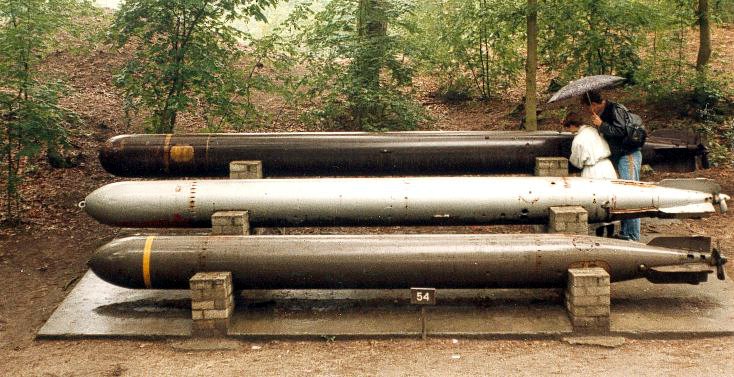
As primary armament, the Type IX possessed four bow tubes and two stern tubes all of 533 mm (21 in). They carried a total of G7e torpedoes were carried. The G7e type was electric, Electric with Lead-acid batteries. It was 7.16 m (23.5 ft) in length. The type carried was the first, called T2 and introduced in 1936. It can reach a target at 3000 m, running at 30 knots (56 km/h). This was not impressive as the submarine had no chance hitting a destroyer, cruisers or the new fast battleships.
The TII variant was less reliable and performed unpredictably compared to the G7a(TI), with shorter range of 5,000 m (5,500 yd) and slower speed at 56 km/h (30 kn).
The IXC completed in 1942 could also have the luck of bring provided with the G7e(TIII) that was just introduced at the time: These improved upon the range of the TII with new batteries and swapped the faulty exploders from December 1942 for more reliable magnetic pistol. Range remained at 5,000 m (2.7 nmi) and tons of defects had been ironed out. This was a very reliable weapon at last and it was furyther improved during the war:
TIIIa Range of 7,500 m (4.0 nmi), 30 kn (56 km/h) max: Wet-heater torpedo only used at night for the rest of the war. They coukd detonate reliably under the keel of a ship.
FaT – G7e(TIII FaT II): Pattern running system (Flächen-Absuch-Torpedo or Federapparat-Torpedo)
LuT – G7e(TIII LuT II) Same, (LageUnabhängiger Torpedo)
Both followed a preset distance before traveling in either a circular or ladder-like pattern through convoy lanes, increasing probability of a hit. Single setting to regulate the length of the prerun and four possible variable settings with different zigzag left/right long or short. However their use was not commonplace, and when operating in wolfpacks, the U-boat had to warn others in the vicinity. The FAT appeared by late-1942 and was used more commonly by March 1943.
TIIId “Dackel”: The long range killer at 57 km (31 nmi) but 9 kn (17 km/h) in this setting, weighting 2,216 kg (4,885 lb). Also a ladder search pattern.
TIIIb: 1,347 kg (2,970 lb) with new propulsion module same as the Neger and Marder
TIIIc: 1,338 kg (2,950 lb) with a bgger payload, 18.5 knots (34.3 km/h) for 4,000 m (2.2 nmi).
TIIIe “Kreuzotter”: Lilely never used on the TypeIX, same payload as the Molch and Seehund, 1,343 kg (2,961 lb), 20 knots (37 km/h) for 7,500 m (4.0 nmi)+.
G7es(TIV) “Falke”: Acoustic variants, for the Type IXC surviving until mid-1943. It ran straight to its arming distance of 1000 m before heading for the loudest noise detected.
G7es(TV) “Zaunkönig”: Introduced by September 1943, improved version. The “GNAT” used small underwater microphones (hydrophones) to listen to the loud noise of a ship’s propellers. It was tuned to home in on the high-frequency sound made by fast-moving propellers. It traveled slower than standard torpedoes at about 24 knots, with a range of roughly 5,700 meters. Early versions could accidentally lock onto the launching U-boat if crews were not super quiet, engines fully stopped. It had however for safety a minimal arming distance.
10.5 cm (4.1 in) SK C/32
Type IXA submarines were given a 10.5 cm (4.13 in) L/45 deck gun placed on a tailored Utof mounting, forward of the conning tower. 110 rounds were carried. These rounds weighted 33.3-pound (15.1 kg), for the HE type. Muzzle velocity of 780 m/s (2,600 ft/s). Range at max elevation optimal, was 15,175 m (16,596 yd). It was able to fire on aircraft at a 10,000 m (11,000 yd) ceiling at max. elevation, manual. Rate of fire was 15 rounds per minute.
10.5 cm (4.1 in) SK C/32 naval gun, 45 calibers long, 1.8 tons, with 180 rounds in store, placed on the forward deck with a 360° traverse and 44.4° up to 80° elevation. It fired a 15.1 kilograms (33 lb) explosive (HE) shell at a 10,300-metre (33,800 ft) ceiling for AA use, while naval range was 15 kilometers (16,000 yd). The gun was enough to at least set on fire, and possibly sink a freighter. More
From mid-1942 onwards some had their 105 cm deck gun omitted, making extra room for AA ammunition. It was recoignized that the U-Boats by that time, with the allies increasing effectiveness, it became futile to waisting time “gunning down” smaller vessels with little strategic importance. Surfacing to play with a deck gun, when most transports and even trawlers were armed, sometimes even heavily, proved the exercize pointless.
3.7 cm/83 SK C/30

37mm FLAK on the aft deck of U-103 training. Note the partial shield, only covering the lower mount.
Unlike the Type VII, the Type IXA had on the aft deck enough space to mount a defensive 3.7 cm/83 SK C/30 straight away, providing welcome AA defensive power. This ordnance was introduced in 1934. However it was not systematically fitted and often was installed in the course of the war.
Specs:
536 lbs. (243 kg), Barrel Length 121 in (3.074 m). Mount: Ubts LC/39 -10/+90 degrees
Shells HE-T: 4.63 lbs. (2.1 kg), mv 3,281 fps (1,000 mps).
ROF about 30 rounds per minute. Probably 1,200 rounds on board.
Useful range 9,300 yards (8,500 m) at 45° up to 22,310 feet (6,800 m) ceiling.
More
2 cm/65 Flak C/30 AA
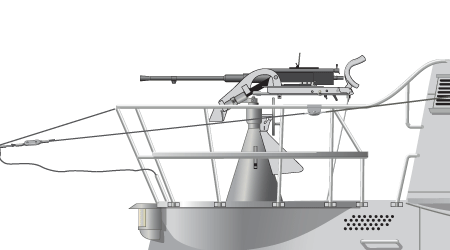 According to Conway’s, either a 2 cm Flak 30/38 or a 3.7 cm SK C/30 FLAK gun was mounted in the kiosk’s aft bathtub platform (“120 mm C30”, probably typo). They had a maximum range of 4,900 metres (5,400 yd), reduced in practice to 3,700 m against fast-moving aerial targets. Rate of fire was 280 rounds a minute at a muzzle velocity of 835 m/s (2,740 ft/s). 2cm Rounds weighed 0.71 pounds (0.32 kg). More.
Four variations appeared:
-Single mount on the 1st level of the CT aft platform (standard at completion)
-Two single mounts side by side on the 1st level of the CT aft platform (1942 completion or upgrades)
-Two twin mounts side by side on the 1st level of the CT aft platform (1943 completion or upgrades)
-Single quad mount (Flakvierling) on the 1st level of the CT aft platform (1944 completion or upgrades)
In all these cases the 37 mm FLAK C/38 was located on the “wintergarten”, the extension platform aft of the conning tower.
Mines
The Type IXa could also be fitted with 44 instead of 24 TMA mines as in the Type IXA. Not all IXs boats were fitted for minelaying with the Type IXC being the first really optimized for these missions.
-The German TMA was a moored mine, which floated above the surface, and could be carried and launched from each torpedo tube, so twelve total, plus 32 reloads. They were small enough to be fitted in the tubes, with a diameter of 11.1ft (3.38m)/21in (533mm), and could be moored down to a maximum Depth of 270m, and carrying a warhead of 215 kg.
Sensors
Gruppenhorchgerät
In short, the GHG was the first efficient German sonar to be widespread.
Range: 20 km to individual ships, 100 km against Convoy
Search area: 2 × 140° at <1 ° at 6 kHz, 1.5° for 3 kHz, 4° for 1 kHz and 8° without filter.
It's possible the first U-Boat completed in 1939 had instead the polder Atlas hydrophones due to shortages.
For radars, none was installed before much later in the war. They will be covered on the next IX sub-variant installements.
Improvements
It concerned merely sensors and A upgrades:
1941-1942, saw more equipped with the FuMO 29 radar and until 1943, the FuMB 1 Metox ECM suite was installed, then by 1944 they had the upgraded 37mm/69 FlaK M/42 installed aft as well as a modified wintergarten aft of the CT to mount a Flakvierling (quad) 20mm/65 C/38 pount or in alternative two twin 20mm/65 C/38 in superfiring positons, or two single 20mm/65 C/38 instad of a single one, also in superfiring positions. They looked “armed to the teeth” with no less than four mounts on deck with their deck gun forward. Others by 1944 also received the FuMB 3 Bali, and improved FuMB 6 Palau ECM suites and the rare still around in 1945 had the FuMO 61 radar installed.
Appearance
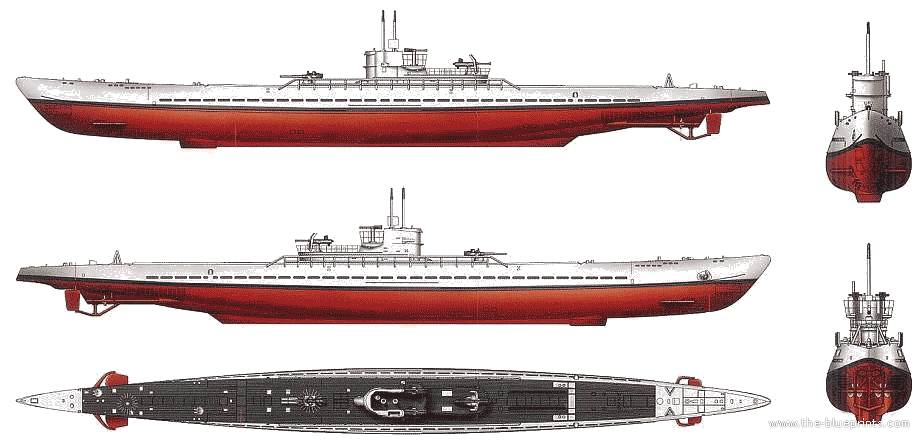
A 3-view of a late Type IXC. Note the “wintergarten”, the large, low aft AA deck and two periscopes proper to the serie.


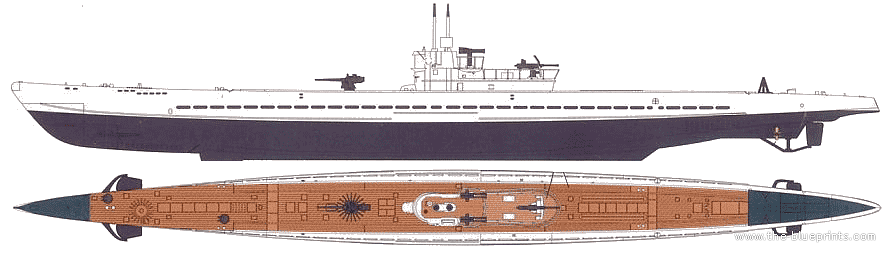
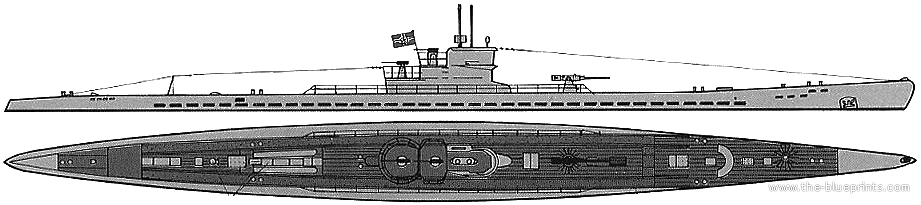
Various IXC schemes from the web, pinterest and the bluepints. New Profiles underway for the next carrer update.
⚙ Type IXC specifications |
|
| Displacement | 1,120 t surfaced, 1,232 t submerged |
| Dimensions | 76.80 x 6.76 x 4.70 m (252 ft x 22 ft 2 in x 15 ft 5 in) |
| Propulsion | 2x MAN M 9 V 40/46 diesels 4,300 shp (3,200 kW), 2x SSW 2 GU 345/34 EM 986 shp (735 kW) |
| Speed | 18.2 kts surfaced, 7.3 knots submerged |
| Range | 208 tonnes fuel: 14,350 nmi/10 knots surfaced, 63 nmi/4 knots submerged |
| Armament | 6× TTs (4 bow, 2 stern)/22 total, 10.5 cm SK C/32 naval gun (180), 1x 37mm AA, 1x 20mm AA |
| Max depth | As Type IXA/B: 150 m (492 ft 2 in) |
| Sensors | See notes, GH sonar, radars and ECM later. |
| Crew | 48-56 |
Career of the Type IXB
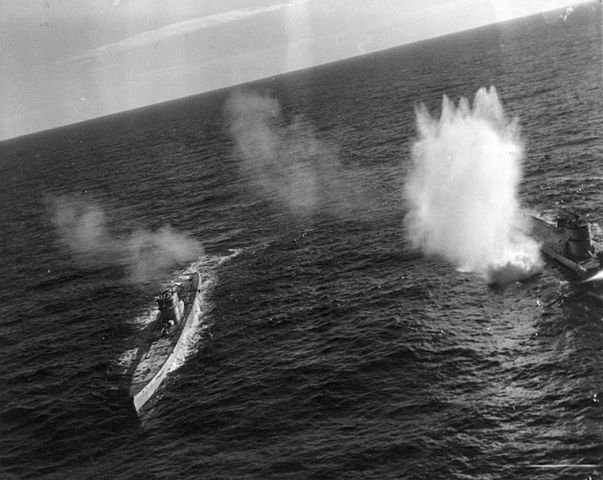
U-66 (IXC lead boat) and U-177 (VIIC) attacked by allied aviation.
The Type IXC were completed after the fall of France so only a fraction operated from Wilhelmshaven, most moved to Lorient and other bases on the Atlantic coast of France. Commissioned until July 1942 they operated in the end tail of the “second happy time” and generally had less success than the Type IXB boat for boat. The latter was the most successful of all sub-class due to its early commitment in the war. Still as said in intro, they sunk collectively a fairly impressive tonnage amount of 5.1 million gross register tons (GRT), almost 100,000 GRT on average per boat with U-66 as champion. Compared to their displacement, this means 4,400 times their own standart tonnage.
Let’s cite some Type IXC aces:
-Karl-Friedrich Merten: 5 sorties, 27 ships sunk (170,151 tons) on U-68 (IXC).
-Georg Lassen: 4 sorties, 26 ships (156,082 tons) on U-160 (IXC).
-Werner Henke: 7 sorties, 24 ships (155,714 tons) on U-515 (IXC).
-Carl Emmermann: 5 sorties, 26 ships (152,080 tons) on U-172 (IXC).
-Ernst Kals: 5 sorties, 20 ships for 145,656 tons on U-130 (IXC)
-Adolf Cornelius Piening: 8 sorties, 25 ships for 126,664 tons on U-155 (IXC)
-Helmut Witte: 4 sorties, 23 ships for 119,554 tons on U-159 (IXC).
-Ernst Bauer: 5 sorties and 25 (118,560 tons) on U-126 (IXC)
-Reinhard Hardegen: 5 sorties, 22 ships (115,656 tons) on U-123 (partly) (IXC)
-Robert-Richard Zapp: 5 sorties, 16 ships (106,200 tons) partly on U-66 (IXC).
-Erwin Rostin: 2 sorties, 17 ships (101,321 tons) on U-158 (IXC)
-Hans-Ludwig Witt: 3 sorties, 19 ships (100,773 tons) on U-129 and U-166 (IXC)
-Werner Hartenstein: 5 sorties, 20 ships for 97,504 tons on U-156 (IXC)
-Karl-Heinz Moehle: 10 sorties, 21 ships 93,197 tons partly on U-123 (IXC)
-Hans-Georg Friedrich Poske: 4 ships for 16 ships and 85,299 tons on U-504 (IXC)
-Ulrich Heyse: 5 sorties and 12 ships for 83,639 tons on U-37 and U-128 (IXC)
-Ulrich Folkers: 5 sorties and 17 ships for 82,873 tons on U-37 and U-125 (IXC)
-Jürgen Wattenberg: 3 sorties and 14 ships for 82,027 tons on U-162 (IXC)
-Jürgen von Rosenstiel: 4 sorties and 14 ships for 78,843 tons on U-502 (IXC).
Note: The be updated over time.
 U-66
U-66

U-66 was laid down under hull n°985 at Deschimag, Bremen in March 1940, launched on 10 October 1940, and commissioned in January 1941. She entered servive under command of Kptlt./K.Kapt. Richard Zapp until 21 June 1942. She trained until May 1941, and made 9 combat patrols, sining 33 ships for 200,000 GRT. She would also damage two MTBs in a gun fight ending as the 7th best U-Boat of the war.
U66 was sunk 6.5.1944 by American destroyer escort Buckley and Avenger of VC-55 sqn from escort carrier Block Island W off Cape Verde.
U-67

U67 was laid down under hull number 986 at Deschimag, Bremen on March 1940, launched on 30 October 1940, Commissioned 1941 under Korvettenkapitän Heinrich Bleichrodt and started training with the 2nd U-boat Flotilla, operational and starting patrols from 1 September 1941. She made seven patrols, sank 13 ships for 72,138 GRT, damaged five for 29,726 GRT, with three wolfpacks. Her first patrols commenced with a trip from Bergen in Norway, to Lorient for the rest of her career. U67 was sunk 16.7.1943 in her 7th patrol by Avenger from American escort carrier USS Core in the Central Atlantic, E off Bermuda. There were 3 survivors.
U-68
U68 was laid down under hull number 987 at Deschimag, Bremen on August 1940, launched on 22.10.1940, and commissioned 2.1941.
U68 was sunk 10.4.1944 by Avengers and Wildcats from American escort carrier Guadalcanal in the Central Atlantic, NW off Madeira.
U-125
U125 was laid down under hull number 988 at Deschimag, Bremen in May 1940, launched on 10.12.1940, and commissioned 3/1941.
U125 was sunk 6.5.1943 by British destroyer Oribi and corvette Snowflake NE off Newfoundland.
U-126
U126 was laid down under hull number 989 at Deschimag, Bremen in June 1940, launched on 31.12.1940, and commissioned 3/1941.
U126 was sunk 3.7.1943 by Wellington of 172nd RAF sqn NW off Cape Ortegal, Spain.
U-127
U127 was laid down under hull number 990 at Deschimag, Bremen in June 1940, launched on 4.2.1941, and commissioned 4/1941.
U127 was sunk 15.12.1941 by Australian destroyer Nestor W off Gibraltar.
U-128

U128 was laid down under hull number 991 at Deschimag, Bremen in July 1940, launched on 20.2.1941, and commissioned 5/1941.
U128 16.5.1943 was damaged by Mariners of VP-72 USN sqn off Recife (Brazil) and at approach off American destroyers Moffett and Jouett scuttled by crew.
U-129
U129 was laid down under hull number 992 at Deschimag, Bremen in July 1940, launched on 28.2.1941, and commissioned 5/1941.
U129 was stricken in August, 1944; on reparations she was transferred to France and broken up.
U-130
U130 was laid down under hull number 993 at Deschimag, Bremen in August 1940, launched on 14.3.1941, and commissioned 6/1941.
U130 was sunk 12.3.1943 by American destroyer Champlin W off Azores.
U-131
U131 was laid down under hull number 994 at Deschimag, Bremen in September 1940, launched on 1.4.1941, and commissioned 7/1941.
U131 was sunk 17.12.1941 by British escort destroyers Exmoor, Blankney, destroyer Stanley, corvette Pentstemon, sloop Stork and Martlet fighter of 802nd FAA sqn (escort carrier Audacity) in the Central Atlantic, NE off Madeira.
U-153
U153 was laid down under hull number 995 at Deschimag, Bremen in September 1940, launched on 5.4.1941, and commissioned 7/1941.
U153 was sunk 13.7.1943 by American destroyer Lansdowne in Caribbean sea at approaches to Panama canal.
U-154
U154 was laid down under hull number 996 at Deschimag, Bremen, September 1940, launched on 21.4.1941, and commissioned 8/1941.
U154 was sunk 3.7.1944 by American escort destroyers Inch and Frost in the central Atlantic NW off Madeira.
U-155
U155 was laid down under hull number 997 at Deschimag, Bremen in October 1940, launched on 12.5.1941, and commissioned 8/1941. She was one of the rare to surrender in May 1945, scuttled 21 December 1945.
U-156

U156 was laid down under hull number 998 at Deschimag, Bremen in October 1940, launched on 21.5.1941, and commissioned 9/1941.
U156 was sunk 8.3.43 by Catalina of VP-53 USN sqn E off Barbados.
U-157
U157 was laid down under hull number 999 at Deschimag, Bremen in October 1940, launched on 5.6.1941, and commissioned 9/1941.
U157 was sunk 13.6.1942 by American Coast Guard cutter Thetis NE off Havana (Cuba).
U-158
U158 was laid down under hull number 1000 at Deschimag, Bremen on November 1940, launched on 21.6.1941, and commissioned 9/1941.
U158 was sunk 30.6.1942 by Mariner of USN VP-74 sqn W off Bermuda.
U-159

U159 was laid down under hull number 1009 at Deschimag, Bremen in November 1940, launched on 1.7.1941, and commissioned 10/1941.
U159 was sunk 28.7.1943 by Mariner of VP-32 USN sqn NE off Haiti.
U-160
U160 was laid down under hull number 1010 at Deschimag, Bremen in November 1940, launched on 12.7.1941, and commissioned 10/1941.
U160 was sunk 14.7.1943 by Avengers and Wildcats from American escort carrier Santee S off Azores.
U-161

U161 was laid down under hull number 700 at Deschimag, Seebeck in March 1940, launched on 1.3.1941, and commissioned 7/1941.
U161 was sunk 27.9.1943 by Mariner of VP-74 USN sqn at coast of Brazil off Salvador.
U-162
U162 was laid down under hull number 701 at Deschimag, Seebeck in April 1940, launched on 1.3.1941, and commissioned 9/1941.
U162 was sunk 3.9.1942 by British destroyers Vimy, Pathfinder and Quentin NE off Trinidad.
U-163
U163 was laid down under hull number 702 at Deschimag, Seebeck in May 1940, launched on 1.5.1941, and commissioned 10/1941.
U163 was sunk 13.3.1943 by Canadian corvette Prescott in Northern Atlantic NW off Cape Finisterre.
U-164
U164 was laid down under hull number 703 at Deschimag, Seebeck in June 1940, launched on 1.5.1941, and commissioned 11/1941.
U164 was sunk 6.1.1943 by Catalina of VP-83 USN sqn at coast of Brazil off Fortaleza.
U-165
U165 was laid down under hull number 704 at Deschimag, Seebeck in August 1940, launched on 15.8.1941, and commissioned 2/1942.
U165 was lost, presumably, 27.9.1942 on British aviation mine at Lorient.
U-166
U166 was laid down under hull number 705 at Deschimag, Seebeck in December 1940, launched on 1.11.1941, and commissioned 3/1942.
U166 was sunk 1.8.1942 by Widgeon of 212th USCG sqn S off New Orleans.
U-171
U171 was laid down under hull number 1011 at Deschimag, Bremen in December 1940, launched on 22.7.1941, and commissioned 10/1941.
U171 was lost 9.10.1942 on British aviation mine at Lorient.
U-172

U172 was laid down under hull number 1012 at Deschimag, Bremen in December 1940, launched on 5.8.1941, and commissioned 11/1941.
U172 was sunk 13.12.1943 by American destroyers George E. Badger, Clemson, Osmond Ingram, Dupont and Avenger of VC-19 sqn from escort carrier Bogue SW off Canary islands.
U-173
U173 was laid down under hull number 1013 at Deschimag, Bremen in December 1940, launched on 11.8.1941, and commissioned 11/1941.
U173 was sunk 16.11.1942 by American destroyers Woolsey, Swanson, Quick W off Casablanca.
U-174
U174 was laid down under hull number 1014 at Deschimag, Bremen in Januray 1941, launched on 21.8.1941, and commissioned 11/1941.
U174 was sunk 27.4.1943 by Ventura of VP-125 USN sqn E off Newfoundland.
U-175

U175 was laid down under hull number 1015 at Deschimag, Bremen in January 1941, launched on 2.9.1941, and commissioned 12/1941.
U175 was sunk 17.4.1943 by American Coast Guard cutter Thetis in Northern Atlantic W off Brest.
U-176
U176 was laid down under hull number 1016 at Deschimag, Bremen in February 1941, launched on 12.9.1941, and commissioned 12/1941.
U176 was sunk 15.5.1943 by Cuban submarine chaser CS13 and Kingfisher of USN VP-62 sqn E off Havana (Cuba).
U-501
U501 was laid down under hull number 291 at Deutsche Werft, Hamburg in February 1940, launched on 25.1.1941, and commissioned 4/1941.
501 was sunk 10.9.1941 by Canadian corvettes Chambly and Moosejaw at Angmagsalik, Greenland.
U-502
U502 was laid down under hull number 292 at Deutsche Werft, Hamburg in April 1940, launched on 18.2.1941, and commissioned 5/1941.
U502 was sunk 6.7.1942 by Wellington of 172nd RAF sqn in Bay at Biscay at La Rochelle.
U-503
U503 was laid down under hull number 293 at Deutsche Werft, Hamburg in April 1940, launched on 5.4.1941, and commissioned 7/1941.
U503 was sunk 15.3.1942 by Hudson of USN VP-82 sqn in Northern Atlantic SE off Newfoundland.
U-504
U504 was laid down under hull number 294 at Deutsche Werft, Hamburg in April 1940, launched on 24.4.1941, and commissioned 7/1941.
U504 was sunk 30.7.1943 by British sloops Kite, Wild Goose, Wren and Woodpecker in Northern Atlantic NW off Cape Finisterre.
U-505

U505 was laid down under hull number 295 at Deutsche Werft, Hamburg in June 1940, launched on 24.5.1941, and commissioned 8/1941.
She survived: On 4 June 1944 was damaged by American escort destroyer Chatelain and air group of escort carrier Guadalcanal NW off Dakar, captured by American escort destroyer Pillsbury and commissioned by USN as Nemo; since 1955 she is used as a museum.
U-506
U506 was laid down under hull number 296 at Deutsche Werft, Hamburg in July 1940, launched on 20.6.1941, and commissioned 9/1941.
U506 was sunk 12.7.1943 by Liberator of 1st USAF ASW sqn W off Vigo.
U-507
U507 was laid down under hull number 303 at Deutsche Werft, Hamburg in September 1940, launched on 15.7.1941, and commissioned 10/1941.
U507 was sunk 13.1.1943 by Catalina of USN VP-83 sqn at coast of Brazil NW off Fortaleza.
U-508
U508 was laid down under hull number 304 at Deutsche Werft, Hamburg in September 1940, launched on 30.7.1941, and commissioned 10/1941.
U508 was sunk 12.11.1943 by Liberator of USN VP-103 sqn in the Bay of Biscay.
U-509
U509 was laid down under hull number 305 at Deutsche Werft, Hamburg in November 1940, launched on 19.8.1941, and commissioned 11/1941.
U509 was sunk 15.7.1943 by Avengers and Wildcats from American escort carrier Santee SE off Azores.
U-510
U510 was laid down under hull number 306 at Deutsche Werft, Hamburg in November 1940, launched on 4.9.1941, and commissioned 11/1941.
She surrendered on May 1945, assigned to France 5.1945 (Bouan).
U-511
U511 was laid down under hull number 307 at Deutsche Werft, Hamburg in January 1941, launched on 22.9.1941, and commissioned 12/1941. To Japan.9.1943 as 呂500 [RO500] U511 was stricken 16.9.1943 and transferred at Kure to IJN as RO500, surrendered in August 1945 and 30.4.1946 was scuttled by Americans off Maizuru.
U-512
U512 was laid down under hull number 308 at Deutsche Werft, Hamburg in February 1941, launched on 9.10.1941, and commissioned 12/1941.
U512 was sunk 2.10.1942 by Digby of 99th USAF sqn at coast of Surinam.
U-513
U513 was laid down under hull number 309 at Deutsche Werft, Hamburg in April 1941, launched on 29.10.1941, and commissioned 1/1942.
U513 was sunk 19.7.1943 by Mariner of USN VP74 sqn at coast of Brazil NE off Rio de Janeiro.
U-514
U514 was laid down under hull number 310 at Deutsche Werft, Hamburg in April 1941, launched on 18.11.1941, and commissioned 1/1942.
U514 was sunk 8.7.1943 by Liberator of 224th RAF sqn in the Bay of Biscay.
U-515
U515 was laid down under hull number 311 at Deutsche Werft, Hamburg in May 1941, launched on 2.12.1941, and commissioned 2/1942.
U515 was sunk 9.4.1944 by American escort destroyers Pope, Pillsbury, Flaherty, Chatelain and Avengers of USN VC-58 sqn from escort carrier Guadalcanal in the Central Atlantic NE off Madeira.
U-516

U516 was laid down under hull number 312 at Deutsche Werft, Hamburg in May 1941, launched on 16.12.1941, and commissioned 3/1942. She surrendered on 14 May 1945, scuttled 3 January 1946
U-517
U517 was laid down under hull number 313 at Deutsche Werft, Hamburg in June 1941, launched on 30.12.1941, and commissioned 3/1942. U517 was sunk 21.11.1942 by Albacore of 817th FAA sqn from aircraft carrier Victorious SW off Ireland.
U-518
U518 was laid down under hull number 314 at Deutsche Werft, Hamburg in June 1941, launched on 11.2.1942, and commissioned 4/1942. U518 was sunk 22.4.1945 by American escort destroyers Carter and Neal A. Scott NW off Azores.
U-519
U519 was laid down under hull number 315 at Deutsche Werft, Hamburg in June 1941, launched on 12.2.1942, and commissioned 5/1942. U519 after 30.1.1943 was lost in the Bay of Biscay.
U-520
U520 was laid down under hull number 316 at Deutsche Werft, Hamburg in July 1941, launched on 2.3.1942, and commissioned 5/1942. U520 was sunk 30.10.1942 by Digby of 10th RCAF sqn E off Newfoundland.
U-521
U521 was laid down under hull number 317 at Deutsche Werft, Hamburg in July 1941, launched on 17.3.1942, and commissioned 6/1942. U521 was sunk 2.6.1943 by American patrol craft PC565 at US coast NE off Norfolk.
U-522
U522 was laid down under hull number 318 at Deutsche Werft, Hamburg in July 1941, launched on 1.4.1942, and commissioned 6/1942.
U522 was sunk 23.2.1943 by British sloop Totland S off Azores.
U-523
U523 was laid down under hull number 319 at Deutsche Werft, Hamburg in August 1941, launched on 15.4.1942, and commissioned 6/1942.
U523 was sunk 25.8.1943 by British corvette Wallflower and destroyer Wanderer W off Vigo.
U-524
U524 was laid down under hull number 320 at Deutsche Werft, Hamburg in August 1941, launched on 30.4.1942, and commissioned 7/1942.
U524 was sunk 22.3.1943 by Liberator of 1st USAF ASW sqn in the Central Atlantic S off Madeira.
The U-505 Chicago Display

Read More/Src
Books
Bishop, Chris (2002). The Encyclopedia of Weapons of WWII: The Comprehensive Guide to Over 1,500 Weapons System… Sterling Publishing Co.
Busch, Rainer & Röll, Hans-Joachim (1997). Der U-Bootbau auf deutschen Werften. Der U-Boot-Krieg (in German). Vol. II. Mittler.
Gröner, Erich; Jung, Dieter & Maass, Martin (1991). U-boats and mine warfare vessels. German Warships 1815–1945. Vol. 2. Conway Maritime Press.
John Gardiner, Conways’s all the world’s fighting ships 1922-47
Links
uboatarchive.net Design Studies Type IXC
uboat.net – Type IXC
on navweaps.com/
en.wikipedia.org Type_IXC_submarine
de.wikipedia.org U-Boot-Klasse_IX
uboataces.com uboat-type-ix.shtml
kbismarck.com utypen.htm#ixc
scribd.com German-U-Boat-Colors-Markings
web.archive.org navypedia.org ger_ss_ixb.htm
uboat.net/ /ix.htm
uboataces.com uboat-type-ix
uboat.net/ hall of fame
U889 on rnsubs.co.uk
quora.com German Type IXC comparison with Japanese subs
quora.com Balao vs IXC
communitystories.ca/ internal arrangements
pinterest.com/ type-ixc-uboat gallery
commons.wikimedia.org/
the-blueprints.com/
Model Kits
on modelingmadness.com
on scalemates.com/ hobbyboss kit IXC
commons.wikimedia.org
Model Kit: ICM S011 German IIWW Submarine U-Boat Type IXC 1