

 KuK Kriegsmarine Submarine: SMS U3, U4 (1909)
The Austro-Hungarian Empire developed U-Boats prior and during WWI. The first U1 sereie was derived from plans of US naval engineer Thomas Lake. But they were criticized for their weak gasoline engines and long, complicated diving procedures and were relegated to training in Pola until January 1918. The naval staff however ordered the next two from Germaniawerft, allowing to test the latest technological advance of this country. U3 and U4 issued in 1908 had a double hull and internal ballasts. Testing showed however excessive design problems so much so they had to be partly refitted and rebuilt. Despite of this being that unsatisfactory unlike the U1 class they were widely used during the war: U3 was sunk by French destroyer Bisson after a failed attack of Città di Catania, and after being rammed and forced to surface in August 1915. U4 sank the cruiser Giuseppe Garibaldi on July 18, 1915 and many other ships. She was ceded to France in 1919 and demolished in 1920.
Development
 By 1904 the Austro-Hungarian Navy wanted an edge for the Adriatic, and had a powerful, albeit small “sample” fleet with a few pre-dreadnoughts, all types of cruisers, and torpedo boats, but no submarines. The staff of the Marinesection in Vienna, was fully aware of foreign naval developments, through publications like Brasseys and Janes about notably submarine developments in the US, Lake and Holland and saw USS Holland commissioned with positive reviews, with Britain announcing the purchase of the licence to start its own series. The same year Vice-Admiral Count Rudolf Montecuccoli (still in office by 1914) just created the Austrian Naval League in September to help voting new projects.
However initialy he doubt submersibles could be of any use in the shallow waters of the Adriatic based on recent hydrographic works back in the 1870s. Plus they were costly and complex to operate and needed a much better trained crew. As usual parliament (Országgyűlés) consulted on this, had its Hungarian half dragging its feet that this prospect. To topple it off, many in the naval staff doubted of the typ based on the reluctance of neighbouring Alfred von Tirpitz, highly dubious of these, versus Prince Henry of Prussia and his clique. Plus Montecucoli wanted no diverted funds from his ambitious expansion program. If there was something to change the status quo, it was Italy which already had its first operational submarines, Delfino tested from 1892, and the mosr ambitious and much larger Glauco in construction for a launch planned in 1905.
The KMT Competition (1904-1906)
Still in 1904 Generalschiffbauingenieur Siegfried Popper (the Navy chief engineer, equivalent to the British DNC), ordered the Naval Technical Committee (MTK) to look for an existing design to purchase and evaluate the nenefit of submarines for the Navy. There was a competition based on specifications published on 17 January 1905. Eventually the committee retained three proposals and a pait of submarines was to be built from each. Domestic proposals were soon rejected. Further technical definitions delayed further proposals into late 1905 and in between Montecuccoli secured these though his new naval plan approved in early 1905 (12 battleships, 4 armored cruisers, 8 scout cruisers, 18 destroyers, 36 high seas TBs and 6 submarines).
One of the accepted proposals was from Simon Lake. All these six subs, were to compete against each other to determine the best design for local production. Base specs were 22.1 meters (72 ft 6 in) for 3.6 meters (11 ft 10 in) and 4.37 meters (14 ft 4 in) draft and 134.5 metric tons surfaced, but Simon Lake, Germaniawerft, and John Philip Holland which took part all denounced the specifications as “unrealistic”. Hence the revision to larger designs. So U-1 and U-2 would be a Simon Lake design (from Bridgeport, Connecticut) with plans formalized in 1906 and a contract signed on 24 November 1906.
The second proposal (for U3 and U4) were the Germaniawerft design in Germany, the subject of this article. The Navy authorized U-3 and U-4 from Germaniawerft Shipyard in Kiel by 1906. Their proposal was an improved U1 (the German one) but featured a double hull with internal saddle tanks and having an improved hull shape through extensive model trials. At that time, they worked both for this only export customer (apart Russia previously) and their own U-Boote arm, in the shadow of a still reluctant Von Tirpitz.
Design of the class
U3 was ordered on 24 November 1906, but laid down on 12 March (earlier than U1 in July) but construction took time. Launched in August 1908 U3 was commissioned in Commissioned by September 1909, so much earlier than the U1 class (June 1911). Comparative tests were not possible before 1910. As said above, German Engineers took their own SM. U1 as a base and greatly improved the hull design to compete against Lake and Holland boats that were famous for their underwater prowesses. However the design philosophy behind U1 and follow-up U-Boats was very different. They were more in line with French designs, of “submersible torpedo boats”, with better thought out surface running performances and cruising range rather than trying to achieve the best performances underwater. However given the competition and willing to obtain the big contract for the next serie in Austria-Hungary, engineers took care more to their underwater performances, traduced into model trials and many calculations. All this data also was useful for the next class of German U-Boats as well.
Hull and general design
The U2 class displaced 240 tonnes (260 short tons) surfaced, 300 tonnes (330 short tons) submerged (230/248t for U1) for an overall lenght of 138 feet 9 inches (43.20 m) or 42.30 at the waterline, by 14 feet (3.65 m) abeam and had a draft of 12 feet 6 inches (2.8 and 3.81 m max), so they were much longer than Lake’s “fatty” U1 design (30.48 x 4.8 x 3.85 m). As it appear there, their were much longer while bein narrower, which translated into a much better hull ratio to fully exploit German engines to achieve the best possible surface speed. They were the largest of all three designs (U1, U3 and U5).
Like the U1 they were double hull models, against the previous MTK advice, and featured saddle tanks, typical of Germaniawerft.
They were also less complicated and more straithforward than the ambitious U1 class or Lake design which featured diving chamber as well as wheels for traveling along the seabed for exploration. Germaniawerft like Holland boats had nothing like it their design. Of the three she was the longest, perhaps best balanced for speed. For detailed description see U1 as they were closely related. They were typical of German designs of the time, with a straight stem, at the end of a boat like forward section but two large ballast stctuctures lower than the deck, practically at waterline level, and an “aerial rudder” aft, with the end of the hull shaped as a duck tail.
The cross-shaped rudder and aft diving planes were below. There were also protective bars. The design featured also two underwater diving planes. The small conning tower was surrounded by a fairing and the single persicope was located aft of it plus a mast. Unlike other U-Boats the helmsan post was located aft of the CT, not before it. There was a very small platform, barely for the helmsman and two watch officers to stand from, but this was a useful raised position. For diving there were long water scoop apertures above the ballast. The prow was raised forward on a short distance for better seakeeping.
Powerplant
These U-Boats were not only the largest in the whole group, they also were the best performing, but featured two fixed pitch propellers, not variable like in the Lake boats. U3 and U4 were given the best engines at the time, Körting Kerosene (or parraffin) engines, meaning gasoline, for surface running. Each was rated for 300 bhp (220 kW). This was completed by two 160 hp electric motors while submerged. This made for a total of 600 bhp (450 kW), less than the Lake’s 720 bhp (540 kW) or even its electric motors rated for 200 bhp (150 kW) other sources stating 340 hp. However the Korting paraffin models proved equally troublesome. These gasoline units procured however a far better speed when surfaced at 12 knots (22 km/h) versus 10.3 knots for the Lake design, and underwater 8.5 knots (15.7 km/h) versus 6 knots on the Lake design. So with less power, German engineers showed they known how to design a hull and obtain much fasrter speed and beating both Lake and Holland on their own game.
To boot, they featured a far better operational range. To the meagre 950 nautical miles (1,760 km; 1,090 mi) at 6 knots surfaced of the Lake boats they opposed 1,200 nmi (2,200 km) at 12 knots (22 km/h), so about 3-4 times better. Underwater they were still good, in fact they did better again at 40 nmi (74 km; 46 mi) at 3 knots (5.6 km/h) versus 2 knots on the Lake boats. Anoter sources states 45 nm at 3 knots.
They could dive about the same or less, roughly 30 meters (90 ft).
Armament
Both were armed with three 45-centimeter (17.7 in) torpedo tubes: Two were in the bow, one in the stern (which was rare back in 1906) and they had enough internal space for tow spares forward, so in addition to those in tubes, five total. However in general they only carried three. There was initially no deck guns planned. None was include in their 1914-15 refit but by 1917 a 37-millimeter (1.5 in) gun on a pintle was was bolted on deck of both boats, but removed in January 1918 when declared obsolete and back to training.
45 cm torpedoes
The model could be either Mark I or “Torpedo Fiume 1906” made locally at that time, having the same general caracteristics as the Whitehead Mark I, or more likely, the US 45-centimeter (17.7-inch) Bliss-Leavitt Mark 2 with a Compressed air reciprocating and dry-heater. It’s dubious for logistic reasons tha would have received Schwarzkopf models.
Specs:
1,900 lbs. (862 kg), body 197 in (5.004 m)
Warhead Mod 0: 207 lbs. (94 kg) wet gun-cotton, percussion or Mod 1 183 lbs. (83 kg) wet gun-cotton.
Two-stage turbine engine, alcohol fired dry heaters: Range/Speed 3,500 yards (3,200 m) at 26 knots.
Guidance: Mark 5 gyro.
⚙ U3 specifications |
|
| Displacement | 240t standard, 300t FL |
| Dimensions | 42.3m long oa, 4.3m beam, 3.81 draft. |
| Propulsion | 2 shafts Ker. engines 600 hp+ 2x EM 320 hp electric motors |
| Speed | 12 kts surfaced, 8.5 kts underwater. |
| Range | 1200 nm at 12 kts surfaced, 40 nm/3 kts underwater |
| Armament | 2x 45 cm TTs bow (3) |
| Max depth | 50+ meters (150 ft) |
| Crew | 21 |
An active Career unlike the U1 class
Modernization
In 1915, U4 saw the addition of a 37mm/20 SFK L/23 Hotchkiss deck gun (see U1) and in 1917, U4 had the same replaced by a 66mm/24 G. L/26 K.15 BAK.
The latter was a low-powered dual-purpose and anti-balloon/anti-aircraft weapon introduced by Škoda in 1915 for river monitors.
Specifications: Caliber/Bore: 6.6 cm (actual bore diameter 2.6 inches, commonly referred to as a 7 cm class gun).
Barrel Length: 26 calibers (L/26).
Designation Breakdown:G: Gewehr or gun type.
L/26: Barrel length relative to caliber.
K.15: Kanone introduced/produced in 1915 (Kanonenjahr 1915).
BAK: Ballon-Abwehr-Kanone (anti-balloon/anti-aircraft cannon).
Mass: Gun barrel/mass approx. 220 kg (490 lb).
SMS U3 (1909)

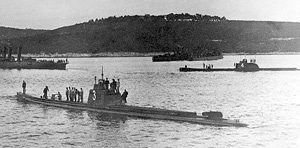
U3 underway on trials showing her CT – postcard, 1909,
SM U-3 was laid down on 12 March 1907 at Germaniawerft in Kiel (werk 135), launched on 20 August 1908 and after completion, towed from Germany through the channel, and then via Gibraltar to Pola, where she arrived on 24 January 1909. She was commissioned on 12 September. During her evaluation her poor diving and handling characteristics were noted, in contrast to her great speed. To alleviate the diving problem common to the Lake boat, U-3 was modified in drydock: Her fins were changed in size, reshape for more test, until they were removed entirely, with a simpler stationary stern flap was affixed to the hull instead. U-3 became a career as training boat between 1910 and 1914. She made ten cruises per month on average, shaping a new generation of submariners. When World War I started she was one of only four operational submarines for the whole Austro-Hungarian Navy. From 22 August 1914, she changed base for Brioni, from which she started a series of reconnaissance cruises, and a month later from Cattaro. In April 1915, like U4 she had a 3.7-centimeter (1.5 in) quick firing (QF) Hotchkiss deck gun added.
On 10 August, U-3 departed from Cattaro for her final patrol north of Brindisi. Two days later, while underway after an uneventful patrol from the Straits of Otranto, she spotted the Italian armed merchant cruiser Citta di Catania. Her torpedoes missed however, while she lost balanced, surfaced, and Citta di Catania, spotted her, changed course, and before U3 was able to dive fully, rammed her. Her periscope were shattered. She then surfaced again onl to be under heavy fire from escorting entente destroyers. She submerged again but the French destroyer Bisson came over her as she attempted to rest on the seabed, dropping depth charge that damaged her. She still remained silent until certain the ships were away and surfaced the following day, only to find Bisson, still waiting for her, detached from the escort group. She opened fire and completely devastated U3, now unable to dive. A white flag was raised and fourteen of her crew were rescued, captured, seven more went down including commander Linienschiffsleutnant Karel Strnad. For her short career, she sank no ship.
SMS U4 (1909)

U4 was ordered in 1906, laid down as hull number 136 at Germaniawerft, Kiel in March 1907, launched on 20 November 1908 and completed in August 1909. Before that, she arrived after fitting out in Pola by April 1909, to be equipped, manned and formally commissioned as SM U-4. The evaluation of the U-3 led to improve her diving and handling characteristics and she obtained the same stationary stern flap affixed to the hull as her sister. U-4 like her was also a training boat between 1910 and 1914, making ten cruises per month on average.
By August 1914 she was one of just four operational submarines and on 27 September she started her first of many reconnaissance cruise from Cattaro under command of Linienschiffsleutnant Hermann Jüstel. On 17 October she spotted a juicy prize, the formidable French armoured cruiser Waldeck-Rousseau, last built by France, fired her two torpedoes but missed. By late November, U-4 spotted, surfaced and seized the 13 GRT Albanian sailing vessel Fiore del Mar as prizen off Montenegro. She received a radio set next month, a crucial asset for her reconnaissance missions.

Lt. Rudolf Singule (right) discussined close to his boat, U-4 at berth at Cattaro (Kotor) in 1915. It’s difficult to assert if her conning tower was fatigued or camouflaged, or both.
Next, she captured three Montenegrin boats on 19 February 1915. She changed skipper for Rudolf Singule, her most successful commander from April ad the same tme she was also equipped with a 3.7-centimeter (1.5 in) quick firing (QF) Hotchkiss deck gun. On 24 May she ventured in the Gulf of Drin and spotted, attacked, but missed Lombardia of the “Regioni” class cruiser. On 9 June, she spotted the recent British scout armoured cruiser HMS Dublin (Town class) escorting a convoy along the Montenegrin coast escorted by six destroyers. This time she was right on target, Dublin was hit by one torpedo off San Giovanni de Medua, with 12 men killed in the impact. However her bulkheads held on and she managed under her own power to reach port for repairs. The 450mm torpedo lacked punch indeed. If hit, Waldeck Rousseau would have likely survived as well.
On 18 July, U-4 spotted an Italian squadron shelling the railroads at Dubrovnik and she soon picked up her best target, the Armoured Cruiser Giuseppe Garibaldi as a target and torpedoed her. The superb 7,234 tons cruiser was hit by the two torpedoes at once this time. She sank with the loss of 53 men and 525 survived and were rescued, it was her greatest success. In August, she was sent to find U-3, overdue. In November, she spotted on patrol the British 3rd class cruiser Topaze of the “gem class”. By early December, she surfaced and attacked two small Albanian vessels in the Gulf of Drin, Papagallo sunk, Gjovadje was taken as a prize. Back home she had a major overhaul and was upgraded again wuth a new German pair of periscopes and a new gyrocompass. On 3 January 1916, she was back in the Gulf of Drin under Lt. Singule so seize the Albanian sailing vessel Halil, sank to two more.
By early February, she spotted and sank the 475 GRT French patrol vessel Jean Bart. It happened 6nm southwest of Cape Laghi close to Durazzo. A few days later she tried to attacked but missed a Birmingham-class cruiser. On 26-27 March, she looked for the overdue U-24. Three days later she sank the British schooner John Pritchard Of Carnar. Instead of torpedoes, she board her, the crew was evacuated and explosive charges were planted. Thish appened off the island of Antipaxos. In July, U-4 saw her 37 mm replaced by a far more capable 66 mm (2.6 in) deck gun designed to destroyer airships.

Giuseppe Garibaldi sinking
On 2 August, U-4 spotted but missed an Italian Nino Bixio-class cruiser. Three days later, she was caught by a British submarine, torpedoed and missed. A week later, she sank Italian schooner Ponte Maria off Brindisi. Later she was the object of another submarine attack. On 14 August she san the steamer Inverbervie off Cape Nau and came back home. She operated two months later, sinking her first ship in this new patrol, the Italian tanker Margaretha on 13 October.
By May 1917, U-4 sank the steamer Perseo, her second largest ship by tonnage in the Ionian Sea. By mid-May 1917, she supported the raid on the Otranto Barrage ending wit the Battle of Otranto Straits. On the night of 14/15 May, she was deployed as a screen boat alongside the cruisers Helgoland, Saida, and Novara attacking drifters and their anti-submarine nets (14 sank, 5 damaged). The destroyers Csepel and Balaton also attacked Italian to and from Valona, sank a destroyer and a munitions ship. U-4 was in ambush off Valona, with two other U-boats to intercept any sortie, with U-27 patrolling between Brindisi and Cattaro and the Kaiserliches Marine’s German UC-25 assigned to mine Brindisi. British cruisers escorted by Italian and French destroyers were spotted on 15 May but she was too far to intercept them. The allies later moved the Barrage farther south and only maintained by day.
U-4 was sent on 30 May off Corfu, the main French advanced base in the area, managing to torpedo and sank the French passenger steamer SS Italia, used as armed boarding ship. On 19 June, she sank in sort succession the French steamers Edouarde Corbière, Cefira, Greek ship Kerkyra, all off Taranto. On 12 July, she torpedoed and sank the French tug Berthilde off Cape Stilo. In September, she received back in port her last upgrade, a new bulwark on her conning tower. She went back from her last patrol on 1 November 1918 never to depart again. She was later ceded to France as a war reparation, but scrapped in 1920. U4 is certainly one of the most successful Austro-Hungarian submarine, sinking a total of 14,928 GRT plus 7,345 tons enemy shipping.
Read More
The German Submarine War, 1914–1918, R. H. Gibson and Maurice Prendergast
Jiri Novak: Austro-Hungarian Submarines in World War I.
Baumgartner, Lothar; Sieche, Erwin (1999). Die Schiffe der k.(u.)k. Kriegsmarine im Bild
Conway’s all the world’s fighting ships 1906-1921.
Links
navypedia.org/
on warhistory.org/ on austro-hungarian-subs
en.wikipedia.org U-3-class
gwpda.org/
uboat.net/