
 Italy (1883) Re Umberto, Sicilia, Sardegna
The Re Umberto considered by some as ironclads, are a departure from “classic” ironclads of the 1880s series, the Duilios (1876), Italia (1880) and Ruggero di Lauria (1884) whih all had their main armament in échelon amidship. The Re Umberto would be the first to embrace the new trend of centerline turrets fore and aft. In addition they will discontinue the use very large guns (432 mm/17 in) which had a slow rate of fire, for faster firing 343 mm (13.5 in) guns, completed by a powerful secondary battery composed of 152 and 120 mm guns. In 1883, the first two ships of this class, Re Umberto and Sicilia, were authorized in parliament by the Finance law. They had been designed by Benedetto Brin, then president of the naval projects committee. In 1885, the parliament also decided to vote for the construction of a third ship, Sardegna, in order to create a complete squadron. They were decommissioned when world war one started, with only Re Ulberto and Sardegna regaining operational status.

Re Umberto served with the two others in the same active squadron for more than 10 years. By 1905 this squadron became the reserve squadron. In fact they were used as training ships as the Italo-Turkish War erupted in 1911. In 1912, Re Umberto career was about to end. She was used as a floating tanker at anchor in Genoa. She was badly damaged in May 1914 and after repairs served as a supply vessel for La Spezia from June 1915. She was reactivated in December 1916, recommissioned and converted into a port defense battery at Brindisi and Valone. In 1918, Re Umberto were once again converted for a final assault of Pola modified to plough through mines and nets like, followed by forty MAS. She was totally disarmed except for eight shielded 76 mm gun, 240 mm Howitzers forward and had bow blades. She was towed to Venice for the raid planned for the end of October but canceled with the armistice. She was stricken in 1920.

“Corazzata Re Umberto 1888” Painting at Palazzo Quirinale, Rome.
Sicilia was decommissioned in July 1914, but resumed service as a tanker at Taranto, a Workshop until the end of the conflict. She was destroyed in 1923.
Sardegna and Sicilia supported the Italian left flank and bombarded Tripoli on 23–26 October 1911 however.
Sardegna was the flagship of the northern Adriatic fleet, based in Genoa until 15 November 1917, and was sent to Brindisi as a coastal battery, her secondary armament reduced to four 76 mm guns, and 3 heavy machine guns for AA defense. On 10 July 1918 she was transferred to Taranto and then left for Constantinople in 1919, where she remained until 1922. Sicilia was removed from the lists in 1923.
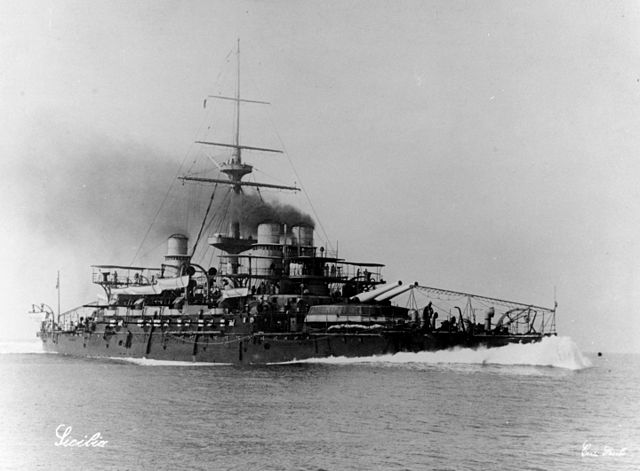
Sicilia, full speed
Development
Starting in the 1870s after the Battle of Lissa, a large naval expansion program to counter the Austro-Hungarian Navy was launched, and the Re Umberto class became the end of this first phase of the program. They were part of ten modern ironclads, and together wit the Duilio, Italia and De Lauria seen before, with their enormous guns, they dwarved the Austro-Hungarian Navy (relaunched under Montecuccoli frm 1904) ad made the Regia Marina the world’s 3rd after France and Britain. The three Re Umbertos were designed by Benedetto Brin, then president of the Committee for Naval Projects. He concluded when looking at foreign navies that the new trend launched by HMS Devastation in 1871 already that the formula of one twin turret fore and one aft on the centerline was most interesting on the point of clearing arcs of fire if guns were to be smaller but faster-firing: There has been, notably in Britain, considerable progresses in artillery breeches.
The decade already saw the transition from age-old muzzle loaders to breech-loaders, smoothbore to rifle guns and balls to shells, solid projectiles to HE and AP, and even the start of ballistic calculations with very early rangefinders. Now it appeared that a fore and aft centerline rather than en echelon (staggerred) amidship configuration was more interesting. Indeed when placed fore and aft these guns retained masive blind spots directly ahead and astern for the opposite gun. This was not an issue when using massive guns that out-range their adversaries, as the ship could be turned to its broadside, in a line of battle, still the usual tactic of the day. But as shown at Lissa, there were alternatives, like the wegde formation versus the line, a direct interpretation of antique tactics when ramming was paramount.

Launch of Re Umberto at Castellamare di Stabia
In melee combat, what mattered more was the rate and arc of fire. Sure, also the Echeloned artillery caused uneven cross-deck weight requiring heavy counter-ballast whereas fore and aft artillery was more balanced evenly along the ship’s spine. The echeloned artilley could also cause superstructure blast damage when firing across the deck even if having a theoretical 360° firing arcs for all guns. Only the fore and aft distribition guaranteed unempeded fire arcs, for their respective quarters and broadside. But Brin poured in other innovations in these ships as well: He prioritized high top speed (around 20.3 knots) at the expense of heavy armor protection, to go with a faster firing artilley. This was a complete tactical overhaul of the use of these capital ships. Lissa also had a deep effect on the way the French saw, at the same time when the Jeune Ecole just started its dominaiton of French naval thinking, that melee combnat wa smore likely than battleline combat. Hence configurations in lozenges.
Brin also gave these ships, for the same reasons, improved main and secondary battery layouts, but also they would be the first to feature wireless telegraph installations invented in Italy by G. Marconi, and the last in class, Sardegna, was the first use triple-expansion steam engines, helping to achieve the high speed required. The Italians continued to chase for high speed versus armour and this would culminate with the Regina Elena class, the world’s fastest pre-dreadnoughts.
The first two ships were authorized in 1883, and in 1885 Brin, proposed a third vessel which was also voted for. The gap enabled theinstallation of a VTE machinery and do some design alterations, so she was quite different from her sisters. They became respectvely Re Umberto (King Umbert, laid down july 1884), Sicilia (Sicily – November 1884) ad Sardegna (Sardinia, 24 October 1885) as the new fulcrum of the fleet. Ratically their high speed was an issue by comparison of the 12-15 knots capable older Ironclads so they were used a bit like battlecruisers, as a vanguard force, to draw out the enemy fleet and bring them close to the Ironclads folling behind. Italy was about to enter its second naval programme and the Re Umbertos represented an important transitional step.
Design
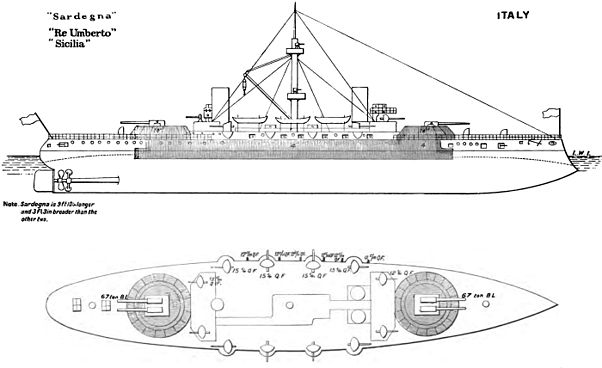
Blueprint – Brasseys 1896.
The three ships were overall very similar, yet they differed in details, notably due to their different construction yards in charge, Regio Cantiere di Castellammare di Stabia, Venetian Arsenal and Arsenale di La Spezia. Here is below this setup:
Re Umberto: 13,673/15,454 tonnes. Lenght 122m pp/127.6m oa, Beam 23.44 m (76 ft 11 in) draught 9.29 meters.
Sicilia: 13,058/14,842 tonnes. 125.5m pp 130.7m oa, Beam 23.44 m (76 ft 11 in), draught 8.83 meters.
Sardegna: 13,641/15,426 tonnes.+ 125.5m pp 130.7m oa, Beam 23.44 m (76 ft 11 in), draught 8.84 meters.
In other sources displaced between 13,058 to 13,673 long tons (13,268 to 13,892 t) under normal load and 14,842 to 15,454 long tons (15,080 to 15,702 t) at full load, Sicilia being the lightest, Re Umberto the heaviest. A longer hull gave a reduced draft in the case of Sardegna from 9.29 m (30 ft 6 in) down to 8.84 m (29 ft).
General Layout

Official photo, Re Umberto as completed
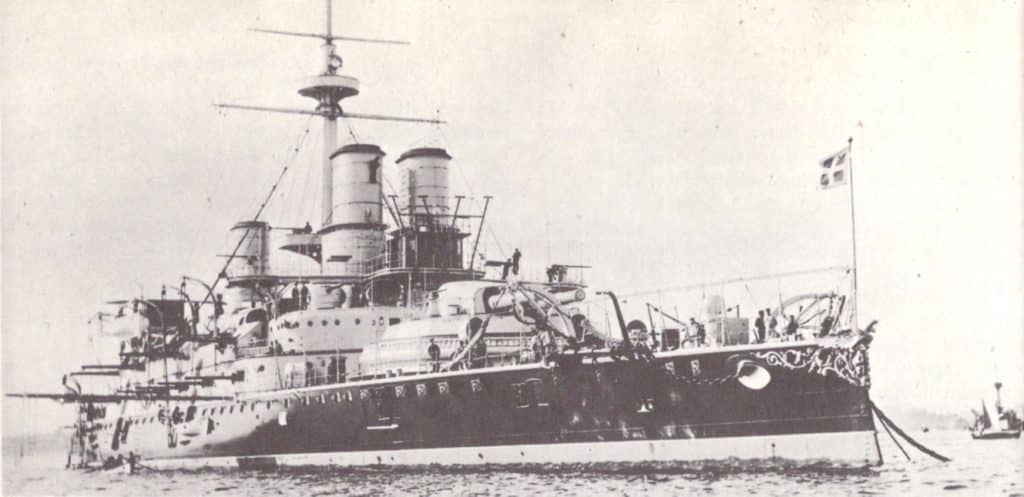
Now for the general outlook, They were low with a typically reduced freeboard, meaning not heavy weather friendly, kept a ram bow, and had a rounded, clipper style stern. They were symmetrical, with the funnels heavenly placed and a single military mast at the center like previous ships. The symmetrical silhouette was a well known ruse of naval architect to prevent an adversary to deduce if a ship was going forward or backward given the slow speeds of the time. Thus complicated ballsitc decisions. The single military (thick) mast support two fighting tops with light guns. It also supported on its second level a searchlight platform. The main boom crane was anchored at its rear base but far enough to traverse almost 300° and to lift deck boats either side of the mast between funnels.

Re Umberto, Brassey’s engraving 1894 edition
The ship had barbettes rather than turrets. They were one-deck tall, towering over the deck fore and aft. The guns rasting on these platforms, which needed to be realigned to the loading system below for each volley, were protected by a “turret” like gun shield. The crews varied in size, it was for Re Umberto of 733, for Sicilia of 736 and for Sardegna 794, an inflation linked to their differences.
Sardegna was indeed the world’s first warship equipped with Marconi’s new wireless telegraph, but also triple expansion engine and cylindrical boilers. She was heavier and longer, but all shared the same three funnels with two in tandem, a configuration popular in the 1880s, as well as a better repartition of fast-firing secondary artillery and complete revision of protection.
Powerplant
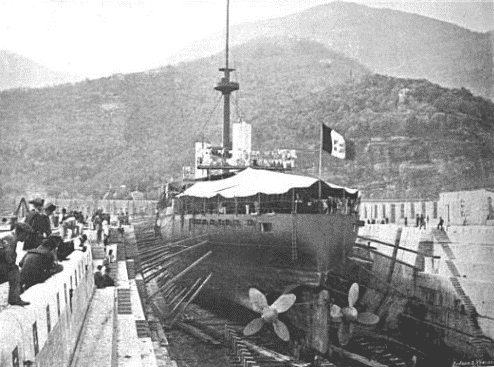
Sardegna in dry dock, showing her propellers and rudder.
The propulsion system for the first two ships comprised two horizontal compound steam engines driving each a shaft for a 4-bladed fixed pitch screw propeller. Steam came from eighteen coal-fired, not box type doubke ended but cylindrical fire-tube double-ended boilers. Their engined has been provided by Gio. Ansaldo & C. under licence from Maudslay, Sons and Field. Sardegna differed by her more modern triple-expansion steam engines, but the boilers remained the same. In fact she was the very first warship in Italy to test triple expansion engines.
All three vessels however had their eighteen boiler exhausts truncated into three groups of six, themselves exhausted through a funnel each, but for practicity two of these funnels, those forward, were paired in tandem. The third single funnel was located much further aft bu from profile, they were heavenly placed and looked like single funnels either side, reinfocing symmetricality. They all varied in output:
Re Umberto’s engines produced 17,000 hp. She was the slowest at 18.2 knots on trials. Completely failed its objectives.
Sicilia for whatever reason as she had the same confifguration did far better at 19,131 hp on trials. She was faster at 20.1 knots.
Sardegna was of course th best of all three for 22,800 hp, and 20.3 knots.
With 18.5 knots (34.3 km/h; 21.3 mph) at max 19,500 indicated horsepower (14,500 kW) in forced draft, Re Umberto failed to reach the specified 20 knots and the yard was denied its bonuses.
Sicilia barely reached its objective at 20.1 knots (37.2 km/h; 23.1 mph) from 19,131 ihp (14,266 kW). Sardegna had its bonus and congratulations as she reached 20.3 knots (37.6 km/h; 23.4 mph) from 22,800 ihp (17,000 kW), but it was less than the expected figured promises with VTE engines. Some expected she could go above 21 knots. Tha would have made her the world’s fastest capital ship. Specific figures for each ship’s cruising radius are unknown, ranging from 4,000 to 6,000 nautical miles (7,400 to 11,100 km; 4,600 to 6,900 mi) at a speed of 10 knots (19 km/h; 12 mph).
Protection
These ships were lightly armored so that the weight spared benefit the power to displacement ratio and yeld higher top speed. This was the brainchield of Brin that decided that no amount of armour protection could defeat modern guns. He believed that armor technology was just not on par yet with advanced of ballistics. The same reasoning, a bit short term, was the same which concerned the French and Germans working in 1960 on theior new main battle tank. They reached the same conclusion and left their tanks underprotected, but were caught up by far better fully stabilized fire control system. Speed was to offer no protection against computer and laser-assisted moder fire control system. Back 80 years prior there was the same debate and fire control was in its infancy. So protection was redirected to protect the ship assuming there was still a risk of a hit, to contain damage.
Instead of going for British solutions, the Italians looked at French armor, and ordered hardened steel plates manufactured by Schneider-Creusot which just inaugurated a new process. Brin could not anticipate the revolution in foundry techniques using carbon, and the successive Harvey and Krupp processes.
Thus, the Re Umberto class were protected by the following:
Belt armor: 102 mm (4 in) thick, thrice lower than their main guns (343 mm)
Armored deck 76 mm (3 in) thick (yes, high angle ballistic was rare in 1880).
Forward conning tower 300 mm (11.8 in) walls on the sides. At least the staff was protected in battle.
Main battery “turrets” 4 in thick faces.
Barbettes 349 mm (13.75 in) thick plating.
Secondary guns shields 51 mm (2 in).
So the great looser in this scheme was the belt. It was hoped that the internal slopes would play their role, as the low freeboard, and heavy compartimentation to mitigate flooding. No bulkheads however.
By their size and weight the tall and heavy barbettes protruding from the deck by a full deck were by far the largest load onto the structure.
Armament

The blueprints profile, origin unknown
The new guns were smaller, but fire twice as faster as those of previous inronclads in addition to the abandonment of the échelon disposition. The hull was therefore much longer but stayed low and comparatively had much thinner armor protection but higher top speeds.
343mm/30 B Armstrong Whitworth
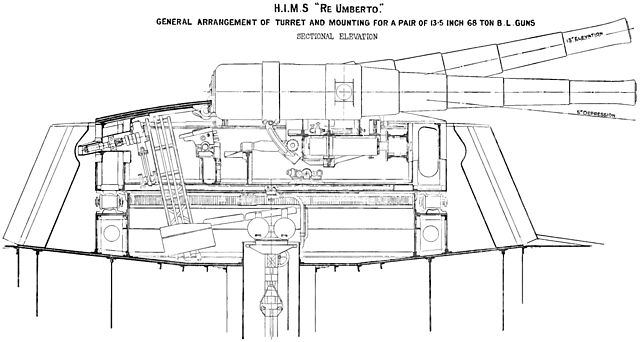
Re Umberto 13.5 in barbette
The Re Umberto class had a main battery of four 343 mm (13.5 in) 30-caliber guns, two pairs fote and aft. They were mounted in barbettes protected by full gun shields working as turrets. These guns were Pattern B Armstrong Whitworth types. These were Rifled Breech Loading (BL), with Built-up steel hoops and wire-wound structural strengthening. They used Heavy armor-piercing (AP) and high-explosive (HE) shells and used brown powder (prismatic gunpowder) used later for smokeless cordite.
Specs:
570-kilogram (1,250 lb) capped armor-piercing (AP) shell with a 230 kg (507 lb) brown powder charge
Muzzle velocity 575 metres per second (1,886 ft/s).
The guns cradles could elevate to 15 degrees, depress −5 degrees controlled by hand, loading done at the same max angle, also by hand.
Rate of fire: Standard Operational Rate c1 round 2-3 minutes or 0.3 to 0.5 rpm per gun in sustained combat and 1.5 or 2rpm on trials.
Range: Approximately 11,500 to 12,000 yards (roughly 10.5 to 11 kilometers / 5.9 nautical miles) when fired at its maximum elevation limit.
152mm/40 A91

Sardegna showing her battery, post 1900. src
They carried a secondary battery of eight 152 mm (6 in) 40-caliber guns placed singly in shielded mounts atop the upper deck, with four on each broadside. They formed the mid-tier secondary battery of the Re Umberto-class and the “A91” designation denoted the Ansaldo Model 1891, licensed from Elswick Ordnance Company (Armstrong). They were given prominent topside positioning, eight placed singly in shielded, open mounts arranged along the upper deck, with four guns per broadside. This high and unobstructed placement gave them wide firing arcs to engage enemy cruisers or support the main 343 mm batteries in mid-range fleet actions, more likely by that stage.
Specs:
Rate of Fire: Roughly 4 to 6 rounds per minute.
Quick-Firing Technology: Like the 120 mm guns, they used utilized brass cartridge casings but because the ammunition was significantly heavier to handle manually, it was down to 5-6 rpm.
Maximum Range c11,000 yards (roughly 10 kilometres) at 20 degrees.
Shell Weight: Fired a 100 lb (45.4 kg)
Muzzle Velocity 2,100 to 2,200 feet per second (640–670 m/s), depending on brown powder or smokeless propellant.
120mm/43 N
Sixteen 120 mm (4.7 in) guns in casemates in the upper deck aboard Re Umberto, eight on each broadside. Sicilia and Sardegna both had twenty of these guns, with ten per side.
These 120 mm (4.7-inch) 40-caliber Quick-Firing (QF) guns, but the N pattern was used internally. Commonly called the Elswick QF 4.7-inch guns. They were were installed specifically to counter fast, agile torpedo boats attempting to close the distance with twelve positioned in the protected casemates of the main deck, four placed inside the fore and aft superstructures behind armored gun shields. Sardegna and Sicilia had 20 of these guns, 10 per broadside. Rate of Fire was faster due to their metallic brass cartridge cases sealing the breech instantly, with a trained crew achieving 8 to 10 rounds per minute. Maximum Range was Approximately 10,000 yards (about 9.1 kilometres) at maximum elevation of 20 degrees. The Effective Range was typically limited to 4,000-5,000 yards. Because they fired a lighter shell of c45 lbs/20.4 kg, they had a poor long-range accuracy against small moving targets.
57mm/43 N
Sixteen 57 mm (2.24 in) 43-caliber guns completed the mix. These were Nordenfelt 6-pounder (hence the N), scattered across the open upper decks, superstructures, and fighting tops (platforms high up on the masts) to guarantee a 360-degree perimeter of defensive fire.
They were capable of a 20-25 rounds per minute under combat conditions
The vertical sliding-block breech fired fully integrated “fixed” ammunition (shell was pre-crimped into a brass casing containing the powder).
Firing Range was approximately 8,600 yards (7.8 kilometers/4.2 nautical miles) at extreme elevation.
Effective Combat Range was under 3,000 yards (2.7 km).
Muzzle velocuty was approximately 2,000 feet per second (610 m/s) but as the projectile was so light, its velocity dropped quickly, decreased accuracy at long distance.
Shell: Standard 6 lb (2.7 kg) common steel or cast-iron explosive.
37mm/25 H lungo
Ten 37 mm Hotockiss long barrel 1.5 in guns completed the picture, with placement on open, highly elevated positions, nearly all placed up on the fighting tops. From their high vantage points, the gun crews could aim directly at the attacking TB’ coxswains, torpedo launching tubes, deck crews.
Rate of Fire: Manual drop-block mechanism rather than a hand-cranked rotary cylinder, up to 30 rounds per minute.
Breech Action: The gun’s recoil cycle automatically dropped the wedge breech block and ejected the empty brass casing so that the loader could slam a new 1-pounder fixed round into the chamber, triggering the breech block to snap shut and lock for the next shot.
Maximum Ballistic Range was roughly 4,500 yards (4.1 kilometres) at maximum elevation.
Effective Combat Range was restricted to under 1,500 to 2,000 yards (1.3 to 1.8 km).
The light shell of 1 lb (0.45 kg) could easily buffeted by crosswinds. This was a steel-walled Common Pointed Explosive (HE) or Steel AP projectile.
Muzzle Velocity: Approximately 1,300 to 1,400 feet per second (roughly 400–425 m/s).
450mm (18 inches)
As was customary for capital ships of the period, the Re Umberto class carried five 450 mm (17.7 in) torpedo tubes in above-water launchers, two per side, one bow and stern.
The torpedoes were Whitehead types which carried a 41 kg (90 lb) warhead with a range of 400 m (1,300 ft) at 30 knots (56 km/h; 35 mph).
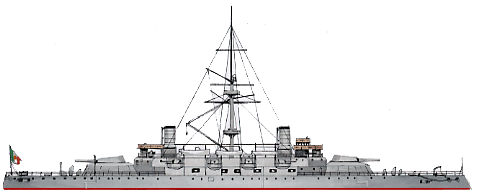
Sardegna in 1914
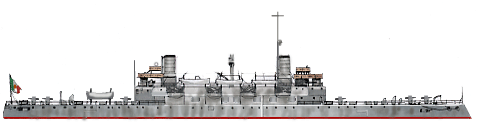
Re Umberto in 1918
Sardegna (1914) specifications |
|
| Dimensions | Length 130,7 x 20,4 x 8.84 mm (428 x 67 x 29 ft) |
| Displacement | 13,600 T – 15,430 FL |
| Propulsion | 2 screws, 2 TE engines, 18 boilers, 22 800 hp |
| Speed | 23.3 knots (xx km/h; xx mph) |
| Range | 4,000–6,000 nmi (7,408–11,112 km) |
| Armament | 4 x 343, 8 x 152, 16 x 120, 20 x 57, 10 x 37 mm, 5 TT 450 mm |
| Armor | Belt 102, Deck 76, Blockhaus 300, turret 102, barbettes 350 mm |
| Crew | 794 |
Career of the Re Umberto class

For their first ten years in service, they were in the Active Squadron but this was uneventful. Re Umberto and Sardegna made ports visits (Britain, Germany 1895) for the opening of the Kaiser Wilhelm Canal. Thery also took part in the international naval demonstration off Crete in 1897, before the Greco-Turkish War. In 1905, all three ships were demoted to the Reserve Squadron. They were fully reactivated for the Italo-Turkish War of 1911–1912. They support Italian efforts in Libya, shelling Turkish objectoves along the coast, and from October to December 1911, stationed off Tripoli, shelling Ottoman defenses for the initial landing, providing fire support to Italian forces after the sieged ended. Back home they escorted troop convoys to Libya by June-August 1912. Postwar Sicilia became a depot ship for Giulio Cesare in Taranto. Re Umberto became a depot ship in Genoa. From mid-1915, Sardegna was stationed in Venice as flagship. Re Umberto became a floating battery in Brindisi. After Caporetto in November 1917, Sardegna wasn sent to Brindisi, then Taranto. In 1918, Re Umberto was converted into an assault ship for the planned Pola raid that never took place. She was stricken in 1920, Sicilia and Sardegna followed in 1923.
Re Umberto

Re Umberto in Genoa, 1911 (Agence Rol)
Re Umberto was ordered from Regio Cantiere di Castellammare di Stabia laid down on 10 July 1884, launched on 17 October 1888, commissioned 16 February 1893. The joined the Active Squadron but will later alternate with the Reserve Squadron each February. In the latter, the crew was reduced. In 1895, she joined the Reserve Squadron wit the older Ironclads Ruggiero di Lauria, Italia, and Lepanto. In June 1895, she joined de delegaton sent to the Opening ceremony of the Kaiser Wilhelm Canal in Germany. 14 Nations were present in Kiel. In July 1895 she also visited Portsmouth and stopped at Spithead, when the Admiralty on the steam-yacht Enchantress sailed to meet the Italian squadron. There was later a garden party and banquet, then grand ball the next days. On July 20 Italian officers with the Duke of Genoa and Admirals Accini and Grandville inspected the local dockyard. On July 22 they were still there for a naval review for the Westminster houses and sailing public. HM. Prince of Wales visited Re Umberto and lunched with the Duke of Genoa on the Royal yacht Savoia, followed by a farewell banquet at Portsmouth town hall. On the 23rd there was a ball on Re Umberto.


Re Umberto in Taranto 1902. Dutch photo, framed and reworked (CC).
In 1896 her and sisters took part in the naval maneuvers of the Tyrrhenian Sea between August and September. Re Umberto was part of the “reds”, simulating a French attack on the Italian coast. In February 1897 she was sent to Crete with International Squadron, to watch over the 1897–1898 Greek uprising and guarantee there would be no atrocities by the Ottoman Empire or the other side. All were ready to send parties. She joined a division with her sister Sicilia (flagship, Vice Admiral Felice Napoleone Canevaro), the cruiser Vesuvio, torpedo cruiser Euridice. By 1899, she was like every year reassigned to the Active Squadron for eight months with five other battleships and cruisers. 1900, 1901, 1902 were about the same, with summer manoeuvers.
In 1903, still the same but now over seven months, from february to after the conclusion of the summer exercises in September. She then had reduced crews for the remainder of the year, the remainder back to their civilian lives. That way, the navy ministry only paid a core of officers and NCOs full time. In 1904–1905, Re Umberto and sisters also took part in the Active Squadron manouvers, but this time over nine months but three months in reduced commission and then the Reserve Squadron, (all three Ruggiero di Lauria-class, Enrico Dandolo, three cruisers, 16 torpedo boats) only active service for two months (summer training maneuvers) and under care taker crew the remainder of the year. In 1908 she was active for seven months. No logs for 1909-1910.

The attack on Tripoli, October-November 1911
Then the Italo-Turkish War started: On 29 September 1911, Italy declared war on the Ottoman Empire to seize Libya. She was at the time in the Training Division with the armored cruiser Carlo Alberto (Rear Admiral Raffaele Borea Ricci D’Olmo) when on 3–4 October, Re Umberto and her sisters sailed to bombard and launch a landing party to capture Fort Sultanje on the western approach to Tripoli. They only used their 6-inch guns and it took until the 4th to silence the fort. A landing took place and the city fell. The Training Division then alternated in support between Tripoli and Khoms. In November with Sicilia, Partenope, Fulmine, Cassiopea she shelled the coastal oasis at Taguira for an Italian garrison.
By December 1911, she was in Tripoli, until relieved by Italia and Lepanto. Re Umberto and sisters returned to La Spezia to have their ammunitions replenished. In May 1912, they patrolled the coast and in june, escorted a convoy with an infantry brigade to Buscheifa, still under Ottoman control. On 14 June after an artillery preparation there was a landing and the city fell. The troops then moved to Misrata still under support of Re Umberto and others, the city fell on 20 July. The Training Division then returned to Italy and escorted another convoy on 3 August to Zuara, last Ottoman port with a landing 2 days later, and supporting bombardments. This achieved the conquest of the entire Libyan coast and by 14 October a peace treaty was signed.

Re Umberto in Brindisi 1917
Re Umberto was laid up in Genoa in 1912 to be converted as a depot ship with a small crew, towed to La Spezia in June 1915, and stricken on 10 May 1914. She was the floating storehouse for the dreadnought Andrea Doria. However on 9 December 1915 her crew was reconstructed when she became a floating battery at Brindisi, then towed to Valona in Albania. In 1918, she was planned to lead an assault on Pola to finish off the fleet. She was modified, with a giant saw/cutter was installed along her ram bow to force her way through defensive nets, all her armament removed to lighten her up, keeping only eight 3-inch guns with gun shields and trench mortars. Behind her were to be no less than forty MAS-boats tasked to rampage the fleet an anchor. However this was in Octber and the war ended before the plan was launched. She was stricken on 4 July 1920, after being mothballed.
Sicilia
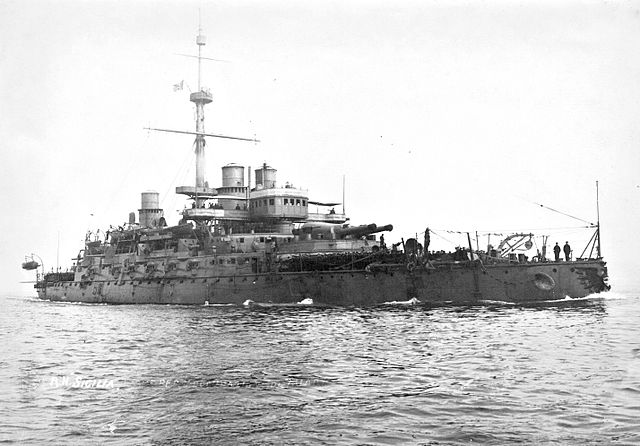
Sicilia, as built.
Sicilia was ordered from Venetian Arsenal (R. Arsenale di Venezia), laid down on 3 November 1884, launched on 6 July 1891 and christened by Queen Margherita, commissioned on 4 May 1895. Fitting-out was completed on 4 May 1895 and she later took part in annual fleet maneuvers in August-September 1896 defending against a simulated French attack. In February 1897, she was sent off Crete to take part in the International Squadron (RN, Austro-Hungarian, French, Imperial German, Russian Imperial Navies and Regia Marina, Imperial Russian Navy) for the Greek uprising on Crete as flagship of the 1st Division, Vice Admiral Felice Napoleone Canevaro, with Giovanni Bausan, Vesuvio, and Euridice.
By 1899, she entered the 2nd Division with Affondatore and Castelfidardo, Partenope and Urania. In 1903 she was active for 7 month. In 1904–1905, she was in the Active Squadron for 9 months but by 1906 she ened in the Reserve Squadron now active only for 2 months (training maneuvers), but by 1908, she was active for 7 months. From September 1911, she was part of the war to acquire Libya from the Ottoman Empire, starting with the conquest of the coast. She was back then in the Training Division like her sister and departed under Rear Admiral Raffaele Borea Ricci D’Olmo by early October, to bombard and seize Fort Sultanje (see above). She sent a party led by her own captain to take the fort. Next she alternated in gunfore support between Tripoli and Khoms, shelled Tripoli over 23–26 October, supporting the left flank and by November, shelled the oasis at Taguira. By December she was stationed in Tripoli until relieved and was resuppliud at La Spezia, after which by May 1912, she patrolled the coast, escorted a convoy and landing to Buscheifa (assault on 14 June) then Misrata (fell on 20 July), then back to Italy, for the last convoy on 3 August to Zuara, and peace signed on 14 October.

Sicilia used as a depot ship, colorized by Erick Navas src
She then became a depot ship for Giulio Cesare, close to completion at Taranto. She was then was stricken on 9 July 1914 but instead of be scrapped, she was retained as the war started and by 16 August 1914, disarmed, converted as a depot ship in Taranto. From 1916 or 1917 (date unclear) she was converted into a repair ship until stricken again in 1923, sold for BU.
Sardegna
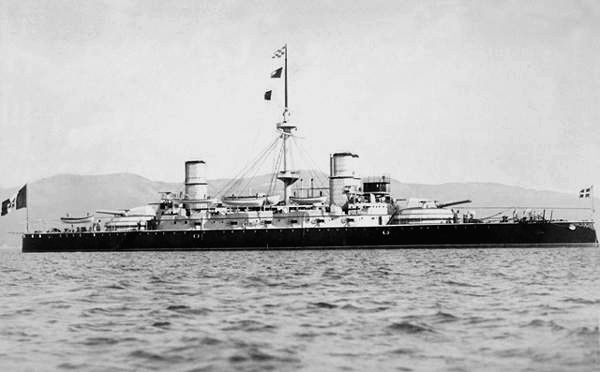
Sardegna was ordered from Arsenale di La Spezia laid down on 24 October 1885, launched on 20 September 1890, and commissioned on 16 February 1895. She was assigned to the 2nd Division, Reserve Squadron as flagship, with Ruggiero di Lauria and Aretusa, based in La Spezia. She later joined her sister Re Umberto, Ruggiero di Lauria, Andrea Doria, Stromboli, Etruria, and Partenope for a visit to Spithead by July 1895 (see above). Next they were present for the opening of the Kaiser Wilhelm Canal but she ran aground in front of the canal, blocking the entrance for several days.
In February 1896, Sardegna was in the Active Squadron with Andrea Doria and Francesco Morosini. She took part in the annual fleet maneuvers, defending against a simulated French attack. By 1899 she was in the Active Squadron, kept active for 8 months. In 1903, this was for 7 seven months. In 1904–1905, this as for 9 months. In 1906 she was definitively transferred to the Reserve Squadron, active for 2 months, the summer training maneuvers. Same in 1907 and 1908, but she was active for 7 months. Likely same in 1909-1910.
She took part in the war in Libya by 1911. Under Rear Admiral Raffaele Borea Ricci D’Olmo in early October, she took part successively in the attack on Fort Sultanje, Tripoli and Khoms. In the first case on 23–26 October, while supporting the left flank she used for the first time a spotter aircraft to help direct the fire, which was limited by the lack of radio. The pilot had to drop a message on her deck after each forey over the objective for corrections. But htis was a first. By December, she was stationed in Tripoli, returned to La Spezia. By May 1912, she patrolled the coast, by June she took part on the attack of Buscheifa, then Misrata in July, Zuara in August, followed by a peace treaty signed on 14 October.
Sardegna starboard size
She was still in reserve, not converted as depot ships in 1914. By July 1915, under Admiral Paolo Thaon di Revel (chief of staff) she was to be part of the blockade of the southern end of the Adriatic but as flagship for the Northern Adriatic Naval Forces with the two Ammiraglio di Saint Bon-class battleships, two cruisers, several smaller vessels tasked to defend Venice until 15 November 1917. Her career until the end of the war was uneventful. But unlike ehr sisters she was active. She was sent later to Brindisi as a harbor defense ship. After the defeat at Caporetto, Venice was threatened by the advance and all of her secondary and light guns were removed and sent to the front. Instead she received four 3 in (76 mm)/40 AA guns and two machine guns. On 10 June 1918 she was sent to Taranto as a guard ship. Postwar she took part in the fleet occupying Constantinople from 7 November 1919 to 5 April 1922. Back to Italy she was stricken on 4 January 1923 and sold for BU.
Links/Sources

Sardegna, Paul Silversone coll. Naval History and Heritage Command src
Books
Gardiner, Robert (ed.) Conways all the world’s fighting ships 1860-1906 (section by Fraccaroli, Aldo)
Beehler, William Henry (1913). The History of the Italian-Turkish War: September 29, 1911, to October 18, 1912. NIP
Brassey, Thomas A., ed. (1896). “Relative Strength”. The Naval Annual. Portsmouth.
Brassey, Thomas A., ed. (1899). “Comparative Strength”. The Naval Annual. Portsmouth.
Greene, Jack & Massignani, Alessandro (1998). Ironclads at War: The Origin and Development of the Armored Warship, 1854–1891. Da Capo Press.
“Naval Notes – Italy”. Journal of the Royal United Service Institution. XLVIII. London: J. J. Keliher.
Robinson, Charles N., ed. (1897). “The Fleets of the Powers in the Mediterranean”. The Navy and Army Illustrated. III. Hudson & Kearns.
Thursfield, J. R. (1897). Brassey, Thomas A. (ed.). “Naval Manoeuvres in 1896”. The Naval Annual. J. Griffin & Co.
Fraccaroli, Aldo (1970). Italian Warships of World War I. London: Ian Allan.
Links
en.wikipedia.org/ Re_Umberto-class
navypedia.org/
facebook.com/
avalanchepress.com
lookandlearn.com/
blog.livedoor.jp/
alchetron.com
3D/Models
on scalemates.com/ Armo · 700-58
stefsap.wordpress.com 1/50 model preserved at Certosa di San Martino Museum, Naples