
 ASW Escorts (1955-56 to 1975-77): F761 Le Corse, F762 Le Brestois, F763 Le Boulonnais, F764 Le Bordelais.
New Cycle ! French Cold War Frigates: First entry, the “Le Corse” class or E50 escort were among the few brand new warships built in France in 1950, financed under MDAP as battle group ASW fast escorts. These four escort ships were strongly influenced by WW2 US Navy destroyer escorts, but with an heavy emphasis on heavy ASW torpedoes (twelve tubes, 12 spares), six 57 mm Bofors AA guns, and a 6-barrel 375mm Bofors ASW rocket launcher as well as classic DCs. Commissioned in 1955-56 they took part in the Suez crisis and were discarded in 1975-77. They led to the improved E52 escorts (14 ships) in 1953-60.
Development
 The postwar situation of the French Navy was peculiar: It had still a number of ex-Free French vessels of allied origin in service, ex-axis war reparation ships ranging from cruisers to destroyers and submarine and shipyards that were badly damaged by allied bombardments of German action, that needed to be restored to operational status. In order to return the Marine Nationale’s to its prewar rank after crippling losses, freed from treaties but bound to keep the Empire, France at first adopted the overly ambitious 1944–1945 rearmament proposal. Then it established its first new, more realistic naval plan in 1947, at least according to its finances in a still largely devastated national economy. The strict alignment to NATO until 1958 also dictated its place and role and there was not the huge cost of deterrence yet to retire funding to the conventional fleet. The alignment on NATO led to the 1949 plan that called for more ASW escorts.
In this context, the rebuilding of the “small fleet” of escorts, according to WW2 experience which separated Frigates from destroyers for precise roles (the first to escort carrier battle groups or capital ships, the second for general purpose or dedicated ASW convoy escort). France return most of its WW2 River class frigate and Flower class corvette yet still needed modern ones. Thus Six British Frigates and six US Destroyer Escorts were transferred, named Algerien, Senegalais, Somali, Hova, Marocain, Tunisien, L’Aventure, Surprise, L’escarmouche, Croix de Lorraine, Tonkinois and La Découverte.
The Aventure class Frigates (1943-1962)
The “Aventure class” (F07) were former Free French River class frigates that were purchased in 1943-44 already, and were rearmed with new 105mm gun mounts. Two were renamed in 1953. (Tonkinois > La Confiance, L’escarmouche > L’ailette). La Découverte was the first discarded, in 1959, whereas the others were retired in 1961-62 and La Surprise was sold to Morocco in 1964. Alongside this an aviso (sloop) was acquired for a short time, called “Francis Garnier”, the ex-Italian Eritrea, in service 1958-1966.
The Arabe class Frigates (1950-1958/69)
The ex-US class was from the Cannon class DEs from 1943, and were known in French nomenclature as the “Arabe class”, named after peoples of the French Empire. Transferred under MDAP in 1950 and 1952 they were, oddly enough called “torpilleurs d’escorte” (escort torpedo boats) in French service, despite the fact they were pure ASW vessels without any torpedo on board. In 1953 however they were called “escorteur de 2eme classe” (2nd class escorts), more appropriate. In 1960s Malgache became a command ship, replacing the old carrier Dixmude (ex-HMS Biter) in this role. They were unchanged compared to the original DET types and stricken either in 1958-59 for the majority or 1969 for the last two used for new roles, one command ship and one TS.
Genesis of the E50 Project (1949-51)
The Navy, expecting to have all its shipyards ready for new constructions FY1949, meanwhile looked at procuring a brand new national class of Frigates: Under the project code E50 (“E” standing for Escort) followed by a number that matched their approval date (1950), had been planned in the 1949 naval plan, a toned done, revised 1947 plan. This 1949 plan included 10,500 tons of new ships, including three escort and patrol ships, adapting the French naval strategy to the newly formed NATO and Western Union alliance framework. France indeed joined NATO at its formation on April 4, 1949 and was assigned ASW escort tasks which were needed anyway already to escort newly formed battlegroups, around Jean Bart, Dixmude, then Arromanches and the two Lafayette class carriers.
In 1949, three types of escorts were planned:
– 2500 tW escorts, intended to accompany large combat ships such as aircraft carriers, these ships will provide future squadron escorts.
– 1500 tW escorts, specially designed for convoy escort and ASW combat, will be our fast escorts.
– 600 tW escorts, but production of which will be abandoned, except perhaps for coastal escorts.
On March 17, 1948, the E 50 project was presented, requiring an 1500 tons stabdard, with a full displacement of 1,900 t. Speed was setup to 26 knots but the range of min. 5000 nm remained a problem for their size. Different poweprlants solutions were considered, with diesel like with a proposal with 3 shaft lines, each with a 6,000 hp Sulzer diesel, but abandoned due to the lacks flexibility, too expensive and requiring too long completion times. The more classic approach of steam turbines and boilers was solution the solution behind the final design approved on October 11, 1950, capable of 20,000 hp and still a range of 4,850 nautical miles at 15 knots.
Only four were ordered indeed as they were essentially prototypes for the future E52. They allowed to test the waters of a new design that would go on until the Cdt. Rivière class built 1962-65. The base requirements for the design were a good enough range, a speed aligned to escort work (28 knots versus destroyers at 33 knots), good AA defence, and a powerful ASW suite on a reasonable 1,200 tonnes standard. At that stage they lacked of course an helicopter capability as this was provided by the capital ships of the escort, one of the four carriers of the Navy before the arrival of the Clemenceau class (PA 54) after the cancellation of their predecessors, the PA28 class. French Frigates would ony integrate and helicopter capability with the 1990s Lafayette and Floreal class.
Final genesis of the E50

Back in 1949 when the E50 project was planned, the Marine Nationale needed squadron escorts (multi-role vessels) and fast escorts, primarily intended for anti-submarine warfare. In 1949, France, along with other Western nations that could afford them (like Britain and the Netherlands), focused its strategy on carrier strike groups. The “fast” designation adopted was intended to highlight their advancement over the standard escorts of World War II generation, rather specialized for protecting much slower merchant convoys at around 10 knots, so requiring a margin of only 18 knots as top speed. The speed advantage of approximately ten knots matched the performance levels achieved by the Royal Navy’s fast frigates or US Navy’s DDEs both resulting from the conversion of legacy destroyers (like the Fletcher DDE). France also looked at new designs capable countering the new generation of Soviet fast submarines derived from the Type XXI. These fast escorts offered superior maneuverability as well, with measured taken with stabilizers, rudders and in general more hydraulic power for tighter turning radius and faster accelerations.
The Corse class recalled the American Dealey class DEs, with a flush deck and transom stern, and the fist three were financed under MDAP. The E50 class would comprise four ships, Le Corse, Le Brestois, Le Boulonnais and Le Bordelais, laid down in 1951-52, launched in 1952-53 and completed in 1955-56. In addition to three twin 57 mm AA, two 20 mm Oerlikon, they shared the same 375 mm 6-tubes ASW rocket-launcher, two DC mortars, DC rack and four triple banks of 550 mm ASW tubes. They were powerful and relatively fast, 27 knots as designed but they exceeded that at 30 knots on trials. Therefore they were fit for the new generation of fast Soviet submarines. All four were stricken in 1975. They were named after regional inhabitants of coastal regions of metropolitan France, a tradition repeated on the next E52 built in 1953-60.
Construction
They would also vary in denomination considerably, at first “escorteurs océaniques” (ocean escort) in 1949 as planned, then “escorteurs de 2e classe” (2nd class escorts) in 1950 and then “escorteurs rapides” (fast escorts) in 1954. Since NATO replaced the “DE” denomination by “F” for frigates, they would receive the pennants F761 to F764. Construction spanned between three yards: The first three financed under MDAP were built at Arsenal de Lorient and AC de la Loire on the west coast and the third, on the national budget, at FC de la Mediterranee (ex-FCM, La Seyne, Toulon) on the French Riveria.
Construction spanned between 1951 and 1956, with very long completion times or 2-3 years due notably to delivery bottlenecks.
Design of the class
Hull and general design

The E50 frigates were relatively small ships, for which there are discrepancies of figures. Conways in its 1995 edition stated they were 1250 tonnes standard, whereas more modern editions goes for a more susbtantial 1,528 tonnes. It’s well possible the 1,250 tonnes figure was an erratum (1,520t instead, likely typo) given that would create a gap of 452 tonnes for “filling” the ship, which is properly enormous even with crew, food, ammunition, water, and oil. Al sources agreeds however on 1702 tonnes fully loaded. Wikipedia EN goes for 1508 ton standard however. Also likely a typo, as 1,528 tonnes is based on the reliable but defunct netmarine.net”s page. Anyway, these ships were short, symbolically just below 100 meters at Length 99.8 m (327 ft) overall in lenght, 95.1 meters betwene parallel, for a beam of 10.3 m (34 ft) and draught of 4.3 m (14 ft). So despite their escort nature, extra speed was obtained by a slender hull, with destroyer proportions of roughly 1/10. There were counterkeels but no active stabilizers.
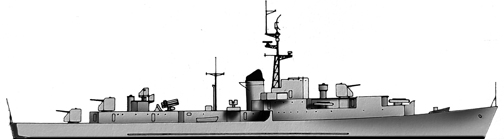
The ships had “full” lines, with a well flared bow, tall raised bow wheeras the remainder of the flush deck started at the height of the bridge and was perfectly flat all the way to the transom stern. The latter was not flat but in a Vee (2 faces). The superstructure was extensive, and the general silhouette drew some inspiration from the US WW2 destroyer Escort indeed. The forward 2-meve base strcuture was stepped with space for the torpedo tubes and the forward twin main gun, in a high positions when the deck forward was bare and short. There was an enclosed 3-faceted bridge with small windows to deal with north atlantic weather, and an open deck behind.
Past it was the mainmast, a lattice supporting the optical pointer DMAA, navigation radar DDRBN-32, and air surveillance, early warning radar DRBV-20A, and right aft of it a separate single funnel made of truncated exhausts of the two Indret boilers. Past this there was a long aft structure with a short aft mast, the Bofors ASWRL, and then the main fire control tower with radar DRBC-31 aft, followed by the two superfiring twin mount. As for the crew it was orignally of 13 officers and 185 ratings, but later in their career went to 9 officers, 52 NCOs and 109 ratings. For them, the ship carried at first 7-meter whaleboat, one 3.5-meter dinghy, one 6-person inflatable boat. From 1972 she received a second 6-person inflatable boat.
Powerplant
The machinery was all made in France. They had two sets of Rateau geared steam turbines, fed by two Indret boilers for a total of 14,914 kW (20,000 hp). The propellers were classic 3-bladed bronze types, fixed pitch. The Indret boilers were dissymetrical types rated for 35 kg/cm² working at max 385° temperature. This made for a top speed of 27 knots (50 km/h; 31 mph) and a range of 4,500 nmi (8,300 km; 5,200 mi) based on a reserve of 390 tonnes fuel oil, which was gargantuan for their size and ensure this range. They also had a secondary power for on-board systems when the machinery was not in use, 4 Renault diesel-driven alternators, 180 kW each (720 kW total). Bordelais experimented a funnel with wings of the “Strombos-Valensi” type. On trials, they averaged 26 to 28 knots.
Protection

Le Brestois at Toulon in 1968, in front of the battleship Jean Bart
It was the “usual suspect” for such small ships: The hull was divided into bulkheads, with a stronger plating above the waterline to protect the machinery spaces and ammunition magazines and lighter plating for the structure above in order to manage stability. There was no armour however. The usual fire-fighting systems were also present, with halon exitinguishers in the ammunition magazines plus emergency rapid-filling cocks, fire points with hoses in the machinery spaces. Other fire fighting posts and bottles were spread thoughout the ship. There was however no NBC protection nor washout system, albeit with proper sealing of all doors and hatches and using air conditioning it was possible to create overpressure.
Armament
 The E50 escorts were well armed, but this was mostly intended to be “close and personal” as they lacked long range weaponry. The originakl 1950 design in fact called for an anti-ship ex-German 105 mm gun, completed by the two aft twin 57 mm but it was replaced by an extra twin 57mm forward instead, far more judicious. Part of it was still resolutely old school however like the depht charges and projectors aft, even the torpedo launchers were large at 550 mm, classic French standard torpedo caliber, and usable against submarines thanks to the K2 acoustic torpedoes that were developed for them. The only medium range armament was the trusted 375 mm model 1954 (licenced Bofors) anti-submarine rocket launcher designed to create a pattern of three charges around the submarine at a distance. Unlike WW2 escorts and their hedgehog it was located aft amidship but had sufficient clearing arcs. Brestois tested in 1958 though the first French 100 mm gun, complete with its combat system and fire control radar.
57mm m1951 Turrets
These models were ubiquitous across the fleet. These three twin 57mm/60 guns modele 1951 were called also 57 mm/60 (2.25″) SAK Model 1950 in Sweden and 57 mm/60 (2.25″) Modèle 1951 in France. Indeed, it was orignally a new Bofors water-cooled design, used by Netherlands, France and Sweden. Bofors introduced this weapon a scaled-up version of the highly successful 40 mm/70 Model 1948. Unlike the latter, the four-round clip (main critic of the operations) was dropped, since the much larger ammunition would have made the clips way too heavy.
Loaders were asked to drop individual rounds into ammunition boxes, feeding in turn quadrant-shaped hoppers mounted at the gun’s trunnions, working by gravity at all angles. After reviewing weapons in 1946, the French Navy Conseil Superieur decided the 40 mm Bofors was now inadequate against upcoming jets and decided to adopt the Bofors 57 mm AA gun. They were mated to a French-designed twin turret, ending on the Jean Bart and T47 destroyers. Still, their effectiveness against jets was questionable. More on these on navweaps.com
Specs:
Mount weight 17 tonnes. Barrel length 60 calibers.
Shells: The 2.96 kg HE/prox. fuse, muzzle velocity 956 m/s.
Rate of fire 60 rounds per minute.
Effective range 3,000 m (9,800 ft).
20mm/70 Mark IV Oerlikon AA
This was completed by two 20 mm Oerlikon AA guns located on the structure’s wings amidship, between the funnel and aft mast. No need to present this ordnance, kept to deal with “asymetric threats” and any helicopter. Range was 900 m, they fired a 120g shell at 830 m/sec. up to 450 rpm practical. No stabilization whatsoever, this was the “last recourse”.
550 mm (21.7 in) torpedo tubes
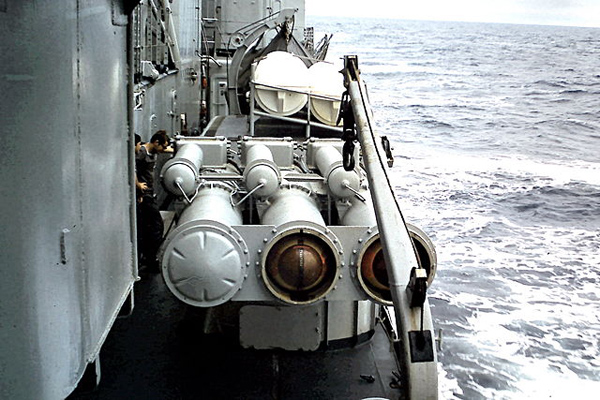 The Corse class had four banks of triple 550 mm torpedo tubes located forward, two on the forward structure, two further out in recesses in the structure, close to the bridge. They were all reloadable. Back in 1955 when completed, the French worked out their first acoustic torpedo of that caliber, recycling bodies of interwar torpredoes with better propulsion systems and an acoustic system. The first models adopted were the K2 weighting 1100 kg, until replaced from 1962 onwards by the L3 model. By any standard this was still a very heavy ASW torpedo armament, quite unique for this French design. This was repeated on the E52 escorts, and still with a total of 24 torpedoes. It was only toned down in the 1960s T. Riviere class which adopted an equivalent to the weapon alfa.
K2 550mm ASWT
The K2 (1956) was essentially similar to the American Weapon Alfa, British Limbo and Italian Menon, but using a torpedo body rather than a rocket. It was made for speed, powered by an Oxygen-alcohol turbine, carrying a 617 lbs. (280 kg) HBX-3 or TNT warhead at 1,000 yards (900 m) at 50 knots.
In case the mission changed dramatically and they needed some anti-ship capability, there was still a stock of interwar 23DT models…
L3 550mm ASWT
The L3 was an electric acoustic-homing anti-submarine torpedo designed in the 1950s and in service in 1960. About 600 has been manufactured. Powered by a Nickel-cadmium Battery, they carried a warhead of 440 lbs. (200 kg) with Tolite A1, and can reach 5,500 yards (5,000 m) at 25 knots.
324mm M ASWRL
Another Swedish-designed weapon (with the 57 mm) aboard was the 324 mm anti-submarine rocket launcher. This was a postwar derivative of British and US Hedgehog types. The six-barrel 375 Bofors Mk 54 launched M/50 rockets (caliber 14.8 in) at 3,625 m (11,893 ft) range with a High explosive warhead using Acoustic Proximity Fuse for detonation. It was installed aft amidship, a poor position changed fopr the E52 escorrts. The number of reloads carried is unknown. The French derivative was called modele 1954, measuring 2.15 m for 302 kg and the mount elevated to +8° to 90° for a useful range of 3,100 m at 180 m/s. See also.
ASW DCs
The French also placed at the stern a single depth charge rack (in french “grenadeur de sillage”) and four projectors. By default of better data we can assume these were WW2 models, s they might be the Guiraud Model 1922: Weight 573 lbs. (260 kg) for a 441 lbs. (200 kg) charge for 50 x 88 cm (19.7 x 34.6 in). Sink Rate or terminal velocity 10 fps (3 meters per sec.) with 100, 165, 250 and 330 feet (30, 50, 75 and 100 m) settings, later augmented to 120m.
Sensors

The E50 escorts had the following:
DRBV 20A
This was called a “1 radar de veille combiné”, meaning a air and sea surveillance radar. Mainmast, top position. No data.
DRBM 32
Early French Navigation radar. Mainmast, lower position. No more data.
DRBC 31 radar
A main “radars de conduite de tir DRBC-31” was mounted aft for the 57mm and setup for AA fire. Called télépointeurs (rangefinders) they were equipped with a DMAA optical telemeter located atop the bridge.
ARBR 10
Radar detector, likely installed on top of the mainmast.
DUBV 1/DUBA 1 sonar
For “sonar de veille (V) directif à haute fréquence/d’attaque (A) directif à haute fréquence” DUBA 1B. This was a combo between a high-frequency directional surveillance sonar and high-frequency directional attack sonar.
Enhanced conways profile
⚙ specifications |
|
| Displacement | 1250*-1500 ton standard, 1702 ton full load |
| Dimensions | 99.8 x 10.3 x 4.3 m (327 x 34 x 14 ft) |
| Propulsion | 2 shaft geared turbines, 2 boilers, 14,914 kW (20,000 hp) |
| Speed | 27 knots (50 km/h; 31 mph) |
| Range | 4,500 nmi (8,300 km; 5,200 mi) |
| Armament | 3×2 57mm/60 M1951, 2× 20 mm Oerlikon, 4×3 550 mm (22 in) TTs, 6× Bofors 375 mm ASWRL, 2× DCT, 1× DCR |
| Sensors | DRBV 20A, DRBM 32, DRBC 31 radar, ARBR 10, DUBV 1, DUBA 1 sonar |
| Crew | 198 originally, 170 later |
Career of the Corse class Frigate
 F 761 Le Corse
 Le Corse (The Corsican) was laid down at Arsenal de Lorient back in March 1952, launched on 8 August 1952 and completed first on 23 April 1955. She same day she was Commissioned, she arrived in Toulon to be assigned to the 1st Fast Escort Division (DER) of the Anti-Submarine Action Group (GAASM) before being based in Brest from late 1959. By late 1956, Le Corse took part in the Franco-British intervention at Suez (Operation Musketeer). Alongside Le Bordelais, she detected an unknown submarine and maintained contact for several hours on November 5. After the suze crisis abated after dipolmatic pressure, she returned to Toulon on December 27. From late 1959, she was assigned to the 9th DER, GEA2 (Escort and Aviso Group, 2nd Maritime Region) specifically tasked of the training school and Cadet Seamen School. Le Corse was placed in reserve on November 2, 1964, moored beneath the Harteloire Bridge, Brest.
Recommissioned on January 9, 1970, she saw service for training again until her final decommissioning from the 1st DER, now undert the Atlantic Escort Flotilla (FLOLANT). Beofre that however on July 4, 1973, she lost her bow after a collision with the escort Frigate Du Chayla. Rather than rebuilding the bow, she received the one from her sister Le Bordelais then in reserve at the Penfeld in Britanny’s mohballs. Her bow was cut off and fitted to allow Le Corse a few more years of service.
She was decommissioned for good in 1975, with a cerempny held on January 31. The hull was stripped bare from equipments and she was mothballed, awaiting disposal in the Brest sheltered roadstead as hull Q 541. She was hit as target by an Exocet MM38 missile fired from the helicopter cruiser Jeanne d’Arc on October 31 and sunk a year later, on October 30, 1976, by a torpedo from the submarine Psyché, cutting her in two. The bow section remained afloat for hours until taken down by 100mm gunfire from the DD Vauquelin.
F 762 Le Brestois
 Le Brestois (Brest Man) was ordered from arsenal de Lorient and laid down in August 1952, launched on 16 December 1952 and completed on 19 January 1956. On November 3, 1956, she was assigned to the 3rd Fast Escort Division of the GAASM with her E52 sisters Le Normand, Le Brestois, and Le Picard. From October 1956, Le Brestois was deployed in the Suez Crisis, where, alongside its division including Le Boulonnais and Le Bordelais she provided protection for the aircraft carriers Arromanches and La Fayette. They returned to Toulon on December 27, 1956. Later in service she alternated between Brest and Toulon, before acting as training vessel for gunnery and anti-submarine warfare in the Mediterranean from 1962.
Back to Saint-Nazaire with Le Bordelais and Le Boulonnais she was present for the launch of the ocean liner France on May 11, 1960. Back in the Med she took part in the search for the submarine Minerve, lost off Toulon on January 28, 1968. She was the reassigned to the 5th Fast Escort Division (DER) and Mediterranean Squadron in 1971. From August 1972 to March 1973, she was deployed in the Indian Ocean, operating from Diego Suarez, off Madagascar. She was decommissioned on July 3, 1975, placed in reserve at Toulon (ceremony September 30,) until used as target and scuttled in the Mediterranean on May 7, 1976.
F 763 Le Boulonnais
 Le Boulonnais (Boulogne man) was laid down at Ateliers et Chantiers de la Loire on September 1952, launched on 12 May 1953 and completed on 5 August 1955. Commissioned the same day, she was assigned to the GAASM (Anti-Submarine Action Group), 1st Fast Escort Division. From October and December 1956 she was deployed in the Suez Crisis, providing protection for Arromanches and La Fayette.
On May 11, 1960, Le Boulonnais was also present at Saint-Nazaire for the launch of the CGT ocean liner France. Le Boulonnais was the first in class to be placed in permanent reserve, never used again after November 1964. From December 1964, she was moored beneath the Harteloire Bridge and from January 1965, officially placed in standard reserve at Brest, remaining at the Penfeld river mothballs until August 1975.
Final ceremony took place on June 1976 after whioch she was stripped down and gutted, then used as a breakwater at Brest, until stricken from the naval register on June 13, 1977 and existed as hull Q572. On December 22, 1994, she was sunk in a live-fire exercise in the Atlantic, by a Super-Étendard aircraft from Flotilla 11F, then scuttled with explosives charges setup by divers.
F 764 Le Bordelais
Le Bordelais (Bordeaux Man) was ordered from Forges et Chantiers de la Méditerranée (FCM) at La Seyne, Toulon, laid down on January 1953, then launched on 11 July 1953 and commissioned on 7 April 1955. She is assigned to the GAASM (Anti-Submarine Action Group). In late 1956 she taked part as her sisters in the Suez crisis. Alongside Le Corse, she hunted a suspicious submarine, detected by initially by an helicopter from FS Arromanches and contact was maintained for several hours on November 2, 1956. On August 1, 1958, Bordelais joined the 9th Fast Escort Division, then assigned to the 7th Division from December 1, 1964.
On May 11, 1960 she was present at Saint-Nazaire with her sisters for the launch of the ocean liner France. She was placed in reserve in August 1966, awaiting fate at the Penfeld mothballs at Brest, cannibalized for parts, never recommissioned. After a collision between Du Chayla and her sister Le Corse on July 4, 1973 her forward section was cut out, over 8-meter long, and grafted onto Le Corse* for her later service. Her former bulkehad was covered by a simple blanking plate to close off her hull for the remainder of her mothball yards. In 1974, she became a pontoon at the minesweepers base. Decommissioned on June 1, 1976, Le Bordelais’s hull redesignated Q556 acted as breakwater and pontoon in Brest. By September 1981, she was sold for scrap, BU at the Guixar dock in Vigo, Spain.
Read More/Src

Le Brestois testing the 100mm (aft), early 1960s.
Books
Robert Dumas et Bertrand Magueur, Les Escorteurs Rapides, Lela Presse, 31 octobre 2018
Conway’s all the world’s fighting ships 1947-95
Links
web.archive.org/ navypedia.org/ le_corse
On users.skynet.be/
web.archive.org/ netmarine.net/ Le corse
commons.wikimedia.org/
fr.wikipedia.org
en.wikipedia.org/
https://forum.warthunder.com/t/e-50-le-corse-class-the-first-cold-war-escort-vessels-of-the-french-navy/18236
https://www.seaforces.org/marint/French-Navy/Frigate-Corvette/Le-Corse-class.htm