
 Fleet Aircraft Carrier Project (1947)
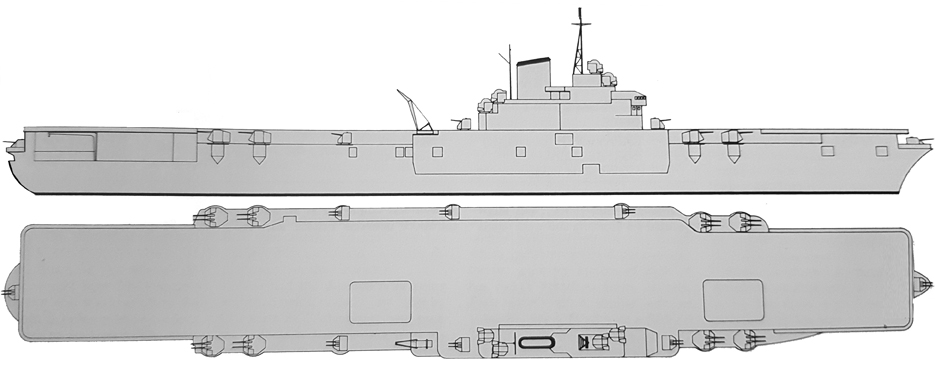
The original Clemenceau was a secret project elaborated after the Joffre class (started but never completed) was further developed in the occupation, with the idea of building a modernized variant after the war ended. This culminated in August 1947 when the design was approved and construction ordered. She was to be laid down at Brest. The PA28 borrowed much to wartime British light carrier design. The straight flight deck was armoured, both hangars were offset to port, two lifts 15 x 10 m with a capacity of 12 tons, forward and aft of the island. Seven arrestor hook cables were placed aft, in the classic configuration, with planes flying-off with two catapults and landing on the other side. However in 1949 the design was already outdated as British recently completed carriers and US upgrades already showing a new path. The PA28 project was abandoned in 1950. The new development line would led to the Clemenceau class (PA 54).
Development
The Joffre class (1936)
First off, naming of these project was straightforward: ‘PA’ means “porte avions” (“aircraft carrier”) but it was followed by project number when the program when approved for development, not by its year of approval. If PA 54 (Clemenceau class) could look like it’s year of acceptance it was not the case. PA 28 was either not a project of 1928. It just followed PA 27 in the development line (see below). As seen in the Joffre class carrier development, France in the early interwar already worked on multiple aircraft carrier projects, and it’s only in 1936 that’s the Joffre class was approved and financed for a construction start in 1937, for a launch in 1938, however completion was still ongoing by May 1940, leaving them no hope when France collapsed. Attitudes of the Germans towards the design was the same about their own carrier almost completed, the Graf Zeppelin, and if Admiral Darlan still hoped by 1942 to complete the pair to join the Vichy French Navy, this was never realized, and the ships were eventually scrapped at the end of the war as essentially outdated design, too costly to rebuild for postwar France.
One wartime event that could have relaunched the carrier option was the merger of the Free French Naval Forces and Vichy’s African Maritime Forces (or rather what left of it after the battle of Casablanca among others) on August 4, 1943. Indeed there was at last enough manpower for a large allied leased vessel, hopefully a cruiser or carrier. Later by July 1944, when the FNFL (The Free French Naval Forces) largely reconstituted with allied ships, mostly corvettes and Frigates was assigned to escort duties, it regained the confidence of the allies. So the Permanent Military Committee in Algiers requested the British for an Archer-class escort carrier. By default, the same also considered converting the incomplete and badly damaged and Jean Bart in Casablanca, or raze the seaplane tender Commandant Teste to create a deck above. However, the first option (Jean Bart) was rejected by the US to not disrupt already overburdened shipyards under standardized procedures. Commandant Teste, scuttled at Toulon in Nov. 1942 was still occupied by the Germans anyway and the landing was only planned for August, and even after rising her, the 167 m (547 ft 11 in) long ship would have been of the size of a Sangamon class escort carrier, perhaps if completed in 1945 at great cost, which brought little advantages.
Postwar Studies
But R&D never stopped. Until 1945 other projects were studied. As real events dictated the fat of the only operational French carrier at the time, the rather mediocre Béarn, immobilized in the West Indies until 1943, no longer capable of operating modern aircraft, it was indeed soon converted for the FFL into an aircraft transport at Avondale shipyards, New Orleans. Various requests made to the British and Americans for a carrier to be operated by the FFL went unheeded. Meanwhile, French design offices in Vichy, London, or Algiers produced more studies, trying to catch up and synthesize designs infused with the lessons learned during the war. Among these was an interesting hybrid battleship-aircraft carrier design, the PA1, 241 meters long and displacing of 28,764 tons for example, with a quadruple 305mm (14 inches) turret mounted aft. Next was PA-5A (1943): 39,000-ton ship (41,575 tons est. final displacement) 238 meters, 29.4 meters beam, 85,000 hp, armed with 8×2 115mm turrets, 32x 25mm guns, 40 as air group.
Even shipyards made proposals: St. Nazaire Penhoet proposed to create an improved version of the Joffre since completing the carrier was difficult: All the layouts have disappeared, templates have burned and to redo all the layouts there was to be a layout room, which had been destroyed as well as the hangar housing the machinery, rusting away for years. But in 1945 completing a design dating back 1935 was not appealing to say the least. The existence of the Joffre’s blueprints allowed Penhoët shipyards to promise construction within 36 months, provided the plans remained unchanged which was accepted by the Superior Naval Council accepted this proposal but preferred to review various preliminary designs from DCCAN. The Council still favoured a Joffre-class to be available asap, with the hope of being able to upgrade it in the next decade.
With project PA-27A, the DCCAN is tasked with drawing up plans and preparing construction of two protected combat aircraft carriers of 29,130 tons and carrying 54 aircraft. But Rear Admiral Barjot warned the Council that no shipyard in France was capable of building such ships within five years for five billion and would even struggled to build two 27,000-ton carriers given the task already of completing Jean-Bart. Admiral. He proposed to convert an existing vessel. General engineer Kahn, behind the Richelieu and Joffre, however, estimated French shipyards’ status was less catastrophic, and saw more a problem with the absence of coal. However, no decision was taken between budgetary constraints and technical or industrial uncertainties.
Postwar Carrier Acquisitions

Eventually, France requested a fleet carrier and an escort carrier from the US, again rejected as at that stage, carriers were more useful in the Pacific theatre, but ultimately, the British agreed to transfer HMS Biter (D97), another escort carrier of the Avenger class, damaged by the crashing of a Swordfish on 16 November 1943 at her stern, which torpedo detonated and destroyed her rudder, steering mechanism and assembly, plus plating. It was laid down in the Clyde estuary after four weeks of repairs, but still not recommissioned by November 1944. Instead she was returned to the US 9 April 1945. The latter, having no use for her, relenting about French demands, and after being refitted, she was commissioned in the French Navy as the Dixmude on April 9, 1945.
This was less the case of taking part of the war, now displaced in the Pacific, but rebuild skills in carrier operations with allied carrier naval aircraft, like the SBD-5 Dauntless. Dixmude will indeed rebuild these skills by taking part in the Indochina war from 1945 to 1949. Stricken from the USN in 1951 she had another refit in France in 1951-53 to become an accommodation ship at Toulon, replacing Béarn, until returned in 1965 and sank as target in 1966 in the Med, with the 6th fleet.
Dixmude however proved unsuitable as a solid fundation to recreate a fleet naval air arm. As a carrier she ceased activity in 1949 but meanwhile, on August 6, 1946, acquisition a proper aircraft carrier, the HMS Colossus renamed FS Arromanches leased for five years, purchased in 1951, was this fundation at last.
Arromanches symbolizes the rebirth of French naval aviation and gave a technical basis as well for the development of a new fleet carrier, despite the limitations of the 1942 fleet carrier design, basically a “second line carrier”, almost unprotected to refill front lines armoured carriers in the Pacific, and also smaller than average and built with many simplifications from Civilian Yards.
Still, the transfers of Dixmude and the Arromanches were merely stopgap measures enabling that construction of French-designed aircraft carriers. They were part of a broader fleet plan comprising mostly surviving worn-out and technically obsolete French ships, like two battleships (Richelieu and Jean Bart, the latter being modernized) and a few cruisers and destroyers, alongside ex-allied vessels and a mostly collection of ex-axis vessels, either German and Italian.
1947 Plan for six “Light Carriers”
By November 1947, the Navy estimated it would keep its two battleships of the Richelieu class, still useful as task force anchors and for coastal bombardment, but also four light aircraft carriers (Arromanches and a new class of three vessels), 3 escort carriers (the two Bois belleau (ex-Indep. class) and Dixmude), 3 cruisers (Interwar but modernized 1940s and TBM 1950s), 6 anti-aircraft cruisers (De Grasse and Colbert being completed, and ex-Capitani Romani vessels), 30 destroyers, 30 escorts, and 30 submarines. The latter were almost all to be build in France.
Note there were alternatives to PA 28:
PA-29: 22,500 tons. Cruiser-level protection. Cost: 4.5 billion France. Construction time: 4 years and 9 months.
PA-27: 26,130 tons. Protection combining that of the Illustrious class (armored deck) and Essex class (extensive internal compartmentalization). Price: 5 billion Francs. Construction: approximately 5 years. Both were rejected as too costly, by the Navy council itself on 2 october 1945 to avoid outright rejection by the parliament at the time.
PA 28 looked the most reasonable at 15,700 tonnes, unprotected, but costing “only” 3 Bn Francs with a construction time of 4 years 6 months.
Indeed at that stage with France barely out of the war and already engaged in Indochina, the DCCAN considered the economic situation ruled out construction of a new, high-speed fleet aircraft carrier for another four years, and that was even by reusing left over material from the Joffre class. It was also delayed by the reconstruction of a proper French naval aviation, with new models not ready to enter service for another three years so around 1948–1949. It was just “overly ambitious”. Acquiring existing carriers was still a far more affordable option.
Design studies for the light aircraft carrier of this plan continued. In 1947, PA 31 was also studied aside PA 28: This was a 38,000-ton protected carrier which had up to 10,300 tons armor protection, notably a 50mm thick flight deck, 100mm hangar deck, 30mm main deck, but lacking a conventional side armor belt, having instead a classic protected deck with side slopes. April 9, 1948: The “50” Plan confirmed an older design, the PA28, from the 1948 tranche, and a new class of 20,000-ton FY1951, likely a derivative of PA 31. Then a draft naval was presented on August 2, 1949, for 4-6 aircraft carriers rated for 20,000 tons, but it fell short. This PA 28 project did not meet with large approval, but was still voted and funded by the National Assembly on August 14, 1947. On September 1, the Navy Ministry awarded the construction contract to Brest Naval Dockyard, the first to be restored to operational capacity postwar. Work was delayed however due to a decree of October 9, prohibiting any new expenditure commitments before the National Defense extraordinary budget was voted. Construction was voted under “absolute priority” and PA-28 named Clemenceau par the Navy secretary M. J. Dupraz with a completion and trials scheduled for September 1952.
PA 28 Comes and Goes

Model of the PA 28
Fast forward and on March 7, 1949, MoD Paul Ramadier halted PA 28 and all preparatory work ceased, albeit equipment already been ordered was stored. The official cancellation of the class was only effective on May 31, 1949. It would have been already named the Clemenceau class. At the time, NATO made France its pivot, De Gaulle had retired, and relations with the United States were good. So that instead of the extra expense of building from scratch new carriers on a design that was already obsolescent (meanwhile in the US and Britain, angled decks were all the rage) the US lent France from USS Langley, renamed La Fayette on June 2, 1951, later followed by Bois Belleau, USS Belleau Woods, both of the Independence class. These were light carriers, but with longer decks, fast, and far more capable than Dixmude. They would be used in Indochina against Ho Chi Minh, another reason of their leasing under MDAP by the US. Modernized, these two carriers had a good protection and modern radars, they were also fully compatible with French Aeronavale Corsairs and Bearcats.
Design of the PA 28 class
Hull and general design
The PA 28 project ships were essentially classic straight deck designs strongly influenced by the British armoured and light fleet carrier designs. They were a middle ground between an Indefatigable class and a Colossus class, notably by the level of protection. Still marked by late interwar designs, their armament, if primary oriented on AA defence, still counter a powerful dual-purpose battery. Displacement as planned was 15,700 t standard and 20,110 t fully loaded. In dimensions, they certainly were not of the scale of an Essex or Midway, with an overall length of “only” 229.50 meters between perpendiculars (753 feet) and 215 meters at the waterline (706 ft) for a beam overall at deck level of 36 meters (118 feet) and between perpendiculars of 25 m (82 feet) for a draft of 6.50 meters (21 feet).

A rear overview of the PA 28 model showing a 2-engines NC1070 and the lift down.
As for the general layout, it looks like a mix between the USS Wasp and a British light carrier indeed. The prow was still separate of the deck (no hurricane bow yet), the two lifts were located offset to port, and the island was generous, of the British style with separate funnel and tripod mast with partly British electronics. There were generous sponsons either side for the heavy DP guns in pairs fore and aft and lighter AA guns, and two rescue boats under davits on starboard plus life rafts stored alongside the island port sponson. No wonder why in 1949 she was already at the limit to operate piston-engine aircraft, certainly not jets. This was a 1939, not a 1949 design.
Powerplant
The propulsion system was compact and powerful: It consisted of the arrangement seen on the super-destroyer Volta, so two groups of turbines of Rateau-Bretagne geared steam turbines designed to produce 92,000 shaft horsepower (68,604 kW) total, powered by four boilers (initially those of the Joffre class, later changed to modern Yarrow types). However, this was changed for two more modern Parsons turbines developing a total power as re-rated pushed to 105,000 hp total driving two propellers with classic 3-bladed fixed pitch propellers. Range was either 7,700 nautical miles at 18 knots or 4,700 nautical miles at 24 knots estimated.
Protection
Albeit most sources states she had none, there was likely a semi-armoured main deck above the waterline as the 1942 fleet carriers, meaning neither the hangar floor or flight deck were armoured. Aside this, they likely had transverse bulkheads to stem flooding fore and aft of the machinery space and in between, a double bottom, lower sides compartmentation. There was also the usual suspects of fire protection with a curtain dividing the hangar, a main fire control point, many hoses fire points and cocks to flood ammunitions magazines, self-filling safe avgas tanks and the likes.
Armament
The AA armament was considerable, with eight twin 100 mm turrets fore and aft and six twin 57 mm (So 24 in all). The 100mm guns were in eight twin turrets divided into four groups, two to starboard and two to port. The sixteen 57mm guns were a new type of ordnance developed with Bofors and widespread postwar, in eight twin turrets, one aft, one bow, three starboard and three port. For more info on these see the article on the De Grasse and Colbert AA cruisers or the T47 class destroyer.
Sensors
This is a complete unknown, however given the clues given by the models, they had two fire control turret forward, the type of which recalled the ones sported by the Battle class destroyer, a radar on top of the tripod that might be British as well. All radar types in service on RN ships in 1946-47 were likely to be adopted, notably for commonality with the Arromanches, which had the 79B air and surface scanning radar, a 277 and a 281B aerials and Type 293 target indicator.
Air Group
The PA 28 had a flight deck 220m long (721 ft) by 36m wide (118 ft). The hangar below as 130 m long by 24.40 m wide (80 ft) and 8.50 m high (28 ft). There were two 12-ton lifts offset to port. Two catapults were at the front and there 8 arrestor wires plus three barricades. This enabled in practice take off and simultaneous landings in normal conditions, but for larger strikes, the deck was cleared to mass aircraft at the rear, ready for launch unassisted. Aircraft complement was 45, albeit it diverged between soources, some stating as slow as 31 unless this was the hangar capacity alone. These were in 1947 still piston engines Fighters, nut not the Seafire, hellcat, Corsair or Bearcat and rather of the new Sud-Ouest/SNCASE SE 580 heavy fighter (dev. abandoned 1946).
More likely it would have been five SE582 heavy fighters instead, fitted with a development of the Jumo 213 in naval version, either a Hispano-Suiza 24Z or Arsenal 24H. However the main strike force was to be split between twenty-two torpedo bombers NC1070 or Nord 1500, provided the development was completed. The baseline was 27 aircraft, and there was an option for 22 SE 582 to be hanging out under the hangar ceiling, as fully workable models, not just spare parts.
Other sources also cites the twin-jet TB SNCAC NC1070.
⚙ PA 28 specifications |
|
| Displacement | 15,700 – 20,000 tons FL |
| Dimensions | 214/230 m oa x 25.4m wl/36 Fd x 6.5 m |
| Propulsion | 2x Parsons turbines, 4 boilers 105,000 hp |
| Speed | 32 knots |
| Range | 7000 nm/25 kts see notes |
| Armament | 16 x 100 mm, 16 x 57 mm, |
| Air Group | 31-45 aircraft, see notes |
| Crew | c1800 |
Conclusion
While the cancellation of PA28 was certainly a blow to aircraft carrier supporters, in hindsight, it proved to be a blessing in disguise: Between its lack of angled flight deck, steam catapult, optical landing system, the first “Clemenceau” was to be obsolete in a decade, with in addition a size preventing any later modernization. The two La Fayette-class in 1952-53 provided an affordable alternative, and R&D went on through the STCAN (Technical Service for Naval Construction and Armament) working on a new, more modern carrier from late 1952. Albeit the very first proposal still had a straight deck, Engineer General Gisserot managed to have the design radically revised to integrate an angles deck which was included from the start and already well angled, to create the PAX presented on March 25, 1953.

Original blueprints of the Foch, PA 54
This was a 19,000-ton vessel with a waterline length of 228 meter but flight deck length of 245 meters (with a hurricane bow), 120,000 horsepower on two propellers and elimination of the DP guns for only twin 57mm gun turret. If PA 28 was a 1942 British light carrier, the new PA 54 was a modernized Essex-class. This was the first draft of what became the next Clemenceau design, a successful pair of ships that basically incarnated the third era of French carriers from 1960 to the early 2000s and replacement by FS Charles de Gaulle.
Read More/Src
Links
web.archive.org/ stratisc.org/ P. Querel on the PA 28
secretprojects.co.uk
forummarine.forumactif.com/
navypedia.org/ fr_carriers.htm
ww2aircraft.net/ advanced-french-fighters