
 The Ottoman Empire’s Navy:
The story of the Ottoman navy goes back centuries, after the fall of Constantinople in 1453. By then an empire was born, that would take the lead in the Mediterranean. Its fleet mostly counted galleys and fast ships based on galley hulls (Xebec and derivatives). In 1571 when the fleet was at its peak, its golden age, a pivotal battle took place between it and a coalition of Christian powers. This defeat however never really stopped the effort of Sultans to dominate the area until the XIXth century. Certainly the poor relative of the Turkish army, the navy had been once the most powerful of the Eastern Mediterranean for several centuries. In 1870, it still dominated the Russians in the Black Sea, and was unavoidable in the Indian Ocean and the Red Sea, not to mention the Mediterranean. But since the empire had suffered defeats, which had been destroyed by considerable losses of territory, the navy had seen its budget dwindle at great speed. See the poster By the way, no ship at the time and until the fall of the Empire sported the prefix “TCG” adopted later (Türkiye Cumhuriyeti Gemisi or Ship of the Republic of Turkey).
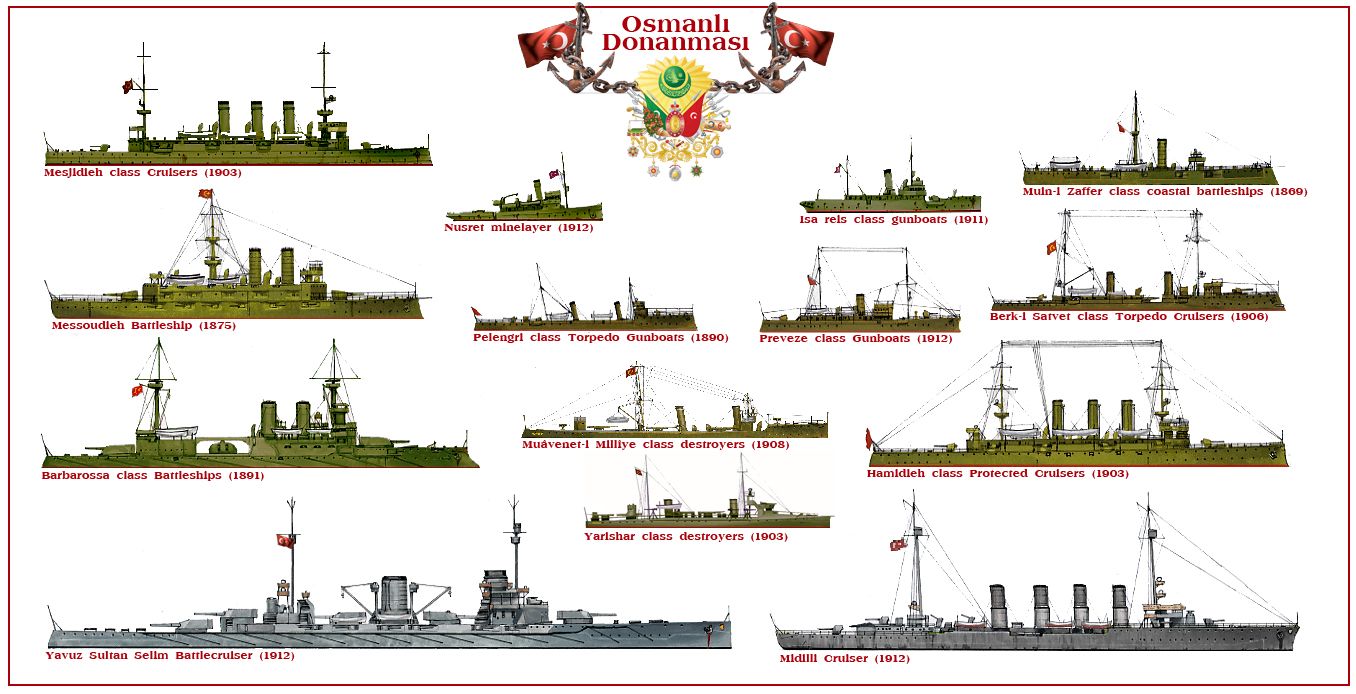

Published & to come
- Barbarossa class battleships (1892)
- Hamidiye (1903)
- Lütf-ü Hümayun (1892)
- Peleng-i Derya class Torpedo Cruiser (1890)
- Turkish Cruiser Mecidiye (1903)
- Yavuz (1914)
Cruiser Midilli (1914)
Sahahani Deria Torpedo cruiser (1892)
Berk-Efshan class Destroyer (1894)
Berk i Savket class Torpedo gunboat (1906)
Yarishar class destroyer (1907)
Muavenet class destroyer (1909)
Marmaris gunboat (1903)
Sedd ul Bahr class gunboat (1907)
Isa Reis class gunboat (1911)
Preveze class gunboat (1912)
Turkish WW1 Torpedo Boats
Turkish Armed Yachts (1861-1903)
Turkish WW1 Minelayers
The Ottoman Empire betweeen 1878 and 1914
Situation after the 1878 War

Major Territorial and Political LossesBalkan Shrinkage: Romania, Serbia, and Montenegro gained formal independence, while Bulgaria became an autonomous principality.
Foreign Occupation: Austria-Hungary occupied Bosnia and Herzegovina, and Great Britain took over administration of Cyprus.
Loss of African Territories: France seized Tunisia in 1881, and Great Britain occupied Egypt in 1882.
Financial and Economic Dependency: State Bankruptcy. Following its 1875 default, the empire agreed in 1881 to the establishment of the Ottoman Public Debt Administration, a council controlled by European powers that managed Ottoman revenues to pay off foreign debt.
Shift in Foreign Policy and Strategy: Centralization under Abdülhamid II. Sultan Abdülhamid II leaned into an ideology of pan-Islamism to unify the remaining Muslim populations and counter nationalist movements.Diplomatic Maneuvering: Despite its decline, the empire expanded its diplomatic network and engaged in competitive modernization and overseas relations to resist total partitioning.
Naval Challenges
 During the 1880s, the Ottoman Navy faced a unique, multi-layered crisis. Under Sultan Abdülhamid II, a fleet that had been ranked the third-largest in the world in the mid-1875s was reduced to virtual immobility.The primary naval challenges during this decade stem from financial ruin, political paranoia, and rapid technological shifts.
Political Paranoia and Strategic Neglect: Sultan Abdülhamid II harboured a deep distrust of his own naval officers. He believed the navy had played a key role in the 1876 deposition of his predecessor, Sultan Abdülaziz, and feared a seaborn coup against himself.The Golden Horn Confinement: To mitigate this perceived threat, the Sultan ordered the main battle fleet to remain anchored inside the Golden Horn waterway in Constantinople.
Rotted at Dock: Stripped of blue-water training exercises and regular navigation, the empire’s heavy ironclads spent the 1880s slowly rusting at port. This effectively hollowed out the empire’s strategic naval doctrine.
Severe Economic Constraints: The economic fallout of the 1875 bankruptcy and the 1877–1878 war with Russia left the treasury bare.Lack of Maintenance Funds: With the Ottoman Public Debt Administration taking control of major imperial revenues in 1881, funding for military infrastructure collapsed.The Cost of Steam Power: The shift from sail to coal-propelled ships required advanced supply chains, specialized engineering, and massive coal imports. The Ottoman state simply could not sustain the immense cost of maintaining a modern steam fleet.
Rapid Technological Stagnation: The 1880s was a period of intense global innovation in naval engineering, marked by the introduction of steel hulls, quick-firing rifled artillery, and early torpedo tech.Widening Industrial Gap: Western European nations like Great Britain and France were leveraging the Industrial Revolution to continuously upgrade their fleets. Meanwhile, Ottoman shipyards functioned primarily on an artisanal level, unable to locally mass-produce steel plating or heavy machinery without heavily reliance on foreign expertise and imports.
Despite their internal stagnation, the Ottomans had to contend with the rise of regional competitors. The Greek Navy’s acquisition of a primitive Swedish Nordenfelt submarine in 1885 triggered a panic in Istanbul.The Failed Submarine Experiment: Hoping for a cheap, asymmetric advantage to secure the Aegean, Abdülhamid II purchased two larger Nordenfelt-class vessels, named the Abdül Hamid and [Abdül Mecid]. In 1888, the Abdül Hamid became the first submarine in history to successfully fire a torpedo while fully submerged. However, both vessels suffered severe stability issues, were highly unsafe, and lacked trained crews willing to operate them. They, too, were ultimately abandoned to rust.This era of decay left the Ottoman Empire practically defenceless at sea, allowing European powers to stage aggressive “naval demonstrations” unchallenged and facilitating the eventual loss of Aegean island control in the decades that followed.
The 1897 Greek-Ottoman War
 The naval deficiencies of the 1880s directly caused a total paralysis of the Ottoman Navy during the 1897 Greco-Turkish War.While the Ottoman land forces—reformed by German advisors—secured a swift and decisive victory on the battlefields of Thessaly, the navy was completely unable to contest the sea. Decades of neglect and political paranoia culminated in an asymmetric failure in the Aegean.
Complete Loss of Aegean Sea Control: Because Sultan Abdülhamid II had kept the fleet locked inside the Golden Horn for nearly two decades, the ships were physically and operationally unprepared for war.
Paper Fleet vs. Reality: On paper, the Ottoman Navy looked formidable, boasting battleships, ironclads, and cruisers. In reality, the ships were so poorly maintained, plagued by rusted machinery, and manned by untrained crews that they could not safely venture past the Dardanelles straits.
Greek Naval Supremacy: In stark contrast, the smaller Kingdom of Greece had actively modernized its navy with new warships. Armed with better armor, maneuverability, and torpedo technology, the Greek fleet assumed undisputed control of the Aegean Sea.2. Inability to Defend CreteThe war was primarily sparked by an uprising on Crete, where the Christian majority desired unification with Greece.Unopposed Greek Landings: Due to Ottoman naval immobility, Greek troopships and ironclads (such as the Hydra-class battleships) sailed to Crete and landed an expeditionary force completely unopposed by the Ottoman Navy.


The Only Confrontation: The sheer imbalance was highlighted by the war’s lone recorded naval encounter: the Greek cruiser Miaoulis easily chased away a lone Ottoman dispatch boat, the Fuad, which was making a desperate attempt to reinforce the island.
Logistical Strandedness: Because the Aegean was effectively a “Greek lake,” the Ottoman military could not use maritime routes to supply its forces. All Ottoman reinforcements, heavy artillery, ammunition, and rations had to be transported via slow, arduous overland routes through the mountainous Balkans.
The Geopolitical Aftermath: Though the Ottoman Army decisively won the war on land and forced Greece to pay a massive financial indemnity, their naval impotence meant they could not hold onto Crete.
Autonomous Crete: Seeing that the Ottomans could not project power to secure the island, the Great Powers stepped in and forced the creation of an autonomous Cretan State under Ottoman suzerainty, but governed by Prince George of Greece.The total failure of 1897 served as a massive wake-up call. It forced the Ottoman government to finally abandon the Golden Horn isolation policy and look toward British and German naval advisors to completely rebuild the fleet from scratch before the Balkan Wars.
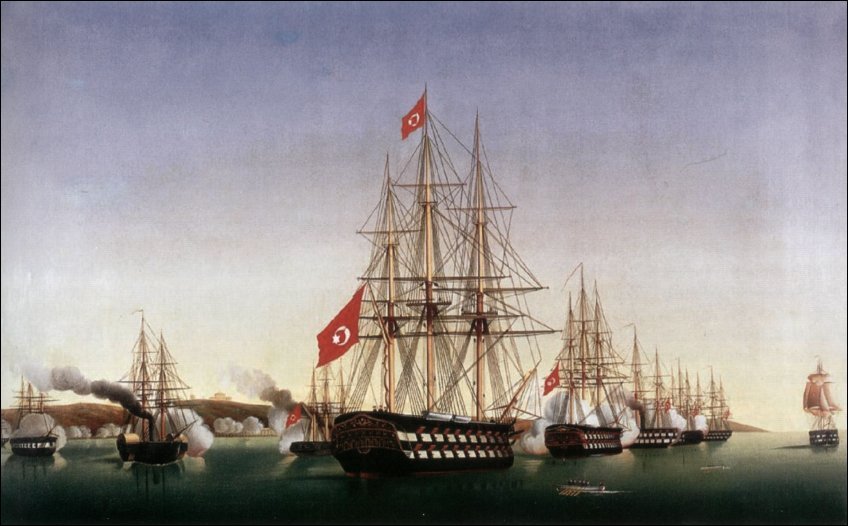
There were virtually no new orders from abroad. The defeats suffered in the face of the Russian fleet were not foreign to it, and the navy had lost its prestige and the confidence of the rulers of the empire. If it had played a major role in the ousting of Sultan Abdul Aziz for the benefit of Abdul Hamid II in 1878, it was dismantled and demoralized; Without maintenance, its numerous and powerful units were abandoned and rotted with rust.
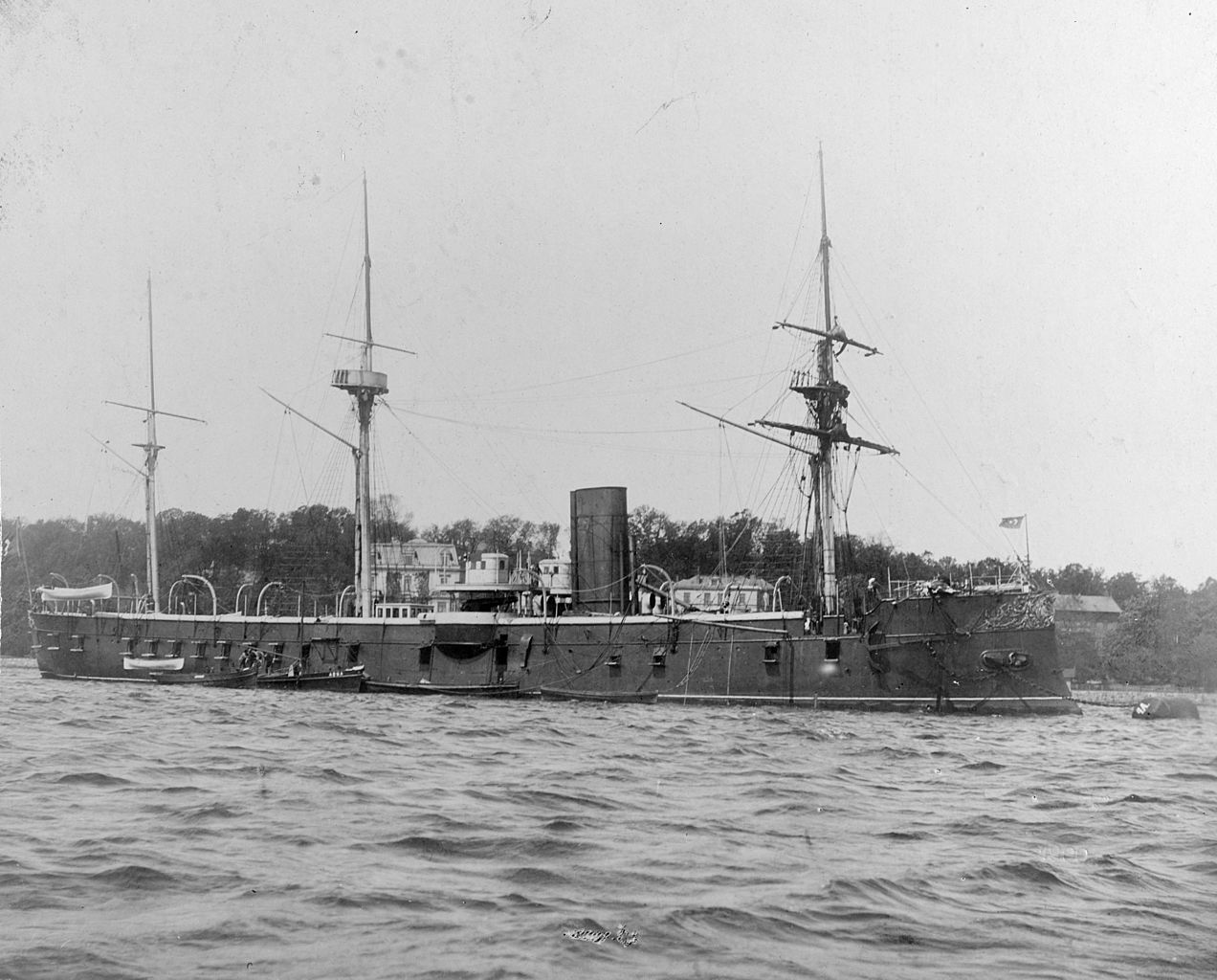
Armoured Frigate Asar-i Tevfik at Kiel, 1905
Beginning in 1884, a few orders gave way, but did not alter the pace of decommissioning of powerful buildings. In 1890, an ambitious new plan had been issued for orders of Hoche battleships to France and the reconstruction of old battleships, but no orders for cruisers or destroyers were pursued. At the beginning of the century, two new cruisers and destroyers were built and acquired but were also condemned to total inaction while the old battleships were modernized and converted into coastal ships.
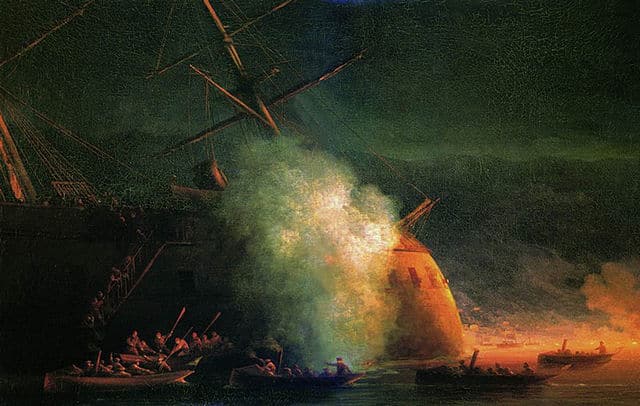
Assari Shevket assaulted and burnt by Russians steamer boats of Grand Duke Constantine on the Sukhumi roadstead, August 12, 1877

The coup d’etat of the “young Turks” was going in 1909 to change the attitude of Turkey vis-à-vis its fleet. This nationalist movement reacted to ambitions of naval power, and announced at the outset a 6-year naval plan consisting of 6 battleships, 12 destroyers, 12 torpedo boats and 6 submersibles. The realization of this plan was delayed so that when the war broke out in 1911 with Italy, the Turkish fleet was completely unprepared. In order to deal with the emergency, the government bought 2 German battleships and 4 destroyers, as well as rapid civilian ships for reconversion into gunboats.
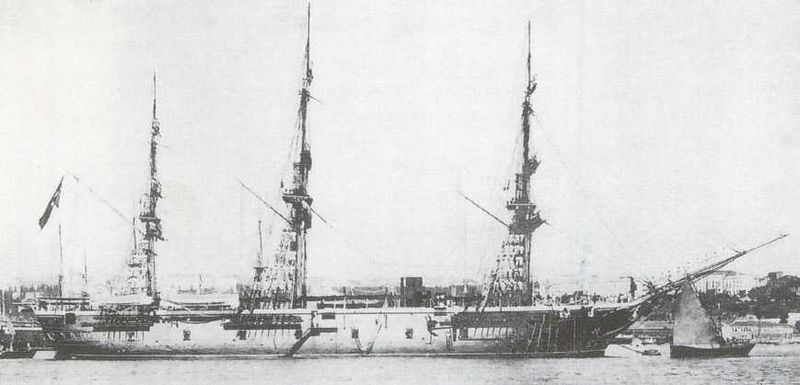
Ottoman Frigate Ertrugul
This decision was to be credited to the two British Rear Admirals, William and Gamble, who had been appointed to the fleet in 1910 by their naval commission in Istanbul. Nevertheless, the lack of audacity of the fleet meant that few sorties The fleet consisted of the two battleships, two cruisers, and five destroyers, came out of the Dardanelles to anchor in Beirut, but the vessels in other ports on the coast, including Izmir, were cut to pieces by the Italian Navy. His forces could not prevent the Greeks from taking control of almost all the islands of the Aegean Sea during the Balkan war.
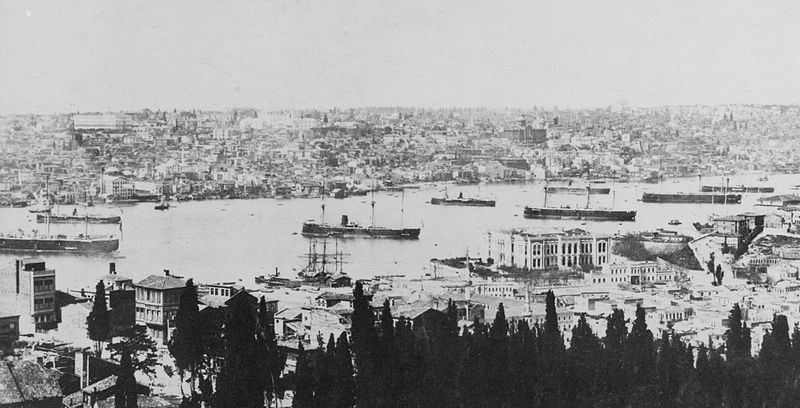
Ottoman Fleet in the golden door
At the beginning of this war against the Greeks, one of the aims of which was to retake Crete, Turkey bought back to Britain the battleship Rio de Janeiro, which should have been called Sultan Osman I. We know that the latter Was at its completion integrated into the Royal Navy. Other orders were given to Germany and France, but none were definitive. It was also studied the possibility that large British shipyards would take over a number of Turkish ports, including Izmir, by a thirty-year lease, but the outbreak of war ended the project.
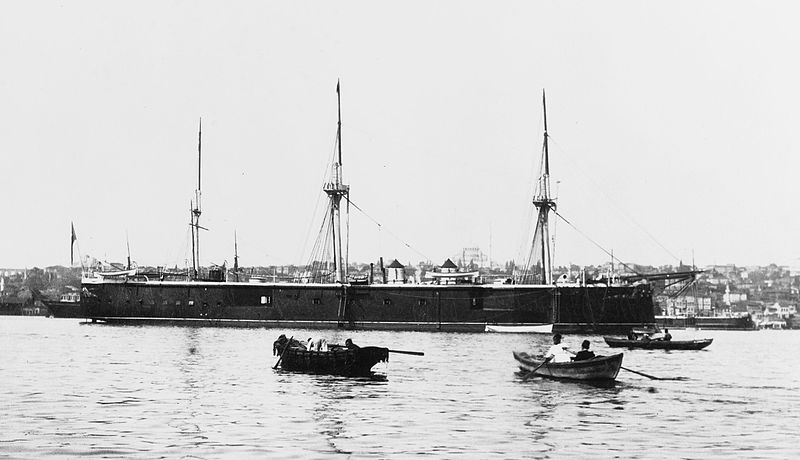
Ottoman ironclad Mesudiye, at the origin (1870s)
In 1914, the Turkish army was very effectively guarded by German officers (a military mission had been installed since the end of 1913 under the orders of General Von Sanders). The navy, partly equipped with the German, was also influenced by the policy of Berlin. When in August the Turkish ships ordered were seized by the British, public opinion but especially the nationalist government declared war on the triple agreement.
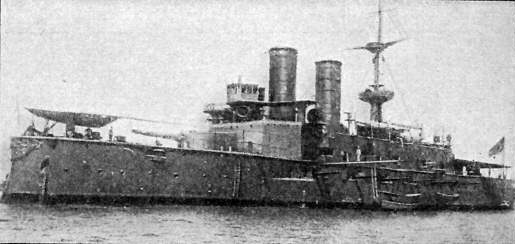
Ottoman ironclad Mesudiye in 1914
A miracle then took place: In the Mediterranean was the German squadron composed of the battle cruiser Goeben assisted by the cruiser Breslau. This squadron, commanded by Rear Admiral Wilhelm Souchon, was at Alexandria, which he was to leave in disaster, and the French and British naval forces were preparing to hunt down and annihilate it. Against all expectations in his desperate position, Souchon chose to rally directly to the Dardanelles and to take refuge in Constantinople, which he reached on the 11th of August.

The Abdul Kadir was a Britih-plans pre-dradnought battleship built in Constantinople that was never completed (1909)
At that moment the two ships were refugees in a neutral port, and the Turkish government, with the consent of Berlin, bought the two ships, which at once strengthened the fleet two fold. As of November 1, the Ottoman Navy reorganized around the Yavuz, shelled large Russian ports of the Black Sea.

Sultan Osman I artist impression, Brassey’s Naval Annual 1914. The ship was to be resold to Brazil but ended in British service as HMS Agincourt.
However, this reinvigorated fleet never made a sortie westwards while the Dardanelles’ forts, mines, nets and batteries would inflict more damage on Franco-British forces during their attempted landings than any other Mediterranean force of the Central Empires. Raids of Turkish-German ships were infrequent but effective, and contributed to the disorganization of Russian supply convoys. In addition, flotillas in Mesopotamia, on the Euphrates and the Tigris, were set up to fight against the British, using small German ships that came through Bulgaria.

Resadiye was seized by the British Government in 1914 and completed, put into service as HMS Erin.
In 1918, however, the Turkish military situation had settled on land to the south, whereas Mudros fell at the right time. The fate of the Goeben would normally have been to join other ships of the Hochseeflotte sent captive to Scapa Flow, but under the new name of Yavuz Sultan Selim and command of Admiral Arir Pasha, she seemed to escape this fate as now permanently integrated into the Turkish fleet, although interned in Izmir under British control. By the treaty of Sèvres in 1920, however, this Ottoman fleet was singularly amputated by discarding and breaking up several ships, reduced to 7 gunboats and 6 torpedo boats whose armament was precisely limited. The Yavuz, like the rest of the heavy ships, was supposed to be given to Great Britain or Japan.
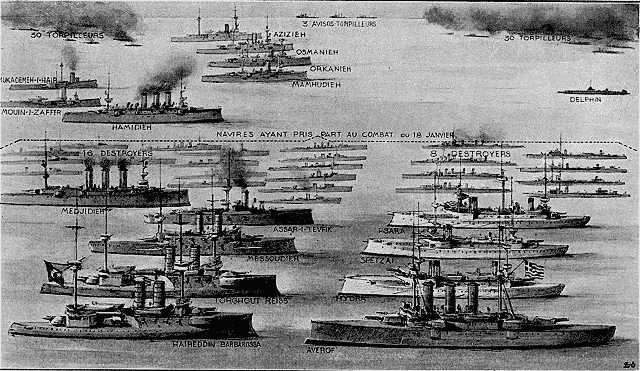
Ottoman and Greek fleets in 1913
Finally, in 1922, Mustafa Kemal (Ataturk) in Anatolia kicked the Sultan Mohammed VI in 1922 after a revolution and a civil war, and the two gunboats of the Kemal forces took refuge in the Fleet of the Black Sea, then in the hands of the “Reds” to avoid capture. Finally, the Turkish Forces defeated the Greeks and their victory was recognized by the Treaty of Lausanne on July 24, 1923. This agreement also signed the release of the Turkish fleet interned in Izmir and saved the battleship Yavuz for good.
The ship would be modernized and refitted, which was carried out by the Gölcük Naval Shipyard from December 1927, overseen by French Atelier et Chantiers de St. Nazaire-Penhöet. Sh was renamed again just “Yavuz” in 1936 and was slightly refitted in 1938. Turkey was neutral during WW2 despite pressure, and the ship was still in service at the beginning of the cold war. Sadly, whereas she was decommissioned in 1953, she was not scrapped until 1973, and all this time nobody tried to have her purchased for preservation, as the only example of a WW1 battlecruiser afloat. Turkey did not had the budget, but contacted the Federal Republic of Germany and offered to sell it in 1963 as a museum ship. But the Western Germans had other priorities than restoring and showcasing an Imperial ship, associated with an old militaristic regime and the rest of the world did not created a collective. Nowadays only her propeller is showcased at Gölcük.
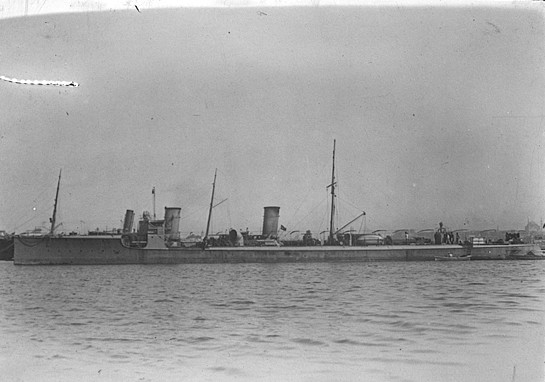
Destroyer TGC Muavenet, of German construction, like most of the fleet in 1914.
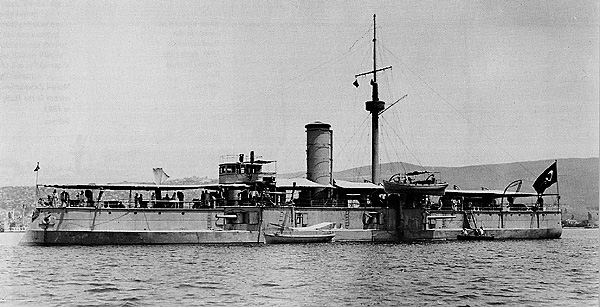
TGC Muin-I-Zaffer as rebuilt, seen here at Salonica in 1911
Detailed list of Turkish ships
Battleships:3 -H.Barbarossa class, Yavuz (1914)
Coastal BS:3 -Nijmi Sevket, Messudieh, Muin-I-Zaffer
Cruisers:3 -Hamidieh, Medjidieh, midilli (1914)
Destroyers:8 -Yarhishar, Muavenet class
Torpedo Gunboats:3 -Pelengri Deria, Berk I Savket class
Gunboats:19 -Sevket Numa class, Iz el Din, Zuhaf class, Marmaris, Yozgat, Sedd ul Bahr class, Isa Reis class, Preveze class
Armed Yachts:7 -Beirut, Galata, Cipka, Tarabulus, Istanbul, Ertugrul, Sogütlü
Minelayers:2 -Nusret, Intibah
Torpedo Gunboats:3 -Pelengri Deria, Berk I Savket class
Submersibles:2 -Müstecip Ombasi, 1 captured 1915
Torpedo Boats:c40 -Abdul Mecid, Akhishar, Berk Efşan, Hamidabad class, N°1-24 class
Turkish Ships of WW1
Battleships class Hayreddin Barbarossa (1891)
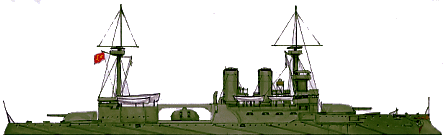
If the operations of the Turkish fleet were carried out with fast units, the battleships of the fleet were however anchored in Constantinople. Indeed for long the most recent Turkish battleship was the Messudieh, dating from 1875. In 1910, faced with impending war in the Balkans (and facing Greece), the Turkish government asked the kaiser for the purchase of two battleships then in reserve, from the Brandenburg class. After agreement on September 10, the two units, the Kurfürst Wilhelm and the Weissembourg were bought and joined Constantinople, while at the same time, the Turkish government approached the British for the construction of two other units. After their arrival, the two units were renamed Hayreddin Barbarossa and Torgud Reis, and repainted in khaki, the singular wartime livery of the Turkish Navy.
They were very active during the first Balkan War, bombing Varna, supporting the Chatajla line against the Bulgarians, then taking part in two naval battles against the Greeks on December 16, 1912 and January 18, 1913. Damaged, they each lost a casemate gun. They were also partially disarmed and their artillery ventilated between other auxiliary ships and fortifications of the Dardanelles. They served as coast guards in 1914-18. TGC Barbarossa was torpedoed and sunk by the E11 on August 8, 1915 near Boulair (Sea of Marmara). Torgud Reis, which towed the Yavuz seriously damaged by mines, saved it in January 1918. In 1928, she was converted into a training ship and broken up in 1957, after 66 years of good and loyal service.
specifications
Displacement: 10,500 t
Dimensions: 115.7 x 19.5 x 7.9 m
Propulsion: 2 shaft VTE steam engines, 12 boilers, 10,200 hp, 16.5 knots.
Armor: Main turrets 380 mm, belt 305 mm, barbettes 150 mm
Crew: 568.
Armament 6 x 280mm (3×2), 8 x 105mm, 8 x 88 mm, 6 TLT 450 mm.
T.C.G Yavuz Sultan Selim (1911)
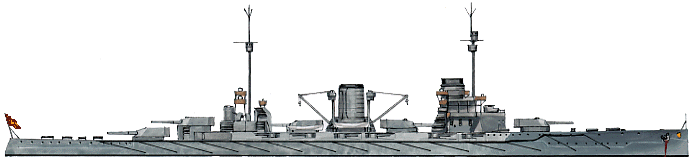
Yavuz Sultan Selim was not named that way until August 16, 1914. She was undoubtedly one the most famous ship of the war after the Lusitania in the consequences it engendered. Originally, the Kaiserflotte battle cruiser SMS Goeben (Moltke class) and her teamship, light cruiser SMS Breslau, formed the German Mediterranean squadron. With the outbreak of hostilities, Vice-Admiral Souchon managed to reach Constantinople during an epic chase (see the Goeben affair).
The Turkish fleet had recently been amputated from two vessels ordered and paid for at British shipyards, and diplomatic relations had stalled. The Kaiser saw there an opportunity to join the Ottoman Empire to his cause by opportunely offering the two German ships, put in a difficult position because of Turkish neutrality. On August 16, Souchon received the approval of the Kaiser and his officers combed the fez while Sultan Abdul Hamid II baptized the Goeben Yavuz Sultan Selim and the Breslau Midilli. Their first naval operation started on October 28, when Turkey declared war on Russia.
The two ex-German ships (with their original crew) were still under the command of Wilhelm Souchon, as grand admiral of the Turkish fleet. He carried out a series of bombardments of the Russian coast, in particular Odessa, Sevastopol, Novorrossisk. Then on November 18, the Yavuz carried out an interception of the Russian battleships of the Black Sea fleet. This became the battle of Cape Sarytch on November 18.
On December 10, she made another outing to Batum, but hit while returning on two Russian mines placed in the Bosphorus. Her repairs were completed in April, and the Yavuz made another sortie and met the Russian fleet. She left the duel with 2 large calibers hit on May 10. On January 20, 1918, she hit two other mines and was bombed twice by allied aviation. She carried out a total of 17 actions in the Black Sea, and was interned and inactive until 1926. From there, she was modernized b a French yard and served during the Second World War. She was written off and broken up in 1956, sadly the only example of a German battlecruiser of that era, and last battecruiser afloat.
specifications
Déplacement: 22 616 t, 25 300 t FL
Dimensions: 186,5 x 29,5 x 9 m
Propulsion: 4 shaft Parsons turbines, 24 Schultze-Thornycroft boilers= 52 000 hp. 25,5 knots
Armour: Battery 200, Citadel 200, Main turrets 230, belt 250, blockhaus 350, barbettes 230 mm
Equipage: 1355.
Armament: 10 x 280 (5×2), 12 x 150, 12 x 88, 4 x 500 mm TTs (Sub, fwd, aft, 2 bds)
Ironclad Messudieh (1875)
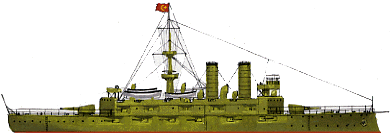
The only battleship in the Turkish fleet before the first Balkan War in 1912 was a completely obsolete battleship, the only remaining from waves of old reformed mixed line ships dating back from the second half of the past century. She was rearmed in 1891 with three Krupp guns of 150 mm, then was completely rebuilt in 1898-1903 at the Ansaldo shipyards. She came out with a new superstructure, new machinery, and a new modern battery (See the sheet below). However the two 233 mm in turrets provided at the front and at aft were never assembled, and the Messudieh resumed service with… two wooden replicas instead !. Of questionable military value to say the least, she was sent to the Dardanelles Strait, firmly anchored in Charnak in addition to the coastal batteries. She was spotted and torpedoed by the British submersible B11 on December 1, 1914.
specifications
Displacement 9120 t standard
Dimensions 101 x 18 x 7.90 m
Propulsion 2 shaft TE steam engines, 16 Niclausse boilers, 11,000 hp, 16 knots.
Armor: Belt 305, battery 254, casemates 80, blockhouse 203, bridge 76 mm;
Crew 600
Armament 12 x 152, 14 x 76, 10 x 57, 2 x 47 mm guns.
Coastal armored ship Muin-I-Zaffer (1869)
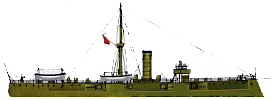
Among the most ancient vessels of the Turkish fleet, the Muin-I-Zaffer was the survivor of a class of two small mixed casemate ironclads, with the Avni Illah lost in combat in 1912. These two mixed ex-ironclads of British construction were rearmed in 1891, while their mast were reduced, and they were completely rebuilt in Ansaldo in 1903-1907. They came out with a single military mast, a lighter hull, rebuilt with side casemates, but kept her original machinery but with new cylinder boilers, and armor. The two vessels participated in the Balkan War, and the Muin-I-Zaffer was still in service in 1914 as a coastal defense battery. She was put in reserve in 1916, her sailors being assigned to other ships, and she played no role during the rest of the war. It was broken up in 1922.
specifications
Displacement 2200 t standard
Dimensions 69 x 11 x 5 m
Propulsion 1 shaft, Horizontal Compound steam engine, 10 Niclausse boilers, 9000 hp, 13 knots.
Armor: Belt 152, casemates 102, CT 152, decks 76 mm
Crew 220.
Armament 4 x 150, 6 x 76, 10 x 57, 2 x 47 mm guns.
Cruiser Hamidieh (1903)
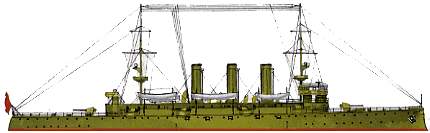
Second of the two modern cruisers of the Turkish fleet in 1914, the Hamidieh was commissioned under the name of Habdul Hamid in 1901 at Armstrong shipyards. It was practically identical to the Medjidieh, although appreciably heavier, longer and wider, with lower windsocks, it had the same protection, the same armament, except that the guns were manufactured by Vickers-Armstrong. Launched in September 1903 and completed in 1904, it was renamed Hamidieh in 1908.
She took part in the two Balkan wars, and on November 21, 1912, torpedoed in front of Varna. She returned to Constantinople at low speed, giving band, but was repaired and operated during the last days of the second Balkan war. She was very active however at the start of the great war against the Russians. She was refitted after the war with two Krupp 150 mm guns and eight 76 mm, then served as a training ship for fleet aspirants. In service during the Second World War, she was BU in 1947.
specifications
Displacement 3300 t standard
Dimensions 100.6 x 12.80 x 5.33 m
Propulsion 2 shaft 2 VTE steam engines, 12,500 hp, 22 knots
Armor: 102 mm deck crew, 30 mm bulkheads
Crew 312
Armament 2 x 152, 8 x 120, 6 x 75, 6 x 37, 2 x TT SM 457 mm broadside.
Cruiser Medjidieh (1903)
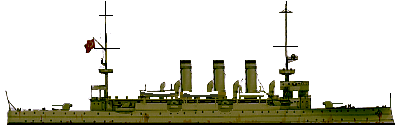
First of two modern cruisers in the Turkish fleet in 1914, the Medjidieh was ordered from Cramp shipyards in the USA at the same time as the Hamidieh at Vickers-Armstrong. It was practically identical to the latter, but nevertheless lighter, shorter and less wide, but also fast and benefiting from the same protection. He also had the same armament, except that the guns were manufactured by Bethlehem Steel. It stood out mainly for its more compact silhouette and high windsocks. She took part in the two Balkan wars, and was very active at the start of the great war against the Russians. It was during one of his sortie in April 3, 1915 that she hit a mine off Odessa. The Russians managed to captured her and repaired her, and she made a career until 1918 under the name of Prut, completely rebuilt in Nikolayev. She would return to Turkey in 1919 and served again, modernized in 1923 and active until 1947.
specifications
Displacement 3300 t standard
Dimensions 100.6 x 12.80 x 5.33 m
Propulsion 2 shaft 2 VTE engines, 12,500 hp, 22 knots max.
Armor 102 mm deck crew, 30 mm bulkheads; Crew 312
Armament 2 x 152, 8 x 120, 6 x 75, 6 x 37, 2 x sub TT 457 mm bds.
Cruiser Midilli (1911)
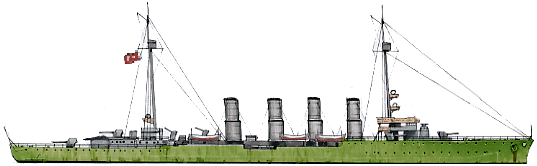
This inseparable traveling companion of the SMS Goeben, light cruiser of the Magdeburg class by the name of SMS Breslau, became the Midilli on August 16, 1914, after having taken refuge in Constantinople. Already under the German flag, she had fired the first shots of the war by shelling Bône and Philippeville in Algeria on August 3, then crossed swords with HMS Goucester while heading east.
Under the Turkish flag, she was widely used in sorties with Yavuz, ex-Goeben, as a scout, but not hesitating to cross swords with other ships, like an old Russian battleship at the battle of Cape Sarytch in November 1914. The second of command was a young officer by the name of Karl Dönitz. On October 29, she devastated Novorrossisk, sinking 14 steamers and destroying the 40 oil tanks of the harbor, seriously hampering Russian moves in the areas. On December 23, she sank a transport and captured a cargo ship intended to block the port of Zonguldak.
In April 1915 she sank two other freighters, then the night of this action, helped by the powerful searchlights of the Yavuz, she sank three Russian destroyers. In August, a duel set her against other destroyers, and she sank two, after being badly hit. On July 4, TGC Midilli shelled Tuapse and Lazarevskoye, sinking the cargo ship Kniaz Obolensky. She was hit in the bow by the Russian Battleship Imperatrista Mariya. She laid mines in the Sea of Azov. In 1916, she replaced her 105 mm pieces with two 150 mm Krupp models, and in 1917, with a complete battery of 8 guns of this caliber. She was seriously damaged by a mine in July 1915, but definitively lost on January 20, 1918 by hitting 5 mines in a British field near Imbros, and sank by the stern in ten minutes with the two thirds of her crew. Yavuz survived her.
specifications
Displacement 4570 t – 5587 t Ft
Dimension 138.6 x 13.4 x 5.1 m
Propulsion 4 shafts, 2 turbines, 11 standard boilers, 35,500 hp. 28.2 knots
Armor (see Magdebug class)
Armament (1918) 12 x 150 mm, 2 x 500 mm TTs, 120 mines.
Cruiser Drama (1912)
Drama was a British designed protected cruiser the Sutlan was advised to build in Italy because it was much cheaper. So under the name “Drama”, she was laid down at Ansaldo, Genoa in 1907, but construction proceeded slowly as negociations for payment dragged on, and she was requisitioned when the war broke out with the Ottoman Empire. She was launched on 11 November 1912 and completed on 25 March 1913, renamed “Libia” when commissioned by Italy. This 3760/4460t vessel was powered by two 4-cyl. VTE engines fed by sixteen Niclausse Boilers, for 22.9 knots and armed Arsmtrong guns, two 6-in/50, eight 5-in/45, eight 47mm/50 Vickers, six 37mm/25 Hotchkiss model 1890 and two above water 450 mm torpedo tubes.
Former cruisers
In 1914 only Messudieh and Hamidieh were operational as cruisers, before joined by Midilli, ex-Breslau. But in the preceding decade, the Turkish Ottoman Navy ordered more cruisers: Heibetnuma (1890), Lufti Humayun (1892), Hadevendighar (1892) and the Shadieh class cruisers (1893). They were far more recent than some ironclads still in service, so why they were no longer commissioned ? The construction was started in Istanbul and Ismid, but most saw their construction stalling, taking 10+ years with little results to show for and most were scrapped on slipway in 1911 as the Navy was completely discredited after the disatrous war against the Italians the same year.
Heybetnüma
She an unprotected cruiser built for the Ottoman Navy. She had a composite hull with wood planking over an iron frame and like the others, was laid Down in 1881 at the Constantinople (Istanbul) Imperial Dockyard. She was launched on January 30, 1890, and completed in 1893, in 12 years. She served a relatively brief, inactive life due to the general stagnation and lack of maintenance in the Ottoman fleet and her own issues. This was so acute she was considered no longer operational and was decommissioned and stricken from active records in 1909, scrapped in 1911.
⚙️ Technical Specifications:
1,463 tons, Lenght 226 feet (68.9 meters)Beam, 37 feet (11.3 meters)n Draft 17 feet (5.2 meters)
Propulsion: 1 shaft horizontal triple-expansion engine, 6 rectangular boilers, 2,785 ihp
Top Speed: 14 knots
Armament: 3 × Krupp 6.7-inch guns, 6 × Krupp 4.7-inch guns, 4 × 47 mm guns, and 2 × 14-inch torpedo tubes.
Lufti Humayun (1892)
 Lütf-ü Hümayun, also orthographed “Lufti Humayun” in western publications, is probably the worst case of shipbuilding failure in the entire Turkish Naval construction. It also reflected on the sorry state of the Ottoman Navy at the eve of the 1897 war with Greece. And this 3rd class cruiser here, despite being commissioned a year before, was never deployed, staying at berth for training… Lütf-ü Hümayun was an unprotected cruiser of the Ottoman Navy, ordered in 1880, started in 1882 at Tersâne-i Âmire, Istanbul, buy only launched on 16 August 1892, trialled in July 1896 and commissioned in October but used as a stationary training ship. In 1905, she was dismantled with plans to rebuild her by Ansaldo but this went nowhere, and she was decommissioned in 1908, sold for BU in November 1909. So technically she was no longer around in 1914. A superb demonstration of a complete shipbuilding failure. Click on the title for more.
Hadevendighar (1892)
The Unprotected Cruiser Hüdâvendigâr, transliterated as above in western litterrature, She was laid down in 1892 at the Tersâne-i Âmire (Constantinople/Istanbul Dockyard), planned as the lead ship of a two-vessel class alongside her projected sister ship, Selimieh. The design followed a contemporary global trend of fitting medium-sized cruisers with comparatively heavy guns.Fate: Due to chronic financial difficulties, lack of resources, and material shortages within the Ottoman Empire, the ship was never completed. Construction was eventually abandoned altogether, and the incomplete hull was scrapped in 1911.
⚙️ Planned Specifications (As Designed)
Displacement: 4,050 tons. Length 280 ft (85.3 m), Beam 50 ft (15.2 m), Draft 20 ft (6.1 m)
Propulsion: 1 shaft likely HRCR and 2 boilers.
Planned Armament: 2× 8.3-inch (210 mm) Krupp guns, 6 × 5.9-inch (150 mm) Krupp guns, 4 × 4.1-inch (105 mm) guns, 5 × torpedo tubes.
Shadieh class cruisers (1893)
This was a minor group of steam-powered cruisers built or designed for the Ottoman Navy (Osmanlı Donanması) around 1893. Contemporary to the Heibetnuma (1890), Lufti Humayun (1892), and Hadevendighar (1892) they were classed as small unprotected scout cruisers for the modernized ironclads and alongside old and new gunboats. They were Part of Sultan Abdülhamid II’s wider, constrained naval modernization efforts of the 1890s, which preceded the major twentieth-century shakeups of the Ottoman fleet (such as the acquisitions of the Mecidieh and Hamidiye in 1903). They are cited in Conway’s AWFS 1860-1905 page 392.
Laid down in 1891 at Ismid, these stell-hull cruisers were oroginally planned to be armed with 5.9 BL guns, then six 4.7 in QF British Arssmtrong guns, completed by four 47mm Hotchkiss, four 37mm Hotchkiss, five 18 inches torpedo tubes, (1 bow, 4 broadside). They were never launched, rotting without much progress wit the frame completed but no full plating by 1904. No decision was taken and they rtusted away on slip until it was decided to free the slipways by breaking them up in 1911.
⚙️ Planned Specifications (As Designed)
Displacement: 1600t. 64 x 9.14 x 3.96 m or 210 x 30 x 13ft.
Machinery 1 HC 2160 ihp fr 14 kts, coal c200t
Armament: 3x 6.7 in/25 (170mm) krupp, 6x 4.7 in/25 (114mm) Krupp, 4x 47mm H, 2x 14-in(350mm) TTs.
Yarishar class destroyers (1908)
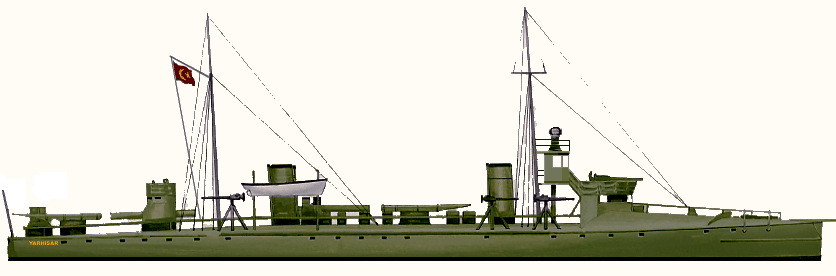
Four destroyers, also known as the Samsun class, were ordered in 1906 from the French shipyards of Gironde on the model of “Durandal” of 300 tons of Normand. The class included the Yarishar, Tasoz, Samsun, and Basra. They were delivered in 1908. They were very active during the two Balkan wars and the world conflict. The Yarishar was torpedoed on December 3, 1915 in the Gulf of Izmit, by the English submersible E11. The other three survived the conflict and were modernized in 1924. They were still used during the Second World War and were demolished in 1948.
specifications
Displacement 284 t standard
Dimensions 56 x 5.3 x 2.8 m
Propulsion 2 shaft VTE steam engines, 2 Normand boilers, 5950 hp= 28 knots.
Armor: none
Armament 1 x 65 mm, 6 x 47 mm, 2 x 450 mm TTs.
Muavenet class destroyers (1909)
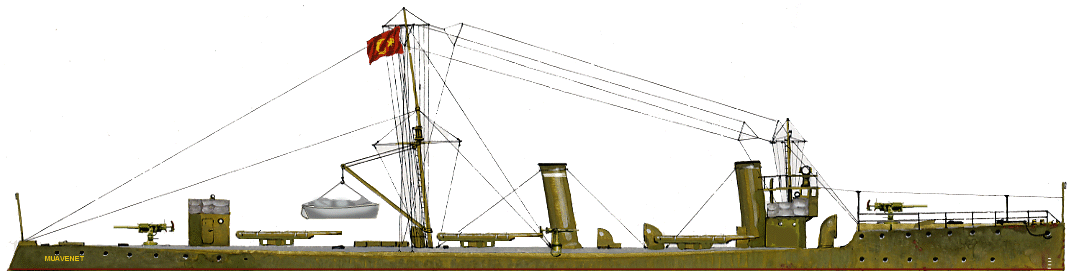
Four destroyers were bought brand new in 1910 from the German Schichau shipyards of the “S165” type, transferred at the same time as the two battleships of the Barbarossa class. The class included Muavenet-I-Millet, Jadhigar-I-Millet, Numene-I-Hamije, and Gairet-I-Watanije. They were very active during the two Balkan wars and the world conflict. TGC Gairet ran aground on October 28, 1916 on a sandbank near Varna. The Turks scuttled him to avoid his capture. TGC Jadhigar for her part was bombed by RNAS aircraft in the golden horn and sunk on July 10, 1917. The other two were BU in 1920.
specifications
Displacement 665t, 765t PC
Dimensions 74.2 x 8 x 3 m
Propulsion 2 shaft Schichau turbines, 4 heaters, 17,500 hp 34 knots.
Armor: none
Crew 84
Armament 2 x 88 mm, 2 x 37 mm, 6 x 450 mm TTs.
Pelengri Deria class Torpedo Cruiser (1890)
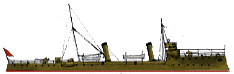
TGC Namet and the Pelengri Deria were built in Germany, to be completed and armed in Constantinople, apparently on British plans. Their armament was Krupp. Their original armament included two 104 mm guns, six 76 mm and three TTs including one in the bow. They slower than expected and made completely obsolete with the appearance of the destroyers. Pelengri Deria was anchored in 1915 off Constantinople, at the point of Seraglio, when torpedoed and sunk by E11 which managed to cross the strait on May 23, 1915. Click on the title to see the full article.
specifications
Displacement 900 t standard
Dimensions 70 x 9.5 x 5 m
Propulsion 2 shaft horizontal TE, 2 loco boilers, 4500 hp= 19 knots max.
Crew 120
Armament 3 x 75 mm, 4 x 47 mm
Berk-I-Savket class Torpedo sloops (1906)
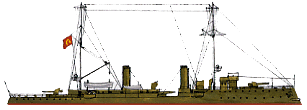
Also called PEYK-İ ŞEVKET. Although proceeding from a past fad concept, the Berk-I-Savket and the Peyk-I-Sevket were ordered by the Turkish admiralty from Germaniawerft shipyards in 1905. They were operational in 1907. They participated in the two Balkans wars, but without notable facts, then proceeded to the great war. The first was badly damaged by hitting a Russian mine on January 2, 1915 off the Bosphorus, but survived, was towed and repaired, to resume service in 1916.
The second was torpedoed on August 6, 1915 in the Sea of Marmara by an English submersible, and her commander succeeded in making it her sail on a sandbank. Towed, repaired, she also resumed service until 1918. After the war, these ships remained in service until 1937 before being completely rebuilt and refitted. They were not reformed until 1944. Article on them pending.
specifications
Displacement 775t standard
Dimensions 80 x 8.4 x 2.5 m
Propulsion 2 shaft 2 VTE, 4 boilers, 5100 hp, 21 knots max.
Armor None
Crew 105.
Armament 2 x 10⁵, 6 x 57, 4 x 37 mm (2 Revolver Hotchkiss), 3 x 450 mm TTs (1 in bow).
Isa Reis class gunboats (1911-12)
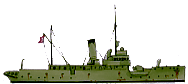
Three units (Hizar Reis, Isa Reis and Duruk Reis) built in 1911-12, ordered from France (Forges & Shipyards of the Mediterranean) at the time of the Balkan War, and which were used as gunboats in 1914-18. All three jumped onto a Russian minefield in the Bosphorus, were bailed out, repaired and returned to service. In 1918, the Duruk Reis was renamed Kemal Reis. They were modernized in 1923 then were reconverted in 1938 into minesweepers. They operated until 1947-48. Article on them pending.
specifications
Displacement 413 t standard
Dimensions 47 x 7.90 x 1.30 m
Propulsion 2 shaft VTE, 850 hp 14 knots
Crew 64
Armament 3 x 75, 2 x 47 Revolver Hotchkiss, 2 x 20 mm AA, 6 x 533 mm TTs.
Gunboat Preveze (1912)
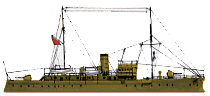
Four recent gunboats were ordered in 1910 from the Saint-Nazaire shipyards: These were the Preveze, Aydin Reis, Sakiz, and Burak Reis. They were launched between January and May 1912 and participated in the end of the second Balkan war. Operational in 1914, they were stationed in Constantinople. None were lost in action, but after the war, the Aydin Reis was donated by Mustafa Kemal’s government to the Russian government, as was the Preveze, to prevent them from being captured by the Allied Expeditionary Force.
The Russians surrendered them in 1922. Three were reformed in 1924, but the rearmed Aydin reis continued to serve until 1948. She was then used as a surveillance vessel and rearmed with 2 pieces of 76 mm and 2 of 57 mm, and fitted with new Babcock & Wilcox boilers.
specifications
Displacement 500t standard
Dimensions 54.3 x 8.5 x 2.4 m
Propulsion 2 shaft 2 VTE, 2 boilers, 1025 hp 14 knots max.
Crew 76.
Armament 2 guns of 100, 2 of 47 mm.
Nusret class minelayers (1912)
TGC Nusret (1912) and Intibah (1886), were high seas tugs converted into minelayers during wartime. They made both world wars and will be scrapped in 1957. TGC Nusret sank indirectly (by the minefield which she laid in the bay of Erin Keui at the entry of Dardanelles) three battleships, a French and two British. TGC Intibah had a very long career since she was completely rebuilt for laying mines and was also much larger than the Nusret at 616 tonnes. She was renamed Uyanik in 1942 and finally broken up in 1957. Finally, the Turkish navy also employed the TGC Kiresund, an old 3056 GRT civilian ship (1877) converted also as minelayer. She served during the Great War and was scrapped in 1927.
specifications (Nusret)
Displacement 364t FL
Dimensions 40.20 x 7.50 x 3.40 m
Propulsion 2 shaft triple 3 cyl. VE, 2 Schultz water-tube boilers, 1200ihp 12 knots
Armor None
Crew 149
Armament 2 × 37mm quick fire gun 60 mines
Turkish Nordenfelt submersibles
 On one hand, there were the two Nordenfelt II/III, one of the most fampus example of Greek arms dealer’s whereabouts selling submarines to his own country, then crossing to Constantinople and sell the same. Surfing on the positive returns of his model in official trials and PR efforts by Zaharoff, Nordenfelt was persuaded to start two more, much larger for the Ottoman government. They were built as the Nordenfelt N°2 and 3 or in Roman numeral II and III. The first was named Abdül Hamid in 1886 and the second Abdül Mecid, the next year in 1887. Both were 30 meters long submarines (100 feet and displacing 160 tons), this time with twin torpedo tubes. But the basic principled remained the same. They were built not at Barrow-in-Furness, but in parts made by Des Vignes (Chertsey) and Vickers (Sheffield) in England, conveyed by ships and reassembled at the Taşkızak Naval Shipyard in Istanbul.
Abdul Hamid was launched on September 6, 1886 in front of many international dignitaries lined along Golden Horn. After fitting out, the first diving tests started in February 1887. Three dives were successfully of around 20 seconds each. Only the hemispherical navigator cockpit remained above water. In early 1888, the submarine was tested through the strong currents around the Seraglio Point. Abdul Hamid proved capable of making 10 knots and, arriving semi-submerged, and then fully submerged, sank an old target ship by firing a single torpedo, a world’s premiere achievement. She underwent more tests and trials at Izmit naval base, and officially joined the Ottoman Navy on 24 March 1888. Soon, this was the case for the second model.
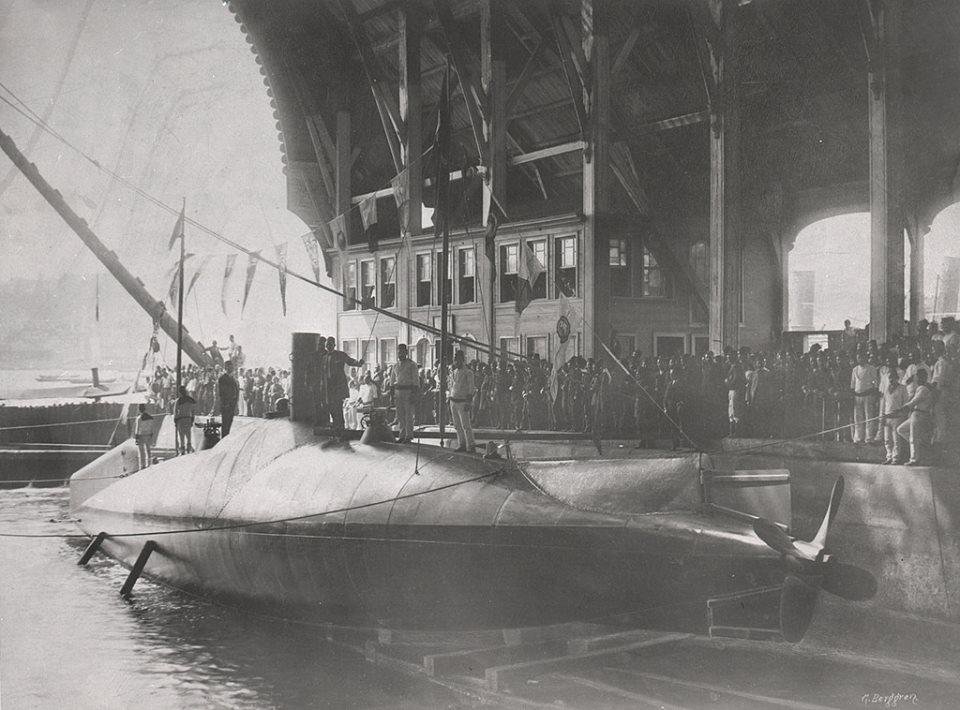
Launch ceremony of Abdülhamid
Off the golden horn, these subs showed their usefulness when operating on surface or semi-submerged like the CSS David, but when submerged fully this was another story. Their steam-driven approach proved to be completely inadequate for underwater navigation. Chronically unstable, they failed in simple underwater manoeuvers other than staying in a straight line, but at least were successful for firing a torpedo: Indeed Abdül Hamid became the first military submarine in history to do so and that would remain the only redeeming point for these forgotten submarine today. Abdülhamid and Abdülmecid were still listed active in the Ottoman fleet, based in Istanbul in 1914. They were briefly used as harbour defence vessels, but their hulls were already too badly corroded for effective service. Read more.
Müstecip Onbaşi
Müstecip Onbaşi was the ex-Turquoise, a submarine laid down at Arsenal de Toulon, on 10 1903, launched on 3 August 1908 and completed in December 1910. She was captured and integrated in November 1915 and from December, while commissioned, she was berthed, used as battery charging plant. She was single-hull type boat designed by Maugas, built under the 1903 programme with a surface buoyancy mediocre and their diesels were poorly designed leading to longer trials. During the Dardanelles campaign, borth the French annd British attempted to cross the strait and enter the golden horn and black sea. This was dangerous with strong current and shallow waters. Turquoise attempted this, and as a result she ran aground and was stranded on 30 October 1915. Her crew was rescued, but she was seized by the Turks, salvaged and recommissioned on 10 November. However knowledge to operate her was lacking. She was towed to port and by December 1915 Müstecip Onbaşi became a floating battery charging plant, for the German submarines present. She was stricken in October 1918, and on 1 July 1919 officially returned to France, refused, and instead BU in 1921 at Istanbul.
Turkish Torpedo Boats (1894)
Turkey had many classes of torpedo boats, among which the larest and largest are assimilated as destroyers in some publications (like conways).
BURHANEDDİN torpedo boats (1885)
Burhaneddin and Tevfik were ordered from F C de la Méditerranée, La Seyne in France: Burhaneddin and delivered, commissioned on 10 November 1885.
They were small Iron-hulled second class TBs, 38/42t, 31.7 x 3.60 x 1.70 m, 1 VC, 1 locomotive boiler 525 hp, 17 kts, 5t coal, 4x 34mm/42 Nordenfelt, quad 25mm/42 Nordenfelt and 2x 356mm TT (bow, 4) plus spar torpedo, crew: 24. Used for instruction and discarded in 1902. No longer listed.
GİLYUM torpedo boats (1886)
Gilyum, Saiki, Tir-i Zafer, Seyf-i Bahri, Vesile-i Nusret were ordered from Schichau, Elbing in Germany, commissioned in April 1886. They were steel-hulled first class TBs wit a fore and aft conning tower, a bow and a stern rudder, two 356mm bow TT under the turtleback forecastle, and spare Schwarzkopf torpedoes. Trials speed was 22.4kts.
Displacement 85t, 37.7 x 4.78 x 1.98 m, 1 shaft VTE, 1 locomotive boiler 980 hp, 21 kts, 18t coal, 2 quintuple 37mm/27 RV L/30, two 356mm TT bow. Crew 18.
Discarded before the war, used froml instruction, decommissioned in 1903 for Gilyum, Saiki, 1905 for Tir-i-Zafer, 1906 for Vesile-i Nusret and 1909 for Seyf-i Bahri.
MECİDİYE torpedo boats (1889-1893)
Mecidiye, Eser-i Terakki, Nımet and Şanaver were ordered from Tersane-i Amire NyD in Istanbul and delivered, commissioned between 1889 and 1893. Şanaver was never completed. Iron-hulled second class TBs locally-built version of FCM Burhaneddin. Construction dragged one and there was no maintenance after delivery so they were discarded in 1902. Details as the Burhaneddin.
NASİR torpedo boats (1889-1890)
After the failure of Tersane-i Amire to produce workable TBs the Sultan authorize dthe admiralty to order seven more modern TBs from Germaniawerft. These were Nasir, Fatih, Nusret, Şahab, Tarik, Pervın, and Seham. They were steel-hulled 1st class TBs with classic features, straight stem, turtleback forecastle wih with a pair of bow 356mm torpedo tubes, single funnel offset.
Specs: 87t, 39 x 4.8 x 2.59 m, 1 shaft VTE, loco boiler 1200 hp, 21 kts, 30t coal, also armed with 2×5 tubes Nordenfelt 37mm/27 RV L/30. The tubes had 2 reloads. Crew 27.
None was active in 1914, the last was discarded in 1911. poor training and absent maintenance took their toll:
Seham sank on 21 April 1901 in the outer harbour at Beirut after a boiler explosion, the whole crew was lost.
Şahab was heavily damaged on 24 March 1901 also by boiler explosion at Selanik, refloated but never repaired, towed to Istanbul, sold for scrap in 1909.
EJDER torpedo boat (1893)
A single 1st class TB built at Germaniawerft, laid down 1889, launched 1890, delivered 1893. She had 3 masts, single 356mm bow TT, single trainable mounting aft, 1 reload. She ran aground on 17 November 1897 near Izmir and was under repair till 1903. This was likely never completed and she was stricken in 1909, status unknown in between.
Specs: 138/150t, 49.2 x 5.69 x 2.21 m, 2 shafts VTE, 2 loco boilers 2200 hp, 24 kts, 50t coal, armed with five quintuple 37mm/27 RV L/30. Crew 22.
BERK EFŞAN torpedo boats (1894)
Berk Efşan and Tayyar were large 1st class TBs ordered from Germaniawerft, Kiel in 1886, sent by railways and assembled from ready sections for completion at Tersane-i Amire, Istanbul (LD 1891, LC 1892, CP 1894). They are considered as destroyers in some publications.
Specs: 230t, 59.9 x 6.6 x 2.4m, 2 shafts VTE, 2 loco boilers 3500 ihp, 21 kts, 75t coal, 6 quintuple 37mm/27 RV L/30, 2x 428mm TT (bow, 2 reloads), crew 50.
Both were active when WWI broke out (oldest in service). They were underarmed for their size. Construction was protracted and difficult and quality and assembly was poor, use was difficult.
Thy were modernized in 1912, with Berk Efşan loosing her Nordenflet guns, and only armed from 1915 by two 47mm/42 SK L/45 C/99, and two 47mm/27 SK L/30 C/91 Krupp guns. Her sister was not modernized and used for harbour defence and instruction until decommissioned in 1909 but still listed until 1921. Berk Efşan was decommissioned in 1924, BU 1928.
HAMİDİYE torpedo boats (1902)
Modern 1st rate TBs built in Italy, Ansaldo, Genoa 1901-1902. 3 funnels, 2 masts, a clipper bow with TT forward and single trainable aft.
Specs: 145t, 50.6 x 5.6 x 1.2m, 2 shafts VTE, 3 Yarrow boilers 2400 hp, 26 kts, 50t coal, 37mm/20 Hotchkiss, 2x 450mm TT (4). Crew 30.
Hamidiye was sunk in action against the destroyers Artigliere and Corazziere at Resadiye on 30 Sept. 1911 during the war in the Ionian Sea. Yunus was modernized in 1914, she lost her bow 1914 450mm TT and in 1916 her 37mm/20 was replaced by a Krupp 47mm/42 SK L/45 C/99. In 1919 she lost her trainable TT aft, and in 1920-1924 laid up, used as dispatch boat.
AKHİSAR torpedo boats (1904)
Akhisar and Alpagot were ordered from Ansaldo, Sestri Ponente, and used an Armstrong design, single funnel 2 masts, clipper bow, launched 25 April 1904 and commissioned in June.
They were slow, 14 knots for Akhissar, but both were active in WW1.
Specs: 165t, 51 x 5.7 x 1.4m, 2 shafts VTE, 2 loco boilers 2400 hp, 24 kts paper, 60t coal, 2x 37mm/20 Hotchkiss, 2x 450mm TT (4) crew 30.
Alpagot was sunk in the war with Italy, by Artigliere and Corazziere on 30 Sept. 1912 at Reshadiye in the Ionian Sea.
Akhisar was modernized in 1915 with a TT removed, 47mm/42 SK L/45 C/99 krupp installed. She was decommissioned in 1930, BU 1935.
ANTALYA torpedo boats (1906-1907)
A large class ordered also in Italy in 1903, built 1904, delivered 1906-1907. Ansaldo design, same design as the Akhisar. Partly active in 1914.
Class: Antalya, Urfa, Ankara, Tokad, Draç, Kütahya, Musul.
Specs: 165t, 51 x 5.7 x 1.4m, 2 shafts VTE, 2 WT boilers 2700 hp, 26 kts, 60t coal, two 37mm/20 Hotchkiss, 2x 450mm TT (4) crew 30.
In the war of 1911, Antalia and Tokad were scuttled on 5 November at Preveze to prevent captired. Salvaged by the Greeks in 1912, recommissioned as Nikopolis and Totoi.
Ankara was sunk by Italian ships at Beirut on 24 Feb. 1912.
Urfa foundered on 11 Dec. 1908 during a storm off Selanik.
In WW1 Musul was rearmed with a 47mm/42 SK L/45 C/99, Draç, Kütahya with a 57mm/42 SK L/45 C/99. The former recovered her second TT in 1919.
Kütahya was lost in WW1, 14 Sepyt. 1916 in Black sea North of Karaburnu on a Russian mine.
The surviving ships were decommissioned and BU 1935-1936.
DEMİRHİSAR torpedo boats (1907)
French large 1st class TBs ordered in 1905 from Schneider, Chalons-sur-Saône, France. Built 1906-1907, based on the 38m class and Bulgarian Druzki class. All active by WWI but the lack of maintance meant they could only do 16 kts. Class: Demirhisar, Sultanhisar, Sivrihisar, Hamidabad.
Specs: 97/101t, 40.2 x 4.4 x 1.9m, 1 shaft VTE, 2 Du Temple boilers 2200 hp 26 kts, 11t coal, 2x 37mm/20 Hotchkiss, 2x 450mm TT(1 bow, twin trainable aft, 5). Crew 23.
Fate: Spared by the war of 1911 all active in 1914. Demirhissar was obliterated and ran aground on 16 April 1915 by the DDs HMS Jed, Kennet and Wear, stranded on Chios. Hamidabad was sunk on 30 October 1917 Igneada (on border with Bulgaria) after a bombardment by Russian seaplanes and the destroyers Bystry and Pylkiy. The others were discarded in 1928 buy only BU 1935.
Turkish Gunboats (generic)
AKKA class gunboats (1859-1860):
Akka, Şevket Nüma, Necmifeşan (ex-Varna) Sünne, British built Wooden gunboats at White Cowes and Money Wigram, Blackwall in 1858-60.
In 1885 Akka was armed with 3x 75mm/22 RK L/24 C/83 guns and a 37mm/37 SK L/40 C/85. She was stricken in 1901.
Varna was renamed after the war of 1879 Necmifeşan. She was hulked in 1902.
Sünne was sunk on 9 Oct. 1877 during the war with Russia, mined on the Danube.
Şevket Nüma was rebuilt in 1898 with a new steel hull and machinery, VTE with double-ended cylindrical boilers, 400hp, 10kts, for 120t and crew 45 armed with four 75mm/37 SK L/40 C/91, one 37mm/37 SK L/40 C/91.
In 1904 she became a Training ship. Stricken in 1909 she was recommissioned in April 1915, and rearmed with a 57mm/42 SK L/45 C/99, two 47mm/42 SK L/45 C/99 Krupp guns, active until October 1918.
MUSUL gunboats (1866)
In Redaction
SAHIR gunboat (1866)
In Redaction
İNTİBAH gunboats (1866-1867)
In Redaction
SAHEDDIN gunboat (1866)
In Redaction
AYNALİKAVAK class gunboats (1869)
In Redaction
RODOS class gunboats (1870-1874)
In Redaction
FİRAT class gunboats (1885)
In Redaction
NASR-Ü HÜDA class gunboats (1904-1908)
In Redaction
KASTAMONU class gunboats (1905)
In Redaction
NUR-Ü BAHİR gunboat (1898/1906)
In Redaction
MARMARİS gunboat (1908)
In Redaction
TAŞKÖPRÜ class gunboats (1908)
In Redaction
AYDİN REİS class gunboats (1914)
In Redaction
Turkish minelayers (generic)
In Redaction
Turkish armed Yacht (generic)
In Redaction
Links/sources
The Ottoman Steam Navy, 1828–1923 by Bernd Langensiepen and Ahmet Güleryüz
The Sultan’s Fleet: Seafarers of the Ottoman Empire by Christine Isom-Verhaaren
The Logbook of the Ottoman Navy: Ships, Legends, Sailors (Pera Museum Exhibition Catalog)
Ottoman Navy Warships 1914–18 by Ryan K. Noppen (Osprey Publishing)
Noppen, Ryan K., and Wright Paul III. Ottoman Navy Warships 1914-18. Bloomsbury Publishing Plc, 2015.
Torpedoboats & destroyers in Ottoman Navy: Sultanhisar & Muavenet. Denizler Kitabevi, 2011.
Ottoman Navy: From the Height of Empire to Dissolution, 1572-1923. Oxford University Press, 2016.
Bodrum Belediyesi Kültür ve Sanat Yayınları / Bodrum Municipalities Culture and Art Publisher, 2015.
Innovation and Empire in Turkey: Sultan Selim III and the Modernisation of the Ottoman Navy. I. B. Tauris & Company, Limited, 2011.
Le navi della Mezzaluna: La marina dell’Impero ottomano (1299-1923). Odoya, 2015.
Zorlu, Tuncay. Innovation and empire in Turkey: Sultan Selim III and the modernisation of the Ottoman Navy. Tauris Academic Studies, 2008.
navypedia.org/ generic
Ships list -Ottoman_steam_navy
Conway’s all the world fighting ships 1860-1905
en.wikipedia.org/wiki/World_War_I_naval_ships_of_the_Ottoman_Empire
Models corner
There’s not much here, apart from german models that can be used for three ships. If you have a good address please contact us !
NNT Modell – TGC Yavuz 1/700
Kombrig 1/700 Brandenburg
3d Model of the Messudieh (Turbosquid)
3d model of the Nusret on turbosquid