
 Turkish Ottoman Navy 1914: Nımet, Peleng-i Derya 1890-1915
The Namet (or Nimet) or Peleng-i Deryâ class were two torpedo cruisers (in other sources gunboats) built for the Ottoman Navy in Germany at Friedrich Krupp Germaniawerft A. G in 1899-1890. Designed for coastal defense and strike roles at a time destroyers were not a thing, the Peleng-i Derya and Nimet were delivered unarmed, and received a heavy armament for their size in Istanbul, with 12 guns, three machine guns three 355 mm German torpedo tubes. Peleng-i Derya was rearmed twice and still operational in 1914, but saw little activity, anchored around Istanbul. She was sunk by E11 in 1915. Nimret was supposed to be completed in Istambul, delivered in sections but never completed and scrapped.

Peleng-i Derya “sea tiger” as completed, unarmed off Southampton in 1896. Her armament was mounted at home.
Development & Design of the class
There is not much about these ships. They were ordered as part of a plan to reinforce the Turkish Navy after the 1878 war with Russia, with vessels capable of taking on new Russian Torpedo Boats of the Black Sea. Back in 1887 indeed, the Ottoman Navy had obsolescent ironclads, planned gunboats and cruisers, but the Russian Imperial Black Sea Fleet could sink the first with ease using torpedo boats. This was a legitimate fear born of an episode of 1878.
In particular, Russian fielded the very capable French-designed 25-strong Pernov-class. To counter them, the usual answer in most navies by the 1880s had been to build torpedo cruisers. Like torpedo gunboats they were gun vessels to outrange and sink and torpedo boat while having themselves torpedoes. Cruisers were just faster, enough to catch or a least match these torpedo boats in speed. It must be recalled that at this point the concept of a “torpedo boat destroyer” did not existed yet. The first ones appeared in the 1890s.
The Ottoman Empire ordered a serie of torpedo cruisers, and the Namet class were the first. They were followed by the Sahahani Deria (1892) and much later the Berk i Savket class Torpedo gunboats (1906). In between investments were made to procure destroyers like the Berk-Efshan class (1894) and Yarishar class (1907). So these first two torpedo cruisers were ordered in Germany after an open tender, a delegation visiting both Britain and Germany. The contract went to Friedrich Krupp Germaniawerft A. G, signed in 1887. The two ships were laid down in 1889 same year. Dates are uncertain, one source states Nımet was launched on 30 January 1890, Peleng-i Derya being launched “in 1890”. Thus the class naming is impossible based on dates, albeit Nımet was never completed unlike her sister. Peleng-i Derya became the only one actually completed when her armament was installed at Istanbul, not her sister. Conways says one of the two was launched in 1891, not 1890. Names are also orthographically different, the same sources states they were named “Namet” and “Pelenki-Deria”. “Nimet” means “Lion” (related to “Nimr” in Arabic) and Peleng-i Derya “Tiger of the Sea”.
Hull and general design
Both this were identical, and the contract stated they would be delivered unarmed in conformity so treaties regarding transit in the Bosphorus. They were both 75.5 metres (247 ft 8 in) long (72 m between parallel), for a beam of 8.5 metres (27 ft 11 in) and draught of 2.9 metres (9 ft 6 in), with a tonnage of 980 GRT (Gross Registered Tons), 755 tonnes standard or light in other sources and 900 tonnes Fully Loaded. Peleng-i Derya and her sister had the same hull with a forecastle but no sterncastle, a ram bow, a small conning tower with a bridge on top, two equal size raked masts, and two equal raked funnels. There were bulwarks along the flank for light artilley in sponsons and the traversing deck torpedo tubes. They were completely unprotected and carried 111 officers and men, 80 in other sources.
Powerplant
Both had two triple expansion engines (VTE) driving two screw propellers fed by four locomotive boilers to generate a total of 4,700 indicated horsepower (3,500 kW). Top speed was 18 knots (33 km/h; 21 mph). Conways states they had TE steam engines (reciprocating, horizontal, not vertical) their output was 4500 indicated HP, for 19 knots contracted. Both carried 175 tonnes of coal for a range than can be estimated around 1000 nautical miles at 11 knots but there are no publicly available figures. It’s well possible their speed was one knot below what was expected which delayed the final payment.
Armament
Armament was made in Istanbul, after the ship had been paid, commissioned, all German guns. It only concerned apparently Peleng-i Derya as her sister was never completed (see below).
It comprised two Krupp 105mm/32 SK L/35 C/91, six single 47mm/37 Krupp SK L/40 C/91, five quintuple 37mm/27 Revolver L/30 Heavy MGs (possibly Nordenfelt), one 356mm or 14 inches TT at the bow (German or Whitehead) and two on the sides, on deck, possibly with traverse. They were of the 356mm TT caliber. There were probably reloads, but numbers are uknown. Conways mentions the 4-in guns and 6-pdr but not the 37mm Revolver gatling style HMGs. See below for the upgrades. Sources diverges as some states the 6-tubes Revolver cannons were installed in 1906.

Profile from navypedia.
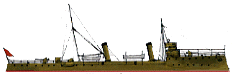
My old profile. A HD profile is in the works (or not…).
⚙ specifications |
|
| Displacement | 755t standard, 900t FL |
| Dimensions | 75.5 x 8.5 x 2.9 m (247 ft 8 in x 27 ft 11 in x 9 ft 6 in) |
| Propulsion | 2 shaft TE engines, 4 loco boilers 4,500 ihp |
| Speed | 18 knots (33 km/h; 21 mph) |
| Range | Unknown |
| Armament | 105mm/32 and six 47mm/37, 3x TT 355 mm SK |
| Protection | |
| Crew | 80 to 111 |
Career of the Namet class
Peleng-i Derya (1890)
Peleng-i Derya however was still unpaid after launch, and payment arrived quite late. She was completed to conduct her sea trials on 16 May 1896 but had an accidental boiler explosion on 22 May at Eckernförde, Germany that delayed her commission, first in germany, then she sailed to Turkey to be armed. Peleng-i Derya was offcially paid for by September 1896. While in a shipyard in Istanbul. In 1906 she was refitted again with her armament as said above, two 12 cm (4.7 in) quick-firing (QF) Krupp guns, two 90 mm (3.5 in) QF guns, three 75 mm (3.0 in) QF K guns, and four 47 mm (1.9 in) QF Nordenfelt (N) guns, as well as three “machine guns” in 1906. From the started she had three 355 mm (14.0 in) SK (German) torpedo tubes. But there are sources issues. In 1906 her 105mm/32 and six 47mm/37 were replaced by the armament described above, two 120mm/37 SK L/40 C/97, but two 88mm/27 SK L/30 C/89 (assimilated to the 90mm), and three 7.9mm/79 likely Maxim machine guns.
Her condition was bad however. Lacking maintenance she was decommissioned in 1913 buut reactivated by September 1914. By 1915 her armament was changed again, her 120mm/37, and 88mm/27, and Machine guns were removed and instead she had only three 75mm (3 inches)/37 SK L/40 C/99 Krupp guns and four 47mm/42 Nordenfelt guns. This was not for long. Still seeing no operations, she was anchored in shallow water near Bakırköy Bay, Istanbul on 23 May 1915, when HMS E11 torpedoed her. She capsized and sank slowly enough to have all but two of her crew surviving. Her wreck was raised and scrapped in 1920. Some parts still are present to this day.
Nımet (1891)
Nımet was built in section in Kiel, delivered to Istanbul for assembly, for the yard to gain experience. It is unsure if there was German supervision, however but all work was stopped in 1893 after little progress was made, and her incomplete, never launched hull was eventually broken up in 1909 to free the slipway.
Read More/Src
Books
Langensiepen, Bernd; Güleryüz, Ahmet (1995). The Ottoman Steam Navy 1828–1923. London: Conway Maritime Press.
Gardiner, Robert (1985). Conway’s All the World’s Fighting Ships 1906–1921. Page 394.
Links
en.wikipedia.org/ Ottoman torpedo gunboat Peleng-i Derya
Ottoman Torpedo Ships
worldarmies.com/
wrecksite.eu/
web.archive.org navypedia.org