
 Imperial Japanese Navy: IJN Tosa, Kaga, launched 1921, one completed 1922, converted as CV.
In the first world war, the Imperial Japanese Navy took part in limited operations with the entente powers, notably in the Mediterranean, but its fleet of battleships saw little action. However the naval staff had grand ambitions for the Japanese stance in Asia, and within the second Eight-Eight Fleet Program (八八艦隊, Hachihachi Kantai) naval strategy first formulated in 1907, calling for eight first-class battleships and eight armoured cruisers or battlecruisers. It evolved and part of this plan was realized with new classes acquired before and during the war (The Fuso, Kongo, Ise class) and started also with a completion postwar, the Nagato class. The latter were the new standard to be followed, leading to a pair of larger battleships, the Tosa class. They were cancelled by the washington treaty while well advanced in construction (launched and in completion), but famously a derogation was obtained and applied to convert the second, IJN Kaga, into an aircraft carrier… This is the story of the Tosa class from its inception in 1919 to its cancellation in 1922 and fate of both ships.
Development
The Tosa class are an interesting what-if, as they were enlarged Nagatos with an extra turret. But they did not came out of the blue. They were the result of the second 8-8 plan of 1919.
The second ‘8-8’ plan
The famous 8-8 plan was an easy to remember baseline for the Imperial Japanese Navy procurement after the end of the Russo-Japanese War. It’s in 1907 that the roots of this “program” were first announced, and meant initially eight battleships (of the new dreadnought type) and eight armoured cruisers as the core of the surface fleet to meet new ambitions. But it was not smooth sailing. Via the 1913 program, the Japanese secured a ‘4-4’ already, with a first partial refusal in 1910 leading to just a single battleship, Fuso, to be built in Britain as four battlecruisers and in between capacity of naval shipyards was improved in order to build the next ships. This was true in 1913 when approved a sister ship to Fuso, Yamashiro, and two new ships built in Japan over a revise design, the two Ise class. Wih the four Kongo, battlecruisers that replaced in 1910 the initially planned armoured cruisers, Japan had its first half of the fleet.

Launch of IJN Tosa, colorized.
However by 1917, when the IJN milited to obtain the second part of the plan in 1915, with a more balanced ‘8-4’ fleet (so four new battleships) it was rejected outright by the diet. It must be said that at the time, rivalry with the army for funding was fierce, and the totality of the naval budget already compared to the Japanese global economy was a staggering effort. However, in 1917 the US entered the war and this freed the Navy to ask the congress for a new massive fleet of ten battleships and six battlecruisers, with construction starting effectively. This changed overnight the diet opposition and in 1918 was authorized a revised ‘8-8’ plan again, so calling for not only four new battleships and four new battlecruisers as well. The four battleships planned were the Nagato class and an improved class, to be named later the Tosa class. They all had in common a new ordnance developed in Japan to gain superiority over the British 15 inches and US 16-inches. These 41 cm (16.1 in) guns were really instrumental and dictated much of the design. The four new Amagi-class battlecruisers in complement would also be armed with the same. In 1919 there were plans for even larger ships, the Kii-class battleships armed with 18-in guns and similarly armed battlecruisers of the “N°13” design, both in discussions when the Washington Treaty intervened.
The Second “Eight-Eight Fleet” was restarted anew due to enormous difference in capability between the first generation of the Fuso and Ise, and in this list, Nagato was now regarded as the first of four classes, further justification for new battleships being gained by planning to retire all pre-dreadnoughts as well as older armoured cruisers. A boost to this revised plan was the U.S. Navy under W.Wilson’s 1919 plan for 16 capital ships, on top of the 16 authorized in 1916. Such force of 24 dreanoughts would have placed the USN at the same level of RN. So in 1920, under Prime Minister Hara Takashi, persuaded still a reluctant Diet to accept this updated “Eight-Eight” plan to be achieved by 1927. Half of these with 41 cm and hald with 46 cm (18-inch guns) that was the new standard also developed in the US and Britain. By adding the Fusō, Ise and Kongō classes this would became, also in 1927 an “Eight-Eight-Eight Fleet” with three eight-ship battle squadrons (it was planned indeed to convert the Kongo class as fast battleships). An enormous advantage.
Genesis of the Tosa class

So the second class to create an homogeneous battle squadron of four 41-cm guns armed battleships, were the Tosa. They were born from a reevaluation of the Nagato design by taking in account the Battle of Jurtland of May 1916. Armor protection, based on new data on British protective schemes (and new intel on the latest US capital ships protection as well) led to design a better protection for the main gun turrets and magazines, and thicker deck armor against plunging fire. Albeit this was secondary, the sub-warfare of WWI had completely reshuffled the game for defense against mines and torpedoes so this too needed improvement.
Design A-125 (1917)
 Captain Yuzuru Hiraga, now was the new, very infiential chief engineer, architected and superintendent of shipbuilding for the IJN, and he reviewed and rejected no less than eleven new designs between October and early 1917. At last was accepted a heavily modified version of the Nagato design called A-125. He argued that it was preferable to cancel the current design for the Mutsu planned to be laid down, on 12 June 1917, and revise the design entirely.
Hiraga also wanted to include in the design the latest advances in boiler technology. This means a bit larger, but higher pressure and temperature models compared to previous ones. By reducing their numbers from 21 to 12 boilers, this freed space aft admiship to include an extra twin main-gun turret. The output at least on paper remained the same, which was still an issue as protection was augmented, and an extra turret and its ammunition also meant extra weight, so the ship would likely be heavier, and thus, slower.
In compensation, Hiraga reduced the secondary armament, from 20 to 16 guns, and they were moved up a deck to improve their arcs of fire, especially to free them from water spray interference in heavy weather. The armour belt was refined, angled outwards to improve resistance to horizontal fire, also thickening the lower deck armor and torpedo bulkhead. Anti-torpedo bulges if well-made, weighted not much, and so would be an interesting addition for underwater protection. Hiraga presented his calculations as a using the same displacement as the Nagatos, but under a million yen more. The Navy Ministry rejected the design to be ported on IJN Mutsu due to a one year delay.
Design A-127 (1918)
In between, Hiraga was free to envision a better and brand new battleship design, more realistic as well, based on a much larger 39,000-metric-ton (38,000-long-ton) displacement: The A-127 design. The armor weight was practically doubled compared to the Nagatos for the same speed to keep both pairs in the same tactical formation. This design was accepted on 27 March 1918. Later in documentation it was known as the Tosa class… Two ships were later approved for construction, IJN Tosa (土佐; named after the ancient Tosa Province) at Mitsubishi Shipyard, Nagasaki 16 February 1920 and IJN Kaga (加賀; named after the ancient Kaga Province) at Kawasaki Shipyard, Kobe, laid down a bit later on 19 July. Protects of completion was an estimated March 1923, so three years construction.
Design of the class
Hull and general design

IJN Tosa and Kaga’s reconstructed design from Hiraga’s plans. Note the truncated funnel and part of the machinery space interleaved with “X” turret (imgurl, origin uncertain).
The Tosa-class had a planned displacement of 39,900 tonnes (39,300 long tons), 44,200 t (43,500 long tons) at full load. At that stage they were already well above the future cap adopted in 1922, of 35,000 tonnes. With this comfortable margin, they would have and pushed to 231.65 meters (760 ft) long at the waterline, for an overall length of 234.09 meters (768 ft). To compare the Nagato were 215.8 m (708 ft) (o/a) long. The beam was also raised in proportion, from 29.02 m (95 ft 3 in) to 30.48 meters (100 ft), for a draft of 9.39 meters (30.8 ft) instead of 9.08 m (29 ft 9 in). Their metacentric height was calculated to 1.292 meters (4 ft 2.9 in) at normal load.
As for the general layout, apart the extra aft amidships turret, the general hull shapes and proportions remained basically the same. The new boilers which were planned in 1917 were adopted for this design and freed a lot of space internally, despite more were installed to compensate for the additional tonnage, and still the hull only needed an extra 15 meters (50 ft) when the extra turret was much longer than this. Space was spared notably by keeping the main superstructure amidship as compact as possible. This structure represented indeed, seen from above, only 1/5 of the deck. All was compacted in it, the tower “pagoda” bridge with its hexapod mast like the previous Nagatos, but now a single funnel and an aft tripod mast. Service boats had to be crammed between the funnel and mast and partly abaft the bridge.

The other massive change compared to the Nagatos and “trick” by Hiraga to spare weight, was to use a flush deck hull, rather than a stepped one. Like the Nagatos, the prow had the same height, and still an curved inwards “ice breaking” bow, three deck levels, and all the way aft, a single level at the stern, much reduced. There were still two main anchors forward two small anchors aft. The hexapod mast, an invention of the Nagato design, replaced the traditional tripods as it was understood that new platforms would likely be installed, and the tripod structure represented less secured points than a 7-leg ones (hence “hexapod”).
This type of mast was quintessentially unique to Japanese battleships (with the “pagoda” developed over additions) as were the Corbel masts for the USN until 1916. They were a solution to place a fire control tower as high as possible, out from the smoke and an ideal observation post for corrections, at least before spotter aircraft were developed, and keeping the wind flowing in and stability as well. It must be argued that a 7-leg mast was less sensible potentially to vibrations, but represented a top weight that needed to be kept in consideration. The crew was estimated c1400 by extrapolation of the Nagatos (1,333) with the extra turret.

Powerplant of the Tosa class
Hiraga looked at what the USN was planning and envisioned also a turbo-electric propulsion system after this was tested on USS New Mexico. The base figure was an estimated 70,000-shaft-horsepower (52,000 kW) for a turbo-electric plant. This would have to procure a speed of 25.25 knots (46.76 km/h; 29.06 mph) coupled with a 2,500-nautical-mile (4,600 km; 2,900 mi) range at full speed, but up to 7,800-nautical-mile (14,400 km; 9,000 mi) range at a more economical 14 knots (26 km/h; 16 mph). Ultimately, the technological gap, given in 1919 there was little chance to acquire a licence from the US, was such this system was rejected.
So instead, Hiraga obtained the purchase of less sensitive and more conventional Curtis geared steam turbines. They were fed by the stem produced by the latest twelve Kampon water-tube boilers, eight burning oil and four burning coal but with injectors to spray oil on coal and boost the combustion rate. This made for a total output of 91,000 shaft horsepower (68,000 kW) – compared to Nagato’s 80,000 shp (60,000 kW). This power was passed on four propeller shafts. It was calculated for same top speed of 26.5 knots (49.1 km/h; 30.5 mph). The fuel stores could carry some 3,600 long tons (3,700 t) of oil and 1,800 long tons (1,800 t) of coal so that at 14 knots, they were rated for a 6,500 nautical miles (12,000 km; 7,500 mi) range.
Protection
 Hiraga designed the ship to resist US 16-inches shells, meaning it was also potentially able to resist 15-inches shells even more. More so, this was to be done at a distance of 15,000–20,000 meters (16,000–22,000 yd). All main armor plates were backed up by splinter bulkheads to contain any shell fragments.
Waterline main belt: It was made in Vickers cemented armor, sloping outwards 15 degrees from the top. Amidships it was 280 mm (11 in) thick, tapered down 254 mm (10 in) thick fore and aft. It was 1.83 meters (6 ft) below the waterline.
Bulkheads: This belt was armor was closed off by bulkheads 229–254 mm (9–10 in) thick creating the transverse limits of the citadel.
Main battery turrets: Those and the barbettes above the main deck comprised from 229 to 305 mm (9 and 12 inches).
Conning tower: Its walls were 254mm back and 356 mm front (10-14 inches) thick, topped by a roof 178 mm (7 in). Communications tube below was srill 76–127 mm (3–5 in).
Middle deck: Used as primary armored deck, top of the armor belt and citadel. 63.5 mm (2.5 in) in non CMA + 37 mm (1.5 in) in HTS above the engine and boiler rooms. Above the magazines, the HTS (High tensile Steel) plating was up to 63 mm.
Lower deck: Two 19 mm (0.75 in) plates of HTS.
Funnel base: 229 mm armor (9 in). Lower Funnel openings (lower deck) had armor gratings. This was a first.
ASW protection: 1-Internal torpedo bulge 2-backed by a torpedo bulkhead (3x 25 mm (0.98 in) layers HTS, angled outwards at the base of the waterline belt). 3-connected 12.7–32 mm (0.50–1.26 in) splinter bulkhead, on the lower deck, behind the waterline belt. 4- Second splinter bulkhead 12.7–19 mm thick between bulge and 1st splinter bulkhead.
So to schematise in metric:
-15° inclined main belt with 280mm thickness between barbettes, tapering to 76mm at lower edge.
-Upper part of anti-torpedo longitudinal bulkhead extended up to main deck and served as 30mm splinter bulkhead.
-Main belt was closed by 330-254mm fore and 254mm aft bulkheads abreast end barbettes.
-Hull outside end barbettes was protected by 229mm belt tapered to 76mm at lower edge.
-Upper 229mm belt extended from main belt to upper deck between end barbettes, closed by 229mm angled bulkheads.
-Lower casemate had 152mm armor. Upper casemate had only 25-19mm protection.
-Flat main 160-102mm deck connected with upper edge of main belt.
-Lower (splinter) deck had 38mm thickness in flat part and connected with lower edge of main belt by 102-51mm slopes.
-Deck over lower casemate was 38-25mm. Turrets had 356mm faces, 203mm sides and rears and 190mm crowns.
-CT had 356mm sides and 76mm roof.
-Underwater protection was 6.5m deep and content 76mm longitudinal bulkhead.
Armament
Apart the extra turret, the Tosa designed armament was a repeat of the Nagato’s.
10x 41cm/45 main guns
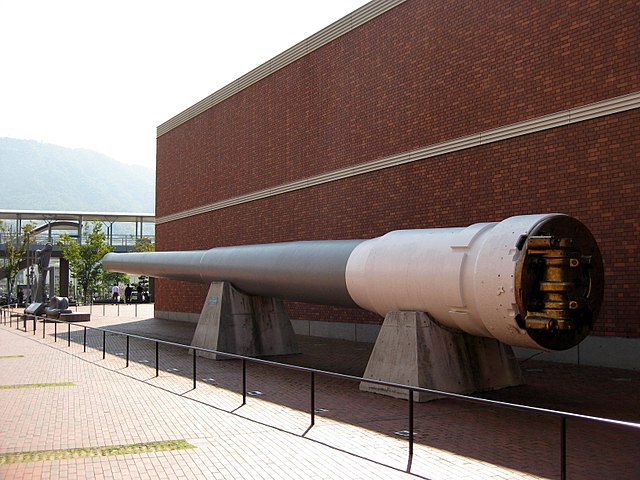
The Tosa class had five instead of four turrets in the previous design: A-B forward and X-Y aft were in classic superfiring positions, but there was “Q” just behind the structure, facing aft “X” superfiring turret, while itself was at deck level, as paper solutions like having an X-Y-Z turret arrangement in which was a triple barbette height was deemed unpractical and reducing stability. The other alternative was Z and Y at the same level and X, the only one superfiring, meaning “Y” was not firing on “Z” directly astern, making it suitable only for broadside arrangements. Even using mid-height barbettes to improve the astern arc in which Y was mid-height compared to X and Z, again was likely considered but abandoned due to internal arrangement’s nightmare. Placing also a triple A-B-C arrangement forward would have been ever worse for stability reasons.
As for the guns themselves, they were hydraulically operated, and their elevation range was −2 to +35 degrees. Rate of fire was of two rounds per minute. They fired the Type 91 armor-piercing capped shell, 1,020 kgs at a muzzle velocity of 780 mps (2,600 ft/s). They also fired a HE shell, 936-kilogram (2,064 lb) with a muzzle velocity of 805 mps (2,640 ft/s) and the special Type 3 Sankaidan incendiary shrapnel exclusively for anti-aircraft use.
20x 140mm/50
The secondary armament comprised twenty 50-caliber 3rd Year Type 14-centimeter (5.5-inch) mounted in casemates on two levels: 12 on the upper sides of the hull, eight in the superstructure above. Their elevation ranged from +20 to +25 degrees and ranges of 15,800 meters – 17,000 meters (19,000 yd) respectively on these two levels. They were all provided with a unique 38 kgs (84 lb) HE shell and their rate of fire was to 10 rounds per minute.
3-in/40 Type 41 AA guns
At the time air threat was still not taken seriously, and the Toras were limited to four 40-caliber 3rd Year Type 3-inch AA guns, all in single mounts. They elevated to +75 degrees, had a rate of fire of 13-20 rpm, and fired a 6 kg (13 lb) shell at 680 m/s (2,200 ft/s). Their effective ceiling was 7,500 meters (24,600 ft). Other name 8 cm/40 3rd Year Type naval gun. They fired a Fixed Quick Fire 76.2 x 405R ammunition weighting 5.7–6 kg (12 lb 9 oz – 13 lb 4 oz) at an angle of +75°.
610 mm Torpedo Tubes
Like the Nagatos, the Toras had eight 53.3-centimeter (21 in) torpedo tubes: Four fired from the beam, in two groups, two above water and two submerged per side. They were supplied with the 6th Year Type torpedo, carrying a 203-kilogram (448 lb) warhead of Shimose powder. They had three settings: 15,500 m/26 knots, 10,000 m/32 knots, 7,000 meters/37 knots. This was still relatively slow and they were removed in the 1920s as seen an obsolete feature. The former above water were to be provided with two torpedoes each, the underwater ones with three each.
⚙ specifications |
|
| Displacement | 39,900 t normal, 44,200 t full load. |
| Dimensions | 234.09 x 30.5 x 9.4 m (768 ft x 100 ft 1 in x 30 ft 10 in) |
| Propulsion | 4 shafts Curtis geared steam turbines, 12 WT Boiler: 91,000 shp (68,000 kW) |
| Speed | 26.5 knots (49.1 km/h; 30.5 mph) |
| Range | 5,500 nmi (10,200 km; 6,300 mi) ast at 16 knots. |
| Armament | 5×2 41 cm guns, 20× 14 cm guns, 4x 7.62 cm LMG, 8× 61 cm TTs |
| Protection | Belt 280 mm, deck 102 mm, barbettes 229–305 mm, CT 356 mm |
| Crew | c1400 |
Construction and Fate
Design A-127, designed by Yuzuru Hiraga, essentially an enlarged Nagato with a flush deck for maximum girder strength. Their former submerged tubes, were later dropped due to problems of firing at high speed. Turbo-electric drive was considered but rejected, albeit the navy tanker oiler Kamoi ordered in 1921 tested such system imported from the US. Hiraga adopted an invesrted sloping belt armour to resist 406mm shells between 12,000 and 20,000 metres. The lower armour deck, prior to this the main protective deck, was virtually eliminated for a heavy flat deck covering the belt, like on US battleships. Below these was a 38mm splinter deck. The former heavy lower armour deck was reduced to an almost vertical inward-sloping continuation of the 76mm (3-inches) torpedo bulkhead, connected to the lower edge of the belt proper by a short upward-sloping deck. Thus upper end of this torpedo-bulkhead/splinter bulkhead was a short vertical 28mm splinter bulkhead, above the splinter deck, itself above the waterline. This ingenious system was also adopted for the next Amagi and Kii classes.
In the end, the Tosa class were very promising battleships and we can only wonder how they would had fared in the pacific after modernization. Both were cancelled as a result of the Washington Treaty and construction was stopped on 5 February 1922. Tosa was later stricken on 1 April 1924 and it was decided to have expended as target in the Bungo Straight. These tests proved instrumental for the Japanese to determine a new type of internal armour that was implemented by Hiraga in the earliest variant design of the Yamato class. Tosa was also tested against mines and torpedoes, bringing valuable lessons on the new underwater protection scheme adopted. IJN Kaga on her side, had no plans, and she was scheduled to be scrapped. However before the signing of the treaty it was obtained by all belligerents the right of converting cancelled battleships into aircraft carriers, knowing they will enter the tonnage count for that category whatever the results of the conversion. Ships converted from battlecruisers were generally the best suited. They were faster, larger, and had a protection easier to degrade compared to a battleship. IJN Kaga thus became an aircraft carroer. Meanwhile IJN Akagi of the also cancelled Amagi class, completed later and less advanced, but the lead ship was damaged in the Tokyo earthquake of 1923. It was initially planned to completed Kaga first as a battleship 25 Dec. 1922 and Tosa in March 1923 and replaced their 76mm AA for the larger and better 120mm/45 DP.
IJN Tosa (1921)

IJN Tosa after launch, showing her level of advancement
Tosa was Ordered through the 1918 Fiscal Year. As part of the second set of high-speed battleships after the Nagato class she had been approved for construction by the parliament back on 14 July 1917. However Engineering blueprints were not completed before 1919. Based on studies of the Battle of Jutland, the protection was much revised, as their powerplant, and tonnage. IJN Tosa was the first laid down, on 16 February 1920, by Mitsubishi, Nagasaki, receding on the same slipway IJN Musashi two decade later. Tosa was planned for launch on October 1921, but strikes in the yard delayed this until November. She was eventually launched on 18 December 1921, two months behind, schedule and fitting-out was started for a completion around July 1922. However, all work on Tosa was halted on 5 February 1922, the next day after the signing of the Washington Naval Treaty. Formally cancellation followed on 5 May.
In August 1922, Tosa was moved to Kure about 80% complete, and 50,000 turned to see her towed out of the harbor, by five tugboats. Her barbettes were in place, but still no turrets or weapons. In case of heavy weather and monsoon rain, these apertures were all masked by mesh-like material to be covered in case by waterproof canvas. Completion included the superstructure deck, bridge deck and conning tower, even the light signal mast aft of the second barbette usable for navigation. The conning tower had to be topped by a provisional bridge for basic navigation, minimal with two levels and wings. There was an exhaust pipe fitted instead of a proper funnel, so that heat could be supplied within. He intended guns and those of her sister, 20 in all not counting spares, were reused in Imperial Japanese Army’s coastal artillery, near Busan, Korea and on Tsushima Island in 1933, the remainder in reserve and scrapped in 1943.
Tosa remained in Kure until 1st April 1924 when she was stricken. Her hull was complete, so it was decided to use her as an elaborated target ship, testing her protection for future designs. So by June 1924 she was towed to the gunnery school’s berth and prepared it for testing. On 6–13 June, she underwent ASW explosions, 5 in all, involving a 100 kg (220 lb) Mk.I mine starboard and 3.7 m (12 ft) below the waterline, located at frame 57. This caused a gash over 22 m2 (240 sq ft) long and in surface, 750 sq ft (70 m2) of plating with the flooding of 23 compartments for the ingress of 995 long tons (1,011 t) of water and she slated to list for 1° 54′. The second and 5th test charges were done respectively on 8 and 13 June) close to the fore main battery magazines. 200 kg (440 lb) and 150 kg (330 lb) charges for that were placed at frame 87 to port and 4.04 m (13.3 ft) below the waterline. The 5th changed ended on starboard, 6.34 m (20.8 ft) below. Both breached the side protection system causing a flood of 1,008 and 726 long tons (1,024 and 738 t) respectively. Tests 3-4 were performed at frame 192 on opposite sides amidship. It was the strongest AWS level.

Test 3 (9 June) was a 300 kg (660 lb) torpedo warhead detonation on the starboard side under the waterline at 4.05 m (13.3 ft). Tested 4 on (12 June) was a 350 kg (770 lb) torpedo warhead detonation to the port side, deeper at 4.9 m (16 ft) below the waterline. They created gashes respectively of 15 and 26 m2 (160 and 280 sq ft) over 160 and 110 m2 (1,700 and 1,200 sq ft) plating. Resulting in the flooding of 1,203 and 1,160 long tons (1,222 and 1,180 t) of water. The list also diverged. Further tests with Type 8 torpedo warheads filled with 300–346 kg (660–760 lbs) of picric acid in the magazine forward of the first turret were considered for testing, potentially a weak point in design, and the detonation created an “extreme structural damage above the waterline”. It was suggested to add extra armor over the room or walls on one side of the magazine to be blown out and away in case of a serious explosion inside, focusing it outside to minimize structural damage. There was also a 370 kg (820 lb) TNT detonation test 5 m (16 ft) away from her side but damage was moderate.
Then came ballistic tests: A main gun shell, of her own caliber of 410 mm (16.1 in) landed 25 m (82 ft) short but continued through water to hit the frame 228, about 3.3 metres (11 ft) below the designed waterline. This was a serious warning to the designers as it went through 76 mm (3 in) of armor below the belt, exploded in the port engine room, which was flooded with 3,000 long tons of water and after the detonations, her list went from 4° to 10°. All these tests not only were critical for the design of the later Yamato’s class armour, but also used in the refitting and reconstruction of existing battleships of the Fuso, Ise and Nagato classes, and the Kongos. This notably forced Hiraga to continue the belt armour well below the waterline, beneath the torpedo bulge.

Tosa once her tests were complete, had seawater pumped out, she was patched over and sent to the Hiroshima gunnery school to be modified again as a target. This was followed by the decision on 14 January 1925, by the Navy Ministry to scuttle within a month due to treaty’s obligations. The Chief of the Kure Naval District completed preparations on 1 February for a sining before 10 February. She was towed by the former battleship Settsu used as a remote target hersef, to an area south of the Mizunokojima Lighthouse some 16.1 km (9 nmi; 10 mi) west of Okinoshima Island (Kōchi Prefecture today) and she was identified and reported by ONI (the United States Office of Naval Intelligence). It was believed her hull will be filled with sand and gravel, and open the sea cocks.
On 3 February she was towed in Saiki Bay via the Bungo Channel and ended in the bay by the 6th to her designated sinking spot when a strong storm had this cancelled. A second attempt was made at on the 8th. To accelerate the sinking in addition to the cocks she had Explosives, two 360 mm (14.2 in) shells installed in her double bottom, plus two containers of 30 kg (66 lb) of Shimose powder into the engine room, port side. All used electrical fuses, instead of clock ones to ensure simultaneous explosions, and this was also a test for possible scuttling charges mandatory on all ships to avoid capture. It needed calm sea to work however, but these failed.

So a day after a team was sent aboard to opened six Kingston valves in the engine room at 01:25, so just past midnight in the 8-9th. She started to sink by the stern and later starboard and by 03:50, iy was a sure thing she would go down, with water pressure inside detonating by pressure remaining air pockets. Between armour and her large size, it’s only by 7.00 AM she disappeared for good. She was by then the 10th and final capital ship complying with the treaty. Many in the IJN believed her huge cost was compensated by crucial ballistic and underwater tests, providing vital lessons for refits and new ships. But for her less advanced sister, less advanced, this was not that easy.
IJN Kaga (1921)
 Kaga was never planned to be converted as a carrier when the Washington treaty was signed and this allowance accepted by all open the possibility of converting these ships as carriers. Instead, the battlecruisers of the Amagi class, also well advanced and that would make better candidates, were chosen. Kaga on her side was started later at Kawasaki shipyard in Kobe on 19 July 1920, but she was launched earlier than Tosa on 17 November 1921. Her official completion however, was stopped on 25 December 1922, and she was far less advanced than Tosa.
Photo: Photo after launch, showing her provisional open steering bridge above the CT and her lesser level of advancement compared to Tosa (imgurl).
So IJN Amagi was undergoing conversion to an aircraft carrier when she was wrecked in the Great Kantō earthquake in 1923. The entire gimble structure crashed on her decks, and her structure did not hold so she collapsed on herself. A commission estimated she was unusable. As a result, Kaga, originally slated to be scrapped under Chapter I, Article IX, was converted instead of Amagi. The IJN was fully aware that her hull was different, and she would be a slower and smaller platform, so the conversion plans needed to be completely reworked. So in the end, they were ready much later than Akagin the second ship of the Amagi class, spared by the earthquake. It took until 1925 to have these new plans drafted and earthquake damage at Yokosuka Naval Arsenal repaired. Thus, she was only commissioned on 31 March 1928, and only joined the Combined Fleet (Rengō Kantai) until 30 November 1929 for the career we all know.

IJN Kaga, seen from the stern, under construction in Yokosuka naval yard in November 1928; note the large pipe that directed exhaust smoke down, away from any landing aircraft. Colorized by Steve Walker
The engineer’s task for the conversion was not that simple. The Amagi class has been chosen because of their longer hull, lesser beam, and reduced armor, better suited to be converted as fleet carriers, like the Lexingtons were. The Japanese admiralty was fully aware of the latter. It was not the case for the Kaga. History showed later how badly suited battleships were for fleet carriers, like HMS Eagle (former dreadnought Almirante Cochrane) or the French Béarn, former Normandie class dreadnought. Both were too slow for fleet service with a small hangar.
Nevertheless, if the general design philosophy of both the Kaga and Amagi class were about the same, and IJN Kaga fortunately had the same beam, but she was also 20 meters (70 feet) shorter. Machinery allowed for 91,000 shp (68,000 kW) versus 131,000 on the Amagi so she was noticeably slower. Also, to reduce her overall displacement, it was evident that armour needed to be cut back. For the rest, the same considerations about the armament left or removed were made, in a debate between the naval architecture bureau and the admiralty. The latter wanted to keep at least the integrality of the secondary battery, some even proposing to keep the two main forward turrets A and B, possibly with the take-off platform mounted on a pivot resting on B turret.
In her final version, with her armour mostly removed or thinned out, she displaced 26,900 long tons (27,300 t) standard, 33,693 long tons (34,234 t) fully load, nearly 6,000 long tons (6,100 t) less than her designed displacement as a battleship and fitting with a margin in the Washington treaty carrier tonnage limit.
This even left room for additional improvements. However, she was also designed at a time naval aviation was still largely experimental, and on this large hull, Japanese engineers opted for a division of tasks, between the low and middle take off platforms, directly facing the hangars, and the top main flight deck, used to recover aircraft. This looks at a sound idea at the time, allowing faster operations on paper. But it was also in line with the small and light biplanes of the time, which needed just small surfaces to take off. With the development of all-metal monoplanes in the early 1930s, twice as heavy, the middle deck in particular was no longer able to be used as a flight deck, and at the lower deck the crew needed to block the wheels while the pilot setup full throttle, in place of a proper catapult, barely made it clear of the deck. Reconstruction became an imperative (see later).
Read More/Src

Colorized by Irootoko Jr
Books
Campbell, John (1985). Naval Weapons of World War II. Naval Institute Press
Evans, David C. & Peattie, Mark R. (1997). Kaigun: Strategy, Tactics, and Technology in the Imperial Japanese Navy, 1887–1941. NIP.
Friedman, Norman (1985). “Japan”. In Gray, Randal (ed.). Conway’s All the World’s Fighting Ships 1906–1921. NIP.
Gibbs, Jay (2010). “Question 28/43: Japanese Ex-Naval Coast Defense Guns”. Warship International. XLVII (3)
Gibbs, Jay & Tamura, Toshio (1982). “Question 51/80”. Warship International. XIX (2): 190, 194–195.
Lengerer, Hans (1982). “Akagi & Kaga”. In Roberts, John (ed.). Warship VI. London: Conway Maritime Press.
Lengerer, Hans (June 2010). Ahlberg, Lars (ed.). “Battleships of the Kaga Class and the so-called Tosa Experiments”.
Lengerer, Hans (2020). “The Eight-Eight Fleet and the Tosa Trials”. In Jordan, John (ed.). Warship 2020. Osprey.
Peattie, Mark (2001). Sunburst: The Rise of Japanese Naval Air Power 1909–1941. NIP
Skwiot, Miroslaw (2008). Nagato Mutsu, Part II. Encyklopedia Okretów Wojennych. Vol. 52. AJ-Press.
Stille, Mark (2008). Imperial Japanese Navy Battleships 1941-45. New Vanguard. Vol. 146. Osprey Publishing.
Jentschura, Hansgeorg; Jung, Dieter & Mickel, Peter (1977). Warships of the Imperial Japanese Navy, 1869–1945. NIP
Links
secretprojects.co.uk development history of the Tosa class
web.archive.org/ navypedia.org/
en.wikipedia.org Kaga
Tosa-class_battleship
oldtokyo.com tosa-class-battleship
on laststandonzombieisland.com/
hazegray.org/ IJN BBs archives
destinationsjourney.com/
Videos
Model Kits
scalemates.com/ IJN Kaga, Tosa Class Battleship SSMODEL 1:700