
 Armada de Chile: Protected Cruiser built 1881-84, sold to Japan 1894
The Chilean cruiser Esmeralda is certainly less famous for its short service of ten years in the Chilean Navy and more as a major prototype, the world’s first protected cruiser as recoignized by most naval historians. This cruiser type introduced a new type of arched, armoured “turtledeck”, protecting vital areas below the waterline such a propulsion machinery and ammunition magazines. This was proposed by Rendell at Armstrong, Elswick, proposed in 1879 and started in 1881. She was taunted at the time as the “the swiftest and most powerfully armed cruiser in the world”. She certainly impressed naval staff across the world and brought many orders to the industrial giant. As a ship, Esmeralda showed the flag to Panama a year after commission in 1885 and supported the Congressionalists in the 1891 Chilean Civil War.
However to finance new ships in its arms race with Argentina, Chile sold her (via a middleman) to Japan in 1894, itself engaged in the Sino-Japanese war. She only saw the tail end of the war however, but was still around for the 1904–1905 Russo-Japanese War, seeing the Battle of Tsushima. In 1912 she was stricken but not preserved. In between, close to a hundred protected cruisers had been commissioned in a dozen navies, and the type gave birth to the armoured cruiser in the 1890s. A true landmark in naval history.

Development
The birth of the protected cruiser
 it’s difficult to convey how much technology progressed in a few decades back in the 1860-80s. Today’s analogy would be the current drone and AI revolution. The ideas behind the protected, and later armoured cruisers are to find in the birth of the “cruiser” concept itself. Most naval historians would agree this type of ship inherited the frigate. They had more or less the same role but Frigates under that name disappeared in the 1880s when Cruisers took over, or ships under other names depending on each navy’s own doctrine and choices of terminology. The absolute queen since 1860 had been the ironclad, but there was not much beside it as these very costly vessels drained resources and manpower, so the real meat and butter oif the fleets back in the 1870s remained the Frigate, and what became the “unprotected cruiser”. The ships were heavily masted, composite, wooden, iron, or steel build, steam-powered with screw propellers, and could be classed depending on their artillery in corvette or frigate. The torpedo made its appearance but the concept was very much in its infancy and the way to launch these was experimented.

Thus, the first protected cruiser was designed and constructed in this era of rapidly advancing naval technology. Eslwick Yard in Britain thoerized that an all-steel ship, not rigged for sailing, heavily armed, fast and well protected could be a revolutionary breakthrough. Some part in this development could be also seen in the birth of the French Jeune École, still around today, for which it created a way to counter a major power in position of naval inferiority, resqorting to asymetric solution (mostly technological) to win, together with alternative strategies and tactics. Amiral Aube notably professed that fleets that could not afford battlelines should instead concentrate on small, steam-powered and heavily armed as well as long-range and fast, concentraing on hunting down merchant shipping instead of seeking out a decisive battle. The torpedo was latter included into this mix. It’s the way to implement this that varied through time and nations, but for France the effect was not the best as its navy was ill-prepared to face WW1.
Back in 1879 there was need for warships from Chile, by then just at war with Peru over bordering territories. Chile faced the alliance of Bolivia and Peru and its territory made easier to supply troops, supply and by sea, both sides tried to acquire warships in Europe. Meanhile there, the great powers choose to remain neutral. Chile desired to build a brand new ship in Britain, just proposed by Elswick, but British neutrality meant it would not be delivered before the end of the war. So instead of a repeat of an existing vessel, the Chileans planned for the long term, and a new war of the pacific. They needed a ship that could take a local ascendency for a decade or more. And over anything the Peruvians and Bolivians could sail her way.
Chilean naval assets in 1879
In the shadow of Almirante Cochrane, the Armada de Chile was at war with Peru in 1879, part of the Pacific war. At the time, this navy sported two Central Battery Ironclads (1874), Cochrane and Valparaiso, completed by a serie of wooden steam and sail vessels, the Composite Corvette Abtao (1865), wooden screw corvettes Chacabuco (1866), the composite gunboat Magallanes (1872), the wooden gunboat Philcomayo (1874). In this was, the Armada gained the ex-Peruvian turret ironclad Huascar, recommissioned in 1880 and preserved to this day. However all these ships were getting old already given the rapid path of technology, so through a government-to-government deal thanks to Chilean exports, the Santagio government of President Aníbal Pinto. Indeed, potassium nitrate (saltpetre) replaced wheat as Chile’s leading export. The newly acquired northern territories fueled a massive mining boom that filled government coffers.
All this enabled the possibility to acquire the brand new ship taunted by Elswick. Previously Chile during this was wated a cruiser already, and a commission toured naval yards across UK.
The Cruiser Arturo Prat (1879)
So famous naval architect George Wightwick Rendel, famous for his armoured gunboats, already looked for a way to gain an asymetric advantage, already worked on a well armed, fast cruiser project perhaps as back as 1876. He developed plans for a cruiser for Chile as tension rose, eventually ordered, and laid down on 10 February 1879. This unprotected cruiser was heavily armed for 1350 tonnes already, with a pair of 254 mm guns fore and aft and capable of 16.5 knots, which was impressive for the standards of the time. The cruiser formed a solid basis for extrapolation, and that was the invention of his all-steel protective deck. Rendel worked at the time for Armstrong Mitchell Co. before its absorption by Vickers. Rendel created the Arturo Prat for Chile at Newcastle upon Tyne, as a low-cost cruiser able to withstand ironclad, not by protection but speed and firepower, “choosing its moment”. Some concepts were borrowed from French naval engineer Emile Bertin, instrumental in the development of the Jeune Ecole (notably protection), but these ideas were not well received by the traditionalist naval staff. These were pre-Fisher years…

In any case, William Armstrong, the founder of Armstrong Mitchell shipbuilding company believed in Rendel’s work. But in order to obtain orders from the Royal Navy, the most lucrative’s, one needed a prototype. So as the Chileans were looking for warships to purchase for the current war and toured yards for a ship capable to ensure this local supremacy for ten years or more, William Armstrong was not shy about his praised of another Rendel design, a well-protected and larger version of the Prat. This new cruiser would be able to prey of trade just like Confederate raiders in the last war, and gave credence to the moot of the Jeune École that a protected cruiser was “the battleship of the future”. Meanwhile, the war ended and Arturo Prat, launched on 11 August 1880, was cancelled as the Chilean-Peruvian War was ongoing and the ship was unlikly to be delivered due to Britain’s neutrality. So she was resold to Japan as Tsukushi and sailed out by 16 June 1883. In between, as the Chilean Government was refunded, William Armstrong proposed advantageous conditions for an even more potent cruiser but planned to be delivered at the end of the war.
Marketing Genius
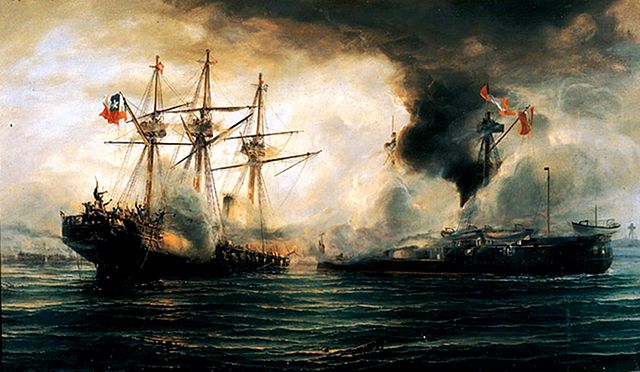
And thus the new Rendel’s design was called “Esmeralda” after “Emerald” a famous wooden corvette captained by national Heros Arturo prat which died fighting the Peruvian ironclad Huáscar at the battle of Iquique. But the name went much further back in time and commemorated the celebrated Capture of the Spanish 40-gun frigate Esmeralda in 1820 during the war of independence in Callao. She became the most powerful warship in the Pacific at the time. In any case, the new design was to be named after the ship, rather than after the captain, when ordered at Yard number 429 of the Armstrong Mitchell, Elswick Yard on 5 April 1881. She was projected to advantageously replace Arturo Prat. Construction proceeded until launch on 6 June 1883. Ten days later, the ex Arturo Prat, now Tuskushi, lef for Japan. The war of the Pacific was sitll ongoing when fitting out commenced. The war then ended eventually after five years on 4 April 1884. That was good timing as Esmeralda was completed in June and commissioned on 15 July.
Even before she was commissioned, her launch was publicized by the yard, believing the new “miracle ship” would bring in additional orders. The press in 1884 was told indeed the was both “the swiftest and most powerfully armed cruiser in the world” and “almost absolutely secure from the worst effects of projectiles”, and went as far as predicting the end of the ironclad era, very much in line with the Jeune Ecole. They were just far cheaper and cost effective than ironclad. Also written in the press Armstrong also predicted in case UK went at war with Chile, the Royal Navy needed to have the equivalent. The company also ordered a long article in the Times of Londo (anonymously written by Armstrong Mitchell’s chief naval architect, Rendel) again taunting the ship after commission at the occasion of the venue of the Prince of Wales.
That campaign started to bear fruit as a 1885 article in The Steamship journal stated the cruiser “attracted greater attention than any other ship”. The bet was by then won, using classic medias of the day like amoder promistional campaign: The yard was soon inundated with orders for new protected cruisers, from a dozen countries. DNC Nathaniel Barnaby at the time was admirative of the effort, not only making the company’s fortune, but also pushing out an entire generation of sailing ships of the Frigate and Corvette type world wide. The commission of Esmeralda also had an effect on the other side of the pond, in the creation of the “new navy”. The sorry state of the neglected USN after the ashes pf the civil war went cold, was shaken by the adoption bt Brazil already of the Riachuelo class completed in 1883. The second was the Esemeralda, adopted by Chile. Ships that could defeat anything the US could throw at them. In case of a war between Chile and the US, the latter would be able to rampage US trade lines in the Pacific without impunity for months and perhaps a year. A concerned US naval officer believed the cruiser could “stand off San Francisco and drop shells into the city out of the shorter-ranged shore-based batteries covering the Golden Gate strait” and added “She could destroy our entire Navy, ship by ship, and never be touched.”
When Esmeralda arrive at Santiago, she arrived in a wave of immense national hope and expectation like no other ship in the country’s history; Not only she had been financed in part by public donations (the other would be a refund by the yard after selling Tuskishi). The national press taunted on the first page over even through long treatises on its potential, and she was praised by then president Domingo Santa María as a deterrent instrument.
Contemporary and Modern reassessments
On one hand, Esmeralda was indeed the wonder taunted by its builder and the press, made in lightweight steel made possible by the new Siemens process, using a more seaworthy design, taller freeboard and on trials she was the fastest cruiser in the world, had a powerful secondary armament, better range, and this trademark armoured deck (see later) making her level of protection unique. She was a potential scary opponent for the US Atlanta class cruisers for example. However, if export success was there from the company, the Royal Navy, under the admiralty’s own designers and DNC N. Barnaby were the most virulent critics of the design. They believed Esmeralda was inferior to their latest Mersey class cruisers:
Sure, she had a higher freeboard but it was sitll comparatively modest (inferior to the Mersey class notably), she lacked a double bottom, as well as a heavily armored conning tower, had no backup steering position or system and the design of her coal bunkers had a fatal flaw in case of a lucky hit in one area in particular. She was fr less well protected than the Mersey with her full armour just representing 3.54% of her total displacement versus 12.48%.
Modern criticisms are mostly focused on the comparison between the real missions of cruisers a the time, and later, and her initial design. She was a paper ship, well sold and made real, but as showed the war of 1894, and of 1905, cruisers just worked differentely that prohetized by the Jeune Ecole and believed by Armstrong (Nicholas A. M. Rodger). The large ten-inch (254 mm) guns combined to its high speed, was on paper a way to choose the time of engagement with a superior opponent, choosing always the most appropriate fighting range. But the reality was that cruisers tend to instead protect maritime trade or disrupt it, not playing cat and mouse with enemy’s capital ships. In the end the 10-inch guns were too slow furing and large, eating up dispkacement that coukd be used more jusdiciously. This was conpoundd by the fact the ship was not a stable platform when firing due to its light construction and low freeboard. This was also realized at the yard, and after the Naniwa class and Giovanni Bausan, the main gun caliber was toned dow to a more manageable 8.2 inches (210 mm).
Design of the class
Hull and general design
Esmeralda was made in Schneider steel. The Company was created in Le Creusot 1836. The company developed an oil-tempering process to produce a homogeneous, uniform steel plate. By casting enormous steel ingots using Siemens open-hearth furnaces and pounding them under their famous colossal steam hammer they created a “mild steel” incredibly hard, yet far less brittle than previous steel experiments, so hard, but light and flexible. This allowed to make a large ship, with much increased dimensions, for a length of 270 feet (82 m) between perpendiculars, with the waterline stopping at a straight stem and ram bow below the waterline, and shorter, rounded poop and aft section (clipper stern) for a beam of 42 feet (13 m), and a mean draft of 18 feet 6 inches (5.6 m). Displacement was 2,950 long tons (3,000 t), not yet called “standard” but “normal”, meaning the calculated water displacement around the hull’s mass.
About her outlook, Esmeralda was quite modern indeed in appareance, the most stricking aspect was the total absence of rigging. She had two masts and poles, functional rig only for signals. Between them were located the main structure organized around tall bulwarks protecting the secondary gun crews. The main guns were in barbettes fore and aft like contemporary ironclads, eating a lot of space forward and aft. The six secondary guns were in side sponsons, shielded. There were structures around the two prominent funnels with many air vents and dorade boxes, and access hatches aft, used notably for supply, close to the aft mast boom. Between the two funnels was located the main bridge and helsman’s post on a cross-like platform spanning the entire beam and ending with aerial sponsons for tertiary guns. The ship was designed for a crew of 296 and for this, there were two whalers, one barge, one pinnace, one yawl and one steam cutter all under davits. They were also usable for landing parties.
Powerplant
Esmeralda was powered by two horizontal compound steam engines (HC) from the company by R. and W. Hawthorn (also a naval yard). They drove two 4-bladed bronze propellers (c4 meters diameter). They were fed in turn by four double-ended fire-tube boilers. These engines had their own separate compartments for survivability. On sea trials in 1884, this powerplant was rated for 6,803 indicated horsepower (5,070 kW) when observed and measured, for a top speed of 18.3 knots (34 km/h; 21 mph). The “normal” speed was rather 18.2 knots, which was still several knots faster than the previous cruiser (Tsukushi). Esmeralda carried 400 long tons (410 t) of coal in normal conditions but this could be pushed by a maximum of 600 long tons (610 t) if necessary placed in side compartments. This was also criticized later as barely sufficient to zip in and out of the Chilean territorial waters, north to south, 4,270 to 4,300 kilometers (2,653 to 2,670 miles) depending on calculations. Her endurance is unknown.
Protection
Protection was of course the main selling point of the design and the very typology derived from it: Frigates and Corvettes could be composite or steel prior to this, but this included mix of metal and wood to buffer shell impacts, but sheating was still light, mostly made of wrought iron plating, which was brittle. In the case of Esmeralda not only the entire hull was made in steel, she was innovative for her arched protective deck below the waterline, running from bow to stern. Albeit it was “only” 1 inch (25 mm) thick over the machinery, down to .5 inches (13 mm) near both ends, the “turtleback” scheme was designed to bounce off incoming low velocity shells, which given the short range of the time, only about 3000 m or 3300 yds for accuracy and lower velocities for these short-barrels, was deemed sufficient even against battleship shells.
They had to enter through side compartments which in addition could be filled be coal above, and filled with cork along the waterline to limit flooding, increasing buoyancy in the case of shell penetration. This was Bertin’s idea, but cork as not ideal anyway, no more than the protective coal bunkers. But to spare weight, they were not subdivided, so they could be flooded anyway. In case shells came lower than the waterline, hit the hull below the arched armour deck, which went below it, forming some sort of rear belt, water depth combined to low final velocity was deemed sufficient as protection.
Other than that, the only armour part of the ship were shields up to 2 inches (51 mm) thick. There was a conning tower forward, but it was onl- provided with 1-inch armor, so just suffucicient against light shrapnnel and small arms.
Armament
Esmeralda had a powerful 4-tiered battery. It comprised two 10-inch (254 mm)/30 in single barbettes fore and aft. Note that the barbettes were not protected at all and the gun crews were in open air. The secondary armament comprised six 6-inch (152 mm)/26 caliber guns in Vavasseur central pivot mountings on deck, protected by shields, three per side on sponsons to fire forward for the outer guns. This was completed with two 6-pounder guns on the bridge wings plus five 37 mm (1.5 in) Hotchkiss revolving cannons in elevated positions, notably on the central platform. But there were no fighting tops in the masts. It was usual at the time to received torpedo tubes, and if Esmeralda was fitted for three 14-inch (360 mm) torpedo tubes they were never installed.
10-inch (254 mm)/30 Armstrong F/G

These massive, 25 tons guns breech loaders had an elevation of 12°, and depression of 5°. They fired shells worth 450 pounds (200 kg) plus a powder charge of 230 pounds (100 kg). The whole operation was manual, and assisted by steam. Each loading required the gun brough back to a neutral position for the whole loading process to start agin, so the rate of fire was less than a short per minute. “F/G” Variants were for export only. It achieved a muzzle velocity of approximately 2,000 to 2,040 feet per second (610 to 622 metres per second) when firing with a full service black powder (or early brown prismatic powder) charge.
Maximum Range: The gun featured an effective maximum range of 10,000 yards (roughly 9,140 metres or 5.7 miles) when fired from a standard naval automatic carriage or a coastal defense barbette mount.
6-inch (152mm)/30 Armstrong I
These had barrels 4.66 metres long, breech loading, rifled. The “I” Variant like the “F/G” patterns were a specific proprietary manufacturing pattern developed by Armstrong for international naval contracts and colonial defence. It had a Vavasseur hydro-pneumatic carriage fixed unlike the disappearing ones in coastal fortifications. Muzzle Velocity was from 1,850 to 2,100 feet per second (564 to 640 metres per second) either using the standard black powder, brown prismatic powder, or later low-pressure smokeless charges. They fired the standard 100-pound (45.36 kg), HE and AP. Range was up to 8,000 yards (roughly 7.3 kilometres).
⚙ specifications |
|
| Displacement | 2,950 long tons (2,997 t) |
| Dimensions | 270 x 42 x 18 ft 6 in (82 x 13 x 6 m) |
| Propulsion | 2 shaft Compound Steam engines, 4 double-ended fire-tube boilers 6,803 ihp (5,073 kW) |
| Speed | 18.3 knots (33.9 km/h; 21.1 mph) |
| Range | 600 tons coal |
| Armament | 2× 10 in/30, 6× 6 in/26, 2× 6 pdr, 5 × 1pdr Revolver |
| Protection | 1 in (25 mm) deck armor |
| Crew | 296 |
Career of Esmeralda (1884-1894)
Esmeralda was laid down on 5 April 1881 in Elswick (Newcastle upon Tyne), launched on 6 June 1883, completed on 15 July 1884. The war ended as she was still fitting out so neutrality laws no longer applied when she received her Chilan crew for the official commission and being handed hover to the Armada. She was prepared for the long transtlantic trip to the Cape Horn and departed on 16 October 1884.
The trip was risky when crossing the cape, but she arrived at Santiago, mid-way across the confetti country. She cruised in view of all Chilean cities while underway, with crowds saluting her before her arrival, greeted by an enthiastic press, bands, parade and a massive crews in addition to an official government’s delegation and the whole naval staff. The president claimed Chile now had the most powerful navy in the Americas…
She would soon take place alongside two well-maintained 1870s Almirante Cochrane-class central-battery ironclads and two older armored frigates. Training in the Chilean Navy was rigorous and very close to Royal Navy standards and traditions since Cochrane, recoignized of the best standards. She likely took part in parades the first year, but by April 1885, the government sent her to show the flag in Panama, alongside ships from France, UK and and the US. The press was deligted to report she made the trip northwards in 108 hours (4.5 days) with 12.6 knots (23.3 km/h; 14.5 mph) on average. Her presence moight have been motivated by a possible annexation of Panama by the US but it might be also simply a show of force. Maintenance was of very high standards, she was docked every four months, bottom fully repainted.

Illustration showing the Battle of Iquique from the sea; Esmeralda is in the background to the left, accompanied by other ships of the Chilean Navy, and HMS Warspite as an observer in front while the port is bombarded
Esmeralda took then part in the 1891 Chilean Civil War: The Navy supported in majority the victorious Congressionalist rebellion over the loyalists, Presidential-led faction. Her captain, Policarpo Toro refused to join the Congressionalists however and was replaced by Pedro Martínez by the crew. The first days she sailed to Talcahuano too look for money and weapons, then sailed further south to intercept the corvette Abtao and two Almirante Lynch class torpedo gunboats just purchased by the Presidential faction, coming from Europe, but she never found them. She then sailed northwards with the rest of the Congressionalist squadron to blockade and control ports. On 19 February, she took part inthe Battle of Iquique: Congressionalist troops, until then outnumbered, retained the port, and thanks to the artillery support of the squadron, repelled Presidential assaults. In fact they even bambarded positions of Presidential troops until they capitulated.
On 12 March, Esmeralda was sent to intrcept the steamer “Imperial” as fast transport ship bringing reinforcements north for the Presidential fation, and managed to catch her in the early morning just in front of Antofagasta. The port city however was defended by battiries and Esmeralda could not get close. When the transport sailed out that night, she lost track due to the poor state of her boilers and lack of propoer maintenance since the start of the war.

Illustration showing Esmeralda with the corvette Magallanes covering the advance of Congressionalist forces during the Battle of Concón
In April 1891, Esmeralda escorted the Congressionalist cargo ship Itata, north of the USA to take on a load of rifles. Then to mask cargo’s destination, both parted ways off the Mexican shores. The “Itata incident” emerged when the namesake cargo ship was detained in the port where she took on rifles, due to US neutrality. However she managed to escape and soon chased by the USS Charleston (1888). Esmeralda was warned of this and the press started to wonder which cruiser would prevail, her or Charleston, a contemporary protected cruiser, quite similar. The transport eventually reached Esmeralda off Acapulco, and USS Charleston broke the chase. Itata then reached Chile. Fearing a complete brakdown of relations with the US and dipolmatic tensions as the white house seemed to privilege the Presidential faction, the Congressionalists eventually sent back the Itata back to San Diego with her cargo intact.
In August, Esmeralda took part in the last naval operation, the landing of Congressionalist troops at Quintero Bay, on 17 August near Valparaíso. There, she fired three shots to alert the Congressionalists of her arrival and on the 21st, with the corvettes O’Higgins and Magallanes, she bombarded Presidential ground forces at the Battle of Concón, at the mouth of the Aconcagua River. Theyr presence alone severely demoralized the Presidential forces present. An observer from the Scientific American describe the reaction as “fearful havoc”. On 22 August, Esmeralda then bombarded to submission the forts of Viña del Mar with the ironclad Almirante Cochrane.
After the Chilean Civil War, the Chilean Navy considered modernizing Esmeralda in March 1894. The situation was indeed tense with Argentina in the south and there was a new naval arms race. A Chilean delegation was sent to Armstrong to get plans in order to upgrade her weapons, machinery, modernize the superstructure (notably with military masts) among others but the cost seemed prohibitive. Instead it was found more judicious to instead order new, more modern ships and sell her instead by ovember 1894 to the Imperial Japanese Navy. The funds raised would allow the order of a new armored cruiser, possibly of the same name. Japan needed warships fat, being herself in high tensions with China. Esmeralda was purchased for ¥3.3 million, but that was only a 3rd of the funds the Cabinet and Parliament had originally earmarked to purchase three new Argentine warships.
The sale also almost never happened as the Government wanted to stay neutral in this first Sino-Japanese War. A scheme was found in which the ships would be officially sold instead to the Ecuadorian government, which secretly acted as middleman. She ship would be paid to President Luis Cordero Crespo, and brokered by Charles Ranlett Flint’s Flint & Co. to Ecuador. There was a formal commissioning, but the ship was the same day secretely handed over to Japanese sailors in Ecuador. The US press believed she would be used in a war against Peru. She ship departed with her mixed crew still under Ecuadorian flag off the Galapagos, and without anybody around, officially handed over to the Japanese with the flags being swapped. The “Esmeralda Affair” and secret arrangements were later made public, weaponrized by president’s Cordero’s opponents, also accused od embezzlement, leading to a Liberal Revolution.

Izumi in 1908, after the Russo-Japanese war.
Read More/Src
Books
Bainbridge-Hoff, W.M. Examples, Conclusions, and Maxims of Modern Naval Tactics. General Information Series, no. 3. Washington, D.C. ONI
Bastable, Marshall J. Arms and the State: Sir William Armstrong and the Remaking of British Naval Power, 1854–1914. Aldershot, UK: Ashgate, 2004.
Brook, Peter. “Armstrongs and the Italian Navy.” In Warship 2002–2003, edited by Antony Preston, 94–115. London: Conway Maritime Press, 2003.
“The Elswick Cruisers: Part I, The Early Types.” Warship International 7, no. 2 (30 June 1970): 154–176.
Warships for Export: Armstrong Warships, 1867–1927. Gravesend, UK: World Ship Society, 1999.
“The Chilean Cruiser ‘Esmeralda’.” The Steamship (London) 3, no. 3 (1 February 1885): 41–42.
Corbett, Julian S. Maritime Operations in the Russo–Japanese War, 1904–1905. Volume 2. NIP
“Crucero ‘Esmeralda’ 3° [Cruiser Esmeralda #3].” Unidades Historicas. Armada de Chile (Chilean Navy).
Fuenzalida Bade, Rodrigo. “Capitán de fragata Policarpo Toro Hurtado [Frigate Captain Policarpo Toro Hurtado].” Revista de Marina Journal 90, no. 692.
Grant, Jonathan A. Rulers, Guns, and Money: The Global Arms Trade in the Age of Imperialism. Cambridge, MA: Harvard University Press, 2007.
Hardy, Osgood. “The Itata Incident.” The Hispanic American Historical Review 5 (1922), 195–225..
Hichborn, Philip (1889). “Sheathed or Unsheathed Ships?”. Proceedings of the United States Naval Institute 15 (1889).
Hurtado, Homero. “Resumen de las operaciones navales en la revolución de 1891 [Summary of naval operations in the revolution of 1891].” Revista de Marina Journal 76.
Lauderbaugh, George. The History of Ecuador. Santa Barbara, CA: Greenwood, 2012.
López Urrutia, Carlos. Historia de la Marina de Chile [History of the Chilean Navy]. Santiago: El Ciprés Editores, 2007.
Lyon, Hugh. “Chile.” In Conway’s All the World’s Fighting Ships 1860–1905, edited by Robert Gardiner, Roger Chesneau, and Eugene Kolesnik, 410–415. NIP
Office of Naval Intelligence. General Information Series: Information from Abroad. 21 vols. General Information Series. Washington D.C.: U.S. Government Printing Office, 1883–1902.
Perrett, J.R. “Some Notes on Warships; Designed and Constructed by Sir W.G. Armstrong, Whitworth, & Co., Ltd.” Mechanical Engineer 34, no. 867 (4 September 1914): 211–213.
Quiñones López, Carlos. “La Tercera Esmeralda [The Third Esmeralda].” Revista de Marina Journal 106, no. 790 (May–June 1989): 308–313.
Rodger, Nicholas A. M. “The First Light Cruisers.” The Mariner’s Mirror 65, no. 3 (1979): 209–230.
Sater, William F. Chile and the United States: Empires in Conflict. Athens, GA: University of Georgia Press, 1990.
Scheina, Robert. Latin America: A Naval History 1810–1987. Annapolis, MD: Naval Institute Press, 1987.
Scheina, Robert. Latin America’s Wars. 2 vols. Dulles, VA: Brassey’s, 2003.
“The Recent Battles in Chile.” Scientific American 32, supplement no. 829 (21 November 1891).
Tromben, Carlos. “Presencia Naval. El Crucero Esmeralda En Panamá [Naval Presence: The Cruiser Esmeralda in Panama].” International Journal of Naval History 1, no. 1 (April 2002).
Thomas Cavieres, Federico. “Cruceros al servicio de la Armada de Chile [Cruisers in the service of the Chilean Navy].” Revista de Marina Journal 107, no. 798 (September–October 1990).
Van Duzer, L.S. “Naval Progress in 1895.” The United Service 15, no. 2 (February 1896), 167–184.
Vio Valdivieso, Horacio. Reseña historica de los nombres de las unidades de la armada de Chile [Historical review of the names of the units of the Chilean Navy]. Santiago: Imprenta Chile, 1933.
Links
nytimes.com 1894 speculations sales esmeralda
nytimes.com 1894
The record v. 13-14 (Apr. 1884-Dec. 1885
en.wikipedia.org
en.wikipedia.org/ War_of_the_Pacific
Videos
Dr Alex video on esmeralda
Crucero Esmeralda y la Crisis de Panamá 1885
