
 Marine Nationale: L9013-9015 FS Mistral, Tonnerre, Dixmude
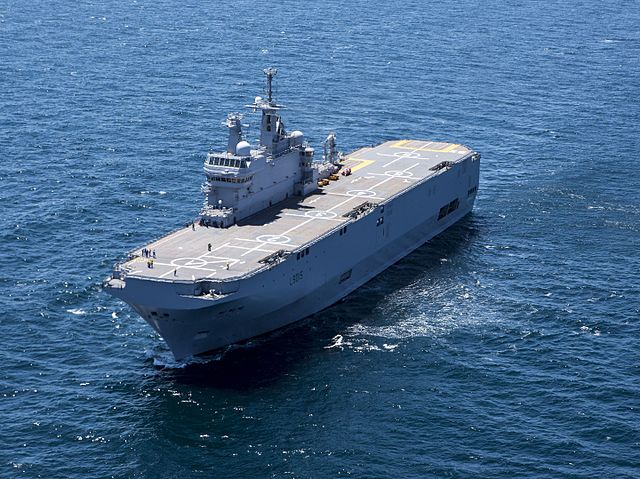
Bastille Day Special! The Mistral class are five landing helicopter docks built in France also called “projection and command ships” (BPC). They were tailored to operate and maintain sixteen NH90 or Tiger helicopters, four landing craft with a capacity for 70 vehicles and 450 soldiers, a 69-bed hospital, a 150 seat command center, and all the bells & whistles for a full NATO Response Force integration and full interoperability with the USN and USMC. So far the Marine Nationale maintains the Mistral, Tonnerre, and Dixmude. One more was planned back in 2010 but cancelled, and two more to the Russian Navy. This very controversial contract was cancelled in 2014 and the ship were resold to Egypt.
Development
 In 1997, DCNS (The state naval construction direction) started a study for a “multi-purpose intervention” ship (bâtiment d’intervention polyvalent: BIP) whereas changed were made in the amphibious operations doctrine. The CNOA (Concept national des opérations amphibies), or “National design for amphibious operations” was to follow the path of large, aircraft-capable landing docks to increase the amphibious capabilities, until then incarnated by the two Foudre and two Ouragan-class landing platform docks.
Previous French LSDs
Both were helicopter capable but lacked capacity for these. The Ouragan class were also in need of replacement, being launched in 1963-67. They had a 900-square-metre (9,700 sq ft) flight deck capable of operating three SA 321 Super Frelon heavy helicopters (comparable to the Chinook and Sea Stallion) or ten much smaller Aérospatiale Alouette IIIs, which was as much as the Jeanne d’Arc helicopter cruiser, also usable if needed in airborne assaults. These were interesting ships, as this deck occupied 1/3 of the ship’s surface, with a small island as bridge, like a carrier. The Foudre class however were completely new and recent animals however. They were inspired by the Bougainville, a prototype LSD replacement ordered on 22 November launched in October 1986 and completed in 1988, same general layout but with a larger, blockier island forward. The helicopter capacity was redced to just 2 landing pads.
The Foudre class were an extrapolation of this design, much larger (twice as much), reaching 12,000 tonnes fully loaded. Built 1986-98, they had still no hangar, but a 1,450 m2 (15,600 sq ft) flight deck, large enough to operate four Super Puma EC225 or two Aérospatiale SA 321 Super Frelon for heliborne assaults. This was comparable to contemporary USN LSDs like the Harpers Ferry class. But still no LHD or Landing Helicopter Dock. The USN operated them since the Tarawa class and other Euro countries were also looking at the design to take the place of a fully fledge carrier. A good example would be the Juan Carlos I in the 2000s. But France planned its LHDs in the late 1990s already.
Specs of the first French LHDs (1997)
The CNOA asserted the capability as the second Foudre class was close to completion in 1997 for amphibious assaults, withdrawals or demonstrations and raids. At that time, a rapprochement with NATO led France to adopt doctrinal frameworks described by NATO’s Allied Tactical Publication 8B (ATP8), also to better integrate with the “European Amphibious Initiative” that also professed a fleet of LHDs to be built across the Eurozone for combined landings abroad, now the Soviet threat was no more. The defensive posture started to cede terrain with overseas interventions and relief efforts. The CNOA emphasized air capabilities as a permium, and that meant having a hangar for the first time. But also to increase in the number of vehicles and personnel carrier. US LHDs were very much designed around the idea of a full marine Brigade, so that was the goal setup for the new BIP design.
The CNOA wanted the new ship indeed to deploy and support four combat companies, so 1,400 men, 280 vehicles, and 30 helicopters, for ten days, and over a 100-kilometre (62 mi)-deep sector. The French equivalent to a Marine MEU (c1600 men). This force should be able to intervene within 5,000 kilometres (3,100 mi) of Metropolitan France. Given French EEZ requirements, it was also to be capable of supporting French oversea territories, as well as allies. Jint operations of NATO/EU forces also emphasised inter-service operations. This became the new goal of the “Troupes de Marine” (French Marine Infantry, which existed since 1622) across brigades. They were still subordonated to the Army, though.
Evolution of the concept (BIP variants)

Comparison between the BPC and the preceding TCD types
Studies for this new “multi-purpose intervention ship” began at a difficult times of constant budget cuts or reduction, which hampered entire frigates or destroyer classes, led to cancellations and delays across the board, notablly the Charles de Gaulle. Defence industries were now underfunded by the state and prepared to massive restructuring and integration, gearing towards exports for sustenance, ot looking at the civilian practices to be more cost-effective. The BIP was designed as very modular and scalable and planned from the start to be cheap as well, appealing to European Union nations willing to embark on this new type of ship to answer the new European amphibious assault doctrine. They were designed to be constructed cooperatively, integrating elements a la carte or even built outside France, but political issues relating to employment and repartition of contracts caused a general failure (sounds familiar). Thus the BIP project ended as solely French. All countries embarked on their own generation of amphibious assault ships, like the british Argus and Dutch Rotterdam.

So still in 1997, several ship designs recycled concept and ideas of the chalands de débarquement (NTCD) carrying vessel combined with a hangar and full deck carrier loosely based on the cancelled PH 75 nuclear helicopter carrier, that was to replace and complement the Jeanne D’Arc already in 1975 FY1980. The largest design was retained in the end: BIP-19. This was the future basis for what became the Mistral class. The BIP-19 was longer than the Foudre class at 190-metre (620 ft) and flush deck, with a 26.5-metre (87 ft) beam, draught of 6.5 metres (21 ft) but a displacement of 19,000 tonnes, all exceeding the requirements of the NTCD concept. But more than anything else, they were very tall, to “stack” in that order, a flight deck, a hangar, a vehicle hangar and med facilities, and a dock. Three smaller designs were also considered, each with 23 metres (75 ft) in beam, the BIP-13 (13,000 tonnes, 151 metres (495 ft)), BIP-10 (10,000 tonnes, 125 metres (410 ft)), and BIP-8 (8,000 tonnes, 102 metres (335 ft)). BIP-8 was closer to an Italian San Giorgio-class, but with a helicopter hangar on top.
Looking at the Wasp class
 At early design stage, the NTCD concept was to integrate a port side lift for helicopter like the Tarawa and Wasp classes, another on the starboard side, one in the centre, one forward of the island superstructure for quick rotation. The idea was with a limited number of spots, a two-wave heliborne assault could be done with a full rotation from the hangar to the deck, potentially of four helicopters in two rotations, which seems reasonable. It was estimated 20 min. would be necessary to pull up a second ready to depart heliborne group.
However this was also too optimistic and created scores of structural issues. In the end, BIP-19 had a main lift aft and centre, and an auxiliary lift behind the island. Concept drawings and descriptions frilm the Direction des Constructions Navales (DCN) however showed aircraft carrier features like a ski-jump ramp for STOBAR aircraft like the AV-8B Harrier II (not in the French inventory but a proposal for export) and between 4 or 5 helicopter landing spots. One was large enough for a V-22 Osprey or CH-53E Super Stallion, also for better NATO and US cooperation, as well as a well deck wide enough for the EDIC (Engin de débarquement d’infanterie et de chars) or two US LCAC hovercraft. The French Senate review however estimated these options an overkill and required design changes.
The NTCD designations also changed over time. The BIP became the “Porte-hélicoptères d’intervention” or PHI (“intervention helicopter carrier”) by December 2001. Eventually when construction was underway they became the “Bâtiment de projection et de commandement” (BPC) for “command and projection” as they were also to act as command ship and center of an amphibious group, verhy much like such units in the USN.
Final Design and construction

At Euronaval 1998, so just a year after BIP-19 was adopted (the number reflected on the ship’s length, 190m), France confirmed the construction to proceed, with a formal approval for the first two, Mistral and Tonnerre, received on 8 December 2000. The contract was published on 22 December and had the public purchase authority’s approval (UGAP) on 13 July 2001. DCN and Chantiers de l’Atlantique obtained both contracts respectively by late July. A common engineering design team that was to supervise construction in both yards was established at Saint-Nazaire, in September. The DCA and DGA started to finalize and adapt the BIP-19 design and with DCN, the Chief of the Defence Staff and Chantiers de l’Atlantique, the new design will keep civilian-grade construction solutions to make construction faster and easier. For the validation process, a 1/120 scale model was built to be tested in a wind tunnel to show its behaviour on strong crosswinds as it was feared its tall profile would have an effect on, its slow speed manouvering. Plus, it was discovered these winds also created dangerous turbulence along the flight deck. The design was thus altered to minimise these effects over safe helicopter operations.
The construction itself was not only partly civilian, it was also modular, atomized, calling for a lot of minor components to be united on completion, on large hull modules, and implicated a hundred sub-contractors across France. This was again to reduce costs and offer more opportunities as using COTS (off the shelff civilian components) offered more options and more competition in order to gain the best offers. DCN was however at the head of the whole “circus” coordinating these efforts for the final construction, responsible for 60% of construction value, 55% of the work time. The engines were assembled in Lorient, the combat systems in Toulon, the rear half of the ship with the island in Brest. STX Europe (subsidiary of STX Shipbuilding South Korea in St. Nazaire) made the forward halves of each ship and was responsible of shipping them to DCN, Brest shipyard, for final assembly. St Nazaire until then had been world renowned for its supersized cruise ships such as Queen Mary 2 and Harmony of the Seas, the world’s largest in their time.

Mistral after launch.
Other companies involved Europe: Like Gdańska Stocznia “Remontowa” for many parts, and Thales Internaitonal (a large part in the Netherlands) supplied radars and communications systems. DNC planned, based on this organization, a 34 months constrution or 2 years and a half, roughly from “laying down the keel” to completion for a conservative cost of 685 million Euros, approximately the same as an HMS Ocean or USS San Antonio and like the previous Foudre-class. This was ambitious, since the latter took 46.5 months to complete and were half the size. But the plan included four ships, not just two from the start. The second pair was to comprise Dixmude and Jeanne d’Arc, the latter usable in the same guise as bot school ship in peacetime and regular LHD in wartime, to replace the 1960s helicopter cruiser. However in between, in 2009, negociations commenced for a sale to Russia, and if the construction slot taken by Dixmude was secured, but the ones for export taken over for the new two export ships, and delayed the “Jeanne” for three more years. Eventually, this 4th ship, thanks to new budgetary constrains, was never built. Instead, one of the three Mistral class would take over the role in rotation, being modular enough to install necessary facilities for a campaign in what is now the “Jeanne d’arc mission”.
The third ship, Dixmude, and the two “Russian Mistrals” were ordered from Saint-Nazaire STX France and STX Europe with DCNS providing the combat system. Even for these two exports, part would be built in Russia, their sterns built in Saint Petersburg by Baltic Shipyard. The next two would be buolt entirely in Russia (see below).
DCN laid their “keels” in 2002, Mistral on 9 July, Tonnerre on 13 December. They had of course flat bottoms. Chantiers de l’Atlantique laid the forward part of Mistral on 28 January 2003, then Tonnerre and the first aft block of Tonnerre was started 26 August 2003, and of Mistral on next 23 October. The two aft sections were assembled side by side in the same dry dock with the forward section of Mistral leaving under tow on 16 July 2004, arriving in Brest on 19 July 2004. On 30 July 2004 the two halves of the first were joined together with their intermediate modules and themselves using the classic jumboisation process and the second by May 2005. Mistral was launched on schedule, on 6 October 2004, Tonnerre on 26 July 2005. Delivery was postponed by a year due to the SENIT 9 sensor system being not ready on time. Another issue was the replacement of the entire linoleum deck covering of the forward sections that deteriorated much faster than expected. Commission respectively was on 15 December 2006 and 1 August 2007, a year late.
The 2008, the French MoD White Paper looking at the recession planned an entry of service of the second pair by 2020 but in 2009, the third ship, Dixmude was ordered earlier than expected with a construction starting on 18 April 2009 in Saint-Nazaire, due to cost constraints. On 17 December 2009, she was named. The fourth was planned but still unnamed, and between after the 2008 financial crisis and austerity, postone indefinitely. So many proposed Dixmude being named Jeanne d’Arc instead, expeded the decommission of the helicopter cruiser in 2010. It was opposed by some French naval circles seeing a dedicated training ship obsolete when having such modular ships as the Mistrals, that could be rotated in the same training role as seen above. The cancellation of a fourth Mistral-class was officially written in the 2013 MoD White Paper. In 2014 with the controversy of the completion of two ships for Russia, some expressed the idea of the Marine Nationale repossessing one and selling the other, but eventually a customer was found for both (see below).
Design of the Mistral

The forward half of the Mistral being towed from STX to Brest for final assembly (reddit).
Based on displacement alone, the Mistral class were significant at several levels. They were the largest ships in the French Navy, after the nuclear-powered aircraft carrier Charles de Gaulle, and had a slightly greater height above water. They also offered France, after the retirement and sell of the Foch to Brazil in 2001, four ships with full decks for aircraft operations, albeit the Mistrals were only designed for helicopter operations. France at the time had no VTOL jet unlike the US, Britain, Italy and Spain, and thus could only support the landed Marine Brigade by attack helicopter, which was in the 2010s, the complex and costly Eurocopter Tiger. Dassault had its hand on the concept and built VTOL prototypes such as the Balzac in the 1970s but there was no need expressed by the MoD.
In addition, unlike early proposals for operations of foreign VTOLs on their decks, they were reinforced enough for a V-22 Osprey, but not thermal-protected for VTOLs. That was, and still is possible in theory to carry and operate VTOLs, albeit there are no dedicated facilities not hangar space for them, and a taking off would be a “one ticket affair”, burning out the flight deck. For the same reason, and even more, that could only operate the F-35 on paper. Critically also, if they could fit in the hangar, the Mistral’s lifts are rated for c13 tons and its Jp5 fuel storage is limited.
General Layout
 The Mistral class are large ships, albeit still small compared to today’s average US or European LHA/LHDs. For an empty displacement of 16,500 tonnes and fully loaded at 21,500 tonnes they symbolically “only” made 199 m (652 ft 11 in) for a beam of 32 m (105 ft), panamax, and a draught of 6.3 m (20 ft 8 in) but its height ratio, especially between the water draft below and air draft above is about 1/4 below, 3/4 above. However between the flat bottom, and active stabilization fins, and ballasts stability is maintained. The Mistrals could run inside estuaries and shallow waters around the globe to some extent. However being that short, for that height, basically the same as a Wasp class, they lacks about 60 meters (197 ft) in length to match.
Now for the layout, they sports a blocky hull characteristic both of LHDs and of civilian optimized container ships: The waterline is narrowed at the forward section with a bow fully merged with the lower lip of the flight deck, fine entries and a bulge for better hydrodynamic efficience, but then a constant beam to to the squat stern, for the well deck and its door. Note that the well deck is relatively short, about 1/4 of the hull length’s, followed by the vehicles parkings, at the upper level since the machinery spaces are in front. The entire two modules, forward and aft, are also well separated functionally: The
forward one is “reserved to humans”, with the higher level modular on two-levels to accomodate the 1400 troops expected, then the joint HQ command post below, and the fully equipped hospital & med services below, then high standard living quarters for the crew and additional capacity for students.
The aft part is reserved entirely to “hardware”, On top, below the flight deck that end with the largest lift, the aviation hangar is limited ends forward of the aft module, but sufficient for a modest park of helicopters, which generally takes less real estate than a conventional aircraft and its wings tail surfaces (see below). Below is the double-deck hangar reserved for the vehicles, made to Ro-Ro civilian standards, but with a better structural strenght to handle armoured vehicles, including main battle tanks (50t+). Ro-Ro could handle generally standard 38t fully loaded lorries at the lowest deck and personal cars above. Vehicles could transition frop the upper hangar to the lower hangar via a ramp and then to the aft well deck a level below and in front of the lower half-hangar. There is also a lot of extra free space for personel, inc. the troops in this area.

A rendition by M. Guillou for Zephyr Eds. via reddit
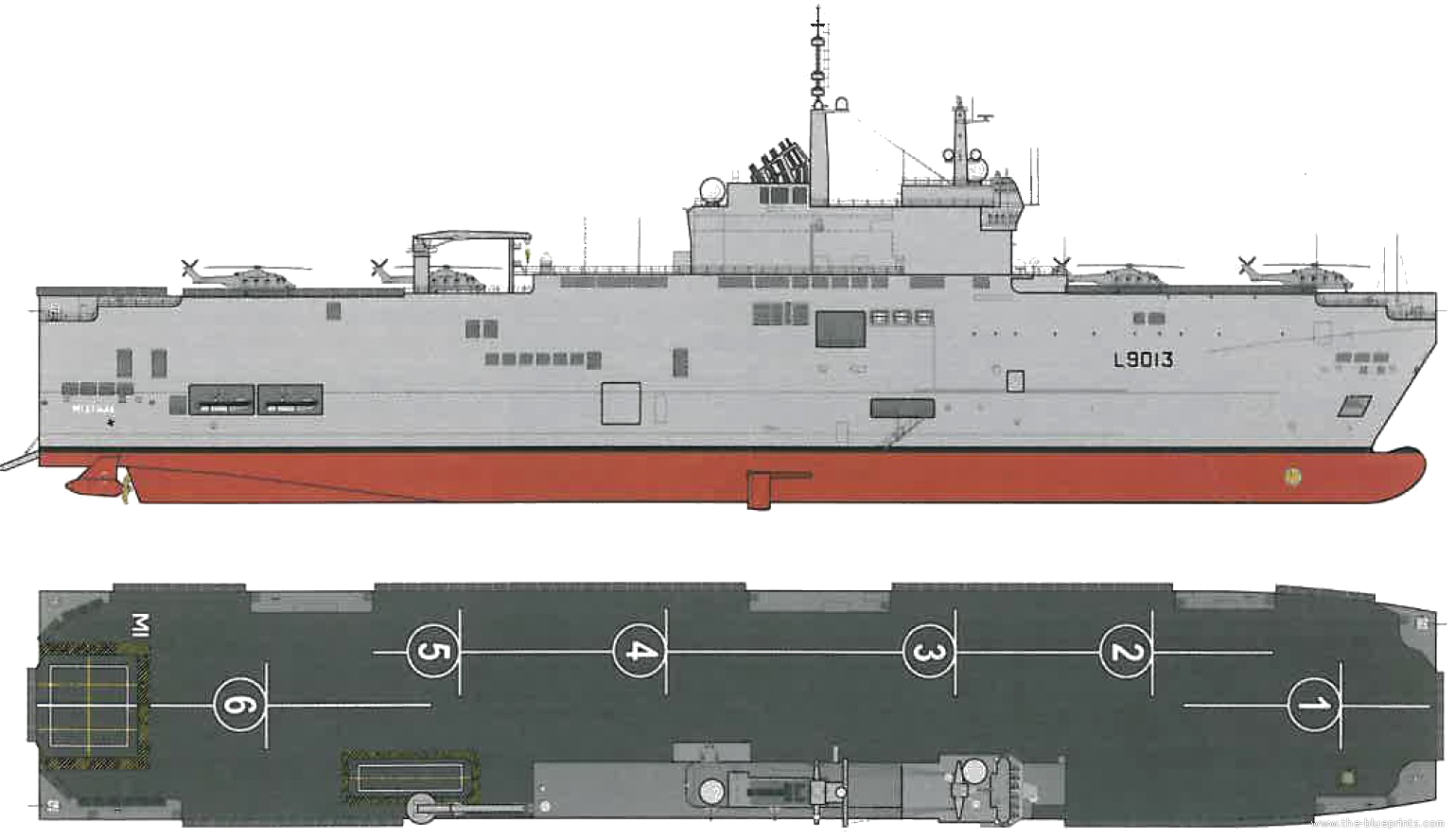
Also, to correctly integrate extra command facilities and sensors, instead of a small island, they adopts a large one, including the lower vehicle hangar aft for the tractors towing the helicopters or payloads around. So, the aft section is decicated to the “machines” and the forward section is dedicated to the “humans”, making for a rational distribution and making the work share easier and more modular if built in foreign shipyards. This is why the two stern sectiosn were made in St Petersburg for the export ships, since all the hardware integrated could be made to russian standards locally, from the helicopters to the vehicles. As for the deck, outside its helicopter spots, the aft side lift and main aft lift, it is cutout forward at the prow and aft to make room for a defensive armament. The island has two masts, one lower foremast above the 2-storey bridge (one for navigation, another for air operations), with sensors, and a taller mainmats in front of the machinery exhausts. There is also an aft observation bridge to handle rearwards operations.
C4R facilities
The Mistral-class had been designed from the keel up also as command and control ships -hence the BPC acronym- to integrate a 850-square-metre (9,100 sq ft) command centre for up to 150 personnel. Information from all sensors is centralised in the SENIT system (Système d’Exploitation Navale des Informations Tactiques or “System for Naval Usage of Tactical Information”) which derives from the USN Naval Tactical Data System (NTDS) and using many similar communication systems to integrate to NATO standard Link 11, Link 16 and Link 22. However the development of the latest SEINIT 9 delayed delivery by a full year. The SENIT backbone is Thales MRR3D-NG Multi Role 3D Radar which working on C band with IFF. It is completed for a full piture to the SYRACUSE satellite system, French satellites SYRACUSE 3-A and SYRACUSE 3-B also provding 45% of the Super High Frequency secured communications to NATO. On 18-24 June 2007 one such video conference was held twice daily between Tonnerre, while underway from Brazil to South Africa with VIP visitors at the Paris Air Show.
Med facilities
The other accomodations created in the forward module of large size and importance is the NATO Role 3 medical facility. It is of the size of a divisional field hospital of equivalent to a 25,000 inhabitant hostpital: Departments integrated are dentistry, diagnostics, all surgical and medical specializations, food hygiene or a psychological unit. In addition there is a Syracuse-based telemedicine system for very complex surgery to be perform with the help of the world’s best specialist. Now for stats, it is 900 m2 (9,700 sq ft) hospital, 20 rooms, 69 hospitalisation beds, plus 7 for intensive care and with two osolated surgery blocks come complete both with a radiology room for digital radiography and ultrasonography. There is also a mobile CT scanner available for deployment, and 50 medicalised beds in reserve to be deployed on a helicopter hangar in case of emergency. This is able to not only fully support a Brigade in operation in a symetric high intensity fight, but a full division in the field as a second echelon unit.
Modern Accomodations
STX was trusted, given its experience with cruise ship’s sound-proofing, to improve the forward section’s living quarters. One thing that helps is that the azimuth thrusters aft are located, like the machinery in the aft, non-liveable “hardware” modul, and that no piping or machinery are visible in the forward module which looks as much as the internals of a luxury liner (less the shiny fluff) as a military vessel. The crew cabins aboard are indeed to the same level of average passenger cabins aboard cruise ships and all 15 officers have their own individual cabin. Senior NCOs share two-man cabins, junior officers and troops are in 4-6-person cabins. When inspected by USN vice-admiral Mark Fitzgerald in May 2007, he claimed he would have used the same space to house three times more personal.
Powerplant

The Mistral class like most LHA/LHDs and unlike aircaft carriers does not need to great speed for operations. The machinery was thus left to civilian standards, giving far more flexibility and ease of maintenance and service. The core are three Wärtsilä diesel-alternators 16-cyl. 16V32 (6.2 MW) and a Wärtsilä Vasa auxiliary diesel-alternator 18V200 (3 MW), which can be combined in order to generate power fed to two Rolls-Royce Mermaid azimuth thrusters (2 × 7 MW), 2 five-bladed propellers with hooked blades to reduce the acoustic signature. This solution also frees a lot of space aft dedicated normally to the shafts. The idea came to roost and other navies adopted it as wll, the Dutch Rotterdam class, Spanish Galicia class, and Canadian Kingston class.
The solution of thusters instead of traditional fixed shafts was novel at the time, and a core innovation of the design. The concept was well known and understood at the time, with significant experience from STX by fitting these to its latest “super cruise liners”, allowing for fine manouvers in restricted waters, if needed a complete 360° in no more space than the ship’s own lenght. In stright line, it made for a top speed of 18.8 knots (35 km/h; 22 mph). The advantage of Diesels was reflected in a small size and footpring inside the ship, beut their height precluded the use of a full-lenght well deck. They brought a range of 10,800 km (5,800 nmi) at 18 knots (33 km/h; 21 mph) and 19,800 kilometres (10,700 nmi) at 15 knots (28 km/h). In addition for stability there are the two side fins that could be entirely retracted. They are active when out, meaning their angle could be changed hydraulically to compensate for the roll.
Armament

The armament is light and strickly defensive, even short range. The mistral are dependent on their escort. In short, they have two Simbad short range missile systems, and an array of light guns to deal with asymetric threats, 20 mm modèle F2 guns, 30 mm Breda-Mauser guns, 7.62mm M134 miniguns and 12.7 mm M2HB Browning.
As built, they had two twin Simbad launchers, four 0.5 inches M2-HB only and the two Breda-Mauser 30 mm/70 guns included in the design were not installed at first. This very short range armament was criticized in the light of Operation Baliste, to aid European citizens in Lebanon during the 2006 war. It was suggested to replaced them by quadruple-launcher automatic Tetral. The loss of INS Hanit to a Hezbollah anti-ship missile showed the vulnerability of modern warships to this asymetric threat. The Mistral, a product of the “dividends of peace” appeared under-equipped for self-defence so Mistral and Tonnerre needed a sufficient escort to deploy in hostile waters. But this contradicted the short number of escorts in the French Navy. There was for example a 5-year gap between the decommissioning of the Suffren-class frigates and their replacements, the Horizon-class/FREMM due to budgetary constraints.
By late 2011, the the NARWHAL20 remote weapon station (RWS) was added to the ships for close-in self-defense by Nexter Systems. They were replaced by the NARWHAL20B guns firing new 20×139mm ammunition, located on the port bow and starboard stern. Dixmude was the first to receive these by March 2016.
By late 2013, two M134 Miniguns were also added to all ships, also to deal asymmetric threats, in light of anti-piracy operations. They were perfect to destroy speedboats and suicide boats and could be dismounted and fitted on door-equipped helicopters, now they makes even more sense in a drone-rich environment.
By December 2014, the French Navy awarded Airbus a contract for the installation of MLRS on Mistrals for fire support. These new GPS-guided rocket have a range of 70 km (43 mi) and unitary 90 kg (200 lb) high-explosive warhead. Details of integration could be a simple deck addition of euch ground based lanuncher without modifying the ship, on a specific deployment.
Simbad SAM
 The only missiles on board are confusingly enough, part of the “Mistral” program. In the Navy they are called Simbad as the missiles are the same but the mount is adapted to naval use. They are very small IR short range missiles of the MANPAD type, more comparable to the RAM CIWS. Now this category is called SHORAD. The Mistral programme were the first French Manpads, a program developed in 1974 by Matra to given France and Europe an organic self-defence SAM at infantry level. A 6-tube launcher was installed on George Leygues and Cassard class Frigates, before being ported on Charles de Gaulle, Mistral-class and its latest evolution the SIMBAD-RC just installed on the Fnew Jacques Chevallier-class support ships. Since 2022 MDBA accelerated the delivery rate. They saw action in Ukraine. On board, there are sixteen Mistral in storage.
Specs:
The SIMBAD is a Mistral missile mount system with 2 launchers, manually operated. On the Mistral they are installed on the deck cutouts fore and aft.
Mass 19.7 kg, 1.86 m and 1.88m including booster for 90 mm diameter.
Solid Rocket Motor, 2-stage, 930 m/s, or Mach 2.7, 6 km alt. or 8 km range.
Infrared homing, Laser proximity or impact triggered 2.95 kg warhead with high density tungsten balls.
20 mm modèle F2 gun
 To deal against asymetric threat (like kamikaze fast boats) and helicopters there are two 20mm F2 gun in oprtionally manned mounts. These Giat 20 F2 Autocannons are a derivative of the famous Swiss Oerlikon of WW2 fame, this variant used a gas unlocked, delayed blowback feeding system for a ROF of 900 round/min at 1,050 m/s (3,400 ft/s), elevates −15° to + 65° at an effective range up to 1,500 m (4,900 ft) against aerial targets. Replaced by Nexter Narwhal autocannons. Specs +75°/-20°, ROF 800 round/min, MV 1,050 m/s (3,400 ft/s) range 1,500 m (4,900 ft) against aerial targets.
30 mm Breda-Mauser
 These systems are also installed on Georges Leygues and the Ouragan class. These are naval autocannon built by Alenia Marconi Systems and Oto-Breda, using the Mauser MK 30 mm Model F gun. These are optionally manned mount, remotelly used by default. The turret indeed has a seat for an operator, otherwise used to access the ammunition system. The Barrel length is 82 calibres, ammunition Calibre 30 mm, Rate of fire 1600 rpm and Effective firing range 3,000 m (9,800 ft). They can be used against ioncoming missiles thanks to radar tracking.
7.62mm M134 miniguns
These systems are light enough to be installed on pintles on the island, or carried by helicopters for ground support. This weapons needs no presentation. It has been around in Vietnam (since 1963) and still is an icon of firepower, using a 6-barrel Gatling system, rotating. For 85 lb (39 kg), 41 lb (19 kg) in lightweight mod. and being 801.6 mm (31.56 in) long overall, it fires a 7.62×51mm NATO, through an electrically driven rotary breech for a rate of fire which is variable, and up to 2,000–6,000 rounds/min for a muzzle velocity 2,800 ft/s (853 m/s) and max range of 3,280 ft (1,000 m; 1,090 yd). It could be eqsuipped if needed with a 5,000-round belt. There are two systems on board, and this is completed by four 12.7 mm M2HB Browning heavy machine guns, also on pintles than could be installed everywhere on demand.
Protection
Passive
This is the usual package: Underwater, the Mistral had a full double hull. There are void compartments alongside the machinery spaces to reduce flooding and bulkheads separating the machinery space from the rest, with remote accesses and energy-autonomous secondary pumps if the powerplant was out of service. In the rooms where are located the three Wärtsilä diesel-alternators 16 V32 (6.2 MW) and the separated 1 Wärtsilä Vasa auxiliary diesel-alternator 18V200 there are automatic sprinklers with fire detection and optional remote use. There are several main fire posts across the ship and hand-held halong fire extinguishers at any level and almost any room. Sprinklers with automatic detection are also installed in the ammunition rooms.
There are the usual safety fillers for all avgas pipes and tanks, and in the hangar, in addition to fire curtains that could divide the space in two, there are is a main fire control post. There are sprinklers and an alarm under the roof (deck). The same is true in the two vehiclles parkings with gas detectors. There is also a full NBC protection, with external detection of all pathogens, chemical or radialogic agents, full sealing of all external accesses and air conditioning with overpressure if needed. The ammunition magazines and CiC are likely protected if needed by optional kevlar panelling but otherwise no armour. The ships are built under civilian standards with add-on military level protection in some places.
Active
This is restuing around three elements:
Vigiscan IR e/o detector: Optronic system tasked of identifying incoming threats by infrared with an automatic threat classification system 1
ARBB-36 ECM suite Classic 1990s electronic warfare suite by Thales France. 1
SLAT torpedo decoy Equivalent to the USN Nixie system, in cooperation with Leonardo. It uses high sensitivity passive acoustic sensors and advanced algorithms to detect and classify targets 1
Sensors
DRBN-38A Decca Bridgemaster
Commercial navaigation radar. frequency 3 050 MHz in S band and 9 410 MHz in X band
PRF 1,760 or 785 Hz, pulsewidth (τ) 0.05, 0.25 or 0.75 µs, PP 30 kW/10-25 kW range 96 nm (192 km) resolution 35m
beamwidth 2°or 2.8° in S and 1°, 1.3° or 2° in X band, 28-45 rpm. 1
Sperry E250 navigation radar
Also called Bridgemaster E, 250 EPA (L) radar. Brochure
MRR3D-NG air/surface sentry radar
Only proper military radar on board, developed by Thales. 3D radar with a multi-beam tracjing fnunction and 8 priority tracks at each rotation. Automated clutter and jamming measurements, signal processioning adaptation, and two operating modes. Brochure
SENIT 9 CCS
SENIT 9 centralized combat system, buried inside the ship. 150 seats. Optional Kelvar armour. Data classified, comparable to USN NTCS.
Capacity

Infographic (CC) showing the maximal capacity of the Mistral class
The Mistral-class had been designed to accommodate up to 450 soldiers with their full equipment and 900+ for short-term deployments, accomodated partly in the forward section and partly in the 2,650 m2 (28,500 sq ft) vehicle hangar. The latter is given reinforced decks, albeit still comparable in working to commercial ferries, to house a 40-strong Leclerc tank battalion, or a 13-strong Leclerc tank company and 46 other vehicles. The older Foudre-class: 100 vehicles, with 22 much smaller and older AMX-30 MBTs in a 1,000 m2 (11,000 sq ft) paking. As seen above it was on two decks with the lower one accessible via a ramp communicating to the well deck.
The well deck is 885 m2 (9,530 sq ft). It can accommodate 4 landing craft, two USN LCAC hovercraft, a capability judged important for interoperability with the USMC and Royal Marines. Hoiwever the basic solution retained was a fuel-saving high speed aluminium catamaran, the 59-tonne EDA-R (Engin de débarquement amphibie rapide).
EDIC Sabre

The older piece of the puzzle so far, 17 in service and also exported. This LCU (acronym: Engin de débarquement d’infanterie et de chars or “Landing Craft, Infantry and Tanks”) is 330–371 t (325–365 long tons) standard, 748 t (736 long tons) full load for 59 m (193 ft 7 in) in lenght, 11.6 m (38 ft 1 in) in beam, 1.7 m (5 ft 7 in) in draught with a bow ramp.
It is powered by two SACM Uni Diesel UD30 V12 M3 diesel engines on two tunelled shafts for 1,000 kW (1,400 hp), 12 knots (22 km/h; 14 mph) and 1,800 nmi (3,300 km; 2,100 mi) at the same speed.
Capacity is 200 t (200 long tons), 180 troops, for a crew of 10. Navigation: Racal Decca 226 radar. Defended by 2×20 mm F2 guns and 2× 12.7 mm M2HB.
The EDA-S Amphibious Standard Landing Craft was ordered to replace Foudre-generation CTM landing craft. Delivery started in 2021. Eight could be deployed on a Mistral class well deck, each with a payload capacity of 65-80 tonnes 11 knots (20 km/h; 13 mph) speed at full load. These are equivalent to classic LCUs in the USN and RN.
EDA-R

Instead of the LCA-C hovwercraft of the USMC the French DGA (Armament Direction) chose a proposition by aluminium specialists of the Nprmandie CMN Yards: A lighweight catamaran with a lifting deck in order to present when landing a full belly. Whe retracted up, this freed the two semi-hulls presenting a much rediced water surface, combined with very powerful engine and piump jets for a transit at 30 knots of needed. This had what a LCAC is capable at 70+ knots and the latter could land its payload deeper on the beach, however the consumption is staggering. Instead the EDA-R was designed for more economical fast rotations with the mother ship. So far, 4 are in service, shared with the there BPCs.
Caracteristics: Displacement 285 tons (light) for 30 m (98 ft 5 in) long, 12.8 m (42 ft) wide, 2.5 m (8 ft 2 in) to 0.6 m (2 ft) draft.
Propulsion: Four MTU Friedrichshafen 12V2000 M92 Diesels 1220 kW+ 4x Wärtsilä Pump-jets, 20 knots (37 km/h; 23 mph) economical, 30 knots (56 km/h; 35 mph) top.
Range: 1,000 nmi (1,900 km; 1,200 mi) at 15 knots (28 km/h; 17 mph) laden. Crew 8, capable of carrying a full Cavalry Platoon (3 VBLs, 3 AMX-10 RC) or a reinforced Infantry Platoon of 6 VAB, a Field Engineering Platoon or a First-Aid Post. It could also carry to Leclerc MBTs.
Air group & Facilities

The flight deck is 6,400 square metres (69,000 sq ft) wide total, for six helicopter landing spots mainly on starboard, but one centerline reinforced for a 33-tonne helicopter. Below there is the 1,800-square-metre (19,000 sq ft) hangar deck occupying the entire aft section, two stoey tall to hold 16 helicopters, with a maintenance area and overhead crane. When landing, the helicopters are assisted by a DRBN-38A Decca Bridgemaster E250 landing radar and optical landing system. The main lift is located eft, the auxiliary side lift is on the aft port side but not with a lower weight capacity as both are limited to lifting 13 tonnes. The aft lift is larger at 225-square-metre (2,420 sq ft) and if for rapid rotation with helicopters with rotors in flight configuration. The 120 square metres (1,300 sq ft) auxiliary lift is only for folded blades helicopters.

The helicopter-only group is mission-based. The Mistral class had been equipped with all helicopters in inventory at th time between the Army and Navy. Trials of 8 February 2005 were performed with the older Lynx and a Cougar, both Navy models in ASW configuration. The first landing of a NH90, the largest in inventiory after the retirement of the SA 342 Super Frelon, took place on 9 March 2006. The ideal configuration is of half NH-90s, half Tigre attack helicopters. On 19 April 2007 Army helicopters Puma, Écureuil and Panther were operated. On 10 May 2007, the reinforced spot saw the landing of a USN MH-53E Sea Dragon off Norfolk. First CO Capt.V. Gilles Humeau, it was possibleon paprt between the hangar and deck to host thirty helicopters, close to a Wasp-class but for 40% cost and crew. The smallest heliborne system is the Schiebel Camcopter S-100 tasked of sea and ASW reconnaissance, with its dipping sonar.
NH-90
 The NHIndustries NH90 is a medium-sized 1995 twin-engine multi-role military helicopter using fly-by-wire flight controls and made with composite materials. This joint model is also used by Italy, Germany, Spain and was exported. So far 525 had been manufactured. It could carry a small vehicle and 20 seated troops or 12 medevac stretchers, or 2 NATO pallets or 4,200 kg (9,259 lb) under external slung load enabling the lifting of light armoured or softskin vehicles. Some versions armed with missiles and 20mm gun pods. The French operated both the Army and the Navy version, so that in ASW configuration, a Mistral could operate 16 NH-90s Marine alongside the smaller Lynx, and Panther. However the NH90 has been criticized as over-engineered, unreliable and way too costly to operate with extensive maintenance periods.
HAP Tiger
 The Eurocopter Tiger (1991) is the main attack helicopter of Europe, formerly a joint-Germano-French peoject to which Spain participated, also purchased by the Australian army. It has been declined in dozesn of variants, all for the Army, typically tasked of anti-tank missions. They are used in the support role of NH-90s or other army helicopters, securing the beachhead, attacking enemy formations. They are capable of 315 km/h (196 mph; 170 kn) without rotor head mast, had a typical crew of two, pilot and weapons officer, have 30 mm (1.18 in) GIAT 30 cannon in chin turret (450 rounds) but could carry a wide array of weapons under stub wings, 12.7 mm FN M3P Browning gun pods, 20 mm autocannon pods, 68 mm or 70 mm rockets pods, AGM-114 Hellfire, Spike-ER, PARS 3 LR, HOT-3 (AT), Mistral or Stinger (AA) missiles.

Author’s rendition for Amber books’ E.V. Martindale Aicraft Carriers tech guide
⚙ specifications |
|
| Displacement | 16,500 tonnes/21,500 tonnes FL |
| Dimensions | 199 x 31 x 6.3m (652 ft 11 in x 105 ft x 20 ft 8 in) |
| Propulsion | 3x diesels 16V32 (6.2 MW)+ 1 Vasa aux. diesel 18V200 (3 MW), 2 RR Mermaid azimuth thrusters (14 MW) |
| Speed | 18.8 knots (35 km/h; 22 mph) |
| Range | 10,800 km (5,800 nmi) at 18 knots or 19,800 kilometres (10,700 nmi) at 15 knots |
| Armament | 2× Simbad SAM, 2x 20 mm F2, 2× 30 mm Breda-Mauser, 2x 7.62mm M134 miniguns, 4 × 12.7 mm M2HB |
| Sensors | DRBN-38A Decca Bridgemaster E250 NavR, MRR3D-NG ASR, 2 optronic FCS |
| Air Group | 30 helicopters max, 2 camcopter, 16 NH-90, 16 HAP Tigre |
| Capacity | 4x EDIC Landing Craft, 2 EDA-R/S or LCAC, 70 vehicles, 450 men |
| Crew | 20 officers, 80 petty officers, 60 quarter-masters |
Career of the Mistral class
Mistral (2004)

L9013 Mistral ws laid down on 10 July 2003, launched on 6 October 2004 and completed, commissioned on February 2006. Her sea trials started alread in January 2005. She was the first to reach Toulon, her homeport for the remainder of her career. She made her first Med deployment in March, to the Suez Canal, Red Sea, Djibouti and India, and back. In July, she intervened in favor of Euro citizens in Lebanon in the 2006 Israel-Lebanon was as the cornerstone of Operation Baliste as flagship, escorted by the frigates Jean Bart and Jean de Vienne, and another assault ship, the Siroco.
On 16 May 2008, the Burmese United Nations (UN) ambassador accused France of deploying Mistral to the Burmese coast for a military action, promptly denied as she instead carried 1,500 tons of relief supplies. In March 2011 she was in Libyan waters for the NATO-led repatriation of Egyptian refugees fleeing the civil war.
Since 2011, Mistral started to take part in regular Mission Jeanne d’Arc annual training operations (after the withdrawal of the helicopter cruiser) shaping future naval officers from the Naval Academy and others, military doctors, naval commissariat officers or maritime affairs administrators.
The first deployment took place in 2011 with Georges Leygues from Brest on February 28, for a four-and-a-half-month mission in the Mediterranean, Red Sea, Indian Ocean with 135 trainee officers. They helped also suring the evacuation from Libya of the 5,000 Egyptian nationals on the border after uprising. At Zarzis, she offloaded 130 cubic meters of humanitarian cargo. She also took part in the same mission frm February 28, 2017, this time in Oceania escorted by Courbet.
The same year in 2011 she took part in Operation Harmattan.
She had an army helicopter detachment by August comprising 18 helicopters, 8 Gazelle Viviane/Hot, 2 Gazelle Cannon, 2 Gazelle Mistral, two Tiger, and 4 SA330 Puma and two Air Force Caracal previously on Tonnerre. Deployment was decided on May 12, and this was a first in terms of joint operations with the RN and its four British Army Apache helicopters aboard HMS Ocean (L12). Both Tonnerre and Mistral were deployed, the second replacing the first and by September 2011, Tonnerre returned to relieve Mistral. In October 22, Task Force 473 departed abck to Toulon. The Gazele fired some 431 HOT missiles and the Tigers some 1,500 rockets and a dozen air-air Mistral missiles.

Landing Craft Air-Cushioned 53 (LCAC) speeds from the French projection and command ship (BPC) FS Mistral (L9013) to the shoreline in an exercise off the coast of Virginia Jan. 25. Exercise Bold Alligator 2012, the largest naval amphibious exercise in the past 10 years, represents the Navy and Marine Corps’ revitalization of the full range of amphibious operations. The exercise focuses on today’s fight with today’s forces, while showcasing the advantages of seabasing. This exercise will take place 30 Jan – 12 Feb, 2012 afloat and ashore around Virginia and North Carolina. (U.S. Navy photo by Mass Communication Specialist 3rd Class Michael M. Scichilone /Released)

LCAT deployed by Mistral in Ex. Bold Alligator 2017
In January 2013, she was escorted by Chevalier Paul in a operation to retrieve DGSE officer Denis Allex, hostage in Bulo Marer.
Grand African Nemo (2018, 2023): From September to November 2018, Mistral carried out the Corymbe mission in the Gulf of Guinea and Grand African Nemo exercise with West African coastal nations as well as in 2023.
Operation Resilience (2020): In answer to COVID-19 pandemic crisis in France, Mistral provided help in the southwestern Indian Ocean, escorted by Guépratte. She landed 60 military personnel in Mayotte to add to local forces, and transported medical, sanitary, and food supplies to Réunion and Mayotte, complementing the air bridge by Air Austral.
On 22 May 2022 she was sent to the Gulf of Guinea with the Frigate Courbet, for a drug-hunting intervention, seizing 2 tons.
Cold Response: Mistral took par tin the Cold Response exercise from February 24 to March 23, 2026 with 14 allied nations, 25,000 military personnel. She also was deployed in the recent US-Israel-Iran conflict, with her amphibious group ezcorted by the frigate Forbin to relieve the Charles de Gaulle CSG by late June 2026 in the Strait of Hormuz. More to come.
Tonnerre (2005)

L9014 Tonnerre was laid down on 26 August 2003, launched on 26 July 2005, and completed in December 2006. Tonnerre started her first long-range deployment in the Mediterranean, Atlantic, and Caribbean from April 10 to July 24, 2007, homeport Toulon. She stopped at Saint-Pierre and Miquelon in the north Artlantic on April 21, Halifax on 23-27th, Norfolk April 30 to May 7 and the Carribean, Fort-de-France 25-28th, then Rio de Janeiro June 8-13, across the South Atlantic ti Cape Town 25th-30th and Dakar in Senegal, West Africa back to Gibraltar July 14-17. She was trained to fit into NATO Response Force 8, enabling her presence in any Combined Joint Task Force (CJTF) under a short notice, making her first alert rotation under Spanish command, with British and Italian ships by January 2007 over six months. She acted as Commander Amphibious Task Force (CATF) from January 1, 2008, taking part in NATO exercises Noble Midas, Steadfast Jaw. Virtually every type of helicopter in service with the French military was certified also on board.
On April 19, 2007, she carreid army’s SA 330 Pumas, Eurocopter AS-550/555 Fennecs from AFB 365 in Martinique, Carib. and a Navy Eurocopter AS 565 SA Panther for exercises and on May 10, 2007, certified the US Navy Sikorsky CH-53E Super Stallion on her forward reinforced forward landing spo off Norfolk. On June 30, 2007, a South African Oryx helicopter was certified on Tonnerre. On July 9, off the Guinean gulf, around ten Gazelle and Cougar were deployed for Operation Licorne, the crisis in Côte d’Ivoire. On September 12, 2007, she took part in the Gabian exercise escorted by Cassard (D614) and Jean Bart (D615), deploying six Alouette III helicopters from Hyères NAS making a simultaneously landing, refuel, rearming and taking off under chonometer. She also took part in the Franco-Moroccan exercise Chebec 2008 on May 15-31, 2008. Tonnerre was escorted by Germinal (F735) and the Moroccan Hassan II. Their respective helicopters landing on Tonnerre near Marseille on May 21-22. This was a relief exercise to victims of a simulated earthquake with naval firefighter teams deployed.
In February 2009, she certified abither USN Sikorsky CH-53E Super Stallion and for the first time, the AH-1 Cobra landed on her regular spots off Norfolk.
She played her part in an US 2nd Fleet exercises in May 9-11, 2007 off Little Creek amphibious base, Virginia. Program manager Kent Taylor, Naval Sea Systems Command directed the ship to certify the USMC LCAC on Tonnerre to prove full interoperability, until then designed by not tested. En exercise took olane on May 24 in the Caribbean Sea off Martinique, with the full landing of the 33rd Marine Infantry Regiment (RIMa) and on July 9 in a lagoon off Abidjann Ivory Coast with the 43rd Marine Infantry Battalion (43e BIMa). On June 30, 144 men and vehicles from a South African Army regiment embarked on Tonnerre for another landing.
From October 1-16, 2007, Tonnerre became the flagship for NATO’s Exercise Noble Midas, with 40 ships such as the Príncipe de Asturias and HMS Illustrious, and the San Giorgio-class LHDs San Marco and San Giorgio plus 5 submarines and 20 aircraft from 12 nations. This exercises a war against “Mapleland” in the Adriatic, and involved beaching and retreiving of EDIC landing craft, and ship-to-shore helicopter operations. On May 9-12, 2008, Tonnerre and the Foudre LPD escorted by an aviso took part in Exercise ANVIL 08 with the 6th Light Armoured Brigade in Nîmes and Naval Action Force in Toulon so 1,500 Army personnel and approx. 1,000 sailors and command staffs for a large-scale amphibious operation in an urban environment at Fréjus and evacuation of nationals.
Tonnerre departed Toulon on September 18, 2008 to Lisbon in September 22-27 for a diplomatic visit and headed back to La Rochelle on September 29–30, to embark SA 341 F Gazelle and two SA.330B Puma helicopters from the 1st Combat Helicopter Regiment, 72 vehicles and 300 troops from the 9th Light Armoured Marine Infantry Brigade and on October 6-17, ecorted by Jaguar and Lion she took part in the inter-allied exercise Joint Warrior 082 with eight navies, off the northwest coast of Scotland, Fastlane area, 29 surface ships and 4 submarines. The French also committed two Dassault Atlantique ATL 2 maritime patrol aircraft from Kinloss AB.
Tonnerre departed Toulon on January 12, 2009, for a joint US-French amphibious exercise COMPTUEX on February 3-15 off the coast of the Little Creek amphibious base, Virginia with USS Wasp, USS Bataan, the Austin-class LPD USS Ponce, Whidbey Island-class USS Fort McHenry, ezcorted by the Ticonderoga-class cruiser USS Anzio, Arleigh Burke-class USS Porter, USS James E. Williams, USS Carney, USS Cole, and USS Bulkeley. Also present were the Oliver Hazard Perry-class frigates USS Carr, Doyle, Hawes, Kauffman, Nicholas, Simpson, French frigate La Motte-Picquet. Underwater were the*Los Angeles-class USS San Juan and USS Boise, replenishment oiler USS Kanawha. LCACs again conducted embarkation and disembarkation from Tonnerre. On May 25-26, 2019, Tonnerre tok part in the Kanawa amphibious exercise in Basse-Terre, Guadeloupe, Carib.
On July 19, 2007 Tonnerre was called in emergency by the Maritime Regional Coordination Centre (MRCC) in Tenerife, Canary Islands to dispatch two Gazelle helicopters on a search-and-rescue mission for shipwreck victims from a Mauritanian vessel in heavy weather. On October 23, 2008, Tonnerre took part in an exercise off Zeebrugge ecorted by the German Navy frigate Bayern, a demo for ambassadors of European Union Military Committee, showcasing the maritime and air-land capabilities of a Euro rapid-reaction maritime force, simulating evacuation and care of nationals in an multinational amphibious task group. She was sent to Cádiz from October 30 to November 4, and back to Toulon on November 7. From November 13, she had a maintenance and preparations for another cycle of operations:
Mission Corymbe (since 2008): a naval deployment to maintain permanent presence in the Gulf of Guinea and coast of West Africa for anti-piracy, anti-terrorism and anti-drug operations. The first was from January 9 to April 19, 2008. She took pret in Operation Corymbe 92 relieving Bougainville (L9077) there from November 2007. It took more of a humanitarian support and concrete cooperation face with port calls in Dakar, Conakry, Lomé, Limbe, São Tomé, Libreville, Port-Gentil, Pointe-Noire, Dakar again in April and back to Toulon.
On January 29, as requested by the Maritime Analysis and Operations Centre, Narcotics (MAOC-N) with the Central Office for the Repression of Illicit Drug Trafficking, Tonnerre intercepted 2.5 tonnes of cocaine on a fishing vesseln 520 km from Monrovia, Liberia, then 3.2 tonnes on a Ro-Ro cargo 300 km SW of Conakry.
On February 19-22, 2008, she took part also in Exercise Zio 2008 with regional West African navies. It was aimed at preparing troops for deployment to Darfur for UNAMID. Tonnerre left Toulon on January 12, 2009, for a 2.5 month deployment to the Atlantic and the usual joined landings with the UNS and USMC. United States. By February 2009, Tonnerre again was part of Operation Corymbe, relieving Foudre.
In 2014–2015, one such deployment saw her supporting the fight against the Ebola virus.
She also took part in several Mission Jeanne d’Arc since 2010 like her sister.
In 2011 she took part in Operation Harmattan the joined intervention in Libya with a helicopter detachment of the army on board. Assembled in August 2011, it comprised 8 Gazelle Viviane/HOT, 2 Gazelle Cannon, 2 Gazelle Mistral (air-air defence), 2 Tiger, 4 SA330 Puma IMEX. Operations started on the night of June 3–4, until transferred on Mistral on July 12-14. Operations were done in close cooperations with British Apache helicopters from HMS Ocean (L12).
In late July it was reported the Tonerre’s Gazelle had fire some 250 HOT missiles. On August 25, the forrce condicted some 30 raids, on average firing 15 HOT missiles, 150 rockets and more 30mm shells. There was a ready force to rescue any downed aircrews. 250 sorties were flown, 450 targets engaged.
Hurricane Irma:
On September 12, 2017, Tonnerre was dispatched to provide aid to the residents of Saint-Barthélemy and Saint-Martin, heavily impacted by Hurricane Irma, the BPC’s first humanitarian mission. She started operatons after arrival on the 20nd with specialized work vehicles, landing craft, ten helicopters, and humanitarian cargo.
The second real life humanitarian mission was the Response to Cyclone Idai in 2019, when detached from Operation Atalanta in the Indian Ocean, 2019 Jeanne d’Arc mission on February 25, in Mozambique. She sailed to Mayotte to load more cargo and equipment escorted by Nivôse from Réunion. They landed help at Beira in this international relief mission.
She also took poart in the CIVD-related Operation Resilience in 2020 to address the overcrowding of hospitals in Corsica, and along the French Riviera from March 21.
After the devastating Beirut harbour explosion later that year, she was sent for Operation Amitié, assisting relief efforts. The August 4, explosion detroyed part of the city with over 190 deaths and more than 6,500 injuries. She arrived on the 13th and remained until September 4, sendont 350 combat engineers of the Ventoux Task Group and 140 vehicles for clearing and securing the city.
From October to December 2022, Tonnerre took part in Operation Corymbe in the Gulf of Guinea and the Grand African Nemo exercise with coastal nations, as well as on November 2025, after another Corymbe mission.
With the War in Gaza since 2023 she took part in Exercise Orion and was deployed to the Gaza Strip on October 25 to deliver medical supplies.
War in Lebanon (2026): She arrived in Lebanon on March 6, 2026 escorted by Courbet to assist in the evacuation of French nationals and Euro citizens and back to Toulon on April 17.
More to come.
Dixmude (2010)
 L9015 Dixmude was laid down on 18 April 2009, launched on 17 September 2010, and commissioned on 27 December 2012. She took par in a Mission Jeanne d’Arc in her first deployment, and again in May 2015.
She also took part in Mission Corymbe in 2012 in the Gulf of Guinea and off West Africa. On March 20, 2021, in such missiones, she carried out the largest cocaine seizure in the history of the French Navy, 6 tonnes after the boarding of a Saint Kitts and Nevis cargo ship Najlan en route from Brazil to Abidja. It was surpassed on March 14, 2024 by the Commandant Bouan with 10 tonnes.
She also took part in Operation EUNAVFOR Atalanta, the European anti-piracy operation in the Indian Ocean. Her helicopters intercepted a Yemeni dhow captured by pirates.
She took part in Operation Serval in 2013, in support of the intervention in Mali on January 21, transporting equipments, P4s, VABSANs, VBCIs, GBC 180s, and AMX-10 RCs to be deployed.
She took part in Operation Sangaris the same year.
In 2014 to build interoperability between the French and US fleets, she qualified a Boeing-Bell MV-22B Osprey on her heavy spot off the coast of West Africa, in January 2014. A second MV-22B landed on May 2, 2016, between Cádiz and Gibraltar in the international naval exercise Griffin Strike. She took part in the intervention in the Central African Republic on December 5, 2013, operating two Gazelle helicopters, and landing P4s, VABSANs, VBLs, and GBC 180s.
She took part in the COVID-19 related Operation Résilience in 2020 in the Antilles-French Guiana zone, to use her extebsive medical facilities and back to Toulon on May 27, 2020.
She took part also in Grand African Nemo 2020 and 2024 as part of Operation Corymbe in the Gulf of Guinea with coastal nations. The last was in November 2024.
In early 2023, she took part in her 4th Mission Jeanne d’Arc as part of Exercise La Pérouse 23. By mid-November 2023, she left Toulon with medical equipment and personnel for Al-Arish, Egypt providing support to hospitals in the Palestinian enclave of Gaza as part of the Israeli offensive on the Gaza Strip after the Hamas attack on October 7, 2023.
Dixmude was deployed also during the War in Lebanon in 2024, the Israel-Hezbollah conflict from September 30, but sailed our for the Gulf of Guinea as part and Operation Corymbe. On April 4, 2015, she evacuated 44 refugee from Yemen to Djibouti after the civil war in Yemen. She evacuated 63 refuged, inc. 23 French nationals, escorted by L’Adroit and Aconit. In April 2017, she took part in the Mouettes Beach landing in Frontignan. In October 2018, she was seen in NATO exercise Trident Juncture 18. In October 2019, she was in the joint exercise Skrenvil 2019 off Fréjus, Fr Riveria. From May 2023 she was present in Exercise Orion. More to come.
Exports:
Since 1997, and again by Euronaval 2007, the Mistral type was agressively promoted for export, mirroring cooperation with the buyer’s own yards by providing half the hull module. The BPC family was marketed c by DNCS and later Naval Group comprises the following:
-BPC 140 (13,500 tonnes)
-BPC 160 (16,700 tonnes)
-BPC 250 (24,542 tonnes, 214.5 metres (704 ft) long). The latter is supposed to be the final design revolution with a reduction in length and other modifications as price-saving. The BPC 250 was in fact selected for the Canberra-class amphibious warfare ships internaitonal tender, for the Royal Australian Navy. Instead the larger Spanish Buque de Proyección Estratégica-class amphibious ship was selected (same designed as the Juan carlos class).
DCNS unveiled the BPC 210 or Mistral 140 in September 2014 at the Africa Aerospace and Defence 2014 exhibition in Pretoria, South Africa. Displacement is 14,000 tons, for 170 m (560 ft) long, 30 m (98 ft) wide, five helicopter spots, range 6,000 nmi at 15 knots with the same azimuth pods and a bow thruster, but all-electric propulsion. One novelty of the smaller design was its alcoves on each side to launch rigid-hulled inflatable boats, and crane repositioned amidships behind the superstructure. There was still 400 m2 as C4R centre, accommodation for 500 troops, 30 vehicles, 30-bed hospital. It was thus promoted as a ship ready for “civilian and military action” with humanitarian and peacekeeping operations in mind or crisis management, force protection, command, medical/logistics support, a strong multi-role support/logistics ship with the South African Navy in particular in mind. But so far no sell was secured.
Failed Bids
 Poland
By late 2011, the Polish Navy, working closely with the Polish Ministry of Defense, considered purchasing one Mistral ship.
 Canada
In 2012, the Royal Canadian Navy showed “strong interest” in buying two Mistral, to be built by SNC Lavalin with an option for a third, a total of $2.6 billion. This was in 2015 changed to a possible purchase of the former Russian vessels, in a face to face MoD exchange at the NATO Ministerial in June 2015. But this was dropped due to budgetary constraints.
 India
India
The Indian Navy has expressed interest in the design as a Multi-Role Support Vessel. But ntothing came out of it so far. India had two carriers but lacks a proper LHD for now. It’s still planned FY2030.
 Brazil
Brazil consider purchasing BPCs and one stopover of Tonerre at Rio was aimed at helping the Brazilian naval staff to discover the ship. However so far, Brazil sticks to its old De Soto County-class LSTs, Round Table class, and Ceara, ex Thomaston-class dock landing ships.
 Turkey
Turkey in time considered purchasing BPCs, but in the end chose a derivative of Navantia’s Juan Carlos I, TCG Anadolu.
Others like Algeria also considering the purchase of two BPCs as South Africa, the United Arab Emirates, Malaysia and Singapore all reportedly expressing interest in the Mistral design.
The success of Navantia’s design internationally is due, notably, to its largest size, better armament and capacity.
 Russia: Sevastopol class LHDs

Back in 2009 however the very first export of the BPC and the most controversial one so far had been a sale to Russia. Back in August 2009, when the first two Mistral were barely in commission, General Nikolai Makarov, Chief of the Russian General Staff, suggested Russia should purchase one ship to later construct three more in Russia. In February 2010, this was planned after 2015 in a joint effort with France. Then French President Nicolas Sarkozy favoured the construction of the first two in France and second two in Russia from 2013, the second delivered in 2015 with a higher proportion of Russian components, two more in Russia by a DCNS/Russian United Shipbuilding Corporation (USC) joint-venture. On 1 November 2010 USC and DCNS/STX France signed an agreement to create this consortium with technology transfer. By 24 December 2010, after eight months of talks, Russian President Dmitry Medvedev approved the purchase by Rosoboronexport with an option for two more, total €1.37 billion (€720 million for the 1st, €650 million for the second, first expected for delivery by late 2014 or early 2015 depending on the the integraton of Russian components, armament, radars, vehicles and air group. Russia by early 2011 paid a front sum after a MoU and on 25 January 2011, a final agreement was signed. However, this did not fare well not only in Europe, bu also from the US.
In 2011, 6 Republican senators led by John McCain made an official complain to the French ambassador in Washington. Congresswoman Ileana Ros-Lehtinen, top Republican at the White House Committee on Foreign Affairs, proposed a resolution to ban France, recently part of NATO since 2009 or any other member states to sell major weapons systems to the Russian Federation. On 8 February 2010, Defense Secretary Robert Gates told their French counterparts the US was “concerned”, but they could not block the deal. The sale was granted by France’s DGA as symbolic of the biggest arms deal with Russia from any NATO country. In fact the more important in significance since the british sell of the Rolls-Royce Nene and Rolls-Royce Derwent turbojet all the way back to 1947. As all historianss knows, this turned to be a nasty suurprise when US pilots encountered the Mig 15 and Mig 17 created around these engines over Korea in 1950-54. The controversy only grew from there. Fresh NATO members, Lithuania, Latvia and Estonia vigorously protested the deal as asked for a veto to be opposed to France at the next NATO summit.
In France, design and construction of the ships was not smoth sailing either. Not only it provoked discontent from part of the oppostion and the press, but at the tech level, many design changes were needed in order to integrate the vastly different Russian Ka-52 and Ka-27 helicopters. In 2013, Dept.PM Dmitry Rogozin also criticited the ship as incompatible with winter baltic or Arctic operations. All the avgas tanks and piping needed to be redone for a grade of diesel produced in Russia for winter operations and specific equipments to deal with ice required. Russian General Staff General Nikolai Makarov however announced the deployment of the first shuip to the Pacific Fleet, for operations in the Kuril Islands. Makarov justified the purchase over any domestic producers requiring a delay of ten years at least for the same. In March 2011, the Russians hit a wall when demanding for sensitive NATO technologies to be included. By April Pdt. Dmitry Medvedev fired the senior Navy official in charge of dicussions and by 17 June the agreement was confirmed for $1.7 billion. Construction proceeded with frequent exhanges with Russian to achieve full compatibility with Russian system, vastly different from NATO.
However three years later on September 2014, new Socialist president Francois Hollande decided to stop the sale, due to the arms embargo over the illegal Russian annexation of Crimea. French foreign minister Laurent Fabius included this blocking of the sale as part of “phase two” economic sanctions. In phase three this this was the cancelling. He acknowlege this would damage France’s economy but by May 2014, Paris still guaranteed their completion to avoid contractual santions from Russia. By November 2014, the Hollande government set two conditions for a sell, a ceasefire in Ukraine and political agreement between Moscow and Kyiv. But Moskow denied it and by December 2014, the new Putin government gave the French a choice to deliver them or refund the $1.53 billion. On 26 May this was aknowledged by the Press than it swas unlikely the ships could be delivered under these conditions. Eventually on 5 August 2015 announced reimbursment of partial payments and ensured to keep the ships in port intended for Russia under maintenance until a decision was taken. In the meantime, Naval group and STX lobbied the Gvt. to offer an exit, which was found through a sale to Egypt. This sale refusal led to numerous protests at St Nazaire, well relayed by the international press, and the images of stranded Russian sailors sent there to train on the ships and having nothing to do in the meantime. In any case, until cancelled, after an official resell to Egypt, and recent (2009) return of France into NATO, this proved one of the most controversial sale over the last 30 years.
L1010 Vladivostok
Vladisvostock was laid down in France on 18 June 2013, launched on 20 November 2014 and assembled, but mothballed, watiting for a political decision, then the sell was rescinded, she was resold to Egypt, commissioned on 2 June 2016.
L1020 Sebastopol
Sevastopol was laid down on 1 February 2012, launched on 15 October 2013, assembled, but mothballed, watiting for a political decision, then the sell was rescinded, she was resold to Egypt, commissioned on 16 September 2016.
Egypt: Nasser class LHDs
On 7 August 2015, a French diplomatic source confirmed that President Hollande managed to obtain an agreement with Egyptian President Abdel Fattah el-Sisi during his visit for the inauguration of the New Suez Canal in Ismailia. Egypt and France agreed on the deal to acquire the two Russian Mistrals for 950 million euros, including training costs. This was much lower than the sell cost to Russia. A “Bargain” that was only possible because Egypt accepted to retake the Russian helicopters planned for the ships as part of the deal, which was impossible to Canada for example, also interested in 2015, being NATO-bound, and forcing the nedd to modify the two ships at great cost back to NATO full compatibility.
 Gamal Abdel Nasser (2014)
Commissioned on 2 June 2016 and currently based in Safaga. To be covered in the future.
Anwar El Sadat (2013)
Commissioned on 16 September 2016 and currently based in Alexandria. To be covered in the future.
Read More/Src

Links
armyrecognition.com/
navalreview.ca/
web.archive.org/ navypedia.org
shephardmedia.com/
tass.com infographics/
defesaaereanaval.com.br/
secretprojects.co.uk/
en.wikipedia.org Mistral-class_landing_helicopter_dock
en.wikipedia.org/ Troupes_de_marine
sentryvideowalls.com
stratpost.com/
researchgate.net/
globalsecurity.org/
web.archive.org/ navypedia.org/
Videos
Video in French – 7th shepherd channel