
 Turret Ironclad Frigate in service 1866-1898.
HMS Prince Albert was designed and built as a shallow-draught coast-defence ship, and first purpose-built for turrets, of the Coles design. She was named after Prince Albert, late husband of Queen Victoria, which died young and left her devastated. Along her wish, HMS Prince Albert remained on the active list until 1899, well past her military value, for 33 years, until retired in 1898 after taking part in her last ever naval manoeuvres.
Design of the class

The starting point of the design for an unwilling Board of Admiralty, was Captain Cowper Coles, long-time advocate of turrets as main armament. He managed eventually to lobby his case, ongoing since his first proposal in 1859, that was not accepted, thanks to many supports in the press and at the House of Commons. His early proposal was revised to form the basis for the design concept of what became later HMS Prince Albert. The problem was that Coles was not a naval architect and past the turret design, all the rest was subject to vivid discussions when it was decided at last to build the ship in 1860. It was voted for 1861, to be built FY1862 at Samuda Brothers, Cubitt Town, London. It took time to take the best decisions relevant for the structure and dimensions, stability, armour, gun-power, rig, speed and range but with the help of the current DNC, Isaac Watts (1860–1863), the final design was chosen as often, as a compromise with a limited freeboard as a coast defence ship, a prudent approach.
Hull and general design
HMS Prince Albert ended as a Frigate-size ship, for a displacement 3,687 long tons (3,746 t), a length of 240 ft (73 m) between PP, a beam of 48 ft 1 in (14.66 m) and a draught of 18 ft 9 in (5.72 m) light and 20 ft 6 in (6.25 m) deep load. This limited its coastal abilities to large estuaries and river mouths. The hull had a moderate ram, almost straight, and a clipper poop, single shaft and axial rudder. She was made in all-iron but with wooden backing for the main armour, and still metal framing.
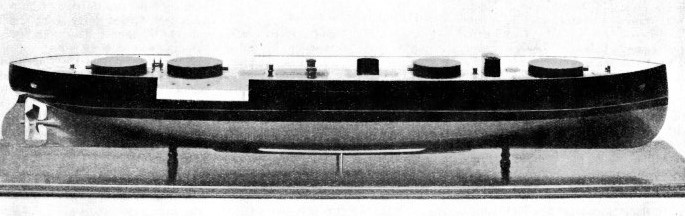
Watts designed her freeboard at just seven feet (2.1 m) to ensure stability, and led to adopt an armament at least comparable to contemporary broadside ironclads. The choice was made of four armoured turrets, each with a single heavy gun, all on the centre-line. Each was designed to carry the most powerful ordnance available at the time, 9-inch (230 mm) muzzle-loader, rifle. Without a poop and forecastle she would be at odds with rough weather, was bulwarked all along, with 2 meters high (6.5) plates protected against small arms fire and shrapnel, but still allowing end-on fire over the bow and stern from the end turrets as they could all fold down. As usual, superstructures were limited to a squared base doe the funnel, and flying bridge, with further platforms added in the 1880s above the turret, running all along between the twp masts, one anchored close to the bow and the other close to the poop.
Powerplant
HMS Prince Albert was powered by a single shaft Humphreys & Tennant horizontal, 2-cylinder HSE, with direct acting, reciprocating steam engine, fed by four square boilers, all coal-burning, for a total output of 2,130 ihp (1,588 kW). On trials, she was able to reach 11.26 knots (12.96 mph; 20.85 km/h) or even 11.87 knots by pushing her engines hard (overheating). In service this was rather around 10 knots. She had a sail plan Fore and aft with steadying sail only, easy to manage for a reduce crew of 201. Her performances under sails are not known. It was designed less for power but for agility, rigged in order to rapidly change course over rapidly evolving shore and coastal wind condition around the British Isles. Range under steam is unknown, one source states she carried 230 tonnes of coal for 930 nm at 10 knots, just enough for coastal transits.
Protection
Made of rough iron plating, bolted over a metal frame (this was an all-metal design, wood was only used for accommodations) and had the following layout:
Belt: 4.5 in (110 mm) amidships, 3.4 in (86 mm) ends or 114 mm (4.1 inches) with 457mm (18 inches) wood backing.
Turrets: 10 in (250 mm) front, 5 in (130 mm) sides and rear or 267-140mm with 356mm wood backing.
Deck: 0.75–1.2 in (19–30 mm).
The full length waterline belt extended from the upper deck to 0.9 meters (3 ft) below waterline, with a wooden backing behind the belt 457mm (18 inches) thick to absorb punishement. At the extreme ends its thickness reduced to 89 mm. The central battery between the main and upper decks was 21m long (69 ft).
Armament
src
Four single-gun turrets. Like HMS Royal Sovereign, converted from a ship of the line, she was a multiple turret design well before the norm became just two, or one, dictated by ever larger and heavier artillery. Royal Sovereign, razeed and completed just a bit earlier, was a completely different animal, wooden-built for its base, and even with lower bulwarks, also folding, and also for coastal defence. Her usefulness was limited by their artillery as like Prince Albert she featured on paper initially four turrets, but with 10+1⁄2 in (270 mm) muzzle loaders on three single and one twin mounting. Later five with the same five 9 in (230 mm) rifled muzzle-loaders. She was larger at 5,000 tonnes also, and slower for that extra turret.
The RML 9-inch was a 12-ton gun, designed in 1865 by the Royal Arsenal, with a barrel 156 inches (4 m) long, 125 inches (3.2 m) for the bore alone, firing a Mk I–V : 250 to 256 pounds (113.4 to 116.1 kg) Palliser, Common, Shrapnel shell. Reload time was excessively long as each was reloaded by the muzzle at a fixed position and needed to return to the correct angle and azimuth by traverse each time. Muzzle velocity however was 1,420 feet per second (430 m/s) and the best firing range was 9,919 yards (9,070 m) with moderate accuracy thanks to the rifling. Unlike US monitors, Coles turrets were rotated by handwheels with 18 men making a 360 degrees in about a minute.
HMS Prince Albert being around so long, was of course modernized: In 1867 she received her famous hurricane deck over the two forward turrets, a trademark of her apperance until the end of her career. In the 1880s her modenrizartion was impossible for her main guns, so she only received two 37 mm or 2-pdr Hotchkiss light guns, and six Nordenfelt HMGs installed along her forward hurricane deck, that was extended all the way to the poop. A new enclosed wooden bridge was installed on it as well.


⚙ specifications |
|
| Displacement | 3,687 long tons (3,746 t) |
| Dimensions | 240 ft x 48 ft 1 in x 20 ft 6 in (73 x 14.66 x 6.25 m deep load) |
| Propulsion | 1x 2-cyl. HCR, 4 steam boilers: 2,130 hp (1,588 kW) |
| Speed | 11.26 knots (12.96 mph; 20.85 km/h) |
| Range | 240t coal, 920 nm/10 knots |
| Armament | 4x 9-inch (229 mm) muzzle-loading rifles, see notes |
| Protection | Belt: 4.5 in-3.4 in, Turrets 5-10 in, Deck 0.75–1.2 in |
| Crew | 201 |
Career of HMS Prince Albert

Just completed in 1867, “without the hurricane deck” as mentioned src IWM
HMS Prince Albert was ordered from Samuda Brothers, Cubitt Town, London, in 1861, laid down on 29 April 1862 and launched on 23 May 1864. She was completed on 23 February 1866. She was commissioned at Portsmouth but almost immediately withdrawn from service, making additional trials followed by alterations, and new trials, a process that lasted until 1867. Furthermore, she also received her hurricane deck at the time for a new open bridge, as there was hardly any visibility prior to that to manoeuvre. Likewise, she was assigned into the first division, Devonport Reserve.
From 1878, August, she was moved in the “Particular Service Squadron” when formed, and in the 1880s she only left the reserve to be modernized (see above, hurricane deck lengthened, light armament added). These were cosmetic changes to keep her relevant at minimal cost. She was re-commissioned only symbolically for the Jubilee Review in 1887, taking part of the naval manoeuvres of 1889. As said above, the death of S.M. Prince Albert of Saxe-Coburg and Gotha in 1861 motivated the naming of the ship, and her retention in the fleet, despite her age. In 1878 she was indeed no long relevant. She was at last relegated to Dockyard Reserve in 1898, decommissioned and stricken in 1899, and sold for BU to Thos. W. Ward.
Gallery

HMS Prince Albert 1867

The Naval Review at Spithead Royal Flotilla The Graphic 1878

src Later in her career with a white hull, perhaps c1880

HMS Prince Albert in 1889, Cdts IWM
Read More/Src
Books
Brown, David K. (2015) [1990]. Before the Ironclad: Warship Design and Development 1815–1860. Naval Institute Press.
Ballard, G. A. (1980). The Black Battlefleet. Naval Institute Press.
Friedman, Norman (2018). British Battleships of the Victorian Era. Naval Institute Press.
Parkes, Oscar (1990) [1966]. British Battleships, Warrior 1860 to Vanguard 1950: A History of Design, Construction, and Armament (New & rev. ed.). Naval Institute Press.
Roberts, John (1979). “Great Britain (including Empire Forces)”. Chesneau, Roger & Kolesnik, Eugene M. (eds.). Conway’s All the World’s Fighting Ships 1860–1905.
Winfield, Rif (2014). British Warships in the Age of Sail 1817–1863: Design, Construction, Careers and Fates. Seaforth Publishing.
Links
on navypedia.org/
en.wikipedia.org/ HMS_Prince_Albert_(1864)
battleships-cruisers.co.uk/
rmg.co.uk/collections
deviantart.com
RML_9-inch_12-ton_gun
commons.wikimedia.org/