
 Nuclear-powered attack submarines (1960-69), service 1961-1993:
USS Sturgeon, Whale, Tautog, Grayling, Pogy, Aspro, Sunfish, Pargo, Queenfish, Puffer, Ray, Sand Lance, Lapon, Gurnard, Hammerhead, Sea Devil, Hawkbill, Bergall, Spadefish, Seahorse, Finback, Narwhal, Pintado, Flying Fish, Trepang, Bluefish, Billfish, Drum, Archerfish, Silversides, William H. Bates, Batfish, Tunny, Parche, Cavalla, Glenard P. Lipscomb, L. Mendel Rivers, Richard B. Russell (SSN-537 to 687)
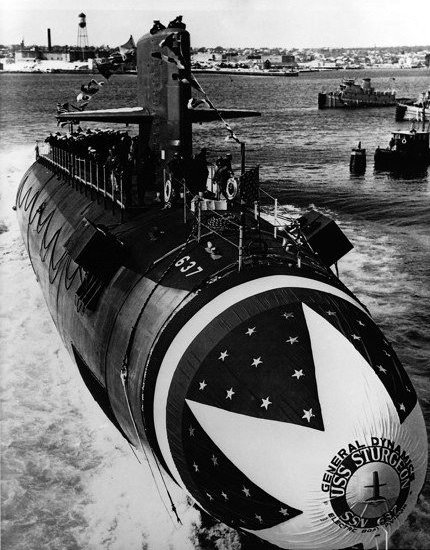 The largest US Navy class submarines class since 1945. Having a scale comparable to the mythical Gato/Tench/Balao that roamed the Pacific but with nuclear powered vessels that were lightyears ahead in technology, is what the Sturgeon tried to achieve. There was a practical goal, easy to justify to the Congress: Replacing the “fleet snorkels”, precisely these WW2 submarines modernized under the GUPPY program as a stopgap. The process to get there needed a good base design to succeed, and it was the Tresher/Permit class.
The design was just repeated and improved for a final 37 hulls ordered for a total of 1194 million dollars shared between six naval shipyards. The first, SSN-537 Sturgeon was laid down in August 1963 at Electric Boat. The last one, SSN-687 was Richard B. Russell in 1971, completed in August 1975. They made the bedrock of a renewed submarine fleet for three decades, before the large Los Angeles class took over until the end of the cold war.
The Sturgeon class was discarded in the 1990s with few exceptions, and some boats were transformed for trials, preparing the way for the Los Angeles: SSN 671 Nawrwhal and SSN 685 Glenard P. Liscomb.
All in all, the subject is to vast to be seen in one go. There will be two parts, the first one about the tech behind the class and its evaluation, the second about their career. #usnavy #coldwar #usssturgeon #ussnarwhal #ussglenardpliscomb #SSN #sturgeonclass #nuclearattacksubmarines
The Sturgeon class History – PART I
Development of SBC-188A:

Seemingly original, declassified generic class plan, from a forum, see the sources.
The Sturgeon and Permit class were essentially the same boats, designed to improve on the Skipjacks, and designed almost around the large BQQ-2 sonar, which dictated the design, to specificatlly replace the WW2 legacy Gato class boats in their modernized form (GUPPY). Under SBC-188A they were an improved design, longer and with also a longer fin to integrate an extra periscopes and more antenna. But the torpedo tubes, sonar, hull shape, inetrnal accomodation and powerplants were unchanged. Production thus could start after a few adjustments in the various yards contracted, namely: -General Dynamics (Electric Boats) in Groton Conn. and Quincy, Mass.: 14 boats for 440 million dollars
-Newport News in Virginia: 9 boats for 282 M dollars
-Litton Systems Inc. in Pascagoula, Mass.: 6 boats for 196 M dollars
-New York Shipbuilding Corp Camden NJ: 1 boat (33.5 million dollars)
-Mare Island in vallejo Cal.: 5 boats for 161.9 million dollars
-Portmouth Naval Dockyard New Hampshire: 2 boatd for 79.9 million dollars.
In total 22 contracts for various tranches for 1,195 milllion dollars, unprecedented.

USS Sturgeon launch at Electric Boat in Groton, baptised by Mrs L.Carver, wife of senator Everett Dirksen on 26 Februart 1966. She was launched stern first.
The Sturgeon class (“637 class” for some) were nuclear-powered fast attack submarines in service from the 1960s until 2004 and the workhorses until gradually replaced by the Los Angeles. The post- cold war Seawolf and Virginia-class were a few due to budget cuts and “peace dividends” that seeing a decrease of the US submarine force, albeit it was put on hold due to the recent expansion of the Chinese PLAN and changing situation in Asia. The Sturgeons were an extrapolation of the Tresher design. The lost of USS Tresher, prototype for the Permit class, led to the creation of SUBSAFE program that was successfully implemented, preventing any future submarine loss so far.

Sturgeon plan, all four views, sections and sail, extract from the drawings database src
First off, the Sturgeons were almost considered part of the Pemrit class, assimilated as a sub-class of the latter, in opposition to the much larger Los Angeles class. SSN 612 and 615 are usually included in the Permit group and together both classes made the largest complement built by the United States since 1945, subdivided (For Conways and many other authors) into the Permit and Sturgeon classes. USS Thresher was famously lost on diving trials on 10 April 1963.
The Permit followed the Skipjack class and were quite different. They combined a stronger hull for deeper diving with an advanced long-range BQQ-2 sonar and its associated SUBROC missile. Diving depth was reportedly 1300ft (396.2m). Later units were lengthened to install the larger BQQ-5 sonar, replacing the BQQ-2. The extra space is free flooding, while the underwater displacement rose by about 200t to 350t (SSN 613-615 and most Sturgeon class submarines).

Ultimately all of these units will have BQQ-5, which was a game changer. The USN had the biggest underwater ears in the entire universe. They all will ultimately receive the Mk 117 fire control system in place of their current Mk 113, and had dedicated facilities for Harpoon anti-ship missile control. Nevertheless, SUBROC is an analog, not digital weapon, while the Mk 117 was a first fully digital fire control system, so the long range ASW capability (except as provided by the Mk 48 torpedo) was lost. SSN 613 and SSN 615 were, in effect, prototype Sturgeons with heavier machinery, taller fins (20ft rather than 13.8 ft or 15 ft), improved safety features (Subsafe programme), and lengthened hulls at 292 ft 3in rather than 278 ft 6 in. SSN 678 and later units were 302 ft long. SSN 666, 672 and others were modified to carry a DSRV (submarine rescue vehicle) aft, for launch and recovery while submerged.

Sturgeon and Permit class comparison
As officially described in 1979, the Thresher class design compromises included a low sail, few periscopes and antennas, limited electronics. The reduced sail height was accepted to minimize speed loss, given the fixed reactor power of the SSW. The SSN 637 class was considerably enlarged for a combination of quieting and additional electronics, us well as improved internal arrangements. Presumably the electronics was a combination of sonar signal processing and torpedo control, one control console being required for each wireguided torpedo.
Design of the class
These submarines were intended primarily for ASW warfare, and for this, boasted a large spherical sonar array, completely filling their bows, so that like the previous class, the whole torpedo battery was down to a pair of tubves either sides, abreast the fin to fire diagonally from the hull. The advantage of the formula, compounded by a larger hull, was to increase the torpedo room and storage. There was just a greater and easier choice of weapons for each tube, giving a captain more options.

There were production improvements along the way. With that many submarines between six yards, construction techniques were streamlined and improved methods communicated between yards. In official documentation several milestones were achieved, in FY1972 three units were delivered from 12 to 52 months late, but two were delivered 2 months earlier than scheduled. It seems delays were linked to the priority to new Polaris subs, creating workforce relocations and bottlenecks. The one which was the most late was USS Guitarro, made in vallejo and which construction was stopped entirely as she sank at dockside, was refloated and completed after repairs.

The sail of USS Sturgeon as preserved today
Hull and general design
a stronger hull for deeper diving with an advanced long-range BQQ-2 sonar and its associated SUBROC missile; diving depth is reportedly 400m. Later units were lengthened to allow the installation of a BQQ-5 sonar in place of BQQ-2; the extra space is free flooding, and underwater displacement rises by about 200t to 350t (SSN613-615 and most Sturgeon class submarines); ultimately all of these units will have BQQ-5. All will also ultimately receive the Mk 117 fire control system in place of their current Mk 113, providing facilities for Harpoon anti-ship missile control. However, since SUBROC is an analogue rather than a digital weapon, and Mk 117 is a fully digital fire control system, the long-range ASW capability (except as provided by the Mk 48 torpedo) is being lost. SSN613-615 were, in effect, prototype Sturgeons with heavier machinery, taller fins (6.1m rather than 4.2m or 4.6m), improved safety features (‘Sub-safe’ programme), and lengthened hulls.
As officially described in 1979, Thresher class design compromises included a low sail, inadequate numbers of periscopes and antennas, and limited electronics. The reduced sail height was specifically accepted to minimize the speed loss, given the fixed reactor power of the S5W. The SSN637 class was considerably enlarged for a combination of quieting and additional electronics, as well as improved internal arrangements. Presumably the electronics was a combination of sonar signal processing and torpedo control, one control console being required for each wire-guided torpedo.
The Sturgeons were lengthened but kept the previous five-compartment arrangement:
-Bow compartment
-Operations compartment
-Reactor compartment
-Auxiliary machinery room no. 2
-Engine room.
The extra length was in the operations compartment. It also benefited longer torpedo racks to accommodate more Mark 37 torpedoes, most advanced at the time. While under late design, these were redesigned to SUBSAFE requirements just as the construction of the first ships was underway. This included revision of the seawater fairings and main ballast as other systems for improved safety. But where the Sturgeons really stands out was their much larger sail, a critic of the compromied Permit class, whhcih tiny sail comparted to the Skipjack saved speed, so that a second periscope could be added and more intelligence-gathering masts. The sail also reduced the risk of broaching surface in heavy seas.
The fairwater planes were now also mounted on the sail and rotating 90 degrees, a reversion to the Skipjack system. Whe breaking through ice, their attack edge was much reinforced in order to pierce and cut through thin ice.
The used of the same S5W reactor, albeit proven and very reliable, with a longer hull, displacement and larger sail meant increased drag, decreased agility, and lowered top speed at 26 knots or 48 km/h. The last nine Sturgeons (FY1972) were all further lengthened of 10 feet (3 m) to add extra electronic equipment and improve habitability as well as facilitate installation of dry deck shelters from 1982. In the official records it was accepted to loose .4 knots to increase crew capacity from 98 to 100. Based on two and a half decks a further tranche enabled indeed a lot of extra space in the pressure hull.
Powerplant
The S5W powerplant was the same as the Skipjacks and Permit class, while the Sturgeons were was much greater by at least 800t so they ended considerably slower, with about 26kts instead of 28 kts and 30+ knots of the Skipjacks. Some in the Navy saw this regression as a perile compare to fast Soviet subs, especially the Alfa class saild to be capable of 41 knots. They were also slower than most torpedoes. There were thus three attempts to improve propulsion. By default, the Sturgeons were to share their bronze propeller with the Permit class, an early 5 bladed model; But after trials it was changed for a 7 bladed one on all boats. Tests were made with a counter-prop model. The design of the rudder and stern planes were exactly the same as the Permit class.
USS Jack tested contrapropellers on her shaft, an arrangement that was unsuccessful and never adopted. USS Narwhal was lenghtened and modified to test an alternative natural convection powerplant, the S5G rather than Westinghouse S5W (see later). Glenard P Lipscomb was further lenghtened to integrate a seto or new turboelectric propulsion, and both aimed at regaining some speed but more so, for quietness. In was theorized indeed by many that the loss of speed could be compensated by many ways:
Not to be detected on the first place, combined a a much greater detection capability, giving the advantage of surprise, and better torpedoes, faster and with a longer range, as well as better ECM and underwater decoys for protection.
Soundproofing
There were improvements across the board:
The bow covering the sonar sphere was made from steel and later glass reinforced plastic (GRP) in booted and not booted variants. The steel “Booted domes” were coated with a 0.5 inches (50 mm) layer of rubber. The GRP domes improved its performance. However for intelligence gathering nothing could beat the towed-array sonar, much more sensitive.
Otherwide soundproofing followed the path of the Permit class, with a basic coating, fairwater intakes and scoops all improved to avoid bubbles, even the torpedo doors, and all internal systems put on rafts and with rubbzerized liaisons and fixtures connecting them to the hull. Several Sturgeon boats were modified still to improve on the original design and test extra reduction noise measures:
–HMS Puffer (SSN-652) was given Raytheon Harmonic Power Conditioners eliminating an electrical bus noise problem inherent in the class. There was an harmonic conditioning of the power system to avhieve this. This simple fix was ported to the entire class.
–USS Batfish (SSN-681) and Bluefish (SSN-675) had the SHT (Special Hull Treatment) in a regular dydock overhaul, a new type of coating further reducing noise and sonar profile.
–USS Glenard P. Lipscomb (SSN-685) was completed with a brand new turbo-electric system for her main propulsion, eliminating the standard reduction gear drive from the steam turbines. Her hull was lenghtened to incorporate the massive motor and associated generators, reaching to 365 ft (111.25 m). Trials however were not considered successful as the speed fell to 23 knots (43 km/h). There were also scored of reliability issues. The experience was not lost to the Los Angeles class though.
–USS Narwhal (SSN-671) was another, even quieter sub-class under the SCB 245 program in parallel to the Sturgeon class (SCB 188A). The whole forward section was a repeat of the Sturgeon-class but with a swap of compartments: The diesel generator was relocated further aft and a slightly greater beam was used to better soundpoof it. More so, she iuntegrated the larger, natural circulation S5G reactor coupled with a new type of direct-drive turbine which were designed from the start to be quieter, and many other features. Only compromise were towards the SUBSAFE regulations, due to her unique main seawater system. But this made Narwhal the quieterst submarine ever in service, worldwide.

Armament
By the late 1960s, the Sturgeons offered more possibility to a Submarine captain that any other type in inventory. There was a choice between long ASW torpedoes, nuclear torpedoes (Astor, or Mk 45, now retired), long anti-ship torpedoes, or SUB-ROC and then Harpoon (tested in Permit in 1976) and finally Tomahawk. Total weapon capacity was still somewhat restricted, so about twenty torpedoes were in stowage most of the time, albeit variety was still there. In some case, there were up to 26 carried, like on SSN-671 Narwhal, but the normal was 23 at best. The adoption of the Mk 48 torpedo was to replaced replace both the long ASW and long anti-ship weapons wheeras the nuclear-tipped Mk 45 was discarded notably as it it consumed valuable internal space but and unlikely to be ever used in action.
The Harpoon, Tomahawk brought an amazing long range strike capacity that could fully embrace the new BQQ-5 sonar detection range, and it was completed by the UUM-44 SUBROC, the Mark 67 SLMM and even Mark 60 CAPTOR mines as well as the MK-48 and ADCAP torpedoes. In any case, but the late 1980s the Sturgeons had the best weapon array of any submarine class in service. Albeit not true SSGN in the Soviet sense, due to the smaller size of their vectors, this was still a considerable upgrade in capacity.
Mark 37 torpedoes

A post-WW II electric acoustic torpedo forst deployed in 1957. The Skipjacks were probably given the 1960 Mark 37 Mod 1, specs below. The 19″ (48.3 cm) Mark 37 and Mark NT37 Designed about 1956 (last introduced, Mod 3: 1967) became the standard US Submarine launched ASW torpedo of the 1960s and until the 1990s.
⚙ specifications Mark 37 TORPEDO |
|
| Weight | 1,660 pounds (750 kg) (mod.1) |
| Dimensions | 161 inches (410 cm) (mod.1) x 19 inches (48 cm) |
| Propulsion | Mark 46 silver-zinc battery, two-speed electric motor |
| Range/speed setting | 23,000 yards (21 km) at 17 knots, 10,000 yards (9.1 km) at 26 knots |
| Warhead | 330 pounds (150 kg) HBX-3 high explosive with contact exploder |
| Max depth | 1,000 feet (300 m) |
| Guidance | Active/passive sonar homing, passive 700 yards (640 m) from target, active and wire-guidance |
Mark 48 torpedoes
 Adopted by the Skipjacks and Permit class in addition or replacement for the Mark 37 in the mid-1970s, the Mark 48 and its improved Advanced Capability (ADCAP) variant were heavyweight submarine-launched torpedoes. They were designed to sink deep-diving nuclear-powered submarines and high-performance surface ships. They entered service in 1972 for the first mod, 1988 for the ADCAP (photo).
⚙ specifications Mark 48 TORPEDO |
|
| Weight | 3,434 lb (1,558 kg) |
| Dimensions | 19 ft (5.8 m) x 21 in (530 mm) |
| Propulsion | swash-plate piston engine; pump jet Otto fuel II |
| Range/speed setting | 38 km/55 kn or 50 km/40 kn |
| Max depth | 500 fathoms, 800 m (2,600 ft) est. |
| Warhead | 647 lb (293 kg) HE plus unused fuel, proximity fuze |
| Guidance | Common Broadband Advanced Sonar System |
Mark 45 ASTOR nuclear torpedoes

These very particular torpedoes were designed in part in respsonse to Soviet rumored small warheads tests and probably adoption on torpredoes and for general tactical use as per the new wide scale 1960s US deterrence policy. The Mark 45 anti-submarine torpedo (ASTOR) was submarine-launched and wire-guided usable against high-speed and deep-diving Soviet submarines. It was first recommended for implementation by 1956 Project Nobska a summer study on submarine warfare. Its was 19-inch (480 mm) in diameter while carrying a W34 nuclear warhead and under direct control maintained between the torpedo and submarine until detonation. It had no homing capability. The design was completed in 1960, 600 were built between 1963 and 1976 until replaced by the Mark 48 torpedo.
⚙ spec. Mark 45 ASTOR |
|
| Weight | 2,400 pounds (1,100 kg) |
| Dimensions | 227 inches (580 cm) x 19 inches (48 cm) |
| Propulsion | Electric |
| Range/speed setting | 40 knots, 5–8 miles (8–13 km) |
| Warhead | W34 nuclear warhead, yeld 11 kilotons |
| Guidance | Gyroscope and wire |
UM-44 SUBROC missiles

The UUM-44 SUBROC (SUBmarine ROCket) was deployed as a long range tube-launched anti-submarine weapon. It carried a 250 kiloton thermonuclear warhead if configured as such, at a more safer distance than the Mark 45 ASTOR torpedo, and essentially replaced it. This weapon was recommended for implementation by 1956 Project Nobska and development started in 1958, completed in 1963. SUBROC entered service with USS Permit in 1964, so basically soon after the class entered service. However the admiral in charge of weapons procurement stated this wepaon caused more problems than Polaris. Main requirement was to be launched through a 21-inch submarine torpedo tube, and after launch, the solid fuel rocket motor fired, the SUBROC container rapidly rose to the surface and the booster carrying the torpedo flew to destination on a predetermined ballistic trajectory. The reentry vehicle (warhead) at the set time separated from the solid fuel motor and its low kiloton W55 nuclear depth bomb dropped into the water, sank rapidly to detonate at a set depth prior to launch. Accuracy was not a problem.
The W55 (the missile) was 13 inches (33 cm) in diameter, 39.4 inches (100 cm) long, for 465 lb (211 kg) in weight and tactically this was an urgent-attack long-range weapon to strike submarine targets out of range without betraying the position of the launching submarine, and recalled ASROC or Ikara. The additional bonus was a ballistic approach to the target making it undetectable by the target and prevented evasive action. It was however less flexible in its use than Ikara or ASROC and could not be used in a conventional engagement.

SUBROC production ended in 1968 and it was obviously never used in combat, with 285 W55 warheads decommissioned in 1990. SUBROC could not be exported either, even never shared with NATO allies. The planned UUM-125 Sea Lance was authorized in 1980, contract awarded to Boeing in 1982 but cancelled in 1990.
This weapon remains an interesting cold war weapon without true equivalent.
⚙ spec. UUM-44 SUBROC |
|
| Weight | 4,000 lb (1,800 kg) |
| Dimensions | 22 ft (6.7 m) x 21 in (53 cm) |
| Propulsion | Solid rocket booster |
| Range/speed | 55 km (34 mi), subsonic |
| Warhead | W55 1-5 kt (4.2 to 20.9 TJ)/25 kt (100 TJ), Depth Fuze |
| Max depth | Unknown |
| Guidance | Inertial guidance ballistic trajectory |
UGM-84 Sub-Harpoon missiles
 The Harpoon was the go-to antiship missile of the USN from 1977. With its amazing range it was tempting to offer the Permit, Sturgeon and Los Angeles classes this upgrade while in service when entering service in 1981. Indeed the UGM-84, name given to the submarine launched variant was fitted with a solid-fuel rocket booster and encapsulated in an upropelled canister using the tube initial propulsion to enable submerged launch at reasonable depth. The flexible wings were folded around the missile body and opened after the missile booster ignited, when it was propelled out of the canister, setup to reach the surface. The canister was partly burned out as the missile ingnited inside after its head popup.
When freed, the UGM-84 raced to its target as a sea-skimming missile on predeterminated target data fed before launch, and then homing took over in full autonomy when reaching its final leg to the target. Data came from radar or satellite, and sonar if needed. This gave US Navy SSNs an unprecedent range of 67 nmi (124 km) for the Block II for example, at Mach 0.71 to 0.9. Normal provision was four of them on board a Permit class from the 1980s. It was also designated GWS-60 (UGM-84B in UK service) and exported to South Korea and Egypt. The Permit class had the UGM-84A and potentially upgraded to the UGM-84C (Block Ic), UGM-84D from 1985, less likely UGM-84G and UGM-84L so close to retirement.
⚙ spec. UGM-84A Sub-Harpoon |
|
| Weight | As regular missile + canister |
| Dimensions | Canister 21-in, c20ft long |
| Propulsion | solid propellant booster motor |
| Range | 130 to 220 km depending on version |
| Speed | Mach 0.9 |
| Warhead | 220 kg warhead |
| Guidance | Initial intertial, active radar homing terminal, later GPS |
Late SEAL Conversions
Six of these boats were later converted to accommodate Dry Deck Shelters, in order to operate sixteen SEALs and their swimmer delivery vehicles. The test unit was SSN 684, modifed between August and December 1982, followed by SSN 678, 679, 684, and then under the FY90 programme SSN 680, 082, and 686, the last delivered in 1992, SSN 666 and 672, and others have been modified to Guide and laych a DSRSV salvage vehicle. Between january 1987 and 1991, USS Parche (SSN 683) was rebuilt at Mare Island for special operations and lenpthened by moving forward her sail, for a total length of 393 ft and a dispacement of 6,140 tonnes fully loaded.
Sensors

Fwd compartment differences, Los Angeles versus Permit/Sturgeon class, from pinterest
The Thresher-class came up with the new passive SONAR AN/BQQ-2, fitted into the bow, filling it entirely and forcing the torpedo room back amidships. The Sturgeons capitalized on this configuration and even used extra bow space to mount a better sonar.
The standard issue suite comprised the BPS-14 or BPS-15 radar, BQQ-2 (BQS-6 + BQR-7) sonar suite, BQS-8 and BQS-12 sonars, the WLR-4 ECM suite and the Mk 113 CCS.
From SSN-665 to 670, 672-677: The BQS-13 sonar replaced the model 12. From SSN-678 to 684, as well as SSN-686 and 687 was adopted the larger and better BQQ-5 sonar suite. The Mk 113 CCS was eventually replaced by the Mark 117 later in their active life as other systems.
In the 1980s, USS Sturgeon, Whale, Tautog, Grayling, Pogy, Aspro, Sunfish, Pargo, Queenfish, Puffer, Ray, Sandlance, Lapon, Gurnard, Hammerhead, Sea Devil, Guitarro, Hawkbill, Bergall, Spadefish, Seahorse, Finback, Pintado, Flying Fish, Trepang, Bluefish, Billfish, Drum and Glenard P. Lipscomb receive the new BQQ-5 sonar suite and the Mk 117 CCS, a considerable upgrade.
AN/BQQ-2 (BQR-7 + BQS-6) bow sonar:
This model was adopted fist for USS Tullibee and also mounted on the Tresher/Permit class SSNs. It combined an Active BQR-7 and Passive PQS-6 arrays, for Active/Passive Search & Track with an unprecedented range of 74.1 km, well beyond the range of torpedoes. Thus, the adoption of SUBROC made a lot of sense and gave USN attack submarine an edge over the Soviet Navy.
The successor AN/BQQ-5 sonar suite was a real improvement as it came with a retractable towed array, the “snake”, for an even more efficient detection sensibility far from the host submarine.
AN/BQQ-5 bow sonar:
Same as the BQQ-2, bow-mounted spherical array installed at first on the SSN 637 and later SSN 688 (Los Angeles). It had a low frequency passive and active search and was an attack sonarmade by IBM which provided a comprehensive digital suite. The AN/BQQ-5 was designed for simplifications, with a single operating console and a way to display its various modes sequentially with setups on screens. However later it was asked to redesign the system with three consoles, causing all sorts of issues, notably extra crew and space, leading to the new “long hull” Sturgeons.
It comprised the TB-29 towed array and the Combat Control System (CCS) Mk 2 (or collectively QE-2 System) later integrated from the start on the Los Angeles (SSN-688) and Ohio (SSBN-726) class submarines. There was a radical increase in acoustic performance and generally improved combat control capabilities.
Later upgrades like the OPEVAL (AN/BQQ-5E system) were not installed as FY1998 as well as the AN/BSY-1 ECP 1000.
Exact range is classified.

USS Pargo drive section, command center
BPS-14 radar:
Raytheon medium-range surface search and navigation radar featuring a horn antenna, operated from inside the submarine. Works in I-J (8-20 GHz) up to 40 nm (73 km).
BPS-15 radar:
Improved model developed by Northrop Grumman, low-power, surface search and navigation radar with a karger horn array at 40-in (1,016-mm) aperture. Replaced by the AN/BPS-16. mounted on the long hulled Sturgeons, Los Angeles and OHIO class (BPS-15A).
BQS-8 sonar:
Ice-navigation sonar: Upward-oriented sonar projector radiating energy spherically, with multiple reflection paths generated under the ice.
BQS-12 sonar:
Component of the AN/BQQ-5C(V)2, Sturgeon class (long hull), Hull Sonar with Active/Passive Search & Tracking and known max Range of 74.1 km.
Raytheon’s AN/BQS-13 was a part of the AN/BQQ-5 sonar suite, also including TB-12/TB-16 and TB-23/TB-29 towed sonar arrays as a medium-frequency, multi-function sonar array installed on Sturgeon-class boats. Photo

USS Sturgeon Command Center
Mark 113 Fire Contol System:
This very advanced fire control system for its time, computerized, combined several displays manageable by a single fire control operator. It comprised the Mk 78 Target Motion Analyzer digital computer which memory module has 1024 round magnets with wires wrapped around them. The Mk 78 TMA determined the Target’s course and speed adn sent the data to the Mk 75 AD.
The Mk 75 Attack Director is an analogue computer using synchros, servos, resolvers, and rheostats plus handcranks to input information displayed with counters and dials. The Mk 75 AD solves data targeting Problems and sends the Gyro Angle to the Torpedo.
The Mk 66 Torpedo Control Console was coupled with the Mk 47 Tone Signal Generator used for the Mk 48 Torpedoes, capable of sending new commands and course corrections after fire.
The Mk 50 Attack Control Console prepared the torpedoes launch, coupled with the Digital Interface Box (DIB).
The Mark 113 was replaced by the Mark 117 fire control system envisioned by some to do any thing and almost replace the operator, but in reality it just increased the training requirement. It was capable to manage longer range and missiles, as introduced in the 1980s.
The radar suite is unknown, likely the same as the Skipjack albeit simplified as the Permit’s fins were smaller. So one radar/aerial combined model.
Same with the EW suite it was probably limited.
Mark 117 Fire Contol System:
The first all digital fire control system and was forward fitted on the later 637 class and the SSN 688 and backfitted on the long hull and earlier 637s and the 594 classes.
more on the Los Angeles class.
WLR-4 ECM suite:
No data yet.


The launch of USS Billfish (top) and Bergall, Trepang (bottom).

Sturgeon class profile
⚙ specifications Sturgeon |
|
| Displacement | 3,640 long tons (3,698 t) surfaced, 4,640 long tons (4,714 t) submerged |
| Dimensions Short hull | 292 ft 3 in (89.08 m) |
| Dimensions Long Hull | 302 ft 3 in (92.13 m) |
| Dimensions beam/draft | 31 ft 8 in (9.65 m) x 24 ft 5 in (7.44 m) |
| Propulsion | 1 shaft S5W PWR, 2 steam turbines, 15,000 shp (11 MW) |
| Speed | 15 knots (28 km/h; 17 mph) surfaced, 26 knots (48 km/h; 30 mph) submerged |
| Range | Unlimited, except by food supplies |
| Armament | 4 × 21 inch (533 mm) TTs, Mark 37, Mark 48, UUM-44 SUBROC, UGM-84 Harpoon |
| Test Depth | 1,320 ft (400 m) |
| Sensors | BQQ-2 sonar (later BQQ-5), Mark 113 FCS (later Mark 117), ESM |
| Crew | 112 |
Improvements and Upgrades
1970s-1980s, USS Hawkbill, Pintado, William H. Bates and Richard B. Russell were modified to carry a DSRV submersible and by the early 1980s, the remainder were armed with four 4 Harpoon SSM (UGM-84) replacing notably the Mark 45 torpedoes.
In between 1982 to 1992, USS Archerfish, Silversides, William H. Bates, Tunny, Cavalla, and Mendel Rivers were modified to carry a Dry Deck Shelter (DDS) in order to carry and deploy 16 SEALs and their SDV. At the time, the Sturgeon class was considered somewhat obsolete and started to be phased out of their primary role and modified for special operations (like early Los Angeles batches recently).
In 1984, USS Guitarro and later USS Sturgeon, Whale, Tautog, Grayling, Pogy, Aspro, Sunfish, Pargo, Queenfish, Puffer, Ray, Sandlance, Lapon, Gurnard, Hammerhead, Sea Devil, Hawkbill, Bergall, Spadefish, Seahorse, Finback, Pintado, Flying Fish, Trepang, Bluefish, Billfish, Drum, Archerfish, Silversides, William H. Bates, Batfish, Tunny, Parche, Cavalla, Mendel Rivers, Richard B. Russell received eight Tomahawk BGM-109 cruise missiles, replacing older torpedoes.
USS Narwhal SSN-671 sub-class (1967)

SSN671 was laid down at yard 182 at Electric Boat, Groton on 17.1.1966, launched on 9.9.1967, completed on 12.7.1969, stricken on 7.1999. She was special boat, designed under project SCB 245, remaining unique in her own class. Forward of the reactor compartment and inside a hull of larger diameter plus with her auxiliary diesel generator relocated from the bow compartment to the auxiliary machine room (operations compartment). What was really new was the replacement of the S5W by a unique natural circulation S5G reactor plus a direct-drive turbine propulsion plant. Two separate reactor tunnels each with their watertight doors allowed access to the engine room. This new experiment was done improve massively her acoustic stealthiness.
In addition to the S5G unit from (coupled with De Laval steam turbines) the design also integrated the following:
-Less powerful main coolant pumps with on and off for even quieter drive
-A scoop seawater injection for the main condensers to shut down the main seawater pumps at high speed
-Cross-connection of the main and auxiliary seawater systems
-New, larger direct-drive propulsion turbine operating on a low shaft speed (300 RPM) and without reduction gears
-Service turbine generators at lower rate: 1,200 RPM (vs. 3,600 rpm usually)
-No waist ballast tanks to eliminate vibration noise caused by the thinner outer hull, potentially vibrating.
 The S5G was made by General Eelectric, which always wanted to best Westinghouse for providing the Navy its own nuclear recator plant. The S5G was marketed as a revolution out of itself for submarines. It had had new primary coolant pumps only needed for very high speeds. The reactor core was designed with very smooth paths for the coolant, which thus, were smaller and quieter and less numerous. In fact they could be disconnected on demand, notably in areas and situations that needed extra discretion. This was sold as a truly quiet design but yet required a larger hull diameter and larger primary coolant piping compared to the S5W reactor. It could not be used on the Sturgeon class with a simple section addition, but was declined into the S6G that was adopted by the Los Angeles class and more so as aprecursor to the S8G reactor in the Ohio-class SSBN.
The normal propulsion setup still used steam turbines but instead of using the classic reduction gear unit was, a single, larher propulsion turbine was used without reduction gears, but using a lower rate from the start. The main reduction gears were identified indeed by specialists as one of the biggest noise makers. The problem now was to purchase and manage a massive main propulsion turbine, 12 feet in diametern 30 feet long.
The concept of a natural circulation plant was further refined and matured on USS Idaho (Ohio class) which had a rigorous performance shakedown to determine it was a success, recommended for fast-attack submarines. On the land facility (photo) the whole plant was floated in a large pool of water to be rotated along its long axis, simulating hard turns, torquing large gyroscopes mounted forward and determine if natural circulation (so without pumps) was still effective in hard turns, so with gravity. A clever use of piping and playing with voids allowed just that.

As a result of all this, USS Narwhal became the world’s quietest submarine of the time. The propulsion plant had to wait however to solve many issues. First off, the very large turbine operating at much lower shaft speed, still needed complex warm-up and cooldown procedures. The generators experienced blade failures when tested. Later improvements in noise reduction techniques enable to push the drive up to 3,600 RPM, yet remaining as quiet as on Narwhal. Seawater injection piping were larger and longer as well and a brand new hull was needed. The other issue was it was not compatible with SUBSAFE regulations, and later reeplaced by other quieting features. Narwhal also had later in her career a “turtleback” structure forward of her rudder to carry either remote-controlled underwater vehicles or a larger towed sonar array.
The Career of Narhwal is still largely classified today. Apart three overhauls (with two for reactor refueling) she mostly cruised in the Arctic waters and likely shadowed closely Soviet vessels, even probably going so far as penetrating formations manoeuvering and in exercises. She earned a Navy Unit Commendation for 1972, plus various Meritorious Unit Commendations for 1971, 1977, 1979, 1994, and 1998, five Battle Efficiency E four Engineering E one Anti-Submarine Warfare A, a Communications C, a Supply E. Later in her career she was deployed for special operations, again, classified to this day.
She was damaged by Hurricane Hugo while moored at Charleston on 22 September 1989 when despite being secured by nine double wires and two 3-inch lines. All but one parted and she drifted into the Cooper River, tugboats failed to bring her back to pier as it was calmer in the eye of the storm. Eventually her crew decided to weather the storm and submerged in the river, only part of her sail remained surfaced and exposed.
In 1993, Navigator Harley O’Neill reunited all 167 original Narwhal crews survivors of the SS67, 167 and 671 in a weekend, hosting and entertain them on boardSSN-671 as special guests, as well as Capt. Lincoln and staff.
USS Narwhal was eventually deactivated in commission on 16 January 1999 at Norfolk, fully decommissioned and stricken on 1 July 1999, and entered NPSSRP in Bremerton for recycling on 1 October 2001. She was not scrapped but instead became the centerpiece of a planned National Submarine Science Discovery Center (NSSDC) in Newport, Kentucky, signed on 30 September 2003 by Secretary of the Navy. The nuclear reactor and propulsion equipment were later to be removed and instead a plug of proper dimensions and shape which contained a theater and classroom were to be installed. By 26 April 2006 the fundraising vampaign failed and the project was cancelled. Thus, she was dismantled by October 2020.

⚙ specifications Narwhal |
|
| Displacement | 4,450 long tons surfaced, 5,350 long tons submerged (4,948/5,293 long tons) |
| Dimensions | 314 ft 8 in x 33 ft x 29 ft (96.91 x 11.5 x 8.80 m) |
| Propulsion | 1 shaft S5G PWR, 2 De Laval steam turbines, 17,000 shp (12 MW) |
| Speed | 20 knots surfaced, 25 knots submerged |
| Armament | Standard Sturgeon class |
| Sensors | BPS-14 radar, BQQ-2 sonar suite, BQS-8 sonar, WLR-8 ECM suite, Mk 113 CCS |
| Crew | 120 |
SCB 302.68: USS Glenard P. Lipscomb SSN-685 (1973)

USS G.P. Liscomb underway early in her career, she had a black/grey livery typical of the 1970s.
SSN685 was a very special submarine modified in her dersign to test a new propulsuon and stretched out, laid down at yard 202 at Electric Boat on 5 June 1971, launched on 4 June 1973 and completed on 21 December 1974. She was unsuccessful and stricken in July 1990. That’s the short story.
Glenard P. Lipscomb was developed under project SCB 302.68 as the second US submarine to use a turbo-electric transmission after USS Tullibee. This was to test the advantaged of such propulsion system, notably for quieter/safer operation. One advantage was to be able to use instant reverse thrust by reversing polarity. The Tullibee plant was just scaled up by six times. The end result was to create a brand new,n very long section to house it and a final displacement of 6,400 tons for 365 feet (111 m) in lenght, making Glenard P. Lipscomb the larger SSN to date, but with slower speeds due to the greater displacement. However oafter intensive trials campaigns it was realized this unit was woefully unreliable due to its direct-current main motor.

The system was not adopted for the next classes. Instead direct flow reactors such as the S5G tested on Narwhal were preferred. Despite her experimental nature, USS GP. Liscomb was still a fully combat-capable attack submarine and she was deployed to the North Atlantic by the fall of 1976, making operations deployments with the 6th fleet in the Mediterranean by the winter and spring 1977, being awarded the Meritorious Unit Commendation. She was in the North Atlantic in 1978, earning another Meritorious Unit Commendation, then Mediterranean in 1979. As part of Submarine Development Squadron 12, she was awarded its own mdeal, as well as the Battle Efficiency “E”, Engineering Excellence “E” FY1977 and 1978 under Robert B. Wilkinson as well as 1979-1980 under Thomas Robertson.
In 1987 she collided with a tugboat in the Cooper River at Naval Weapons Station Charleston. She needed drydock repairs but the tugboat sank.
She was decommissioned and stricken on 11 July 1990 and went through the Sub recycling program at Puget Sound from 1 December 1997 but her active career had been only 16 years quite short for a SSN worth nearly 20 millions.

⚙ specifications Glenard P. Liscomb |
|
| Displacement | 5,813 tonnes surfaced, 6,480 tonnes submerged |
| Dimensions | 365 ft x 31 ft 8 in (111.2 x 9.65 x 7.80 m) |
| Propulsion | 1 shaft S5W PWR, 2 GE steam turbines, 15,000 shp (11 MW) |
| Speed | 18 knots (33 km/h; 21 mph) surfaced, 23 knots (43 km/h; 26 mph) submerged |
| Armament | Standard Sturgeon class |
| Sensors | BPS-15 radar, BQQ-2 sonar suite, BQS-14 sonar, Mk 113 CCS |
| Crew | 121 |
USS Parche SSN-683 (1973)

SSN683 Parche was laid down at yard 1176 in Ingalls NyD on 10.12.1970, lauched on 13.1.1973 and completed on 17.8.1974. She was stricken last, in July 2005, after being rebuilt for tests.
From January 1987 to 1991 she was completely rebuilt at Mare Island N Yd. She was lengthened at 122.4 meters in lenght overall 9.65 meters tin bealm and 10.7meters height for a total displacement of 6140 tonnes surfaced and 7140t submerged and re-engined with the S5W2 reactor rated for 20,000hp, for 15 knots surfaced and 30kts submerged. Her crew comprised 147 men. She was equipped to recover objects from the sea bottom as well.
During her career, she was used to recover Soviet missile fragments from the seabed after test launches. When collected in large numbers the missiles could be reconstituted and design determined with more certainty. Parche’s missions remains classified but she also retrieved and placed wire taps placed on Soviet underwater communication cables as well as other clandestine missions, going as far as gathering intel in front of important Soviet bases and facilities. From 1987 to 1991 she had an extended refueling overhaul at Mare Island Naval Shipyard and was modified for R&D, gaining a 100 feet (30 m) section forward of her sail, flat-topped and receiving accomodations to support a larger crew, more equipment and receiving an array of intel-gathering equipments with collecting antennas and electronic gear as well as the most advanced navigational and ocean engineering systems at the time as well as auxiliary navigational and maneuvering features helped by short-range sonars, armored spotlights, closed-circuit television cameras for under-ice and seabed operations, posssibly also retractable wheels.
She entered service with Submarine Development Squadron 5 in the Pacific Fleet from 1992 and transferred to Naval Base Kitsap at Bangor, Washington, by November. She recovered Chinese missile fragments and during the 3rd Taiwan Strait Crisis (1995-1996) most likely recovered Chinese DF-21 and DF-15 ballistic missiles.
She operated that way until decommissioned on 19 October 2004, stricken on 18 July 2005. For her career she earned 9 Presidential Unit Citations, 10 Navy Unit Commendations, 13 Navy Expeditionary Medals. The Submarine Recycling Program was completed 30 November 2006 for her.
⚙ specifications Parche 1994 |
|
| Displacement | 5,813 tonnes surfaced, 6,480 tonnes submerged |
| Dimensions | 401 ft (122 m) x 31 ft 8 in x 28 ft 8 in (9.65 x 8.74 m) |
| Propulsion | As Sturgeon class |
| Speed | 15 knots (28 km/h; 17 mph) surfaced, 25 knots (46 km/h; 29 mph) submerged |
| Armament | Standard Sturgeon class |
| Sensors | BPS-15 radar, BQQ-2 sonar suite, BQS-14 sonar, Mk 113 CCS |
| Crew | 179 |
Legacy: the Los Angeles class
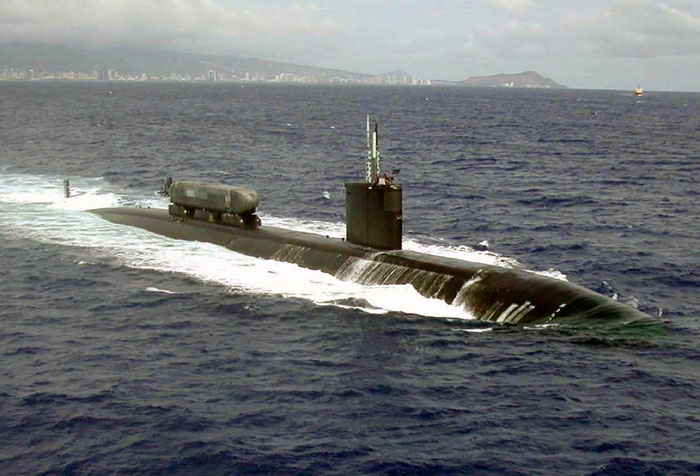
As sure as the Permit class led to the Sturgeons, the Los Angeles class, which development started in 1967 ended approximately 50% larger than the Sturgeons with “major improvements” in stealth and speed to too could keep up with carrier battle groups. 62 were built from 1972 to 1996 and they still made the bulk of today’s US submarine fleet.
This last great SSN class of the Cold War was developed with a much larger size, defined in order to regain the 1958 Skipjack speed range while being quieter than the Sturgeons, keeping track of the fatest Soviet SSNs in a genesis started in 1965. USS Los Angeles was laid down in January 1972, three months after the last Sturgeon, USS Richard B Russel at Newport News. The great novelry was a S6G reactor which had double the power and was largely based on the work done on USS narwhal. She reached 31 knots but this was somewhat at the expense of strenght hull, and very significant decrease in diving operational depth. The other innovation was the new BQQ-5 sonar and its improved towed sonar component.
Though a new, stronger steel hull was designed for them, it not approved due to budget cuts as well as the new computerized fire control system Mk.112. The Mk.117 was only installed from USS Dallas (1979) onwards. It was also anticipated in first studies back in 1968 to give them 20 vertical tubes for anti-ship missiles but the complexity of the system and spiralling up cost plus displacement calculated to 13,700 tons had it rejected by Admiral Zumwalt. The Los Angeles had more torpedoes (26), while offering the same range as the Sturgeons, including SUBROC/Harpoon and Tomahawk.
In 1981, USS La Jolla was the first to launch encapsulated Tomahawk missiles, a system only operational from USS Atlanta in 1983. From USS Providence in 1985, a section with 12 silos equipped with Tomahawks were forward of the sail. From USS San Juan (1986) the class adopted the new BSY-1 combat system plus new retractable bow fins. From USS Hartford (SSN-768, 1993) the tail was modified to resemble that of the new generation Seawolf class. A total of 42 were in service by 1990, another 19 post-cold war constituting the world’s largest SSN class in twenty years.
Career of The Sturgeon class
Short Hulls
USS Sturgeon SSN-637 (1966)

SSN637 was laid down at yard 168 in Electric Boat, Groton on 10.8.1963, launched on 26.2.1966 and completed on 3.3.1967. She spent a month in refresher training before a shakedown cruise on 3 April 1967 on the East Coast and Puerto Rico, then back to Groton for fixes and maintenance, then additional training qualifications until 18 September 1967, after which she sailed in early trials operations, back on 2 October 1967, and transferred to Submarine Development Group 2. On 22 January 1968 she trained in ASW for five-week to compare her to the Permit-class.
Next she had a three-month post-shakedown from 3 March 1968 until June 1968. She took part in the search for the missing USS Scorpion (Skipjack class) off the Azores. This summer, she was prepared for overseas deployment from September to early November 1968 and evaluating a new sonar detection device until February 1969. She was visited when stopping at Annapolis, Maryland by March 1969 followed by more training in May-July 1969 and earning a Meritorious Unit Commendation.
She took part in exercises in August-September 1969 and CNO’s personal exercises from 29 September to 31 October 1969, being awarded a second Meritorious Unit Commendation by December. She ade another deployment from 29 January to 8 April 1970 and by May-June was used for aircraft ASW tactics and equipment. More exercises followed in July 1970 and from 15 August to 1 September, sound trials. On 5 October 1970 she was overhauled at Groton until 5 October 1971, being awarded a Navy Unit Commendation for “exceptionally meritorious service”.

Next she was sent to her first operational unit, Submarine Squadron 10, homeported to New London, Connecticut, had a refresher training, a shakedown cruise (6 October-15 December 1971 and then until in upkeep. She was in two ASW exercises and overhaul at Groton from 6 March to 27 May 1972, sea trials until 15 July, then sonar systems tests until mid-December 1972. From 1 January to 2 April 1973 she stayed in local waters off Narragansett Bay. On 3 April 1973 she went to the Weapons Range in the Caribbean but on 21 May, ran aground near St. Croix (Virgin Islands), her bow chin damaged, and she was back to Groton on 4 June for repairs until 17 July. Until October 1973 she was in exercises and entered Portsmouth for proper bow repairs until 22 April 1974. She operated from New London until 13 August 1974, then Norfolk for Atlantic Readiness Exercise 1-75. Her first true overseas movement from 29 November 1974 was to the Mediterranean, 6-month from 9 December 1974 and ex. ICEX ’89 in which she surfaced through ice in the Arctic Circle.
She had a refit at Charleston as Hurricane Hugo struck and could be scrambled to leave port as storm started, avoiding damage.
Missing logs for 1975-1993.
She was decommissioned on 1 August 1994, stricken on august 1994. She entered the Nuclear-Powered Ship and Submarine Recycling Program at Puget Sound Naval Shipyard in Bremerton, Washington, process done by 11 December 1995..
USS Whale SSN638 (1966)

SSN638 was laid down at General Dynamics in Quincy on 27.5.1964 and launched on 14.10.1966, completed on 12.10.1968. Whale had for first home port Charleston in South Carolina and started in November her shakedown training completed in December, followed post-commissioning trials, and qualifications. Operations started in January 1969 on the southeastern coast. On 18 March she sailed to the Arctic Circle, surfaced at the North Pole on 6 April to commemorate Robert E. Peary’s 1909 arrival and made a navigation patrol under the polar ice cap. She later stopped at Faslane, Scotland and back to Charleston in May. Next she was sent in Groton for post-shakedown repair for three months and back to Charleston, on 16 October. In January 1970 she test operations with a Navy Underwater Demolition Team and in March was in exercises. In April she was a TS for the Prospective Commanding Officers’ School at New London and back HP in May, followed by advanced acoustic trials. She made a long overseas patrol from 27 July 1970 until mid-September, stopping at Holy Loch and the Jordanian crisis, 6th Fleet. She was back in November. By July 1971 she had special operations in the Atlantic until September and stopped at Bremerhaven. On 20 March 1972 she was again in special operations and stopped at Holy Loch, back on 9 June.
She remained at Naval Submarine Base New London but her her first major overhaul at Electric Boat Groton from 7 August 1972, over 46-week until 27 October 1973 followed by post-overhaul shakedown, refresher until December. She was scheduled for the Mediterranean with the Middle Eastern crisis, Arab-Israeli War of October 1973 but in January 1974 she was still not away, delayed until May 1974 and Operation “Safe Passage”. From 12 May she operated for the 6th Fleet and took part in NATO) exercises “International Week” and “Dale Falcon” and while back to Groton, in a fleet ASW exercise until 28 October. In 1975 she worked locally for the Atlantic Fleet but on 29 September made anotehr Med TOD, 6th Fleet, taking part in “Ocean Safari” and other multilateral exercises, back in March 1976. She had a Portsmouth refueling overhaul until 7 July 1978 and trained until 1979, before being deployed for another Med TOD, for fleet exercises and in 1980 she was in refit/repair in the floating drydock Shippingport in Groton. In 1981 she had training and test deployments, plus “Thunderbuoy” and “Whitefish” exercises. She was back in the Med by June 1981 for six months and the Libyan crisis in the Gulf of Sidra, resupplied by the tender Orion in La Maddelena and back in early 1982. In May 1982 she was deployed in the Atlantic deployment and stopped at Faslane, earned a Battle “E”.
In 1983 under CO James E. Welsch she had a North Atlantic and abbreviated Mediterranean patrol to relieve USS Tullibee, called the “Nor-Med Run”. She left La Maddalena on Xmas 1983 for Groton. In January 1985 she was back in the Mediterranean until November. In 1986 she had a major overhaul, completed in January 1988 and shakedown, tests under CO J. W. Francis. She transited the Panama Canal on 19 June and back to Groton, SubRon 10. She was in the Mediterranean in January-June 1989. In August -December 1990 in the North Atlantic under CO Ronald Deering (5th Meritorious Unit Commendation). In 1991 she won another Battle “E” and was assigned to SubRon 2 for a North Atlantic deployment in 1991. In 1992 she took part in UNITAS XXXIII to South America under CO Andrew V. Harris, Jr. back in November. In 1993 she stopped in Bermuda and was drilled at the Autec Torpedo Firing Range, followed by a scientific exercise under the ice cap, North Pole. In January 1994 she was back in the Arctic with HMS Trenchant (S91) for JOINTSUBICEX 1-94, surfacing on 16 April 1994 for a circumnavigation and back in July 1994. She was deactivated in commission on 28 April 1995, in reserve on 1 October 1995, and prepared to be scrapped at the Nuclear-Powered Ship and Submarine Recycling Program of Puget Sound in Bremerton from 20 October 1995, officially decommissioned on 25 June 1996, stricken. She was recycled by 1 July 1996, officially scrapped on 29 September 1997.
USS Tautog SSN-639 (1967)

SSN639 was laid down at yard 1098 in Ingalls, Pascagoula on 27.1.1964, launched in 15.3.1967 and completed on 17.8.1968 under command of Commander Buele G. Balderston. On 30 August 1968 she departed Pascagoula to join the Pacific Fleet via Panama Canal on 8 September, Pearl Harbor on the 23th and SubRon 12 as flagship. After post-commissioning tests and sea trials, shakedown training cruise off the Hawaiian Islands, she was bac for fixes in January-February 1969 at Puget Sound, and completed her shakedown in September. Fixes later included replacing her entire diesel generator, completed on 19 February 1970. In her exoercises she won a first Battle Efficiency “E” and a Navy Unit Commendation. It seems she monitored a test of a new missile launched by a Soviet Echo II in 1969. She completed a first WESTPAC in 1970, stopping in the Philippines, Hong Kong, Okinawa, Japan, and Korea and winning anoter Meritorious Unit Commendation for her mission until April 1971. But on 20 June 1970 while patrolling the North Pacific off Petropavlovsk-Kamchatsky (major base for SSGNs) she attempted trail K-108 (Echo II “Black Lila”) whe the later while “close aboard” and unaware she was close, veered, but without depth-finding hydrophones, her hydrographic equipment registered ‘zero distance’ and it was found the ECHO II was directly above and descending. K-108 slammed belly first into Tautog’s sail and her screws completely mushed the sail, loosing one. Tautog sailed away and the crew was scared to death that K-108 broke up and sank but when Tautog arrived in Pearl Harbor, damaged was assessed and the USN obtained a big cgunk of Soviet propeller. K-108 was revealed post cold war to have beeing able to return to Petropavlovsk-Kamchatsky and her CO Boris Bogdasaryan provided the USN a concise narrative of the collision (no casualties). This was a gangerous game, denied by both parties at the time and only revealed post-1991, first by the Chicago Tribune and ended in 1999 book “Blind Man’s Bluff”.
On 9 October 1970, Tautog departed Pearl Harbor for East Asia, Okinawa on 23 October and joined the 7th Fleet, for ASW training, HMS Aurora (F10) and concluded on 28 March 1971 at Yokosuka, then Pearl Harbor on 5 April. On 21 March 1972 she was in “special operation”, earning the Navy Unit Commendation by June 1972. From January 1973 she had an overhaul until 15 April 1974. From 3 May 1975 she operated in the Central and Western Pacific, drydocked at Guam in June, back on 18 October and awarded the Navy Expeditionary Medal. She remained in local waters in 1976 and in 1977 she visited Mombasa, Kenya. On her way to Pearl Harbor the President of Uganda Idi Amin precipitated an hostage crisis and she received orders to join a task force around USS Enterprise (CVN-65). She cruised the coast of Kenya and received a Meritorious Unit Commendation back to Pearl via Guam in March and South Korea in April, then Subic Bay, HK in May. She was sent to Vallejo for her second major overhaul and new reactor core from December at Mare Island until July 1979. She had a new WESTPAC in March 1980 earning the Navy Expeditionary Medal and a Battle “E”, ASW “A”, Engineering “E” and Meritorious Unit Commendation in June 1980. In 1981 she was back with the 7th Fleet and in the Indian Ocean, first Sturgeon to transit the Malacca Straits, visiting Singapore and gaining more awards.
The winter 1982 saw her with USS Aspro in the Arctic, two months below ice and a dual surfacing at the North Pole, a first. The summer 1983 was another Arctic sortie, but in 1984 she had a two-month shipyard availability and back to 7th Fleet operations, Northern Pacific back in November 1984. The summer 1985 saw her exercising with USS New York City and in October she left Pearl Harbor for another WestPac. From October 1986 she was overhauled at Puget Sound, until May 1989.
She made another Westpac in May 1990 and fled a massive typhoon in Subic Bay. She then made a 3rd Arctic deployment in April 1991 with USS Aspro for three weeks. The summer 1991 saw her in exercises and hosting the crew of JMSDF submarine Akishio. By late January 1992 she fired her first MK 48 Advanced Capability torpedo, sinking the ex-Darter south of Oahu. She made her 1992 WESTPAC for 180 days. By October 1993 she had another WESTPAC and joint exercise with the JMSDF. In February 1995 sheleft Pearl Harbor for her 11th WESTPAC and exercises with the Japanese, Korean, and British naval forces,winning the Navy Expeditionary Medal. In February 1996 she had a personnel transfer at Pearl Harbor in strong winds, running into the west bank of the harbor but damage was slight. By July 1996 she made a final WestPac with weapons testing, stopping at San Diego and Esquimalt, Bangor and making her final, 1,119th dive on 13 October. She was inactivated on 25 October 1996 for 6 months, left for Puget Sound and stricken/decommissioned on 31 March 1997, scrapped at Puget Sound Naval Shipyard from 15 March 2003 to 30 November 2004.
USS Grayling SSN-646 (1967)

SSN646 was laid down at Portsmouth N Yd in Kittery, Main on 12.5.1964, launched on 22.6.1967 and completed on 11.10.1969. Logs partly missing. On 20 March 1993 she collided with the Russian submarine Novomoskovsk, a Delta IV-class SSBN north of Murmansk after tracking her and a collision happened when she met her starboard bow. None had heavy damage. In June 1996, she took part in NATO Exercise TAPON 96 in the Alboran Sea, Gulf of Cadiz, eastern Atlantic with USS Conolly, Príncipe de Asturias, frigates Baleares, Santa María, Numancia, Spanish submarine Delfin, Greek destroyer Formion.
In June 1995 she had a training and readiness exercise off Panama and narrowly missed a collision with Natalys. She was deactivated on 1 March 1997, in reserve, stricken on 18 July 1997 and recycled/scrapped ay Puget Sound Naval until 31 March 1998.
USS Pogy SSN-647 (1967)

SSN647 was laid down at yard 1167 in New York SB, Camden on 5.5.1964, launched 3.6.1967 and completed at Ingalls, Pascagoula on 15.5.1971. Pogy was at sea from 22 April 1975 for local operations and on 27 April 1975, 5 nm (9.3 km) off the coast of Oahu she sighted a capsized 15-foot (4.6-meter) sailboat drifting, saving the stranded crew. She took part in SINKEX 1-75 firing a Mark 48 torpedo against a target submarine the USS Carbonero (SS-337) equipped with a noisemaker to defeat her torpedo. In 1996 she surfaced in the Arctic ice pack. On 25 August 1996 she took part in SCICEX-96 experiments. In October 1996 she collected in the Bering Strait thousands of water samples over a hundred locations under the polar ice cap and surfaced 19 times until back to San Diego on 26 November. USS Pogy was decommissioned, struck on 11 June 1999. She was scrapped at Puget Sound until 12 April 2000.
USS Aspro SSN-648 (1967)

SSN648 was laid down at yard 1103 in Ingalls, Pascagoula on 23.11.1964, launched on 29.11.1967 and completed on 20.2.1969 under CO Roy Wight. She left Pascagoula on 26 February for Key West to load torpedoes and sail to her home port in Pearl Harbor via Panama Canal on 8 March, arriving on 24 March and joining SubRon 1, SubDiv 12. She unloaded her torps at Bangor and had fixes at Puget Sound until 4 May 1969, then was tested along the West Coast until back to Pearl Harbor on 8 June. In August she worked as a school ship for prospective commanding officers taking part in “Kilo 5–69” and “Holdex 4–69” ahd having post-shakedown repairs. In 1970 she remained in local operation but departed for a first Westpac on 19 July 1970 to Yokosuka and 7th Fleet operations, Okinawa on 8 November, Subic Bay on 15 November, Hong Kong in December 1970 for R&R, and ASW exercise on 8-17 December, plus patrol on “Yankee Station”, Gulf of Tonkin for Vietnam War operations. On 2 January 1971 she headed for Guam for tests and back to Pearl Harbor on 5 February, remaining in hawaii until 1972. On 5 January she was in restricted shipyard availability until March and resumed local operations. Her second WestPac started on 13 May. She visited South Korea in August and Sasebo, teamed with USS Hawkbill (SSN-666) in August and had R&R in Hong Kong. She sailed to Guam in September for upkeep and back to Pearl Harbor in November. On March 1973 she left for Pascagoula via Panama for her first major overhaul at Ingalls until 12 May 1974. Underway back to Pearl she stopped at San Diego and Bremerton and arrived in June.
In 1975 May she made a third WestPac notably working with USS Kitty Hawk (CVA-63) in September. In October had Guam she had a battery replaced by a submarine tender. In November she had a large ASW exercise with the 7th fleet and was back HP on 4 December. 1976 saw her in upkeep and on exercises and from 15 March in drydock until 23 April followed by west coast exercises from September via Esquimalt and Bangor to unload weapon for her October Puget Sound overhaul and new nuclear reactor until March 1979. In April she had weapons trials. She left in May for San Diego and in Pearl Harbor on 8 June, in local exercises until February 1980. She started next her 4th WestPac in February, via Okinawa in March, Exercise “SHAREM 35”, the Philippines until 6 April, Mariana Islands and Guam, the Japan, Yokosuka in May and Hong Kong in June, back on 30 August. She remained there and in 1981 she had a maintenance time until March. In the midsummer she had another WestPac (5th) from September and notably visit Western Australia, back on 16 March 1982. She took part in “RIMPAC 82”. From July she had a 5-week TS cruise and FLEETEX 1–82, back to Pearl on 12 August. She worked with USS Tautog (SSN-639) in a joint operation in the Arctic, surfacing the North Pole on 20 November. By February 1983 to May she was in local ops and started a 6th WestPack in June until October. In January 1984 she was drydocked on USS Competent (AFDM-6) for restricted availability and in July 1984 started her 7th WestPac also in the Indian Ocean. In April 1985 she was on the West Coast and later the Arctic, back in September. By May 1986, she returned to the Arctic, back in July and Northern Pacific ops. In October she entered Mare Island for her overhaul modernization, back at pearl in October 1989. She made a patrol in the Northern Pacific, earning a Battle “E” thrice for SubRon 1 under CDR J. A. “Andy” Borchardt and CDR J. M. “Mike” Willy as well as a Meritorious Unit Commendation for 1994. Her last Westpack brought her to New Caledonia and she had her decommissioning ceremony at Pearl Harbor in early 1995, formally on 31 March, stricken; scrapping at Puget Sound from October 1999 to 3 November 2000.
USS Sunfish SSN-649 (1966)

SSN649 was laid down at yard 2, General Dynamics, Quincy on 15.1.1965, launched on 14.10.1966 and completed on 15.3.1969. Sunfish nad her shakedown in April-August and exercises, then post-shakedown alterations at Groton. She had her first deployment from 16 June to 26 August 1970 and met her HP Charleston, having another sortie from 6 October to 1 December 1970 and on 22 January 1971 for a fleet exercise, back on 9 March. She was off Port Everglades in April and had ASW exercises until the end of the year. From 3 January 1972 she made her first Med TOD with the 6th Fleet,back on 21 May and stand-down until October then Norfolk overhaul until August 1973. She had a refresher off New London and back in November with tests in the Caribbean, back to Charleston on 9 December for upkeep. She later operated off the East Coast until June 1974 and Med TOD until December 1975, then MK 48 Torpedo SINKEX, awarded SubRon 4 Battle E and Meritorious Unit Commendation. She had a refir at Ingalls in 1978, hit by Hurricane Frederic causing delays, but she was in trials by early 1980 and back at Charleston. HP changed to Norfolk in 1996 and made a record-braking 1,000th dive under CO E. Jackson Roeske. She returned to the Mediterranean in 1995-1996. Her September 1996 deployment was the last. She was awarded the Armed Forces Service Medal, crossed the Panama Canal, stopped at San Diego to offload torpedoes and ended at Puget Sound to be decommissioned on 31 March 1997, stricken, recycling complete on 31 October 1997.
USS Pargo SSN-650 (1966)


SSN650 was laid down at yard 174 in Electric Boat, Groton on 3.6.1964, launched on 17.9.1966 and completed on 5.1.1968 under Commander Steven A. Whitein. She was assigned to SubDevGp 2 and home ported at New London in the Connecticut. She was altered for acoustics tests at Groton, alterations later ported to all U.S. submarines. She wa slater in arctic research, surfacing at the north pole several times and searched for the missing USS Scorpion (SSN-589) from 27 May to 7 June 1968. She had trials in the Caribbean Sea and off New London. Long story short (logs missing) she made her 650th dive on 29 March 1978 and in 1985 was drydock for major overhaul at Puget Sound for 18-month. In 1993 she made the first civilian oceanographic submarine cruise of the Arctic. She was decommissioned on 14 April 1995, stricken, scrapped at Puget Sound from 1 October 1994 to 15 October 1996.
USS Queenfish SSN-651 (1966)

SSN651 was laid down at yard 571 in Newport News SB on 11.5.1964, launched 25.2.1966 and completed in 6.12.1966 a day ahead of the lead boat USS Sturgeon. Her early months of 1967 were spent inunder-ice operations in the Davis Strait and she joined her HP Pearl Harbor in the spring 1967 via Panama Canal and the Pacific Northwest. In mid-1970 she returned to polar ice for a cruise, mapping the Arctic Ocean’s seabed, surfaced at the North Pole in August 1970 and explored the Siberian Shelf, in the Laptev, East Siberian, and Chukchi seas. In 1970 and 1973 she made two WestPack with Vietnam TOD, six secret missions. She was overhauled at Bremerton and revisited the North Pole in 1985 and 1988, also visiting Austrlia, Melbourne in 1978. In 1976 she was sent to the Magnetic Silencing Facility at Kitsap Bangor. In 1983 she ledft pearl Harvour to escape damage during the Hurricane Eva upon orders from COMSUBPAC. While back at Oharu as the base lost all power, she had her reactor connect online with two other submarines in reserve current flow through shore power cables and restore energy to the base and city, the whole island of Oahu for 36 hours until repairs were completed. In July 1985 she had a mission with USS Aspro to the North Pole. She was deactivated on 21 September 1990, decommissioned on 8 November 1991, stricken on 14 April 1992, scrapped at Puget Sound from 1 May 1992 to 7 April 1993. Her salvaged escape trunk was used for training the US Army Special Forces Underwater Operations School in Key West ever since.
USS Puffer SSN-652 (1968)

SSN652 was laid down at yard 1109 at Ingalls, Pascagoula on 8 Febuary 1965, launched on 30.3.1968 and completed in 9.8.1969. She was assigned to the Pacific Ocean and earned two Navy Unit Commendations and a Presidential Unit Citation, among other while her first CO earned a Legion of Merit in several secret intel sorties along Soviet Pacific Naval bases and SSBN routes. On 22 May 1978 she had a valve opened by error, releasing 500 US gallons of radioactive water into Puget Sound during an overhaul. She operated with SubRon 1 from May to October 1980 under CO Howard W. Habermeyer, Jr. for her 5th Westpac and on 18 July 1980 docked at HMAS Stirling in Western Australia for an R&R until 25 July 1980, earning a 3rd Navy Unit Commendation when back.
In her 1980 Westpac in local operations from November 1980 to May 1981 she had an SRA completed in August 1981 and was awarded a Battle ‘E’, Engineering ‘E’, and Supply ‘E’. Until late October she had workups and made a 6th Westpac from November 1981 to 14 May 1982 and returned to Western Australia in February 1982, earning when back a 4th Navy Unit Commendation and new Battle ‘E’.
For the movie “Hunt for Red October” actor Sean Connery stayed on board USS Puffer to prepare for his role as Captain Marko Ramius with the honorary status of Navy commander, allowed to give orders while underway. The scene for the flashing light sequence was filmed on board at San Diego and the mess cook was given a script. Number 2 periscope was modified as a prop to transmit Morse code but USS Puffer is not listed in the credits. After 25 years in service, Puffer was decommissioned on 12 July 1996, stricken, scrapped at Puget Sound from 20 October 1996 to 28 March 1997. Her fairwater ended at a permanent outdoor art installation at Lake Washington, Seattle, Magnusson Park.
USS Ray SSN-653 (1966)

Ray was laid down at yard 573 in Newport News SB on 4.1.1965, launched on 21.6.1966 and completed on 12.4.1967. She had her shakedown training and testing until 6 October 1967, making then a first Atlantic patgrol until 12 December. In 1968 same in the Atlantic from 8 April to 10 June, 13 November to 20 December and by January-May 1969 she had exercises off the East Coast and Caribbean. She left HP Norfolk on 6 June 1969 for special operations and arrived at Holy Loch on 26 June until 31 July back to Norfolk. In 1970 she trained in the Atlantic with other units and by December 1970, she entered Norfolk DD for a 14-month overhaul. In March 1972 she took part in NATO “Strong Express” and “Escort Deep” and back in December. From February 1973 she had her first Mediterranean TOD until mid-summer. Atlantic operations until August 1975 saw her chane HP and unit, SubRon4 in Charleston, after a 18-month overhaul and refueling. From August 1977 she had a second Med cruise. On 20 September 1977 she struck a coral mountain while submerged in the Med, 10 miles (16 km) off Tunisia after equipment failure and inexperience. Her sonar equipment was destroyed and she had cracks along the hull, but the crew only had contusions and a dislocated hip. She was inspected in La Maddalena (Sardinia) and sent back to the states for full repairs over a year at Charleston. 1977 to 1988 saw her in more Mediterranean/North Atlantic deployments. She made an ICE-EX in 1986 (North Pole) with USS Hawkbill (SSN-666) and USS Archerfish (SSN-678), a triple surfacing. In 1988 and 1991 she made more Arctic Circle deployments for a Meritorious Unit Citation, Navy Expeditionary Medal, three Arctic Service Ribbons. She made a 6-month Med Tod with USS Forrestal (CVA-59) battle group (October 1989 to April 1990) and was present in the Gulf of Sidra and crossed the “Line of Death”. She stopped at La Maddalena and Toulon, then Gibraltar and was drydocked at Charleston afterwards. She was deactivated in 1992 ending as one of the most-decorated attack submarines for the Atlantic Fleet, formally decommissioned on 16 March 1993, stricken, scrapped at Puget Sound Naval from 15 March 2002 to 30 July 2003.
USS Sand Lance SSN-660 (1969)

Contract awarded on 24 October 1963, for USS Sand Lance, laid down at Portsmouth N Yd on 28.10.1967, launched on 11.11.1969 and completed on 25.9.1971. Last to be constructed for the Navy at Portsmouth Naval Shipyard. Homeport was changed from Portsmouth to Charleston and she had her 1971 on shakedown there. She remained off Charleston area training in 1972, but by February 1973, she was prepared for special operations and back on 21 April 1973, until 11 June, then back for another deployment of special operations until reaching Faslane in Scotland on 13 August. Sand Lance left Faslane on 20 August for Charleston (5 September) but soon proceeded to the Mediterranean to monitor shipping in the Straits of Gibraltar as the Yom Kippur War flared up. She operated out of Charleston/western Atlantic/Caribbean until June 1974 before her overhaul at Norfolk over 15 months. No more logs.
In 1987, Sand Lance had a Law Enforcement Operations in the Caribbean. She was sent to Portsmouth for a refueling overhaul, new propeller and hull coating changes. She had sea trials in 1990 and returned and back at Charleston HP. In 1991 she took part UNITAS around South America via the Panama Canal. From October 1993 to March 1994 she was in the Mediterranean, stopping at Naples, Monte Carlo, and at the Support Activity Base Santo Stefano Island in Italy as well as Toulon and Gibraltar. In 1994 back at Charleston close to USS Grayling (SSN-646), sshe experienced flooding in the engine room’s lower level, as a main seawater hull valve was removed for maintenance (wrong main seawater openings). Blanks were placed over her hull penetrations by divers, the flooding stopped, but the engine filled up and needed cleaning and drying, then inspection.
In 1995, Sand Lance left Charlesto for HP Groton, Connecticut, SubRon 2. In 1996, she patrolled the Arctic Circle, surfaced through the polar ice cap, North Pole, on 12 July. It was believed she would be decommissioned soon, so this enabled her crew to earn their “blue noses”. She was decommissioned on 7 August 1998, stricken the same day, scrapped at the Puget Sound Naval Shipyard in Bremerton from 1 April 1998 to 30 August 1999. Many items were samed and now are in the Smithsonian Institution in Washington, D.C.
USS Lapon SSN-661 (1966)

USS Lapon was laid down at yard 578 in Newport News SB on 27.7.1965, launched on 16.12.1966 and completed on 14.12.1967 and reported to Commander, Submarine Force (ComSubLant), United States Atlantic Fleet from NS Norfolk in Virginia. After her Operational Readiness Review in early 1968 in SuBaseNLon she was deployed for SpecOp (first MUC) and post shakedown availability. In 1969, she had a training exercise before the CNO, CinCLant and ComSubLant, showing them hown to trail another submarine. She had then a second SpecOp (second MUC) and in 1969 under command of Chester “Whitey” Mack, she trailed a Soviet Navy Yankee class SSBN for a record 47 days, her entire deterrent patrol (Presidential Unit Citation and her CO eaned the DSM).
Lapon was sent in the Mediterranean Sea as the Yom Kippur War broke out and monitored Soviet submarine activity for 44 days. She had to run back to resupply at La Magdelena as food stores were empty. She setup another record for most Soviet submarines trailed for a crew NUC (Navy Unit Commendation).
She would earn meany more across her career, MUC (Meritorious Unit Commendation) and PUC 1969, Navy Expeditionary Medal (Specop), several Battle “E”, the Marjorie Sterrett Battleship Fund Award 1970, NUC 1973, MUC 1979, Operations “A” 1979, Engineering “E” 1979, MUC 1982, Operations “A” 1982, MUC 1983, 1985, Arctic Expedition Ribbon 1988 and a last Battle “E” in 1991. She was deactivated on 1 October 1991, decommissioned on 8 August 1992 at Puget Sound, stricken and dismantled/recycled from 1 March 2003 to 31 August 2004. The sail was saved and displayed at Springfield, Missouri and in 2005 at Vietnam War Memorial, then war memorial at American Legion.
USS Gurnard SSN-662 (1963)

SSN662 was laid down at Mare Island N Yd in Vallejo on 22.12.1964, launched on 20.5.1967 and completed on 6.12.1968. On 8 July 1972, she lay in Apra Harbor for minor repairs after a patrol in the Mariana Islands. With Typhoon Rita approaching Guam she submerged. “Cobalt 2” B-52 SAC (Capt.) Leroy Johnson took off from Andersen AFB to avoid the storm, fly over it, but after takeoff, the crew bailed out, in the ocean at 05:25. A C-97 Stratofreighter spotted them, vectored in USS Barb, surfacing at 23:00, 12 miles (19 km) from the reported location, but she could not find them in the heavy weather, while rolling violently. The crew was localized again at 01:15 hours next morning but it was impossible to rescue them until 07:40 hours in 40-foot (12 m) waves and meanwhile, Gurnard arrived on the scene, found Captain Leroy Johnson and brought him aboard and later retrieved the body of Colonel J.L. Vaughn (radar navigator).
Missing logs. Gurnard made a sub-Arctic cruise, under the polar ice cap, from September to November 1984 with USS Pintado (SSN-672). On 12 November 1984 they surfaced together at the North Pole. In March 1990, Gurnard returned there fir Ice Ex ’90, making a 4th winter submerged transit in the Bering Sea and surfaced on 18 April with USS Seahorse (SSN-669). She was decommissioned on 28 April 1995, stricken and recycled/scrapped at Puget Sound Naval until 15 October 1997. One diving plane became a sculpture in Magnuson Park Seattle, 1998.
USS Hammerhead SSN-663 (1967)

SSN663 was laid down at yard 579 in Newport News SB on 29.11.1965, launched 14.4.1967 and completed on 28.6.1968. In 1981, she won the Marjorie Sterrett Battleship Fund Award. Tom Clancy in 1984 novel “The Hunt for Red October” rode into port aboard Hammerhead in the late 1980s before the filming of the 1990 film adaptation. One spotted mounted roll of toilet paper in Hammerhead’s sonar room for wiping grease pencil markings off the screens gave him a scene detail idea. Under command of Commander Forrest Novacek, she was decommissioned on 5 April 1995 and stricken the same day, scrapped at Puget Sound Naval Shipyard, completed on 22 November 1995.
USS Sea Devil SSN-664 (1967)

SSN664 was laid down at yard 580 in Newport News SB on 12.4.1966, launched on 5.10.1967 and completed on 28.6.1968. Sea Devil was assigned to SubDiv 62, Norfolk, operated from there into at least 1977 and was afterwards assigned to SubRon 4, Charleston SC from the mid-1980s until decommission. She made several arctic and sub-ice deployments but usually patrolled the far north Atlantic, performing many SSBN stalking missions, having her majot overhaul in 1981-82. She was decommissioned on 16 October 1991, stricken, scrapped and recycled at Puget Sound Naval Shipyard in Bremerton from 1 March 1998 to 7 September 1999. Nuclear fuel stored until 2001, transferred to The Naval Reactors Facility in Idaho.
USS Guitarro SSN-665 (1963)

SSN665 was laid down at Mare Island N Yd, Vallejo on 9.12.1965, launched 27.7.1968, completed 9.9.1972. Her construciton has been plagues by a grave incident: On 15 May 1969, she was moored in the Napa River at Mare Island Naval Shipyard for fitting out when at 16:00, a civilian nuclear construction group started to calibrate the aft ballast tanks, until relieved by a different, non-nuclear civilian construction group. They put the sub at half-degree of trim to force fill the forward ballast and overcome the reported up-bow attitude. This work went on until 20:00, and despite at 16:30 and 20:00, a security watch advised the non-nuclear group that she was riding too low forward that water entered the sonar dome manhole, this was ignored. They left for a meal break at 20:00 but at 19:50, the nuclear group completed their calibrations, started to empty the tanks aft when at 20:30 when the second group was back from their break, Guitarro took a rapid down angle, and all forward hatches underwater started to flood rapidly the pressure hull. Closing watertight doors and hatches failed due to disconnected cables so at 20:55 she sank to the bottom, leaving her sail above water. This was serious enough to lead a Congressional report blaming the lack of centralized control and responsibility. She was refloated three days later on 18 May but Damage repair was estimated from $15.2 to $21.85 million and this resulting in a 32-month delay until her commissioned on 9 September 1972.
She was stationed at Point Loma in San Diego, California, under Alvin H. Pauole, then Scott Van Hoften and developed tactics for prototype combat systems to be fitted on the Pacific submarine fleet, like the new Towed Array Sensor System (STASS), and BQR-20 sonar displays. Around 1975 she tested the BQQ-5 sonar and Mk-117 fire control system as well as the development of submarine-launched Harpoon and Tomahawk. She launched several of the latter at a test range off Southern California. USS Guitarro (SSN-665) hosted for the first time high-ranking Russian officials in 1991. She was decommissioned on 29 May 1992, stricken the same day, scrapped at Puget Sound until 18 October 1994.
USS Hawkbill SSN-666 (1969)

SSN666 was laid down at Mare Island N Yd in Vallejo on 12.9.1966, launched on 12.4.1969 and completed on 4.2.1971. Under her first skipper, jokes circulated among crewmen about her being a demonic ships”, called the “The Devil Boat” or “Devilfish” because her hull number 666, “number of the beast”. Her sail had been preserved in 2000 (the millenium year) in the park of the Idaho Science Center of Arco, and nothing strange had been reported… In 1982, Hawkbill had her main scheduled overhaul of the reactor core at Puget Sound, later passed her sea trials and sound trials, port visits to Nanaimo in British Columbia and Alameda, San Diego, until reaching Pearl Harbor under CO Fred Crawford, for Submarine Squadron ONE. In 1983, Hawkbill she made a Qespac cruiser under CO George Roletter, stopping at Yokosuka, Subic Bay, and Hong Kong. She made another from Lahaina (Maui, Hawaii) to Pearl Harbor and by early 1984, wasn sent for a guelling 87-day arctic mission under the polar ice cap, via Chinhae, South Korea and Guam, earning Battle Efficiency “E”. She was decommissioned on 15 March 2000, last of the “short-hull” to be decommissioned, stricken and recycled at Puget Sound Naval Shipyard until 1 December 2000.
USS Bergall SSN-667 (1968)

SSN667 was laid down at yard 185, Electric Boat in Groton, laid down on 4.4.1966 and launched on 17.2.1968, commissioned on 13.6.1969. Bergall joined the Submarine Development Group 2 in Grotons to fully test the AN/BQS-13 sonar. In 1970 she tested the new MK-48 torpedo, having her conversion and in 1971 in its operational warshot configuration. In 1972 the AN/BQQ-5 was removed, but this earned her a first NUC. She would later earn as second, as well as four Meritorious Unit Commendation (MUC), many Battle “E”, ASW “A”, Weapons Prof. “E”, Damage Control “DC” and Communications “C” and 6th Fleet “Hook ‘Em” award in the Mediterranean 1977 and 1982. She also apprared in the movies “The Submarine”, “Topside Safety” and episode 3 of the British TV series ‘Sailor’ showing a medical evacuation by helicopter from HMS Ark Royal. She was the first to carry and test a Deep Submergence Rescue Vehicle (DSRV), alongside 14 deployments and exercises. In 1983 she made a 3 months mission in the North Atlantic Patrol and upon return at SUBRON 6 HQ, she resupplied and got underway for a second Patrol due to another relieving sub, unable to leave the pier.
On 23 April 1984, she was rammed by the submarine rescue vessel USS Kittiwake (ASR-13) at Norfolk while moored to the pier, aft of Kittiwake. The enquiry showed later while in maintenance one propeller was spinned after the gearbox was re-wired improperly, and her stern backed into Bergall’s sonar dome. So the latter was mushed and needed repairs. In the Summer 1984, she operated ships divers wt the DSRV. In October 1984, CDR Stephen Gibbs took command and by January 1985 she was deployed for the North Atlantic, and after refit at Holy Loch deployed to the Mediterranean, for 6th fleet operations. In April 1985 she had a refit in Sardinia. In June she returned home in Norfolk, after 6 months away. She was inactivated on 4 August 1995, decommissioned 6 June 1996, stricken 6 June 1997 and scrapped at Puget Sound until 29 September 1997.
USS Spadefish SSN-668 (1968)

SSN668 was laid down at yard 581 in Newport News SB on 21.12.1966, launched on 15.5.1968 and completed in 14.8.1969. She was assigned to HP Norfolk, SubRon 6 HQ. After shakedown in the Atlantic, post-shakedown repairs and alterations at Newport News (June-July 1970) she took part in exercises in the North Atlantic and after being back, returned to the Atlantic in October-December 1970 and back to Norfolk for upkeep. On 18 February 1971, she departed again, and stopped at Faslane, Scotland, back on 18 April, and remaining in training.
In 1972, she remained off Norfolk and Atlantic June-August, visiting Holy Loch and back. Same from 10 October, back 17 December 1972. In June 1973 she remained on the East Coast with independent exercises; attack submarine training. In May-June 1973, she supported CruDesFlot 8 for their Atlantic readiness exercise, sea control. By late June she stopped at Portland Is. England. In July she was back. Next September 1973 she started a major overhaul at Norfolk until July 1974.
She took part ICEX 1984 under CO George Bardsley and ICEX 1992 under R. B. Williams as well as ICEX 1993, and completed two deployments in the Persian Gulf, 1995 and 1996. In late 1996 she end ended at Puget Sound Naval Shipyard, decommissioned on 11 April 1997 under CO C. W. “Buddy” Puryear, stricken the same day, scrapped from 1 October 1996 tp 24 October 1997.
USS Seahorse SSN-669 (1968)

SSN669 was laid down at Yard 189 in Electric Boat, Groton on 13.8.1966, launched on 15.6.1968, completed in 19.9.1969. Her motto was “Thoroughbred of the Fleet.” After shakedown in the Caribbean Sea and visits to Roosevelt Roads, San Juan, Frederiksted (St. Croix, Virgin Is.), she returned for HP Charleston and was accepted in SubDiv 42. From November 1970 she patrolled the Atlantic and Caribbean and practiced ASW training. On 30 November she left Charleston on her first major deployment, Atlantic and stopping at Bremerhaven in West Germany, back on 14 February 1971. She then had an extended Mediterranean deployment from 21 June via Rota, Spain, 2 July and until 4 October (1st MUC). She remained at Charleston for the next 3.5 months but on 24 January 1972 she ran aground, stranded for two hours while existing Charleston (minor repairs). On 9 February she made a North Atlantic Ocean deployment and stoped at Faslane, Scotland, back on 11 May. She spent the summer in the Atlantic, escorting air groups and destroyer operations. In September she was in the North Atlantic for ex. “Strong Express” with the RN and RCN by October 1972 and RNN, back on 5 November.
She soon was back at sea under a 24h notice due to the start of the Yom Kippur War on 25 October 1973, ensuring freedom of passage. From 16 August to 25 September 1975 she stayed wit the USS Nimitz (CVN-68) and USS South Carolina (CGN-37), Navy Nuclear Task Group 75. In early 1976 she was in the North Atlantic for 90 days. On 3 November she returned to the Mediterranean until 11 May 1977. In 1978–79 she had her major mid-life refueling and overhaul at Charleston NyD. In 1980 she toured the North Atlantic, Norwegian Sea, Mediterranean over five-months and by July 1981, took part in a second major Second Fleet exercise. She was in the Indian Ocean bt October 1981, back in April 1982 (46,000-mile, 181-day circumnavigation) and until the fall, in the North Atlantic for DSRV operations and MARCOT 82 exercise. In 1985 she ws sent to the Arctic Circle, August-October in the North Atlantic. In July 1986 also in the Arctic, and surfaced at the North Pole. Her second transit via Panama Canal was by early 1987 to Puget Sound for overhaul from February 1987 through March 1989. By May she completed her 3rd Panamian transit back to Charleston. March-June 1990 saw her in Arctic waters and North Pole.
In 1991, She earned a second MUC for under ice operations, surfacing at the North Pole, and other operations between the North Atlantic and Mediterranean. In 1993 she won a second Battle Efficiency ‘E.’ In 1994, she took part in UNITAS XXXV-94, five-month circumnavigation around Cape Horn and a 4th Panamanian transit, back to Charleston in December 1994. By early 1995, she was sent to Puget Sound for deactivation, via Panama and making DSRV operations. She was decommissioned on 17 August after 25 years of service.
USS Finback SSN-670 (1968)

SSN670 was laid down at 582 in Newport News SB on 26.6.1967, launched on 7.12.1968 and completed on 4.2.1970. On 10 July 1975 her CO permitted a topless dancer to perform on the sail’s diving plane while she departed Port Canaveral in Florida as a reward for performance by his crew during a major overhaul in Portsmouth the preceding year, cut two months off. But on 1 August 1975, the Navy command learned of the incident, she was ordered back to port, the captain relieved of command “pending the investigation of an incident of a non-operational nature.” On 2 October 1975, CNO Admiral James L. Holloway III found this “have distracted the attention of those responsible for the safe navigation… in restricted waters.”. In June 1978, she entered Newport News for her major scheduled refueling overhaul, completed in January 1981. She made a test shakedown in the Bahamas, stopped also at Port Canaveral, Frederiksted, St Croix and St Maarten. In 1986 she won the Marjorie Sterrett Battleship Fund Award, Atlantic Fleet. She was decommissioned on 28 March 1997, stricken and BU at Puget Sound, Bremerton until 30 October 1997.
USS Pintado SSN-672 (1969)

SSN672 was laid down at Mare Island N Yd in Vallejo on 27.10.1967, launched on 16.8.1969 and completed on 11.9.1971. Pintado was homeported to San Diego with her first 7th Fleet Western Pacific deployment from November 1972, back in February 1973 and second April-September 1974. But that May, she collided with a Soviet YANKEE class SSBN while posted in the approaches to the Petropavlovsk-Kamchatsky naval base; smashing much of her sonar sphere and jammed all starboard-side torpedo hatches shut as her diving planes. The Soviet submarine surfaced immediately. Pintado remained submerged and departed at top speed to Guam for drydock repairs over seven weeks. From October 1974 to September 1975 she remained in local waters. In March 1975 she was the first USN sub to launch a sub-Harpoon missile. In August she changed HP for Bremerton and had an overhaul at Puget Sound, then San Diego from June 1976. She made another WestPac from August 1977 and operated with the S.Korean Navy by December, when colliding with one ship when executing a crash dive (rudder top smashed). February-September 1978 saw local waters training, then Arctic cruise September-December 1978, surfacing at the North Pole on 10 October. From September 1979 she made a first deployment in the Indian Ocean with CBG Alpha and Bravo during the Iranian hostage crisis and back in January 1980. For her 1981 Westpack, she earned a NUC.
June 1982, saw the start of her major 16 months ovehaul at Pearl Harbor Naval Shipyard, until December 1983. She made another Arctic cruise in September-December 1984 with USS Gurnard. On 12 November with her, this was third pair surfacing together at the North Pole. From July 1985 to January 1986 she made her 5th WestaPac with the 7th Fleet, over 33,000 nmi (61,000 km; 38,000 mi). She surfaced at the North Pole a 3rd time on 16 June 1987 (Jan-June 1987 cruise). From January 1990 she was overhauled at Mare Island and was homeported from January 1992 to Pearl Harbor, SubRon 1. August-October 1992 saw a 4th Arctic operation, back in November, a full circumnavigating of North America over 20,000 nmi. By July 1993, she had a 6-month UNITAS deployment, circumnavigating South America. February-August 1996 saw a 6th, final WestPac working wth the Japanese and S.Korean Navies. She was decommissioned on 26 February 1998, stricken and scrapped at Puget Sound from 27 October 1998.
USS Flying Fish SSN-673 (1969)

SSN673 was laid down at yard 193 at Electric Boat, Groton on 30.6.1967, launched 17.5.1969 and completed on 29.4.1970. She was the third ship of that name, contract awarded to the Electric Boat Division of General Dynamics Corporation in Groton, Connecticut on 15 July 1966. Her launch was sponsored by Mrs. John W. Harvey, widow of the last commanding officer of USS THRESHER. She entered service under CDR Donald C. Sheldon, Subron 6 Norfolk. CDR James D. Williams took over in 1973 and by November she had an extensive overhaul. In 1976 CDR Thomas A. Meinecke took command and she visited Bremerhaven in Germany in October. That year she also won the Marjorie Sterrett Battleship Fund Award, Atlantic Fleet. On April 1977 she surfaced at North pole at midnight, remaining there for 12 hours, 11th to visit, 10th to surface under command of Dr. Waldo Lyon aboard and CDR Thomas A. Meinecke. Se entered Portsmouth Naval Shipyard for overhaul by late 1977. After sea trials she joined Subron 6 stationed at D&S Piers in Norfolk and in June 1979 she completed torpedo range certification between the Bahamas and Puerto Rico. By the fall she was deployed to northern Atlantic for “Spec Op” and for this, was awarded the Navy Expeditionary Medal.
In April 1980 she was awarded Battle Efficiency “E,” for operations excellence. In Aug. 1980 CDR Steven J. Loucks took command and she was Deployed to the Mediterranean for 5 months visiting Athens, Greece, Naples, Italy, La Spezia, Italy, and Ashdod in Israel, back in October. In 1981 she took part in the Atlantic Ocean security for the first Space Shuttle launch.
Until December she was deployed to the northern Atlantic for “Spec Op” and awarded Navy Expeditionary Medal ad her first MUC. In 1983 CDR Joseph T. Lario took command. In 1983 she was HP at Port Everglades but Returned to Norfolk 1984 after 5 months med deployment. In Oct. 1985 was at New London for a Refresher training and in June 1986 CDR Robert L. Hendricks took command. In July, she started an overhaul at Puget Sound until Jan 1988 and back to Subron 6 Norfolk for trials and qualif. with then CDR Stanley J Mack in command by 1989. In 1990 she started a Med Cruise and by Nov. 1991 CDR Louis T Roumaya took command. In 1993 Green Peace activists attempted to board her, 12 managed to climb aboard but were beaten back. On 24 Nov. 1993 CDR Wiley Robert Deal Jr. assumed command and she was back in Oct. 1994 to Norfolk aft 4-month med/S. Atlantic cruise (Toulon, La Maddalena, Gibraltar, Roosevelt Roads, Curaçao, Bridgeport). In May 1995 she had Mine laying exercises, and a Joint Service Special Warfare operations, Tomahawk launches. She wa sinacted on 7 Nov. 1995 at Norfolk, in reserve 20 Oct. 1995 decom. 16 May 1996 and stricken, scrapped at Puget Sound until 15 October 1996.
USS Trepang SSN-674 (1969)

She was laid down at yard 195 at Electric Boat on 28.10.1967, launched on 27.9.1969 and completed on 14.8.1970. After local training off her home port of New London, Trepang sailed for the Arctic early in 1971 and in February-March, udder polar ice cap with many tests of weapons systems and scientific experiments on the geological history of the ice cap. She stopped at Faslane and was back to the Caribbean and New London on 22 April, via Frederiksted/St. Croix (Virgin Islands) for weapons systems qualif. By November she wa sin independent operations, North Atlantic. Back to New London on 5 February 1972 she had upkeep, training, and mde a second North Atlantic deployment from 24 July to 25 September and returned via Halifax. She then operated along the US East Coast and to Fort Lauderdale.
After drydocking at Portsmouth in 1973 she had tests off the Florida coast, then upkeep in April and her Nuclear Technical Proficiency Inspection before being back to New London for an Operational Reactor Safeguard Examination on 4 May. On 8 June she joined the Med’s 6th Fleet, for special operations just before the Yom Kippur War in October and back in November 1973 for upkeep.
On 15 February 1974 she had a “special operation” unril 9 April, spend time at Holy Loch and back. Local operations went on until reassigned in October 1974 to Portsmouth HP, and her annual overhaul.
Assigned to SubRon 10 by March 1975, her overhaul ended by August and after crew training, recertification, post-overhaul upkeep with USS Fulton (AS-11) she had her post-refit trials by December and post-overhaul testing at Roosevelt Roads NS Puerto Rico and ASW trials off Frederiksted, St. Croix and back to New London.
She returned to the Med on June-November 1976, and by mid-January 1977, took par tin “CARIBEX 77”. She had a new Nuclear Technical Proficiency Inspection, Mk-48 Torpedo Proficiency Inspection, Operational Readiness Inspection and after drydocking in May-June, she took on midshipman orientation cruises in September, pre-deployment certif. and training in the Atlantic between October and December and back for a routine post-deployment standdown. From January 1978, Trepang until March had further training and NATO Ex. “Safepass.” She was deployed to the med under a special CNO (Chief of Naval Operations) project and until the fall of 1978 evaluating new equipment for that project. By October however 1978, the FBI arrested three men on charges of conspiring to steal USS Trepang, they had been contacted by an undercover agent, were intended to kill the crew, put out to sea and rendezvous with an unidentified buyer. Hollywood stuff. Long stoiry short she performed her special Med mission until 1980. No logs for 1980-85.
In April 1985, Trepang had her ICEX-85 and assisted civilian researchers for the Arctic Research and Environmental Acoustic (AREA) program, surfacing at the North Pole on May 3, 1985, spending 4 months in the Arctic and bound to HMNB Portsmouth and New London in the Connecticut. In 1987 she had a new Mediterranean deployment and had upkeep at Toulon Arsenal in France, but stopped also at la Maddalena in Sardinia. No logs 1986-87. In 1988 she visited Bermuda, Scotland after her Northern Atlmantic deployment, winning a Battle “E” and after a skipper change in November 1988, earned an MUC. From March 1989 she had regular refueling overhaul at Portsmouth and took part in the “Host City” program with Dover, NH. By September 1991 she had overhaul sea trials and was homeported to Charleston. Until the end of her career she had more Mediterranean cruises and stops notably at Haifa, taking part in Operation Sharp Guard and trained with SEAL Team 6. In 1995 she had joint exercises with the Chilean Navy.
Her final 6-month deployment to the Med was between June and December 1997. By late 1998, she circumnavigated the world to “burn” as much nuclear fuel as possible and was awarded a Joint Meritorious Unit Award before being decommissioned on 1 June 1999 at Bremerton, stricken the same day. She was scrapped/Recycled at Puget Sound until 7 April 2000. Most of her furniture ended in the “Fast Attacks and Boomers: Submarines in the Cold War” exhibit at the Smithsonian 2000-2003.
USS Bluefish SSN-675 (1963)

SSN675 was laid down at yard 196 in Electric Boat on 13.3.1968, launched on 10.1.1970 and completed on 8.1.1971. For her first deploymùent she jopined the 6th Fleet as the Yom Yom Kippur War started, arriving on September 1973. For thisn she was awarded the Battle Efficiency Award for her operational readiness. She circumnavigated the globe near the North Pole, on 3 May 1975, surfaced on 4 May 1975. In 1977 for her second Med TOD, she became the first nuclear-powered submarine to visit Israel. She was also the only one in her class to circumnavigate the globe in an extended patrol via the Indian Ocean in 1982. Bluefish was decommissioned under her last Commander, Richard C. West, on 31 May 1996 and stricken the same day. She ended like the others in the Nuclear-Powered Ship and Submarine Recycling Program at Puget Sound Navy Yard, Bremerton, Washington and scrapped until 1 November 2003.
USS Billfish SSN-676 (1963)

SSN676 was laid down at Electric Boat on 20.9.1968, launched on 1 May 1970 and completed on 12.3.1971. Upon commissioning she entered the Submarine Development Group 2 in Groton, Connecticut. She made a first Mediterranean deployment with the 6th fleet, taking part in exercises and tactical/sonar development tests for which she was awarded the Battle Effectiveness Award. In 1973, she trailed the Soviet submarine K-279, a Project 667B Murena DELTA I SSBN in the Barents Sea and identifying her. In 1974, she was still there to see her launch of the new Soviet R-29 ballistic missile. For this and other successful fleet exercises, she was awarded the Meritorous Unit Commendation (MUC) 1in 1974. She took part in the 1977 Silver Jubilee Fleet Review in Britain. She was also fitted to carry the Mystic class deep submergence rescue vehicle. In the 1980s she made more regular deployments as well as in the 1990s but took no direct part in Gulf War Operations. However her last patrol in the Arctic Ocean, ended in November 1997.
She was decommissioned on 1 July 1999, stricken the same day and scrapped/recycled ay Puget Sound Naval Shipyard until 26 April 2000.
USS Drum SSN-677 (1963)

Starboard bow view of the nuclear-powered attack submarine USS DRUM (SSN 677) entering port.
SSN677 Drum was laid down at Mare Island N Yd in Vallejo on 20.8.1968, launched on 23.5.1970, commissioned on 15.4.1972. After commissioning, Drum had initial testing in Puget Sound and departed for San Diego on 22 May 1972 s new HP. She had six months operational tests/fleet training at Puget Sound, Hawaii ot off San Diego and was back at Mare Island by November 1972 for post-shakedown testing. From March 1973 she departed for her first WestPac deployment, longest of her career (8 months) and back to HP San Diego in November 1973. Her second WesPac was by the fall of 1974, stopping at Japan, Hong Kong, Philippines and back in May 1975, awarded her first NUC. She departed in June 1976, for a 3rd WestPac, back in November 1976 and a first MUC. In 1977 she was homeported north, to Bremerton, Washington after a Puget Sound refit to be fitted with a Mark 48 torpedo impact testing (non-refueling overhaul) completed in April 1978. While in post-refit trials she visited Seattle and Everett and back to San Diego as HP by July 1978.
Until April 1979 she resumed training, testing, and prepared for her next deployment from May to October 1979, including “special operation”, earning a second MUC and visiting Guam, Thailand, and the Philippines. She had local operations and had two months repairs and alterations at Mare Island.
From May 1980, she operated in the San Diego area and started another WestPac by October 1980, notably stopping in Guam and the Philippines until April 1981. Some sources states the mystery sub that collided with K-324 might have been USS Drum. In November 1981 she sailed for a new WestPac and stopped in South Korea, Japan, back in early 1982. She had tests and exercises off Southern California, visited San Francisco and had repairs and alterations at San Diego by the summer of 1982. From late 1982 she started a deployment and saw the Philippines, Australia, and Japan as well as the Indian Ocean and Diego Garcia, back in June 1983. She later took part in the Advanced Capability (ADCAP) Mark 48 torpedo testing at the Canadian Forces Maritime Experimental and Test Ranges in Nanoose Bay (British Columbia). By May 1984, she started another WestPac and was present for RIMPAC ’84n back home in November 1984. In 1985 she had local tests off Puget Sound and visited Esquimalt. By October 1985 she was homeported to Bremerton and had soon her last overhaul at Puget Sound until November 1987, then back to San Diego, SubRon 11. 1988 saw her in local operations, then 2 months of independent operations (3rd MUC awarded) and by May 1989, 10th WestPac (2nd NUC) stopping in Lahaina, Maui and Pearl Harbor and Japan back in August 1989.
1990 saw repairs and alterations until March and in April, transfer to SubRon 3. She took part in RIMPAC ’90. In September 1990 she started her new WestPac, seeing Guam, Japan, and Singapore, earnign a 4th MUC and a Battle “E” for FY1990, back in March 1991. In August she was in independent operations, back late September. In October she was at Fleet Week ’91. and earned a second Battle “E”. By February 1992, she had another WestPac and port visits at Pearl Harbor, Japan, Guam, Singapore, and Australia and transiting the inner passage of the Great Barrier Reef. She won a 5th MUC and was bacl to San Diego in August 1992, toured by senior Russian naval officers and dignitaries. Her new deployment as from 27 December 1993, stopping at Guam, Japan, and New Caledonia. She took part in San Francisco’s Fleet Week ’94 and visited Astoria.
On 13 February 1995, Drum departed San Diego for her 13th and last WestPac and visited Guam. While leaving Hong Kong she collided with the Panamanian-registered cargo ship Sei Bright (slight damage to her bow). No injury and Drum had no notable damage. She was back to San Diego on 13 April 1995 but her Commanding Officer was relieved of duty but this wa slater solve “not for cause.” On 20 May 1995 she was inactivated at San Diego, and by late May 1995, departed for Pearl Harbor for full deactivation, decommissioned and stricken on 30 October 1995. She remained at Puget Sound and entered the Nuclear-Powered Ship and Submarine Recycling Program. On 20 May 2010 she was being recycled in drydock 3 Puget Sound and her sail was removed for display, now at the USN Recruit Training Command at Great Lakes, Illinois. The Mare Island Park Historic Foundation was raising money tomake her a floating museum ship, authorized by the congress on FY1997, but not enough money had been raised.
Long Hulls
USS 678 SSN-Archerfish (1963)

Archerfish was laid down at yard 198 in Electric Boat, Groton on 19 June 1969, launched on 16.1.1971 and completed on 17.12.1971. She was stricken in April 1998.
USS Silversides SSN-679 (1963)

Silversides was laud down at yard 199 of Electric Boat on 28.11.1969, launched 4 June 1971 and completed on 5 May 1972. She was stricken in July 1994.
USS William H. Bates (ex-Redfish) SSN-680 (1963)

Laid down as USS Redfish at yard 1174 in Ingalls, Pascagoula on 4.8.1969, she was renamed before launch on 11.12.1971 as William H. Bates and completed on 5.5.1973. She was stricken in February 2000.
USS Batfish SSN-681 (1963)

Batfish was laid down at yard 200 of Electric Boat on 9.2.1970, launched on 9.10.1971 and completed by 5 May 1972. She was stricken in April 1999.
USS Tunny SSN-682 (1972)
 SSN682 was laid down at yard 1175 in Ingalls, Pascagoula on 22.5.1970, launched on 10.6.1972 and completed on 26.1.1974. She was stricken in April 1998.
USS Cavalla SSN-684 (1972)

USS Cavalla was laid down ay yard 201 in Electric Boat on 23.5.1970, launched on 19.2.1972 and completed on 9.2.1973. She was stricken in April 1998.
USS L. Mendel Rivers SSN-686 (1973)

She was laid down at yard 597 in Newport News on 26 June 1971, launched on 2 June 1973 and completed on 1st Feb. 1975. She was stricken in May 2001.
USS Richard B. Russell SSN-687 (1974)

SSN-687 was the last Sturgon class, laid down at yard 598 in Newport News SB on 19 October 1971, launched on 12 Jan 1974 and completed on 16 August 1975. She was stricken in June 1994.

Read More/Src
Books
Links
A Brief History of The Push-Pull of Submarine Combat Control Systems
https://www.history.navy.mil/research/histories/ship-histories/danfs/s/sturgeon-iii.html
https://web.archive.org/web/20150814124605/http://www.history.navy.mil/museums/keyport/pdfs/sturgeonsail.pdf
http://www.hisutton.com/Sturgeon_SSN.html
http://www.hisutton.com/USS_Parche.html
description of the class on gao.gov/ pdf
navypedia.org/ sturgeon
http://www.navsource.org/archives/08/08637.htm
https://www.rayunion.net/Bottomguns/653boat.html
en.wikipedia.org Permit-class_submarine
Videos
Model Kits
Main query on scalemates
Mikro Mir 350-004 SSN-637 Sturgeon US NAVY submarine 264 mm scale 1/350
https://sdmodelmakers.com/sturgeon-class-submarine-model-12-inch.html
USS Sturgeon SSN-637 Blue Water Navy | No. BN-35025 | 1:350
https://modelshipworld.com/topic/11397-uss-flying-fish-ssn-673-by-torpedochief-finished-yankee-model-works-1350-scale-resin/
Full plans on Ebay
3D
https://free3d.com/3d-model/uss-sturgeon-submarine-6353.html