
 16 ships completed 1990-2002 (3 to Chilean Navy), 4 active 2026
The Type 23 were the last cold war Royal Navy Frigates, with a development that went back to the late 1970s. This is also the last class of that era still with us today. They became in the post cold war years, the core of the fleet alongside the Type 45-class (Daring) destroyers. However, budget cuts led to a situation in which only five ships are currently commissioned, albeit all mostly in in refit. This is out of sixteen, meaning the remainder 3/4 had been decommissioned or mothballed, three sold to Chile two scrapped already and the remainder awaiting disposal. Their replacements, the Type 26 and 31 are currently in construction.

Development
The “British Dukes” making for a sexier class name than their official “Type 23” RN and NATO denomination, were the very last frigates designed in the cold war, with planification going back as far as 1978. They were supposed to be ASW ships first and foremost, but with the full array of sensors and short range weaponry for fleet and their own defence. Versatile, they could be regarded in part as the replacement of the Broadsword class as well as in the spirit of the beloved old “Leander” class. The Type 23 were envisioned as a “light anti-submarine frigate” fitted with a towed array sonar to deal with the latest Soviet nuclear submarines in the North Atlantic. Funding was justified by the planned replacement of the Leander-class frigates of the 1960s, FY1985. But they were also supposed to replace the Type 21 (Amazon class) frigate as the backbone of the Royal Navy’s surface ship anti-submarine force. Procurement was announced in the 1981 Defence White Paper. They were supposed to be “simpler and cheaper than the Type 22, its characteristics framed with an eye to the export market, as well as Royal Navy needs.”.

There was also a “stretched” Type 23 proposed by Yarrow in 1990 published in then Naval Architect review. More for an enhanced Type 23 were published in the article “Yarrow Shipbuilders Limited Type 23 Frigate”, a special supplement of Naval Forces, No. III/1989, Vol. X (cdts secretprojects.co.uk). The main gun back in 1982 could have the 1989-cancelled Deadeye (5-inch semi-active laser guided
projectile (SALGP)).
In task was the Royal Corps of Naval Constructors, in close partnership with the then prime contractor designated, Yarrow Shipbuilders. The ships at first had no anti-air warfare system at all. However the Falklands War led to install Sea Wolf missile in VLS. In June 1984, BAe Dynamics was tasked of the latter. The advantage of the launcher was to avoid turning the ship to the correct fire direction. For anti-ship capability, Harpoon surface-to-surface missiles were to be completed by a classic medium calibre gun for naval gunfire support. But this was the start. The Type 23 as it went through R&D evolved as more complex and better balanced for “general warfare” instead of the initial “light ASW frigate”. It was in part because new technologies and concepts entered the fray. The hull notably was redesigned to have a radar cross-section reduction, more automation for a smaller crew size, a CODLAG propulsion and all what needed for a very quiet running, both for range and better sub hunting.

Their prime targets were the latest SSBNs, the gigantic Typhoon class, Delta IV, Oscar SSGNs, Victor III, Sierra and Akula SSNs. All had been much improved in terms of quietness, albeit the combo hull-sonar/VDS about to be put in place was leaving nothing unheard. By December 1986 was confirmed the cancellation of the initial Ferranti command and control system (CCS). It was no longer sufficient for the ship’s needs and notably taking full advantage of the towed sonar array. Dowty-Sema proposed a much more powerful CCS architecture that was accepted in August 1989. However this also meant delays in completion, and the first ships entered service without their Sea Wolf system integrated. In 1998 as the first ships were already in service, it was reported to the House of Commons an exceptional 85–89% average availability over the first five years of service. 1996 however this dropped due to record of repairs and fixes. They were however criticized as not having flagship facilities, but that was the role of the Type 45.
The cost of the Type 23 ballooned, from £75 million each by late 1980 to modifications imposed by the Falklands war experience, notably a brand new damage control and fire hazard systems making for £110 million by 1985 and in 2001 with the last ships completed, it was reevaluated to £135.449 million. However, part of it was due by 1998 to the new Merlin ASW helicopter, the costliest in RN history at a whooping £97M for 44, representing by then 57% of the global cost when individual cost, without the Merlin, was around £90+ apiece. So when including the helicopter cost, this went up to £170.1M per ship. HMS Norfolk was the first in service (1 June 1990 under a final £135.449 million) but scale economics and construction experience reduced this down to £60–96 million.
Design of the class
Hull and general design

The ships features new hull lines and more important, new superstructure shapes designed to reduce radar cross-section. It was not as extreme or clean as the French Lafayette class or the latest German MEKO and assimilated Frigates like the Brandenburgs, but more elements were hidden under panels when possible. The deck was still free however all along its lenght and the structures were more traditionally placed, albeit slightly sloped. In the great lines, the hull has a pronounced clipper shape with three anchors, some flare, and a slope downwards to the flat portion of the flush deck. There was a bulge to improve (decrease) the bow wave thanks to the functional chin bow sonar radome shape. There were two short forward amidship fixed counter-keels followed by two active stabilization planes. There were two drive shafts aft with struts, 5-bladed props (see below) and a pair of tall and narrow rudders.
The new Type 23 ended larger than initially planned, with a displacement of 4,900 t (4,800 long tons) by 2024, or 3,600 tonnes light, up to 4,300 tonnes for the first ships fully loaded in the 1990s.
In length, they reach 133 m (436 ft 4 in) for a beam of 16.1 m (52 ft 10 in) and draught of 7.3 m (23 ft 11 in). In comparison to the latest Cornwall (Broadsword III), they were shorter (148 meters overall Cornwall), but beamier, with a reduced draught. The ships carries 185 but has accommodation for up to 205.
As for the structures, there were three blocks: The two main blocs, of almost same height were the bridge forward (ended by the mainmast/Mack with exhausts), the lower central block amidship around the blocky funnel fitted with IR reduction exhaust measures (aspiration of cool air). And there was the rear block defined by its hangar for the large (huge in proportion) Merlin helicopter. The helideck and hangar indeed occupies more than 1/3 aft of the ship. The VDS space is enclosed, no longer open below the helideck as in previous ships, for better protection. There are no longer the traditional motors cutters amidships under davits but a pair of Pacific 24 RIBs for boarding and spec ops managed by cranes abaft the funnel. This is completed by a number of containerized life rafts. The stealthy profile is disturbed otherwise by numerous platforms for chaff launchers and EW systems along the structures. However, the armament is grouped mostly on a short section forward of the bridge, with the main gun, followed by the VLS for the Sea Dart, and the Harpoon launchers transversally mounted. A forward position which is unusual. Further aft are the 30 mm DS30M Mk2 guns or 30 mm DS30B guns, Miniguns or Browning M2HB and GMPG posts.
Powerplant

The Type 23 were CODLAG ships with either:
-Four 1,510 kW (2,025 hp) Paxman Valenta 12CM diesel generators for PGMU ships
-Four 1,650 kW (2,210 shp) MTU 12V4000 M53 diesel generators for non-PGMU ships.
-They were coupled to two GEC electric motors delivering 2,980 kW (3,996 hp) each as fina drives.
-Finally, there were two Rolls-Royce Marine Spey SM1C Gas turbines delivering 19,500 kW (26,150 hp) that could be coupled for extra boost.
This complex system ensured range and speed if needed with all components rafted to reduce vibrations. They could reach speeds exceeding 28 knots (52 km/h; 32 mph), range 7,500 nmi (14,000 km; 9,000 mi) at 15 kn (28 km/h; 17 mph). This was at least more complex compared to the COGAG arrangement of the previous Cornwall class, capable of 30 knots and 4,500 nautical miles at 18 knots. Outputs differs, with F229-231 and 233-236 having 37,540 + 4,000 hp power units for 41,540 hp total and F237-239, 78-83 52,300 and the same for 56,300 hp total. Respective top speeds are 28 and 30 knots. They carried more diesel fuel, 800 tonnes compared to the 700 tonnes of the Cornwalls. Other sources gives a 7,800 nm range at 17 knots.
Armament
4 Harpoon SSM
The ships carriers eight RGM-84C/GWS.60 in armoured canisters, two groups forward of the bridge. These quad Harpoon Block 1C as originally fitted were retired from most ships 2023, but retained on F229 by late 2024) and in the process to be replaced by the replaced by Naval Strike Missile on F79, F82 & F239 from 2025. On going.
Sea Wolf GWS.26 SAM

In a VLS between the Harpoons and main gun forward. The capacity is 32 missiles, with 16 immediately ready for launch and two reloads. This was updated recently for the 32-cell Sea Ceptor GWS 35 Vertical Launching System (VLS) canisters for 32 missiles (1–25+ km) replacing the original Sea Wolf SAM, with the range doubled from 10 to 25 km.
The Sea Wolf is a 82 kg (180.8 lb) 1.9 m (6 ft 2.8 in) missile with a diameter of 180 mm (7.1 in) and a wingspan of 450 mm (17.7 in).
It carries a warhead of 14 kg (30.9 lb) HE blast-frag with direct contact or proximity fuze.
The Engine is the Blackcap solid fuel sustainer for a max range of 10 km (5.4 nmi), 3,000 m (9,842.5 ft) ceiling, at Mach 3 (3,700 km/h; 2,300 mph).
Guidance is an Automatic Command to Line-Of-Sight (ACLOS) via Control surfaces.
4-in(114mm)/55 Mk 8
This ancient model (1972) had been upgraded multiple times. Mk 8 was used in the Falklands War for naval gunfire support. The current version has been upgraded with a new loading system and new stealth body.
Barrel length: 244.75 inches (6.217 m) bore 55 calibres.
Shell: 113×700mmR, fixed QF 46 pounds (21 kg) HE 4.45-inch (113 mm)
Rate of fire: 25 rounds per minute automatic, up to 27.5 kilometres (17.1 mi).
30mm/75 DS-30B
Full 30mm DS30M Mark 2 Automated Small Calibre Gun. RWS with optional manual drive, posted either side of the ships amidship, used as CIWS.
This 2007 system from MSI-Defence Systems and Alliant Techsystems had the following specs:
Barrel length: 94.88 inches (2,410 mm). Shell 30×173mm, 1.18 in caliber.
Muzzle velocity 1,080 metres per second (3,500 ft/s) (HEI-T ammunition)
Effective firing range: 5,100 metres (16,700 ft).
The DS30M Mk2 guns could be replaced by 30 mm DS30B guns.
20mm/90 GAM-B01
Optional on some ships. British CIWS/RWS from BMARC (British Manufacture and Research Company) and Oerlikon Contraves produced from the Mid 1980s.
Optionally manned, mostly used against fast boats and drones. Cyclic rate 900 rpm at 1.050 m/s. Single 200 round belt of 20x128mm ammunition. Max range 2 km against surface targets, 1.5 km vs. aerial targets.
This is completed by two Miniguns and four points for GMPG (General-purpose machine guns). By the 2020s, some ships traded their miniguns for M2HB heavy machine guns.
MTS90 TT
Two twin 324mm DMTS90 ASW torpedo tubes located on deck amidship. These are 12.75 in (324 mm) Sting Ray torpedo tubes.
Mass: 267 kg (589 lb) for 2.6 meters or 8 feet 6 inches, 330 mm (13 in).
Max range: 8-11 km (8,700 to 12,000 yd). Warhead: Torpex, 45 kg (99 lb).
Engine Electrical pump-jet with Magnesium/silver-chloride batteries for 45 kn (83 km/h)
Guidance: Active and passive sonar.
Sensors
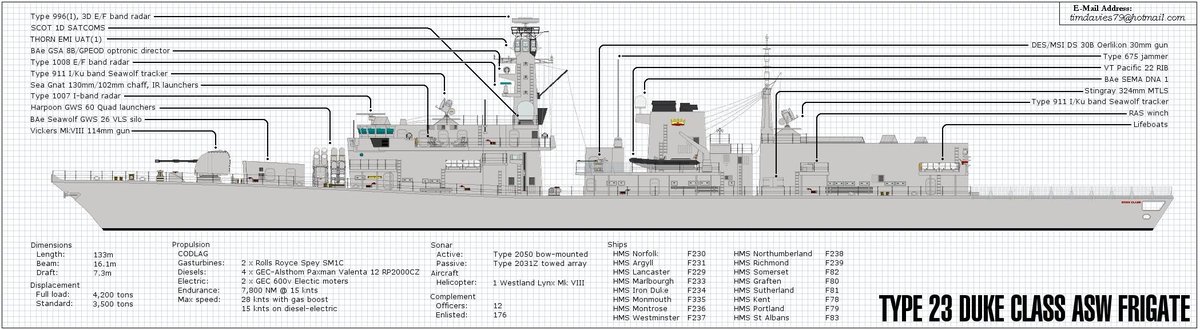
src: X.com – Tim Davies
The list of sensors is the following:
Type 996(1)
Type 911 FCR
Type 1007 radar
Type 2050NE sonar
Type 2031Z sonar
GSA.8/GPEOD Sea Archer E/O director
DNA(1) SSCS Combat Control System
They are to be further developed in a 2027 update.

Type 997 Radar on HMS Argyll
Active Protection
The ships comprised the following suite:
UAF(1) EW system
Two type 675 ECM suites
Four Sea Gnat/Siren UAF-1 decoy RL
Two DEC laser dazzlers
Four DLF(2) floating decoy launchers
Type 2070 torpedo decoy (F237, 238 only)
Type 182 torpedo decoy
Air Group
Wildcat HMA, Helicopter
Latest evolution of the cold war Lynx. Can be fitted with anti-submarine torpedoes or Martlet anti-ship (ASM)/air-to-air missiles. It is deployed as carrier strike group helicopter from 2021. The Sea Venom ASM reached initial operating capability in 2025 and is projected to achieve full operational capability in 2026.
Westland Merlin HM2 Helicopter
This large model could be armed with four anti-submarine torpedoes, but also drop buoys, a VDS, having a full suite to search and destroy submarines.
Drones
In later upgrades she ships received optional Peregrine ISR UAV, first tested from the mid-2024 on F229. Only cost prevents its large adoption.

Author’s poster for an Amber Book publication on modern warships.

⚙ Type 23 specs. |
|
| Displacement | 4,900 t (4,800 long tons) |
| Dimensions | 133 x 16.1 x 7.3m (436 ft 4 in x 52 ft 10 in x 23 ft 11 in) |
| Propulsion | CODLAG, 4× Paxman Valenta/MTU 12V4000 M53 diesel, GEC EM, RR Spey SM1C, see notes |
| Speed | 28 knots+ (52 km/h; 32 mph) |
| Range | 7,500 nmi (14,000 km; 9,000 mi) at 15 kn (28 km/h; 17 mph) |
| Armament | 2×4 Harpoon SSM, Sea Wolf GWS.26 SAM (32), 4.5-in/55 Mk 8, 2x 30mm/75 DS-30B, 2×2 324mm DMTS90 TT. |
| Active Protection | type 675 ECM, Sea Gnat/Siren UAF-1 decoy RL, DEC laser dazzlers, DLF(2) floating decoy launchers |
| Sensors | Type 996(1), 911, 1007 radars, type 2050NE sonar, GSA.8/GPEOD Sea Archer E/O director, UAT(1), SSCS CCS |
| Air Group | 1 helicopter, see notes |
| Crew | 185 |
Modernizations and Upgrades
General Chronology
By late 1990s, all had the type 996 replaced by the type 996(2) and type 1008 radars.
By the early 2000s, Lancaster, Iron Duke, Sutherland, Somerset, St. Albans, Westminster, Northumberland, Richmond then in the 2010s, the Monmouth, Montrose, Kent, Portland saw their Lynx helicopter replaced by the Merlin helicopter.
In 2004-2005 Westminster and Northumberland her their type 2031Z sonar, type 2070 torpedo decoy, type 675 ECM suites, DLB decoy RL replaced by a type 2070 torpedo decoy, type 695 ECM suites, and four DLH decoy RL.
In 2005-2012 successively Richmond, Somerset, St. Albans, Sutherland, Kent, Portland Has the type 2087 sonar, type 2170 SSTDS anti-torpedo system, and same.
By 2006-2008, Norfolk, Lancaster, Iron Duke, Monmouth, Montrose, Westminster, Northumberland, Richmond and later until 2001, Argyll, Somerset, Sutherland, Kent, Portland, St. Albans saw the replacement of their 114mm/55 Mk 8 main gun by a Mk 8 Mod, their two 30mm/75 DES-30B by the DS-30M Mk 2, as well as addition of a SIGMA IR detector, and Shaman/Sextant ISTAR communication interceptor.
In 2006-2011, the ones still commissioned received the Sea Wolf GWS.26 Mod.1 SAM (32).
By 2009-2010, Argyll, Montrose, Westminster and later Lancaster had their Seawolf upgraded to the SWMLU GWS 26 Mod. 1 SAM, their Sea Gnat/Siren UAF-1 decoy RL replaced by the UAT-1 and their SSCS DNA(1) CCS replaced by the CMS-1 DNA(2) CCS.
In 2011-2013 Kent, Richmond, Portland, St. Albans, Northumberland received the same SWMLU GWS 26 Mod. 1 SAM and CMS-1 DNA(2) CCS and by 2013-2015, Iron Duke and Monmouth as well.
Next in 2013-2015 for Iron Duke, Somerset, St. Albans, Monmouth they received Scan Eagle UAVs, the new type 997 ARTISAN radar and two type 911(1) radars, MIDAS ECM suite
From 2017, Lancaster, Iron Duke, Monmouth, Argyll, Montrose, Westminster, and Northumberland received the new Cea Ceptor SAM VLS (32×4), as well as new Scan Eagle UAVs, the type 997 ARTISAN, and type 911(1) radars.
MIFEX
The class started to have mid-life refits over 12–18 months at a cost of £15-20m in the 2000s. In addition to their drive train overhaul and changes in the network, they underwent a more radical drydock change: A transom flap adding up to one knot in speed while reducing drag, and thus, fuel consumption by 13%. They also were repainted with an Intersleek anti-fouling mix using microscale “fish skin” coating also adding two knots in speed as tested on the Ark Royal. Figures now range between the official 28 knots and the public trials of Lancaster at 32 knots after her refit.
The ship also underwent the following upgrades:
1-Sea Wolf Mid-Life Update (SWMLU) for the sensors and missile guidance for point defence.
2-New remotely operated 30 mm guns.
3-Mk8 main gun upgraded to the Mod 1 featuring a new all-electric loading system, smaller radar cross-section.
4-Communications and command systems upgraded.
LIFEX
A further Life Extension (LIFEX), again to keep the Sea Wolf relevant, was by its substitution for the new Sea Ceptor anti-air defence missiles, first tested from HMS Argyll on 4 September 2017.
Other upgrades includes:
Sonar 2087
This is the new towed-array system from Thales Underwater Systems, pushing the range and precision well beyond known SSN’s range. Sonar 2087 was added on eight Type 23 frigates between 2004 and 2012 and the five oldest (HMS Montrose, Monmouth, Iron Duke, Lancaster and Argyll) however were omitted due to budget cuts. However the Chileans benefited from the Sonar 2087.
Artisan 3D radar
The original medium-range radar was replaced by BAE Systems Type 997 Artisan 3D radar under a £100 million program announced on 4 August 2008. Still a medium-range radar optimized for littoral zones AA/AS plus air traffic management capabilities and to combat complex jammers. HMS Iron Duke was the upgraded with it in 2012–13. It is claimed “five times more capable” than the Type 996.
Common Anti-Air Modular Missile (CAMM): Sea Ceptor
CAMM(M) is the sea variant of the Common Anti-Air Modular Missile scheduled to replace the Sea Wolf from 2016. Its range is pushed to 25+ km compared 10 km and has an optional surface-attack capability, not chosen due to cost. It reuses the same VLS but could be packed more tightly, four for one Sea Wolf.
Martlet Lightweight Multirole Missile
The Duke class had no proper CIWS capabilities so by early 2019, HMS Sutherland tested a new 30mm cannon with a launcher for five ‘Martlet’ Lightweight Multirole Missiles. They destroyed a speedboat target at the Aberporth range (Wales) to complement the 30mm Bushmaster cannon and bring longer range and a faster response. This also to complement the Miniguns, later replaced by simpler Browning M2HBs. However due to ciost issues it was limited to be carried by the Wildcat helicopter. A pairing which recalls the WW2 Grumman Wildcat/Martlet.
Interim SSM, NSM, and FC/ASW missiles
From March 2019, a study for an interim replacement for the Harpoon before the Anglo-French (MDBA/Thales) Future Cruise/Anti-Ship Weapon (FC/ASW) programme scheduled for the 2030s. This interim replacement missile was supposed to be installed on five of Type 23 frigates until paused (later cancelled) by November 2021 by First Sea Lord, Admiral Tony Radakin. Cancellation was official by February 2022, but restarted in July 2022 and by November the Naval Strike Missile (NSM) was announced, a dual-purpose missiles replacing the roles of the Harpoon and Tomahawk and planned for 11 ships of the Type 23 and 45.
Montrose and Kent were the only one deployed by 2021 with their Harpoon full load with more equipped by August 2022, to be sent to the Persian Gulf. The DC/ASW is likely never to be deployed on the last active Type 23 given their planned retirement. The current NSM program was designed with Norway (state offices and Kongsberg) and live tested at the Andøya range during Exercise Aegir 25. This 400 kilogram missile with a statoreactor is already in service with Norway, US and Poland, is capable of Mach 1 and beyond 100 miles range.
Career of the Duke class
Although the Type 23 is officially the “Duke” class, and includes such famous names as HMS Iron Duke (recalling Jellicoe’s own HMS Iron Duke at Jutland), five were former County class cruisers (Kent, Norfolk also went to namesake guided-missile destroyers). Monmouth, Lancaster, Kent and Argyll were inspired by the previous, 1901 Monmouth-class. These Ducal and County names broke the alphabetic traditions and renewed with cruise names of the past like the Leander class they were supposed to replace. D names were however used for the Type 45 Daring-class destroyers. Being commissioned from 1990, they took part in many deployments linked either to the Iraq and Gulf wars, deployments in Afghanistan, red sea and arabian sea, but also the adriatic blockade of ex-Yugoslavia. However their career was more cushy than really challenging.
The oldest ship today of that class, HMS Iron Duke, is now classified as a General Purpose ship, homeported at Devonport and acting as an ASW specialist, equipped with the Type 2087 Towed Array Sonar, for the Queen Elizabeth class carrier battle groups. Devonport is the main base for the current Type 23 planned for replacement by the Type 26 ASW and Type 31 GP frigates. The 2021 defence white paper announced however the decommission of Montrose and Monmouth. Monmouth had its LIFEX cancelled, being laid up in 2018. She was stricken by June 2021.
In 2024 HMS Westminster and HMS Argyll were next on the chopping block. In 2021 after an exchange with the House of Commons Select Defence Committee,First Sea Lord Admiral Tony Radakin suggested however them to be retained longer to ensure enough escorts, keeping a baseline of 17 ships (6 destroyers, 11 frigates) and rise to 19 escorts from 2026. The main issue is currently not funding or technical but rather personnel shortages. In addition the oldest surviving Duke class are now 30+ years old, making the cost of upgrades prohibitive. In November 2024 the new Labour government conformed the withdrawing of HMS Northumberland FY2025. Next were HMS Iron Duke and HMS Richmond FY2026, down to five Type 23 to be maintained until replaced by the new Type 26/31.
 Alm. Cochrane class Frigates (2008)

Budget cuts meant decommissions were announced as early as 21 July 2004, from to the “Changing World review” about global defence spending, by Sec. Geoff Hoon: HMS Norfolk, Marlborough and Grafton were to be paid off. In 2005, they were announced to be sold to the Chilean Navy, for delivery in 2008, after refit awarded by September 2005, awarded to BAE Systems under a £134 million GBP contract. The ex-Marlborough, Norfolk and Grafton were sold to Chile for £134 million after a letter of intent signed in December 2004, formal signature on 7 September 2005. The refit under the Defence Logistics Organisation and BAE Systems was done from 22 November 2006. The first ship transferred was named Almirante Cochrane (FF-05), followed by Grafton on 28 March 2007 as Almirante Lynch (FF-07) and Marlborough on 28 May 2008 as Almirante Condell (FF-06). They were recently upgraded by Lockheed Martin Canada at Chile’s ASMAR shipbuilding complex and are expected to serve well beyond 2035.
 HMS Norfolk (F230)
 Norfolk (F230) Marconi Marine (YSL), was laid down at Scotstoun on 14 December 1985, launched on 10 July 1987, commissioned on 1 June 1990. She was decommissioned on 15 April 2005. Sold to Chile as Almirante Cochrane. To be further developed in 2027.
HMS Marlborough (F233)
 Marlborough was laid down at Swan Hunter, Wallsend on 22 October 1987, launched on 21 January 1989 and completed on 14 June 1991. Decommissioned on 8 July 2005. Sold to Chile as Almirante Condell. To be further developed in 2027.
HMS Argyll (F231)
 Argyll was ordered as a GP (General Purpose) type from Marconi Marine (YSL) at Scotstoun, laid down on 20 March 1987, launched on 8 April 1989 and 31 May 1991. She had a MIFEX from Jun 2015 to Feb. 2017 and finally deactivated by May 2024, Awaiting disposal. To be further developed in 2027.
HMS Lancaster (F229)
 Lancaster was ordered as a GP type at Marconi Marine (YSL) at Scotstoun, laid down on 18 December 1987, launched on 24 May 1990 and commissioned on 1 May 1992. She had her MIFEX from March 2017 until December 2019, then finally decommissioned on 6 December 2025. Awaiting disposal. To be further developed in 2027.
HMS Iron Duke (F234)
 Iron Duke was ordered as a GP type from Marconi Marine (YSL), Scotstoun, laid down on 12 December 1988, launched on 2 March 1991 and commissioned on 20 May 1993. From January 2019 to June 2023 she had her MIFEX. In service since 2019 but decommissioning announced. FY2026. To be further developed in 2027.
HMS Monmouth (F235)
 Monmouth was a GP type ordered from Marconi Marine (YSL), Scotstoun, laid down on 1 June 1989 and launched on 23 November 1991, completed by 24 September 1993. She was discarded on 30 June 2021, since then, sold for scrap. To be further developed in 2027.
HMS Montrose (F236)
 Montrose was ordered from Marconi Marine (YSL), as a GP type and laid down on 1 November 1989, launched on 31 July 1992 and commissioned on 2 June 1994. She was had her MIDFEX from October 2014 to July 2017. She was decommissioned on 17 April 2023 and since, sold for scrap. To be further developed in 2027.
HMS Westminster (F237)
 Westminster (ASW type) was ordered from Swan Hunter, Wallsend, laid down on 18 January 1991, launched on 4 February 1992, commissioned on 13 May 1994. She had her MIDFEX refit by November 2014 to January 2017 and was decommissioned in May 2024, currently Awaiting disposal. To be further developed in 2027.
HMS Northumberland (F238)
 Northumberland was ordered as an ASW type at Swan Hunter, Wallsend, laid down on 4 April 1991, launched on 4 April 1992, commissioned on 29 November 1994. She was modernized (MIFEX) between May 2016 and May 2018. She was decommissioned on 12 March 2025. Now Awaiting disposal. To be further developed in 2027.
HMS Richmond (F239)
 Richmond was an ASW type from Swan Hunter, Wallsend, laid down on 16 February 1992, launched on 6 April 1993 and commissioned on 22 June 1995. She had her MIFEX from August 2017 to February 2020. She was announced on 13 July 2026 to be out of service, decommissioning announced. To be further developed in 2027.
HMS Somerset (F82)
 Somerset was an ASW type from Marconi Marine (YSL), Scotstoun laid down on 12 October 1992, launched on 25 June 1994 and commissioned on 20 September 1996. She was MIFEXed from November 2018 to March 2022. In Active Service today.
HMS Grafton (F80)
Grafton was ordered from Marconi Marine (YSL) at Scotstoun and laid down on 13 May 1993, launched on 5 November 1994. She was commissioned on 29 May 1997. She was decommissioned and refitted after 31 March 2006, sold to Chile as Almirante Lynch. To be further developed in 2027.
HMS Sutherland (F81)
 Sutherland was an ASW type ordered from Marconi Marine (YSL) at Scotstoun and laid down on 14 October 1993, launched on 9 March 1996, commissioned on 4 July 1997. She was MIFEXed from December 2020 to March 2024 and is now in Active Service. To be further developed in 2027.
HMS Kent (F78)
 Kent was an ASW type from Marconi Marine (YSL) laid down on 16 April 1997, launched on 27 May 1998 and completed on 8 June 2000. She was MIFEXed from January 2017 to August 2018 and is now by 2026 at Devonport for a refit. Currently commissioned. To be further developed in 2027.
HMS Portland (F79)
 Portland was an ASW type ordered from Marconi Marine (YSL) at Scotstoun laid down on 14 January 1998, launched on 15 May 1999 and completed on 3 May 2001. She had her MIFEX between February 2018 and March 2021. Currently in Active Service. To be further developed in 2027.
HMS St Albans (F83)
 St Albans was an ASW type Marconi Marine (YSL), Scotstoun, laid down on 18 April 1999, launched on 6 May 2000 and commissioned on 6 June 2002. She had her MIFEX between July 2019 and November 2023. Currently in Active Service. To be further developed in 2027.
Read More/Src
Books
Conway’s all the world’s fightining ships 1947-95.
Links
secretprojects.co.uk/ type-23-frigate dev. variants
seaforces.org/
web.archive.org/ navypedia.org
en.wikipedia.org Type_23_frigate
weaponsystems.net/ 20mm Oerlikon GAM-BO1
News:
telegraph.co.uk/ hms-iron-duke-withdrawn/
independent.co.uk/ hms-iron-duke
ukdefencejournal.org.uk/ uk withholds which warships will get new missiles/
Videos
Model Kits
Trumpeter HMS TYPE 23 Frigate – Westminster(F237) (Plastic model)
Trumpeter 1/350 scale Type 23 Frigate HMS Westminster by Steve Pritchard
