
 Nuclear Powered French Aircraft Carrier (Planned): FS Verdun (1958)
Back in 1958, after the Clemenceau class was decided, was approved a third, much larger PA58 project or “Verdun class”: A nuclear-capable aircraft carrier. Authorized in 1958 it had dimensions already close to USN supercarriers. However Verdun was eventually cancelled before construction. It was engineered to launch nuclear-capable Mirage IVM from two US 75m steam catapults, two deck-edge lifts a roomy hangar, better armor protection than previous carriers and an Air Group of more than 50 aircraft. However the project faced high costs, and opposition with shifting strategic priorities, plus technical hurdles regarding the navalized Mirage IV and potential interceptor Mirage IIIM contributed to its cancellation. The Clemenceau and Foch soldiered on until the end of the cold war… Another interesting European “what-if” carrier.

Development
Introduction
When the 20,000 tons Clemenceau class was approved, the admiralty already planned a much larger carrier specifically to operate nuclear strikes. The project name PA58 was sufficiently advanced at some point for the ship to be named and known as the Verdun. Their construction was considered in 1958 but the program was cancelled in 1961. Apparently, the PA58 alias Verdun was a much larger design compared to the PA54 given its projected displacement of 45,000 tons, inspired by USN Super-carriers of the time, but the length was the same (262 m pp, 286 m wl) whereas the hull’s width was larger at 34 m for a flight deck 58 m wide, quite an improvement.
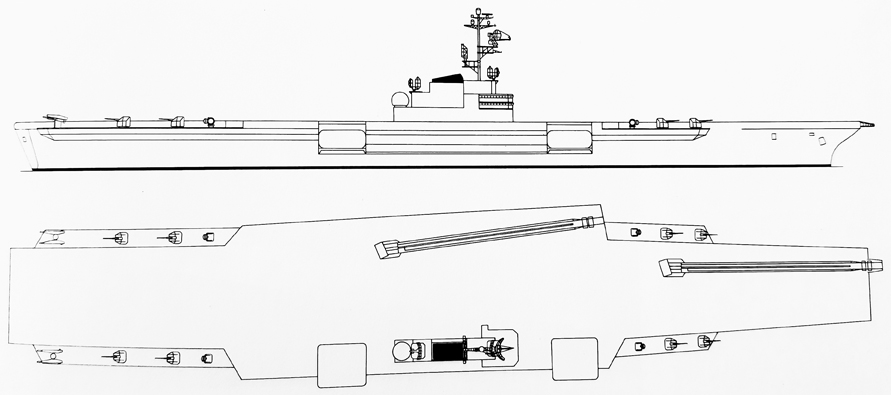
The PA58 was propelled by Steam turbines on 4 shafts, producing a total of 200,000 shp, for a speed of 33 knots (61 km/h; 38 mph). Parking size inside was much enlarged as well as aicraft handling. The PA58 had two lifts admidships and wo capapults and an angled deck placed the same way as PA54. It was to be armed with two Masurca SAM systems placed at the end of the side sponsons and height standard 100 mm DP guns placed for and aft abaft the flight deck. The placement of these SAMs recalled the American Kitty Hawk class.
The air group would have been largely similar to the Clemenceau to the exception of a navalized version of the heavy Dassault Mirage IVM, which was envisioned. The plane weighted 20 tons which required significant modifications on the lifts and catapults compared to PA54. The air group nevertheless comprised a combination of ASW Alizé aircraft and Etendard fighter-bombers. In 1960 the admiralty saw delays accumulating due to financial problems and eventually envisioned a smaller, cheaper design without the Masurca SAM but it went nowhere and the whole program was discarded and abandoned in 1961.
Later both the Foch and Clemenceau were modified to accommodate the AN52 nuclear bomb. A new “large flight deck” nuclear-powered carrier will emerge in 1990 and take the role of the former abandoned Verdun, the Charles De Gaulle.
Genesis of the French Nuclear Carriers
In 1958, just as General De Gaulle (in June) returned to power after the May 1958 crisis in Algeria, the Navy approved an enlarged clemenceau class carrier, the PA-58 “Verdun class” rated for 45,000 tons. Since the start, it was to be an equivalent of the Forrestal class operating its own brand on the Vigilante, with the Mirage IV. It was also to be armed with a new long range SAM system roughly equivalent to the Terrier missile.
The story is not De Gaulle ordering this carrier out of the blue instead of the Clemenceau class, as the latter had been already approved by the precedent government under president René Coty took office, final president of the Fourth Republic. He had to face the end of the Indochina was with peace negociations led by the new PM Pierre Mendès France from June 1954, and at the same time North African Independence Talks (agreements granting autonomy, preparing Tunisia and Morocco for independence) as well as the start of the started of the Algerian War when the Front de Libération Nationale (FLN) launched open revolts in Algeria in November 1954, creating a new and deeply divisive crisis for the French government.
The Clemenceau class, a program approved the same year, but launched in 1957, were the culmination of many clandestine wartime or postwar designs, and essentially the cancellation of the PA28 program which was regarded in 1949 already outdated and was cancelled in 1950. It’s not that France accepted having no carriers: The Marine Nationale indeed operated in Indochina the two ex-Independence Lafayette and Bois Belleau, the escort carrier Argus, and more importantly the ex-colossus, FS Arromanches. For the Indochina war operations until 1954 their piston-engine air group was sufficient for essentially ground support operations against the Viet-Minh.
French Nuclear Program
However this was the context of a colonial war, with a part of the politician elite still clinging to the Empire. However there were also a part of the general staff in the Air Force, Army and Navy alike that believed france needed to have its own deterrence. Like Britain, the country had a talented scientist and his team Nobel Prize-winning physicist Frédéric Joliot-Curie which already worked in this field before and during the war. De Gaulle in 1945 saw potential in this endeavour and created the French Alternative Energies and Atomic Energy Commission (CEA), officially focused on civil applications but azlso creating the industrial infrastructure to refine fissile material. By 1954, after the failure of the European Defence Community PM Mendes France already signed secret decrees officially launching the military application phase of the French nuclear program, ongoing since 1945. Then came the 1956 Suez crisis, a second schock that led in 1957 PM felix Gaillard to launch the first official 5-Year Atomic Energy Plan and authorized the financing for the infrastructure that would eventually build the first French atomic bomb. So when he arrived after the May 1958 related to the ar in Algeria, De Gaulle agreed to more financing for the program and became its driving force. He wanted to acquire the “full triad”, a ground force tactical components, a strategic air component, with the Mirage IV, and the Navy convinced him to acquire also a naval component.
Indeed at the same time in the US, the three services battled for possession of the deterrence force. Ultimately it was shared between the three, albeit the Air Force under Curtis LeMay and his “bomber mafia” obtained the bulk of the program and finances. Still, the Marine National staff observed the start of a program that would culminate with the aircraft carrier project USS United States (CVA58) in 1947. This giant, island-less carrier was to operate at the time, a two-engine bomber, the Lockheed P2V Neptune that could be modified to carry one gravity atomic bomb. Since ballitic missiles were just concepts at the time, the carrier-based bomber could give the USN an unprecedented reach. However CurtisLeMay won this match and the Navy saw its authorization by Truman on 29 July 1948, and a construction start, then cancelled on 23 April 1949, just five days after the keel laying… However under Eisenhower this policy of air-force only dominance had been contexted by the army that obtain its own, tactical nuclear program (The “pentomic army”) with famous assets as small as nuclear shells (atomic annie) and jeep-carried rockets (davy crocket).
This led to a new program of supersonic atomic bomber, the North American A-5 Vigilante that some regards today as the sexiest jet to ever see carrier service. Its own program started in 1954 as a way for the Navy to get its revenge, after the failure of the XA2J Super Savage project.
Genesis of the PA58
Back in France, When Charles de Gaulle returned to power in June 1958, he inherited a well-advanced technical program and weaponized it politically to forge absolute French strategic independence, formally rejecting NATO’s integrated military command. The first nuclear test (Gerboise Bleue) was led in the Algerian desert on 13 February 1960. Soon nuclear bombs were designed for the Mirage IV (Mach 1.5, 1,500 km range and +1-ton payload), and a land asset using a tactical missile appeared later in the 1960s, the Pluton. The program was approved in 1954 and maiden flight was made in 1958, certainly influencing the French naval thinking around the possibility of carriers before the advent of a SSBN component. The carrier of the Vigilante as a strategic bomber ended however in 1961 and it was repurposed as a reconnaissance model. In France, Dassault was explicitely in 1956 asked to develop an equivalent to the Vigilante. Discussions about a carrier for these likely also began that year (with the Suez crisis).
The French naval staff already recoignized the limits of the 1954 when the “light carriers” of the Clemenceau class, in line with the Arromanches, the very first of the 1942 light fleet carrier program awaiting a planned decommission. They were large enough to operate jets, like the USN did after the modernization of similarly sized Essex class carriers, but not larger aircraft, like twin-engine bombers. Tests in the US showed only the Midway class and later Forrestal “supercarriers” could do so. Thus, PA54 and PA55 considered too small at 20,000 tons standard to operate new projected bombers and with a small air group capacitysaw the admiralty planning a larger carrier dedicated to nuclear strike operations. At first PA58 (not called that way) was considered a third aircraft carrier in the previous class, just larger, so potentially PA56. The acronym had “PA” standing for “Porte Avion” and when the project was finally appropved after many revisions, the number 58 referring to the fiscal year.
Earlier the proposed naval plan drawn up in 1949 called for four 20,000-ton aircraft carriers so that two could be available at all times. On August 22, 1949, this was revised to six fleet carriers. On July 15, 1952, another five among which two would be placed under the authority of the French Union, not NATO. The NATO MRC 12 document of the 1952 Lisbon Conference stated indeed France needed to put an aicraft carrier at its disposal on the first day, two by D+30, three by D+180. By 1953, the final position was for three aircraft carriers total. Thene the accepted design to replace PA28, called PA 54 was included in the 1953 budget. The sirst of the Clemenceau class was laid down in November 1955 and Foch or PA 55 was included in the 1955 budget and laid down in February 1957. The third was provisionally designated PA 58 and Verdun was proposed as its name to replace the Arromanches pending decommission in 1962. The new projected carrier was slated for the 1958 budget… and then cancelled at the last minute for budgetary reasons. The Navy then attempted to revive the project with PA 59, less ambitious, an “improved Clemenceau” or a larger aircraft carrier at 35,000 tonnes but still capable of operating strategic bombers in “France’s residual strike force.”
One core concept all along the project was its array of strategic bombers. It was not born with PA58. Indeed according to the report published for the Higher Naval Council on May 30, 1957, the issue of embarking atomic bombers (in French it had even a name, “muratisation”) was raised in the design phase of PA54 already. To carry 20-ton aircraft with sufficient operational range the Higher Naval Council reported after its reunion of July 30, 1957 that a French atomic bomb would be available by 1965, a French hydrogen bomb by 1970. Admiral Pierre Barjot thos rose the question of tactical atomic nuked for the fleet. However inter-service rivalry resurfaced as by October 1956, a ministerial directive defined a three-part mission structure for atomic the first comprising both strike and defense, and the last one intervention. The first was defined as exclusive to the Air Force but Navy 7 months later was granted a part in this rome in a supplementary directive.
The fate of the carrier now called “Verdun” still not formally, was sealed by a new discussion by the Higher Naval Council, which deliberated on the fate of Verdun on May 6, 1958. Alain Poher was then the new Secretary of State for the Navy. He insisted on a more austere variant of the PA53 design based on budgetary constraints making for an envelope of 35 billion francs versus the 45–47 billion required for the larger Verdun project the Navy wanted. This became PA59. This was the “austere” variant, without the Masurca SAM and would have been smaller.
However, politics intervened, as De Gaulle back at the helm modified the constitution amidst the Algerian crisis, and the new fifth Republic was also given a clearer vision of its deterrence, the new Force de Frappe. All was now centralized as the nuclear strike force around ballistic missiles. The Navy still hoped a revival in the 1960–1964 program, for a keel laying in 1962, commissioning in 1967. But it was definitively abandoned in 1961. The cost of the Algerian war had severely restricted the budgets, and De Gaulle had been advised to choose the more modern solution of additional ballistic missile submarines instead, far more promising and more cost-effective, of the new Redoutable class. It was said that the spiralling cost of the Masurca SAM system was another reason of this cancellation.
Design of the class
The PA58 was essentially a “stretched PA56”, with many modifications made to ensure the deck was strong enough both of a large jet of the class of the Mirage IV in its navalized variant in development,
and apart a few sketches, a model was built as a base for further dicussions. It had a projected displacement of 45,000 tons, but was closer to a Midway than a Forestal, at 262 m between perpendiculars and 286 m overall, 34 m side for the hill and 58 m for the flight deck. This was quite an improvement over the PA54 but still smaller than a Forrestal. Propulsion was not to be revolutionary, instead counting on 4-shaft Parsons steam turbines for 6 boilers and 200,000 shp for a fleet speed of 33 knots.
The carrier bomber question was long in tooth: At first the bomber was just 15 tonnes, and for it, 50m Mitchell-Brown steam catapults, same as Clemenceau, were selected. This was bomber project CB 62. It would have been assisted by JATO and/or air-refuelled. It’s the 30 august 1957 Navy superor council on the PA 59 that raised the catapult option at 75 or 100 m. It was decided also, given the size of the expected Mirage IVM later adopted, to have two larger, heavy-capacity (22-tonne, 17 m × 14 m) deck edge lifts. Still compromises were made as there were no side catapult, on the angled deck. Instead a pure separation was chosen and only two large catapults were located forward, one on the axis, the other on the angled deck. The design of the angled deck however was essentially the same as for the PA54 but increased to about 75 m. The parking space amidships was increased and the hangar positioned centrally. The Mirage IVM was expected to be alt least 19m long and 12m wide, so only fitting the lifts if placed in deck-edge lifts, its tail over the sea, or transverse. At 20 tonnes light, the catapult lengh and strength, arresting cables, deck, lifts, were all tailored for it as well.
The naval staff also decided for a modern armament, and at the time, equip the ship with at least two missile launchers Masurca SAM systems like on the Kitty Hawk class placed at the end of the side sponsons. It was completed by the same fual purpose artillery as for the PA54 project, eight standard 100 mm DP guns placed fore and aft abaft the flight deck. The propulsion was for long an open question as well, but the French were aware of the rapid deployment of nuclear power in the USN, seeing the launch of USS Nautilus, championed by admiral Rickover, in 1954. However the development cost of a pair of nuclear reactor at that time was judged too steep and conventional propulsion eventually was chosen as nuclear power in France was not advanced enough. New steam turbines on four shafts woumld provided the necessary 200,000 shp and 33 knots plus feeding new and powerful catapults. Like the latter British CVA-01 program, these “atomic carriers” would carry nuclear-capable bombers, Bucaneer in the British case.
Hull and general design
When looking at the PA58, at 35,000 tonnes standard, this would be even now a large carrier. 30% superior to the PA54, it was even larger than the actual Charles de Gaulle (45,000 versus 42,500) fully loaded, much longer at 286 meters overall (938 feet) versus 261 m, 30 meters difference (90 ft). The internal hangar measured 200 m (656 ft), with two dek-edge lifts. The hull measured 262 meters between parallels (860 ft) and the hull 34 meters (111.5 ft) for 58 m overall (190 ft) and a draught of 9.14 m (30 ft). The angle deck was 192 meters (630 ft) long, angled at 8°. The two elevators measured 17 x 14 meters (55 x 45 ft) both on starboard forward and aft of the island. There are four arresting wires. Plans initially called for two 75-meter catapults or even a 100-meter catapult for the axial one but overall the general layout is similar to that of the Clemenceau class, so see the later for detailed layout, notably the island was almost identical.
Powerplant
There were serious discussions about nuclear propulsion based on what was developed already for the first gen. French SSN, see the Redoutable class development for more. Of course Admiral Barjot among the pro-PA 58 wanted, if possible, nuclear reactors for the benefit of range. However under the CEA studies for these had begun also for a future nuclear submarine program, but in 1958 development was far from conclusion: After the PAT prototype came the CAS 58 reactor variant, tested at Cadarach, but it only reached criticality in 1964. So in between it was chosen to go for a more realistic conventional propulsion: Four propeller shafts, driven by steam turbine and eight steam boilers for a total output of 200,000 hp, enabling a sustained speed of 34 knots (on standard displacement of 42,000 tonnes), an expected 35+ knots on trials in forced draft. Range is unknown, buyt would have been greater than the Clemenceau class thanks to larger dimensions.
Protection
The protection layout is decribed generally comparable to that of the Foch and Clemenceau, but reinforced regarding the hull structure and flight deck, both armored like the Midway class. The protection structure was also integral to the flight deck, like on the British built Arromanches and not separated, like on US Carriers. Which gives us an armour box protection over the machinery and other vital parts between 30 (1.2 in) and 60mm (2.3 in), and a 50mm (2 in) flight deck or more. There were extensive separations for the machinery space, transverse and longitudinal to reduce flooding risk, extensive compartments behind the belt and likely the same scheme as for the Clemenceau. There was also by default the same fire proteciton measures, from the self-filling avgas network to curtains and fire posts in the main hangar. However it seems Verdun would not have been protected NBC.
Armament
PA 58 in its initial form was to be ambitious, far more than the Clemenceau, limited to eight main guns. Verdun was provided with two more gun turrets given her size, locally placed the same in twin sponsons fore and aft, but also sponsons were created for her Masurca SAM system, two twin-arm launchers for and aft.
Various armament layout options were studied, but without specific dates:
A- twin Masurca launcher forward and three 100 mm turrets aft;
B- Twin Masurca launcher with two 100 mm turrets forward and three 100 mm turrets aft;
C- Two 100 mm turrets forward, a twin Masurca launcher, and two 100 mm turrets aft.
The Technical Service on June 25, 1957 sent specifications to the Chief of Naval Staff under general engineer Amiot, head of the Naval Construction Group, within the Technical Service. With the design ultimately selected, eight 100 mm guns plus two missile launchers (30 per launcher) like in Option 3 was chosen. The need for an anti-submarine weapon with a range matching the BF sonar ledt study the installation of the Latécoère Malafon, carrying a L4 torpedo, stowed in the magazine. The French ASROC.
This preliminary design was approved by the Minister after a meeting on July 30, 1957, but the armament configuration was revised and by October 7, 1957, ten 100mm guns, two Masurca, two Malafon launchers were selected, which was quite ambitious. The two aft sponsons now had three 100mm guns plus their own fire-control director, the forward sponsons had two 100mm guns, one Masurca launcher like on B Variant. The two Malafon launchers were on sponsons on the aft deck. There was even a variant with twelve 100mm guns displacing the Masurca launchers on the forward sponsons, too exposed to seawter spray.
The core principle was the idea of four independent air-defense combat units around the ship fore redundancy.
Masurca SAM
They shared between them 60 missiles. The Masurca was the most ambitious cold war early long range SAM system. In 1958 it was in early development phase. The name was a semi-acronym for “Marine Supersonique Ruelle Contre Avions”. Ruelle was the center working on the design. This was a medium-to-long-range shipboard surface-to-air missile (SAM), an in-between the Terrier and Talos. However the system started to suffer delay, then costs overruns and was eliminated fom the design in 1959 (for PA59).
It eventually entered service in July 1967 on the destroyer Suffren and cruiser Colbert, and remained active for over 40 years until retirement in 2008.
It was a two-stage missile consisting of a solid-propellant rocket booster and a sustainer motor, comparable to the RIM-2 Terrier, was supersonic at 3,700 km/h (Mach 3+) and had a range of c55 kilometers (34 miles) to defeat incoming russian bombers. The initial version was Guided by radio command and DRBR 51 tracking and guidance radar. It was launched from the 40 tonnes twin-arm trainable launcher paired with an internal automated reloading and handling chamber.
100mm M53
First generation M53. 55 cal., firing a 100 x 700mmR HR fuse shell. In brief:
Elevation: 29°/s
Traverse: 40°/s
Rate of fire: 78 round/min
Muzzle velocity: 870 m/s
Effective firing range: 17,000 m (elevation 40°)
Maximum practical range: 6,000 m aerial/12,000 m surface targets
Sensors
By default of having data on this, what is left is conjectural. Using the Clemenceau class as reference as built there would have been likely the following:
DRBV-20C, DRBV-23B, DRBV-50 surveillance radar, two 2x DRBI-10 for identification, two DRBC 32A, and two DRBC 31D fire control radar as well as the navigation NRBA-50 and CCA radars, the US SQS-503 sonar, as well as the electronic counter measure suites ARBR-16, ARBX-10. Agains missiles there were also 2 Syllex decoy RL and the SENIT-1 Combat Control System. The main difference was the installation of the two DRBR-51 tracking radars with two associated target illuminators on PA-58, it was indeed eliminated from the next PA-59. The installation, proposed but not pushed further, of the Malafon ASW missile would have imposed some tailoring from the SQS-503 sonar and possibly the DUBV 23 hull-mounted sonar and DUBV 43 variable depth sonar if upgraded in the 1960s. Before that, an earlier towed sonar (low-frequency) was even slated for installation.
Air Group
The cornerstone was programme CB62, for the development of an all-time carrier-capable fighter as well (which became the Mirage III) as well as a supersonic nuclear bomber. The Project of a Mirage IIIM is a complicated history but found a solution after cancellation with the F-8 Crusader. It was indeed supposed to be the missing capability of the PA53 and PA58, which already had a capable ASW model, the Breguet Alizé, and the Etendard IV for day, vectored naval reconnaissance and attack missions, equally capable, but subsonic and lacking a radar. The large bomber was estimated to be 20 tonnes and thus only fitting the PA58 project, if realized.
Mirage IVM
The PA58 air group took advantage of the larger size for 50 aicraft, versus 40 for the Clemenceau, and it was one core driver for its size based on 45,000t, centred on one extraordinary aircraft: the Mirage IVM. This heavy strike aircraft was latter, under development for the Navy since 1956. The final model was derived from Dassault’s air force model and its 19 m, wingspan of 12 m, take-off weight of 20 tonnes imposed reinforced deck spaces, new catapults, new lifts and new arresting cables. This navalised derivative of the Dassault Mirage IV strategic bomber. But Dassault was not alone. For a competition, the Navy was also proposed the Sud-Ouest SO 4060 M (a navalised SO 4060 “Super Vautour” twin engine bomber with more pronounced swept wings). But the latter was already of an ageing design configuration, and proved too large. It was downsized as the SO 4062 but eventually never accepted. However with uts more promising top speed and delta wings, the Mirage IV Marine was more attractive, and was retained.
This process started by December 28, 1956, followed by a March 1957 design for a single-seat Mirage IV-M, shortened but with folding wings and folding tail fin, until abandoned in late 1958, following the 1955 launch of two 22,000-ton Clemenceau (R98) and Foch (R99) which catapults were unable to launch this 16.5-ton aircraft.
The final Mirage IVM developed was powered by two SNECMA ATAR 9 rated for a 6,000 kg thrust and had a Span of 11.75 m, a Length of 19.35 m (16.30 m with wings folded), and an height 5.30 m (5.00 m with fin tip which had folding wings). Being a delta it had a maximum take-off weight of 16,500 kg and speed of Mach 2, Ceiling 20,500 m. Like its air force cousin, it was designed for a deep penetration of 1500 km with a gravity bomb as payload, using a peculiar, arched drop pattern to escape the detonation area. However development ran into serious issues from the start: Like the Mirage III, the delta configuration made for blistering approach speed, so very special measures were needed to break speed when landed. It was a headache from the start. Even the catapult was deemed unsufficient for the fully loaded configuration, so it was planned to take of with JATO rockets in assistance.
Mirage IIIM
Alongside the Mirage IVM, in 1956 the French Navy opened a competition for a carrier-based interceptor capable of Mach 1.8 and suitable for all-weather conditions, intended to form part of the air wing of Foch, Clemenceau, and Verdun. Dassault proposed a naval Mirage III for this role, though the programme never matured. Unlike the Super Etendard, the Mirage IIIM had delta wings ensuring the same high speed as the Mirage IV, and it had a radar, but for the same reason breaking speed before landing, naturally very fast for delta fighters, was complicated. In addition, it featured modifications for carrier operations, including an arresting hook and catapult attachment points (catapult spool) and to compensate for the extra weight, planned to use a more powerful Super Atar engine. All this was very costly. So when PA58 was cancelled, without frm commitment for the already serviceable Foch and Clemenceau the government decided instead to pick up “off the shelff” the F8 Crusader instead, which had been qualified for the large US carriers and the smaller Essex class thanks to its variable-incidence wing. That maked it desirable for the French, which managed to obtain an even greater incidence for their own carriers. The Crusader remained in French service far longer than its USN cousin, well past the end of the cold war, as its designated successor, the Rafale, was eagerly awaited by the Navy.
The remainder of the air group was identical to the Foch and Clemenceau:
Typically between 5 and 8 Breguet Alizé turboprop ASW hunters, 18 Etendard IVM for attack (later 14), and 3-4 Etendard IVP for reconnaissance. The “pedro” plane guard helicopter was Alouette III was carried, two on board, and there was a variable park of 2-6 large Super-Frelon Helicopters. They could be used for radar surveillance, SSM strikes, transport and ASW.
⚙ specifications |
|
| Displacement | 35,000t standard, 45,000t FL |
| Dimensions | 262/286.3 m x 34/58 m x 9.14 m (939 ft 4 in x 190 ft 3 in x 30 ft oa) |
| Propulsion | 4 shafts geared turbines, 8 boilers, 200,000 shp (147,000 kW) |
| Speed | 33 knots (61 km/h; 38 mph) |
| Range | Unknown, c8-9000 nm/18 kts |
| Armament | 10x 100mm/55 Mod 1953, 2x Masurca SAM(60), 1 Malafon ASWM |
| Protection | Box protection over machinery and other vital parts 30 – 60mm, flight deck: 50mm |
| Sensors | DRB-51 (Masurca), see notes. |
| Air Group | 50 aircraft, c8-10 Mirage IV, 10-12 Mirage III, 18 Etendard IVM, 4 Etendard IVP, 2 Alouette III |
| Crew | 1700+ |
Read More/Src
Books
Jean Moulin, Clemenceau, Foch: Les Porte-Avions Français (Lela Presse / Marines Éditions, 2006)
Patrick Boniface, “Clemenceau carriers”, Ships Monthly, September 2015, pp. 46–49.
Les Avions de Combat Françaises 1945–60 (Docavia series)
Note au Conseil supérieur de la Marine pour sa réunion du 28 avril 1960, Service historique de la Marine
Francis Dousset, Les Porte-avions français : des origines (1911) à nos jours. Éditions de la Cité 1978
Conway’s the world’s fighting ships 1947-95
Links
secretprojects.co.uk
key.aero/
stratisc.org Hervé Couteau Bégarie about French carriers
alternatehistory.com/
fr.wikipedia.org/
opex360.com/
whatifmodellers.com/
en.wikipedia.org/ French_aircraft_carrier_Verdun
lefauteuildecolbert.blogspot.com