
 Regia Marina: 4 midget submersible 1938-43: CA-1 to CA-4
First on four articles on Regia Marina’s midget submarines in ww2:
The CA class were a secret weapon developed from 1937 by Italy. This first class of midget submarine (Italian “sommergibili tascabili”, the latter traduced rather as “pocket sub”) in the second world war, had a design started prewar: They had been designed by Caproni, the aircraft manufacturer, in 1937 for harbour attacks (from mother ships) and other roles. The prototype was completed in 1938. Their purpose was to ambush ships in enclosed waterways, or force passage of straits, create coastal defensive barriers, force enemy bases, with the experience of Pola in mind. The prototype however proved unsuitable in practice. Still by 1941 the project was relaunched and the first two were completely redesigned followed by two others buit shortly after for X-MAS covert operations. Now they had been retasked to transport underwater “gamma men” to mine ships in harbours. Despite good trials, none of the CAs were ever deployed in operations a their mothership submarine, Leaonardo Da vinci, was sunk. They were captured by the German after the Cassibile armistice, never used either, scuttled and BU postwar. But still left a fascinating story.

Development
Already before WWI, Italy already tinkered with midget submarines, notably later for the attack of Pola. These were the alfa and beta class, then A-B classes.
WWI Legacy
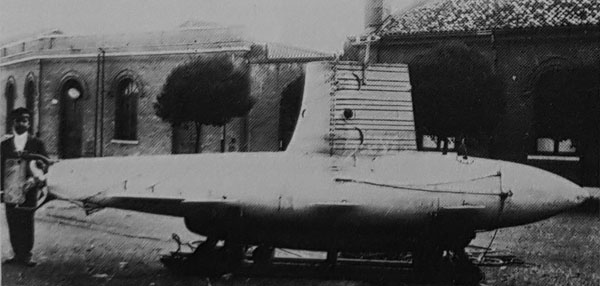 The Alfa and Beta Classes were built between 1912 and 1913 at Venice Naval Yard. They measured roughly 6 meters long with a 76 cm diameter, displacement of around 10 tons. They were design to run on electric power only for silent approaches, for harbor defense or attack, provided they could be carried close to the objectives. They were tested successfully but never officially commissioned due to the limits of electric batteries or motors at the time, making for an extremely limited range of around 30 nautical miles and very low speed. See also.
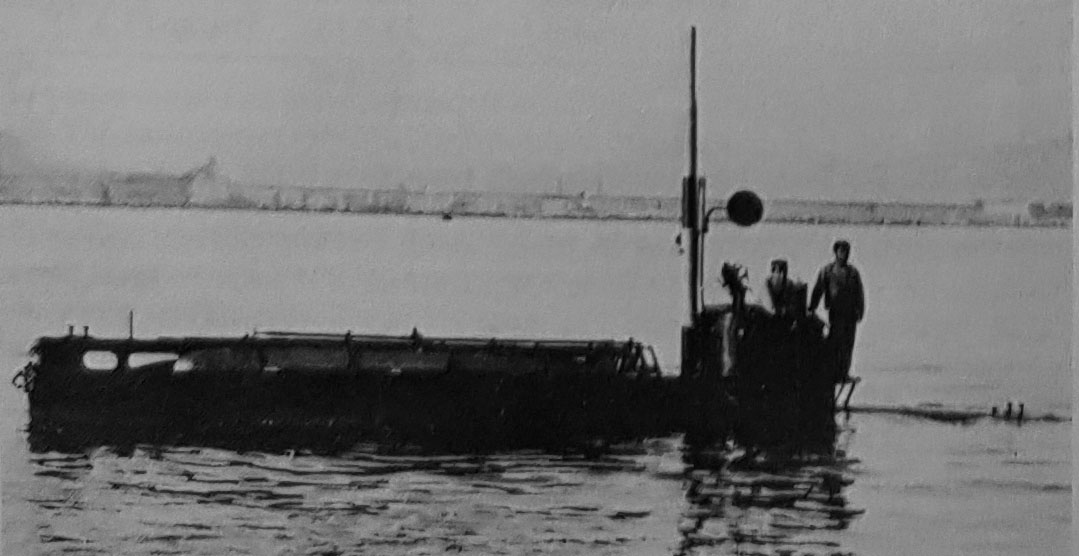
A5 on 1916. see also
In World War I however the A Class (A1-A6) designed by Edgardo Ferrati based on the earlier Alfa was modular enough to be knocked off and transported on standard railway flatcars. The five operational units were used for harbor defense from late 1915 and early 1916, but considered largely ineffective and withdrawn in 1918. The improved B-Class (B1-B3) built in 1916 were an evolution for harbour attack (with Polan in mind). One, B3 was experimentally fitted with caterpillar tracks so to crawl along the seabed or climb over/tear down the submarine nets blocking access to Pola. It was never tested in combat. All B-class boats were stricken by 1919. As for their legacy the Regia Marina perfected instead a human-portable and human-guided torpedo (Siluro a Lunga Corsa or SLC “Maiale”) as an alternative solution for harbour attacks.
Caproni’s CA Prototype
The idea came back in 1936 for specific needs of a possible war, notably again to attack ports, constricted straits and channels. The list of potential targets included Toulon in France for example, provided the submersibles could be brought in harbour under disguise (for example from the underbelly of a modified cargo mothership). Or like in WW1 for harbour defence again. It was hoped that progress in electric powerplants and batteries would solve most issues the A-B class had in WWI. What is certain is that they were designed in great secrecy. There was no tender, Caproni was contacted directly to be in charge of the design, instead of a shipyard, notably to keep secrecy and because the submarine was to use unusual solutions.
Indeed in 1908 the aeronautical engineer Giovanni Battista “Gianni” Caproni created what became became one of the most important aviation syndicates in Europe, and one talented and innovative engineer. The HQ was located at Taliedo, near Milan, in industrial northern Italy. The company became the premium manufacturer of bombers for the Regia Aeronautica in WWI, with mass production, making a great contribution for the entente effort. With the interwar austerity, Caproni focused on a burgeoning civilian market but get sidetracked with the mediatic and overly ambitious Transatlantic “Noviplano” and other projects that went nowhere. In 1930s, Caproni expanded into a massive corporate industrial conglomerate, absorbing Reggiane, Isotta Fraschini for the engines, creating branches like Caproni Bergamasca and Caproni Vizzola and still supplying the R.Aeronautic with new models, trainers like the mass-built Ca.100, Ca.133 transport, Ca.311/313/314 series light bombers and eventually the revolutionary Campini N.1 experimental “thermojet” (motorjet) powered prototype.

With its industrial resources and engineering pool, Caproni was entrusted to design indeed in 1937 a very small submarine for special operations, using techniques for all-metal aircraft to make it lighter for transport, but still able to submerge. At Taliedo, Captoni’s team worked with naval engineer Vincenzo Goeta to create this small torpedo submarine usable to ambush restricted passages or for coastal defense. Two prototypes were assembled in 1938. They were designed to be modular, disassembled to be transferred by rail. They were sent to Venice for sea trials and to continue to keep them secret, none had been launched, commissioned or were even registered in the Regia Marina’s list. Tests on the prototypes eventually designated “CA” (from “Caproni type A”) were negative however. Seaworthiness was poor, notably between their light construction small size, they pitched and rolled like toys, an the use of their two torpedo tubes, launching 457 mm or 18-inches models, proved unsuitable. However Caprini had the sense to place them in external cradles, not in internal tubes. First off there would be little room for spares and thus reloading was impossible, and a launch in thi conditions would have trigger an immediate imbalance making them rose to the surface without any trimming tank wizardy solving the issue. The two boats were eventually taken to La Spezia, and left there in disarmed and mothballed, waiting for an assignement that never came.
A second design for X Mas
 The project remained dormant until 1941 and the “Black Prince” (Junio Valerio Borghese) at the head of the X-Mas flotilla decided he could make use of the design again. Quick bio here: The aristocrat and devoted fascist became the most famous commander of the Decima Flottiglia MAS (X MAS) for “Decima Flottiglia Motoscafi Armati Siluranti”. This elite smal boat unit pioneered special operations for the Regia Marina and arguablmy became its most famous, efficient and decorated unit. Its legacy was hugely influential, setting the historical template for modern naval commando and frogman units worldwide. The unit, after surfaced attack projects with MAS-Boats transitioned t covert operations. It specialized in stealth underwater and surface raids on bases in the Mediterranean and Borghese initially commanded himself the submarine Scirè modified with deck cylinders to carry two SLC (Siluro a Lunga Corsa) or “Maiale” allowing frogmen riding them to plant mines on the hull of British ships in harbour.
In Alexandria on December 1941 they sank HMS Valiant and HMS Queen Elizabeth in shallow waters (they needed months of repairs) with limpet mines. But X Mas also deployed explosive-laden assault motorboats (MTMs) and SLCs for more successful raids on Gibraltar and Alexandria. By May 1943, Borthese was in full control of his unit and given a free hand on any project. He then worked on how to use the CA submarines. Borghese choose to join the new “Social Republic” (RSI) under German occupation post September 1943 and took part in brutal Anti-Partisan Warfare operations and Northern Italy’s defense against Yugoslavia. Many of his former divers defected to join the allies during the co-belligerence era (Mariassalto), training british divers for German-controlled harbour attacks, notably using “chariots”. Borghese himself was tracked down and eventually surrendered to the Allies in April 1945. Sentenced to 12 years prison in 1945 he was released in 1949 despite recoignized war crimes, returned by US Intel to pass on information on Yugoslavia, now under Soviet influence. The man even tried a coup on 7 December 1970 and fled to Spain, dying in 1974.
Design of the class
The CA1/2

The original CA-class were double-hulled, 10 meters in length overall (32 ft), for a beam of 1.9 meters (6.3 ft) and draft of 1.6 meters (5.2 ft). They displaced 13.5 tons surfaced, 16.4 tons submerged. Maximum tested depth was 55 meters (180 ft), and the crew consisted of just two very busy men. Propulsion called for a 60 hp diesel engine when surfaced and an electric motor rated at 25 hp took over when submerged. Baytteries were used as ballast and powered the motor. Top speed while surfaced was 6.5 knots (12 kph), 5 knots submerged (9.3 kph), which was already far better than the A-B class or Alfa-Beta prototypes back in WWI. Operational range was 700 nautical miles at 4 knots surfaced, approximately 57 nautical miles at 3 knots submerged, which was more than enough to proceed into any harbour, and get out. Armament was not internal to the pressure hull due to size constraints, external. Thesre were two 450 mm cradle-type torpedo launchers. Cradles, like those of Drzewiecky had not been used on submarines since WW1. This meant they electrically trigerred from inside the command post via a cable, with or without settings (unknown). Being a secret project very little survived of their design.
The CA3/4 and retofits of CA1/2
In 1941, specialists from the Xª Flottiglia MAS requested that the two submersible be refitted to transport underwater “Gamma” men for covert raids directly inside enemy harbors. The midget subs were both returned to Caproni, and had their diesel engines, torpedo tubes, and periscopes removed. In place, accommodations were installed for two fully equipped “Gamma” operatives. There was still a single crew member piloting the submarine. He could exit through a watertight opening underside. As armament, eight large 100-kilogram limpet mines were to be carried, to be unstrapped and attached to the hulls of enemy ships while in harbour.
Hull and general design (CA-3)
The second part of this post focused on the second design, quite different. They still shared their class name with the first two due to their similar origin, at Caproni. In 1942 indeed, after the United States entered the war, Junio Valerio Borghese devised a plan to attack New York Harbor using a CA type midget submarine with commando frogmen. Modus Operandi was the same as for SLCs, the subs would this time not attack with torpedoes but instead carry a number of limpet mines to be placed by divers. Instead of the single mine of an SLC, such midget sub could carry many more, extending the action area. These modified midget submarines would be then transported across the Atlantic on the deck of a long-range submarine, or better, inside the hold of a giant 4-engine CANT Z.511 Idrogigante (see below).
Before conversion the CA1 displaced 13.3/16.1 tonnes for 10/1.96/1.60m as specified. After conversion with the torpedo vradles removed and instead fittings for external limpet mines were installed, the ronnage was actualy reduced down to 11.8 tonnes surfaced and 13.8 tonnes submerged. Dimensions were unchanged, still 10 m (32 ft 10 in) long overall for a beam of 1.96 m (6 ft 5 in) and a draught of 1.6 m (5 ft 3 in).
After conversion the engines did not changed either, albeit the performances rose a little bit. As for the general layout, apart the attachements for the limpet mines and external changes due to the side doors for the divers and bottom escape hatch for the poor pilot they did not changed much.
Powerplant
Propulsion initially limited to a 25 hp r 21 kW Marelli electric motor, giving them a top speed of 5 knots and range of 57 miles at 3 knots while underwater. If the approazch from the mothship was by night, they were supposed to make a longer approach, and be towed by a submarine to the objective close enough to close the gap by night using a noisier MAN diesel rated for 60 hp and providing a top speed of 6.3 knots. Range was now 700 nautical miles at 4 knots, or 1,300 km, giving far more options. The main issue was the exhaust gaz evacuations. Aside the rowing solution, later another was tested, by a larger submarine acting as a “carrier” when approaching enemy ports. The construction of two additional units incorporating further modifications was commissioned from Caproni.
In their final version in 1942 the modified CA1 and CA2 now the diesel remove and only their Marelli electric motor remaining for a shorter but silent approach with the spage freed to install additional battries. So power remained at 25 hp but now for 6 knots underwater, 7 knots surfaced, and 70 nautical miles at 2 knots instead (130 km). They left c20 nautical miles to get in and out and the remainder usable to move the divers across the harbour. The modified CA 3 and 4 newly built by Caproni were powered only by a single 25 hp Marelli engine and performances were the same. In both the diesel was discarded as reundant as long as they could be carried close enough by their mothership.
Armament
Original: 457mm torpedoes
Made either by Silurificio Whitehead in Fiume and Silurificio Siluri in Naples, to be carried on external drop-collars on recesses on top of the CA class submersible, alongside the bulbous “conning tower”.
The system freed a lot of weight from the top of the submarine, which needed to be compensated by trim tanks and ballasts not to rise above water.
The type is unclear, but back in 1938, or from 1942 they might have been the submarine-adapted 45 cm (17.7″) W 200/450 x 5.75. They were also used on the Cagni Class Submarines.
Overall Length: 18 ft. 10.5 in. (5.750 m), 441 lbs. (200 kg) warhead.
Settings 3,300 yards (3,000 m)/44 knots or 8,750 yards (8,000 m)/30 knots, Wet-heater.
Setup was done via electric cables connected to the torpedo from inside the submarine, likely by the second crew member aside the pilot.
Of course all this petered out, likely due to trim imbalance, and the torpedoes were neverl installed again. The cradles were later modified for mines, see below.
100 and 20 kgs Limpet Mines (1942)
The CA-1/2 as midified in 1941 could carry externally eight 100 kgs limpet charges. CA 3/4 purpose built later were further modified to carry these and in addition no less than twenty 20kg limpet mines. 20 kgs of TNT was not somthing to scoff about and could still make a nasty hole in any cargo ship or tanket, less well protected than warships against underwater threats. The 100 kgs charges were for battleships, carriers, cruisers, liners or everything in between. Given the result of the ones detonating under the British battleships in December 1941, the effect was devastating.
The limpet mines were maintained inactive, with the TNT safely stored inside the cylinder and a simple primer that was manually activated by the diver when on position, using its magnetic attachements, activated when put in place against the hull. The timer using a simple graduated knob was then setup to the required delay. The same techniques used by the SLC were to be used in that case, with the difference the divers were no longer riding a “human torpedo” but arrived inside a roomier, dried compartment that was filled just before action. The divers exited the lower hatches into action, fetching their attached mines to those carried inside (the 20 kgs mines) in the case of CA 3 and 4.
⚙ specifications |
|
| Displacement | 13.5 tonnes (13.3 long tons) surfaced, 16.4 tonnes (16.1 long tons) submerged |
| Dimensions | 10 x 1.96 x 1.6m (32 ft 10 in x 6 ft 5 in x 5 ft 3 in) |
| Propulsion | See notes. MAN diese, marelli EM 60/25 hp |
| Speed | 6.3 kts surfaced, 5 kts submerged |
| Range | 700 nm at 4 kts, 57 nm at 3 kts |
| Armament | Orig: 2x 458mm Torpedoes (drop collars). Later: 8x 100kgs lumpet mines |
| Max Diving | 55 m (160 ft) |
| Crew | 2-3, see notes |
Career of the CM class
The Italian submarine Leonardo da Vinci was chosen for the task, modified at the Italian base in Bordeaux, BETASOM. CA 2 was transported by rail from Italy and its trials, conducted near La Pallice. Were supervised by Borghese himself by late 1942. Leonardo Da Vinci was sunk in May 1943 however, before the operation could be carried out. No new submarine was available. Leonardo Da Vinci was probably the best Italian submarine of WW2. By tonnage sunk, it ranked first and made its mark in the Atlantic, sinking 17 Allied ships totaling 120,243 Gross Register Tonnage (GRT).
Se was modbilized for the clandestine attack on the New York Harbor. The project was first started in July 1942 by Junio Valerio Borghese from BETASOM. She to to carry one CA submarine to the mouth of the Hudson River. Inside was a team of divers armed with 28 explosive charges. Once in position, CA-3 or 4 would enter by night into the harbor. The divers had the largest charges, 100 kgs limpet mines fited to the full at the same place the torpedo cradles were on the CA-1. They could also carry smaller 20-30 kgs charges to target less important ships in the harbor.
Early tests were carried out in August 1942. They were promising. Leonardo da Vinci was fitted indeed to carry and launch a single CA-class submarine and recover it for the return trip. In reality, however, recovery remained very hazardous and mprobable, as navigating by night would have been highly problematic. With scrambled patrols, sawn coming and its low speed, plus the very remote possibility to fin back Leonardo Da Vinci, the mission was rather a one-way ticket in which the CA would be scuttled and the divers try to signal their location to be recuperated the nexy nght or just vanish into New York, perhaps to find sympathetic Italian resident contacts to be hidden until extraded.
Anway, the mission was postponed for various issues of training and preparations, and meanwhile, Leonardo da Vinci was too precious to be kept inactive. She was used for an extra patrols, from which she never ame back. Da Vinci Sank with all hands on May 23, 1943, west of Portugal by British warships HMS Active and HMS Ness. No submarine large and stable enough existed at the time to schedule the mission and ultimately the operation was canceled when the armistice was signed four months later.
The other option was never activated: It was an airborne transatlantic Operation: By January 11, 1943, the 4-engine floatplane Z.511 “Idrogigante” was still without goal. Captain Armando Ulivi and Engineer Vuolo, Armando Palanca arrived at Monfalcone to to test the Z.511. In February her flowed back to Vigna di Valle on Lake Bracciano for extra fuel consumption tests with the new engines (thay wanted to achieve 6,000 km at 330 km/h). On February 7, 1943, General Eraldo Ilari prersided the raid to New York for BETASOM in which it would stop in mid-Atlantic to collect fuel from a submarine for the return flight and instead of SLCs, carry a large shipment of leaflets over New York. But this raid was replaced by one for the SM.95. The CA-3 would have been way too large to be carried by any seaplane anyway. With the Italian Armistice and still no large carrier submarine “mothership”, in sight, this stopped further planning. X Mas was virtually disbanded and Borghese fled to the newly created RSI.
CA-1
CA 1 was built by Caproni, Taliedo, launched on 15 April 1938. She was scuttled on 9 September 1943
CA-2
CA 2 was launched by late April 1938. Scuttled in 1944
CA-3
CA 3 was the first of II.type, launched on January 1943, scuttled on 9 September 1943.
CA-4
CA 4 was launched on January 1943. Scuttled on 9 September 1943
Read More/Src
Books
Alessandro Turrini, Ottorino O. Miozzi e Manuel M. Minuto, Sommergibili e mezzi d’assalto italiani (due volumi), Roma, Ufficio Storico Marina Militare, 2010.
Paolo M. Pollina, I sommergibili italiani, Roma, Ufficio Storico Marina Militare, 1963.
Virgilio Spigai, Cento uomini contro due flotte, Marina di Carrara, Associazione Amici di Teseo Tesei, 2007.
Erminio Bagnasco e Maurizio Brescia, I sommergibili italiani 1940-1943 – Parte 1ª, in Storia Militare Dossier n. 11 2013.
Links
hisutton.com/ Decima MAS attack on New York
navypedia.org/ ca1
navypedia.org/ ca3
List_of_submarines_of_Italy
it.wikipedia.org/ Classe_CA
navweaps.com/ torpedoes of italy ww2
Caproni_CB22
Flottiglia_MAS
navypedia.org/ italian subs
https://www.secretprojects.co.uk/threads/ca-class-midget-submarines-royal-italian-navy.32923/