
 MDAA ex-US Independence class Carriers: FS La Fayette (R96), Bois Belleau (R95) (1951/53-1960/63)
The “Lafayette class” were two ex-US Independence class aircraft carriers loaned to France to fight the Indochina War. Lafayette was acquired in 1951 and later modernized, returned in 1963 as the ex-USS langley. FS Bois Belleau was the ex USS Belleau Woods (litteral translation), a famous battle in France in 1918 that “made” the US Marines. She was loaned in 1953 and returned in 1960. In the interval both proved critical in bringing on demand air support in operations along what is today the southern and northern Vietnamese coast. They were survived by Dédalo, the ex USS Cabot of the same Independence class, in service until 1989 with the Armada. Other Independence class carriers also were found in service in Vietnam.

La Fayette R96 in the Along Bay, Indochina 1953
Development
The Vietnam war, the longest in cold war US history, one of the conflicts stemming from the containment of communism in Asia, had a prelude call the Indochina war which took place before and during another Asian hot point, the Korean Peninsula war. This “competition” explains notably why there were so few French troops deployed there (albeit the Ralph Monclar Batallion acquired almost legendary status by its Spartan actions at Twin Tunnels, Chipyong-ni, Wonju, and Heartbreak Ridge, earning tons of decorations and heavy losses). The French naval actions and strategy in Indochina could be summup in the French Cold War naval Page and especially the USN Vietnamese Operations page as an introduction. Suffice to say that in 1945 French forces came back to reclaim Indochina (Vietnam, but also including Cambodia and Laos) from the Japanese, with a transfer of control from British troops to French troops.
Long story short, negociations to have some form of autonomy petered out and a serie of incident led to the bombardment of Haiphong and a full-blown war led by Ho Chi Minh. The Indochina war was a difficult one for the French just out of WW2, occupation, and devastation, having neither the will or means to defend its colonial Empire (at least in the general public). French troops were sent for “pacification” operations, trying to learn guerilla warfare along the way, until the fateful decision of digging in deep into enemy territory in 1954 for a decisive battle of attrition at battle of Dien Bien Phu. Undestimation of Giap’s forces led to a defeat and negociations, with the end of a French presence in what became North and South Vietnam, Laos and Cambodia.

The FS Dixmude, ex-HMS Biter, back to Bayonne, USA on 5 May 1956 for decommission.
Before all this happened, French naval presence in Indochina was massive. Nearly all its suviving assets of WW2 made tours there, from the smallers landing ships and minesweepers to the battleship Richelieu and cruisers, as well as, aircraft carriers. The old Béarn being now a submarine depot ship, the role of naval air support fell onto a motley collection of aircraft carriers. The largest and most important was undoubtely FS Arromanches (R95), the ex-Colossus, the lead ship of the 1942 light carrier program. She was leased in 1946 and purchased in 1951n named after the Normandy Landing site that freed France. Arromanches made several tours in the Gulf of Tonkin, flying F6F Hellcats and SB2C Helldivers for close air support for French Union forces, including during the pivotal Battle of Dien Bien Phu.
The other ex-British carrier was much smaller and less capable. It was the ex HMS Biter, renamed FS Dixmude. Originally launched in 1940, HMS Biter served with distinction in the Atlantic and Mediterranean theatres. After World War II, she was lent to the French Navy in 1945, eventually being permanently transferred in 1951. Her small deck still authorized the use of a wide range of piston-engine aircraft. However this was not enough.
The level of close air support demanded required just more carriers. But France, which did not lacked carrier design projects, had not the finacial means to make these, as shown by the ill-fated PA28 carrier project, and the Clemenceau class carrier were delayed, entering service long after the conclusion of this war. What was not lacking in 1950 however, was the number of surplus carriers of the allies. The US commissioned about a hundred carriers, many of which ended in Royal Navy service (escort carriers of the Bogue class, and derivative Attacker, Ameer, etc.). The US still needed its most capable carriers of the Essex and Independence class for Korea, but mothballed most of its escort carriers, the Casablancas and Commencement Bay classes. So in 1950 when the French seeked assistance from the US they already looked at these potentially available carriers under loan, a more affordable solution. The main issue was to find crews.
President Harry S. Truman shifted U.S. policy from post-WWII anti-colonial neutrality to funding the French war effort in Indochina to contain the spread of communism following the communist victory in China (1949) and start of the Korean War (1950), formally recognizing the French-backed State of Vietnam and approving tens of millions of dollars in military and economic aid, establishing the Military Assistance Advisory Group (MAAG) to supply the French with weapons and strategy, the ancestor of the MDAP system. Its under Truman that the principle of leasing one surplus carrier to the Frence was approved and financed. The one chosen was the ex-Independence class USS Langley (CVL-27), decommissioned since 1947. She was to be refusbish before transfer in 1951. For three years, until the arrival of Bois Belleau, La Fayette, with Arromanches and Dixmude, provided the bulk of French naval air support in the war.
Later in September 1953 President Dwight D. Eisenhower still wanted to avoid direct U.S. military intervention in the First Indochina War but agreed to more heavily fund the French, laying the groundwork for future American involvement in Vietnam. It Continued funding up to 80% of the French war effort, supplying aircraft and technical advisers, and proving instrumental to authorize the loan of a second carrier, the ex USS Belleau Woods, provided the French had the crews.

USS Bellau Woods in the Pacific, 1945
So that “class” of two loaned carriers only existed for the duration of the Indochina war and after 1954, they remained active back home in Toulon for training as interim ships before the arrival of the Clemenceau class, of the size of an Essex class carrier. The “new” USS Langley (launched in May 1943, commissioned on 31 August) was named after CV-1, the first USN aircraft carrier back in 1922. She was sunk in 1942 in the Pacific. CVL-27 was part of the fast fleet carrier task force (TF 38/58) instrumental in the island hoping campaign of 1942-45, she took part in the Marshall Islands campaign, the Carolines, Mariana, and battle of the Philippine Sea, the South China Sea Raids, battle of Iwo Jima and Okinawa, earning nine battle stars. She was in reserve in 1945-47, then mothballed. USS Bois Belleau (CVL-24) was launched earlier on 6 December 1942 and commissioned 31 March 1943, having a longer career: She soldiered in Gilbert and Marshall Islands campaign, New Guinea campaign, Mariana and Palau Islands campaign, Philippines campaign (And October 1944 battle), Volcano and Ryukyu Islands campaign (Iwo Jima-Okinawa), and last summer offensive on Japan. Like her sister she made two further Magic Carpet trips and was decommissioned in 1947 but not mothballed in order to be put out of reserve faster. USS Bois Belleau earned on her part a Presidential Unit Citation and 12 battle stars. Both made good of taxpayer’s money, especially given their additional later career.
Design of the class

Commissioning ceremony on La Fayette at Philadelphia, 2 June 1951.
The La Fayette and Bois Belleau as renamed in 1951 and 1953 were Independence class carriers. They were classed as CVL meaning fast light carriers. Only ships of their type before the Saipan class, started too late in the war to see action, they were based on cruiser hulls to gain time. The idea was from President Roosevelt and some advisers. It was resisted by the top Brass in January 1942 as “too small to be useful”. After the Pearl Harbor atttack on 7 December 1941 the USN indeed was found criticially short of aircraft carriers. Sure, since 1939 treaties went out of the windows, but the US remained neutral and the Congress was not keen at funding new fleet carriers. Despite of this, a replacement for the Yorktown class was planned in 1940 (which became the Essex class) but noby thought they could be ready in time. In early 1942 the Cleveland class cruiser were in construction.
A massive class of 50+ ships tasked of escorting these future carriers as the hearth of a new battle fleet that became TF 38/58. To get these missing carriers as fast as possible, before the Essex class were commissioned in 1943, the Navy desperately needed stopgap ships so the president authorized the conversion of ten of these cruisers then in construction as light carriers. They will be moderately small given the base was narrow and light, but long (180 meters) compared to escort carriers, and fast at 33+ knots. This meant that unlike cargo conversions that led to escort carriers, these new Independence class CVLs would be able to keep up with the battle fleet: The three Yorktown and two Lexingtons, as well as USS Wasp were all 30+ knots. The Navy tried to find roles for these given their limited air group. They would be used notably to provide replacement aircraft to fleet carriers or assumed the local CAP (fleet air defence), freeing Fleet carrier own fighter groups to undertake escort mission of dive bombers and torpedo bombers. The conversion took a bit longer than expected whereas the Essex were completed faster than expected so they were commissioned more or less at the same time and eventually found their own “sweet spot” alongside the fleet carriers.

Lafayette in September 1951
For the French, the loan of these carriers of moderate size was more realistic for their means than two ex-Essex class, if available, but understandably the USN was not keen as leasing these precious big ships. They were now the core of the USN and alongside the spanking new Midway class, would stay around for decades, through Korea and Vietnam. The main issue for the French was find crews, with postwar demobilization. However the air groups would be provided by the US and commissions went there to inspect parks and mothballs and “do some shopping”. Long story short, these Independence class were still perfect for the close air support groups they would operate in 1950-54, no jet was planned yet for Indochina operations and they were not required.
Hull and general design
The Lafayette and Bois Belleau were “stock” Independence class, just refurbished. They had been modernized though, but mostly this concerned postwar AA changes and new electronics. Both carriers displaced Full load some 14,751 long tons (14,988 t) for an overall length of 622 feet 6 inches (189.74 m), a beam of 71 ft 6 in (21.79 m) at the waterline and a draft of 24 ft 3 in (7.39 m). The flight deck was 552 ft (168 m) long for a beam of 109 ft 2 in (33.27 m). It was straight, not modified with an angle given the limitations of the design. Again, they were based on narrow light cruise hulls. They had a small island on the port side, with a derrick mast loaded with electronics. AA was placed in various sponsons along the deck, without heavy gun unlike the fleet carriers and their twin 5-in/38 turrets. They also had two axial lifts 12.7 t, 12.8 x 13.4 m, one forward of the two 1 H 2-1 steam catapults, one aft.

In addition to the island they also had four small funnels to exhaust the boilers also on the port side. The hangar measured 78.6 m long for 16.7 m wide and 5.3 m in height. In total the flight deck had an area of 3,773 m², and the hangar of 1,313 m² and internal volume of 6,957 m³. They could simultaneously retreive and launch aircraft, but sitll lacked deck space, while having eight arresting cables and one arresting net. Overall, these ships had little room for growth that limited upgrades, expection made of Dédalo which was thoroughly modernized to the point of operating Matadors (AV8 Harriers) jets. After 1946 however both lost one catapult. Both ships sported a full crew of c1570, including the ship’s crew, and air group staff, pilots and mechanics, which was rather large for their size.
Powerplant
Being Cleveland class cruisers, they were designed to reach 33 knots on trials. They had four Babcock & Wilcox boilers (which needed overhaul before or after transfer) feeding the same number of General Electric geared steam turbines and four shaft propellers, fixed pitch, for a total output of 100,000 shp (75,000 kW). This was good for a top speed speed in service of 31.6 knots (58.5 km/h; 36.4 mph) and likely less than 30 after 1945 additions. They also carried 2,633 tonnes of fuel oil for an endurance of 13,000 nm at 15 knots, or 24,000 km.
Protection
Again, their origin as cruiser, even light, meant they had the best level of protection for the hull available at the time, notably using STS armour. From CVL-24 onwards, the armour scheme included the following:
Armuour Belt: 127mm (5 inches) on 16 mm (0.6 inches) plating
Bulkheads: 127 mm (5 inches) to enclose the machinery space and ammunition storage.
Main deck: 51 mm of STS steel (2 inches), including the lifts.
There were also fire protection integrated in the gasoline piping systems, backup power for emergency pumps, manual pumps and fire extinguishers, hangar fire curtains and a main fire post with hoses.
Being WW2 ships they lacked any NBC protection however, and the French never integrated it. They had no air conditioning either but a natural draft thoughout the ship for Pacific operations.
Armament
USS Belleau woods in 1946 had ten twin 40mm/60 Mk 1, and four single 20mm/70 Mk 10.
USS Langley in 1946 nine twin 40mm/60 Mk 1 (no quad), and five twin 20mm/70 Mk 24 AA guns.
R96 La Fayette in 1951 had still her nine twin 40mm/60 Mk 1 Bofors but also five twin 20mm/70 Mk 24 Oerlikon and a single H-4B catapult.
R97 Bois Bellau had now back her two quad 40mm/60 Mk 2 Bofors, ten twin 40mm/60 Mk 1 Bofors and four single 20mm/70 Mk 10 plus one 1 H-4B catapult.
In 1960 Lafayette lost all five twin 20mm/70 AA guns.
Sensors
Originally, the Independence class (late type) from CVL-24 onwards, were completed with SK, SC-2, and SG radars.
In 1951-53, they had been modernized with the SPS-6, SPS-8, SPS-10, SPS-17 radars and WLR-1 ECM suite.
R96 Lafayette came out with the SK-2, SG, SP radars and R97 Bois Bellau had an SK-2, SG, and the SPS-4 radar.
But they were modernized further: In 1955, back to France, La Fayette was fitted with the latest USN SPS-6 radar and the same year, Bois Belleau instead received the new French DRBV-22A radar.
In 1959 Lafayette received the DRBI-10 radar. This was her last electronic upgrade.
Air Group

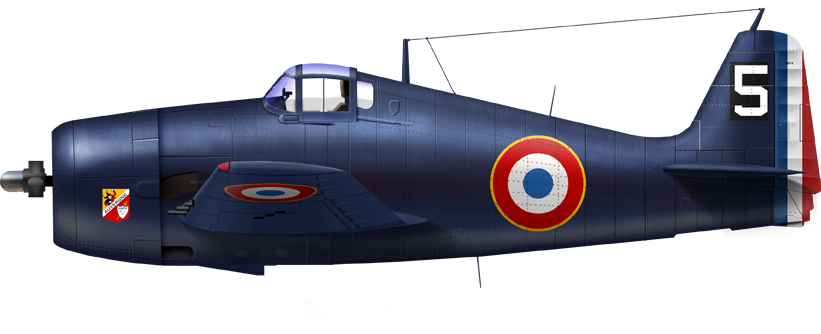
French Grumman F6F-5 Hellcat, here from GC-II/9 “Auvergne” at Tan Son Nhut, French Indochina, 1952.
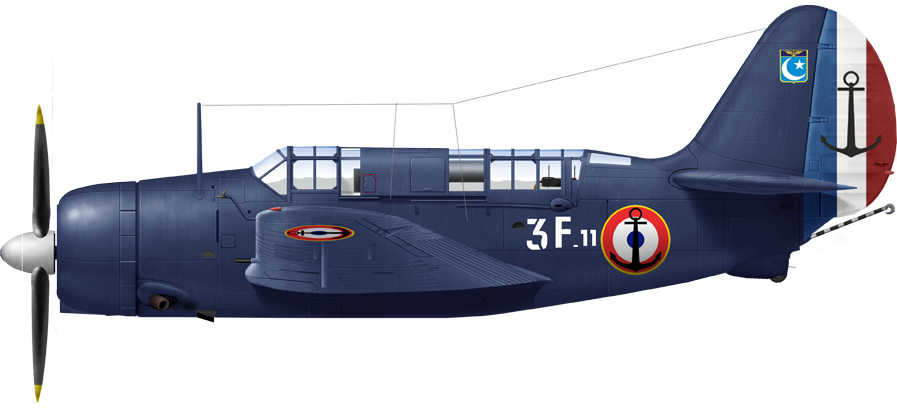
Curtiss SB2C-5 from Flotille 3F, Battle of Dien Bien Phu 1954.

Grumman TBM 2S3 Flotille 6F in 1950. The French operated the TMB3W also, the first French carrier-based Airborne Early Warning (AEW) aircraft before the adoption of the Tracker and then Hawkeye.

F4U-7 of Flotille 14F, 1956
Technically, the ships could operate 30 aircraft, between those on deck parks and the hangar. It varied, but comprised legacy F6F Hellcats and TBF Avenger, SB2C helldivers at first, as well as the F4U-7 Corsair later. However as the war progressed, the Navy made a transition to new models. Lafayette was described as operating in 1953 twenty F6F-5 Hellcat modified as fighter bombers and ten SB2C-5 Helldiver for precision bombing. In 1956 she returned to France with a park of twenty F4U-7 Corsair which likely replaced the Hellcats in 1954, and ten TBF Avengers used for ASW work, the latter being a readaptation in her Mediterranean ASW role as part of NATO. None ever sported any Jet. The United States supplied France nearly 200 Bearcats (including F8F-1 and F8F-1B variants) but they were only operated from land bases as the pilots found them too fast-landing for their carriers. Later in her career, Lafayette also operated helicopters, the Sikorsky S-58 for ASW and the Piasecki HUP as plane guard and liaison.

Sikorsky S-58 helicopter, La Fayette 1962. 166 units were built or assembled locally for the French Air Force and Navy.

Piasecki HUP “Pedro” on the French aircraft carrier La Fayette (R96) in 1962. It was used as plane guard.

Grumman TBW-3W Avenger and Vought F4U-7 Corsair on the French aircraft carrier La Fayette (R96) in 1962.

U.S. Navy Lieutenant W.F. Tobin, Landing Signal Officer (LSO), waves aircraft on board LaFayette (R96) in Indochina, 1953.
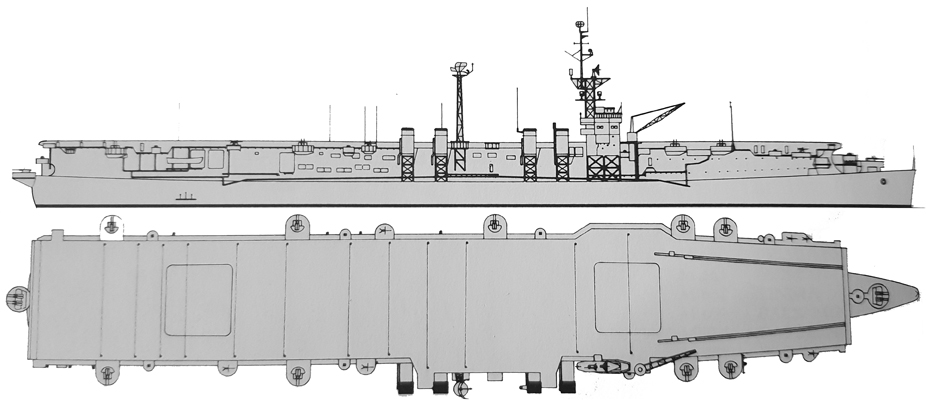
La Fayette in 1959 (conways)

⚙ specifications |
|
| Displacement | 10,622t standard, 14,751 full load |
| Dimensions | 182.9m wl/189.7m oa x 21.8m wl/33.3m oa x 7.39m full load |
| Propulsion | 4 sets GE geared steam turbines, 4 Babcock & Wilcox boilers: 100,000 hp |
| Speed | 31 knots (57 km/h) |
| Range | Fuel oil 2,633t: 13,000 nm/15 kts |
| Armament | 2×4 40mm/60 Bofors Mk1, 9-10×2 40mm/60 Bofors Mk1, 20mm/70 Oerlikon, see notes |
| Protection | belt 127+ 16mm STS, bulkheads 127mm, main deck 51mm |
| Sensors | SK-2, SG, SP, SPS-4 radars, see notes |
| Air Group | 30 aircraft, see notes. |
| Crew | 1569 |
Career of the Lafayette class carriers
All but the French ships were decommissioned in 1954–56, reclassified as aircraft transports in USN service by 1959. USS Cabot was completely modernized and became in 1967 the Spanish Dédalo.
 La Fayette R96 (1951)
 USS Langley (CVL-27) was loaned to France from January 8, 1951, to March 20, 1963, as La Fayette (R96) a symbolic name as the French general that joined and assisted Georges Washington in his campaign for Independence, and helped with Franklin securing help from the French. It was charged emotionally of this bond linked to the creation of the United States and a good fit for the class name (Independence). Lafayette was also both in 1914 and 1940 a famous US volunteer squadron and since 1990 a class of Frigates. The name was sported in the USN as well for a class of SSBNs ordered the same year as the carrier was returned home.
The Aircraft Carrier La Fayette was officially transferred to French service on June 2, 1951, and based in Toulon. She carried out numerous missions in the Far East and for these, awarded the Croix de Guerre des T.O.E. (Cross of War for Overseas Theaters of Operations) and like her sister Bois Belleau later, her aircraft performed hundreds of sorties over Indochina. Her air group is unknown in 1951 albeit French sources states Lafayette had a wartime air group of 24 Gruman F6F5 Hellcat and eight Gruman TBM Avenger. Both were tailored to use HVAR rockets.
In 1953, she operated F6F-5 Hellcats (codename NUMA) from Flotilla 12F and SB2C-5 Helldivers (SPARTACUS) from Flotilla 9F. She returned to France in June 1953 with 12F and 9F on board and retired her Hellcats, then proceeded to Karouba to receive brand new F4U-7 Corsairs. After undergoing modernization in 1953–1954, La Fayette resumed service in the Mediterranean, and the the coast of Africa. She thus missed the most critical operations in Indochina and the battle of Dien Bien Phu, where Bois belleau replaced here. She also missed the last engagements of the war.

Lafayette in Toulon 1961
Still, in early 1956 with the war already over, she briefly returned to Indochina (renamed South Vietnam) to support the new regime, and carrying Flotilla 15F of F4U-7 Corsairs. She did not took part in the Suez intervention, with mobilized only Arromanches (and neither her sister). She underwent a last major refit in 1958–1959 in Toulon. In March 1960, La Fayette took part in relief operations for the Moroccan city of Agadir, devastated by a massive earthquake. She also took part in the repatriation of the first refugees from Algeria but did not took part in air support operations over Algeria. She was was eventually returned to the United States in 1963. La Fayette under her new tricolor, covered nearly 350,000 nautical miles, her aircraft completed 19,805 deck landings.
Bois Belleau R95 (1953)

USS Bois Belleau underwent modifications in 1946-1947 until decommissioned on 13 January 1947, placed at the Alameda Naval Air Station, remaining laid up until 5 September 1953. Under a decision of President Eseinhower she was transferred to the French Navy under the aid called the Mutual Defense Assistance Act (MDAA, future MDAP). When recommissioned on 23 December 1953 in the US she was renamed Bois Belleau, paying hommage to the USMC battle of Belleau Wood on 1–26 June 1918 to stem the spring offensive on the Marne. The United States Marines Corps lore dating back to the battle, with the invented nickname of Teufel Hunden (“Devil Dogs”)… The French fully involved in the First Indochina War, appreciated the service of La Fayette for two years now and was still in need of additional aircraft carriers to support her and Arromanches. The loan of Belleau Wood was ordered by President Dwight D. Eisenhower provided the French provided a crew, which proved diffocult and delayed her delivery to France until December 1953. Upon arrival in Toulon her boilers were thoroughly inspected. Instead of the ones of Lafayette, overhauled before transfer, they were found to be in poor condition upon reactivation. The four Backbock boilers needed a full cleanup of all their elements which further delayed the return to full service. Meanwhile, pilots trained and qualified.
Bois Belleau was ready at last and departted Toulon, crossed Suez, and arrived in southeast Asian waters on 30 April 1954. Back the, these were already the final stages of the Indochina War. Her air group was mobilized eventually to support the besiegd Frence in the fateful Battle of Dien Bien Phu, especially when it reached critical stage. At that stage on May 3, the first day of air operations, she had the Hellcats of Flotille 11F and Helldivers from Flotille 3F. They were supported by Vought F4U-7 Corsair, final production variant had been built exclusively for the French Navy (Aéronavale) between July 1952 and January 1953 and were spanking new, but the pilots were still “rookies”. They tried to destroy Vietminh concealed jungle artillery positions on the hills but AA fire was heavy. Her air group was called to support Operation Condor (April 28 – May 10, 1954) and the French airborne elements (GCMA) harassing Viet Minh supply lines and aid at the tail end of Dien Bien Phu.
Eventually the French garrison surrendered on 7 May. All French carriers remained in the Gulf of Tonkin but their support in the battle had been critcized due to the long flight time to Dien Bien Phu and back. The sortie rate was still quite impressive. Bois Belleau remained in the area until November 1955. After undergoing maintenance in Hong Kong from May to July 1955 she returned to the Gulf of Tonkin to relieve Arromanches this time with her complement of F4U-7 Corsair of Flotilla 14F, used over Northern Annam from July 15-20, Hué and Dong Hoi on July 28-29.
She thus took part in the Red River Delta Consolidation and Evacuations and the defense of Hanoi, Haiphong. They were called also to try to prevent the descruction of Groupe Mobile 100 (GM100) in the Central Highlands (Annam), trapped in a massive and catastrophic ambush along Route 19 in June-July 1954. They were also called for the last skimishes in Tonkin and Annam to preserve bargaining power at the Geneva Conference. The ceasefire took effect on August 1, 1954. Until mid-September, she shuttled between Ha Long Bay, Cam Ranh, Tourane, and Cap Saint-Jacques, evacuating approximately 6,000 refugees. She participated in the final evacuation of Tonkin and returned to Toulon on December 16.

Back home at Toulon, she could have been sent back to the US, but was retained instead and for the rest of the 1950s, Bois Belleau alongside with La Fayette and Arromanches formed the core of the French carrier fleet until the Clemenceau class were completed. Following a refit and modernization, Bois Belleau spent three years participating in squadron operations and in all major national and NATO exercises in the Mediterranean. In June 1957, Bois Belleau joined six French ships participating in an international naval review in Hampton Roads, Virginia. This French squadron was led by the new anti-aircraft cruiser De Grasse, and this was the largest foreign delegation to the review. The squadron under command of Amiral Jozan (flagship De Grasse) included the destroyers Chevalier Paul and Dupetit-Thouars, frigates Le Gascon and Le Lorrain.
This was her last major sortie.
Her final months of service were dedicated to transport missions, notably carrying 296 aircraft for the Air Force from Norfolk to Brest and Saint-Nazaire. On September 12, 1960, in Philadelphia, she was formally returned to the United States, having covered 183,216 nautical miles under the French flag over the course of seven years. She was struck from the Naval Vessel Register on 1 October, and was sold to ship breakers for scrap on 21 November.
Books
Jordan, John & Moulin, Jean (2025). French Aircraft Carriers, 1910-2000. Naval Institute Press.
Moulin, Jean (2020). All the Aircraft Carriers of France: From 1912 to Today. Navires et Histoire. Le Vigen, Lela Presse.
Links
https://www.navypedia.org/ships/france/fr_cv_lafayette.htm
https://www.navypedia.org/ships/usa/us_cv_independence.htm
https://www.navsource.net/archives/02/27.htm
https://avions-de-la-guerre-d-algerie.over-blog.com/article-grumman-tbf-tbm-avenger-52525334.html
https://web.archive.org/web/20190210123144/http://www.netmarine.net/bat/porteavi/lafayett/index.htm
https://web.archive.org/web/20191115174320/http://www.netmarine.net/bat/porteavi/bbelleau/histoire.htm
https://web.archive.org/web/20080513155811/http://www.ninesisters.com/langley.htm
https://web.archive.org/web/20191102124810/http://www.hazegray.org/danfs/carriers/cvl27.htm
https://en.wikipedia.org/wiki/French_aircraft_carrier_La_Fayette
https://en.wikipedia.org/wiki/USS_Belleau_Wood_(CVL-24)
https://commons.wikimedia.org/wiki/Category:La_Fayette_(R96)
Videos
Model Kits
Take a basic Independence !