
 Argentinian MEKO 360H2 Type D-10 to D-15:
Almirante Brown, La Argentina, Heroína, Sarandí, Rivadavia*, Moreno* 1980-84 *Cancelled.
 We start a new cycle, on Argentinian ships of the cold war, before and after the Falklands war. At the eve of the war, the Hércules class were the best guided missile ships in Argentinian service, and ironically both were Sheffield class (Type 42) ordered in 1971. Inactive in the war, lacking spare parts postwar, the Navy laid them up until reactivated in 1988. But well before the war in 1976, the Junta looked at another, less “risky” provider for a new destroyer class. Only Germany offered at the time a well-rounded export ship, the MEKO 360. So the government ordered six MEKO 360H2 in 1979, the biggest order for Blohm & Voss at the time, after their only sell to Nigeria (360H1) in 1977. Construction was delayed as the gas turbines were made in Britain, until late summer 1982, the ships were commissioned in 1983-84. The Almirante Brown remained in service until 2024, after two modernizations.
Development
Before even the 1976 coup, the previous Government of Isabel Perón, had been voting the 1974 Naval Constructions National Plan to replace old World War II-vintage ships. This started a process to enquire about several naval yards and Germany ended as favourite when Blohm & Voss announced its export brand in 1976. At the eve of the Falkland Wars, Argentina under its commander-in-chief and Junta member, Admiral Jorge Anaya, had a mix of US and British vessels as the core of its fleet: The aircraft carrier 21 de Mayo was the centerpiece of Task Group 79.1, completed by the old cruiser General Belgrano as the core of Task Group 79.3. Her sister 9 de Julio had been stricken in 1977. There were two Hércules class or Type 42 destroyer, and just one Fletcher class of the previous Almirante Brown (5 DDs acquired 1961) serviceable, Domecq García (ex-Braine), which was stricken in November 1982. However there were also two Segui class (Sumner FRAM II) acquired in 1972 (+1 spare), Comodoro Py, a Gearing FRAM II acquired in 1973, three French-built corvettes, and for submarines, single Guppy and a Type 209 submarine.
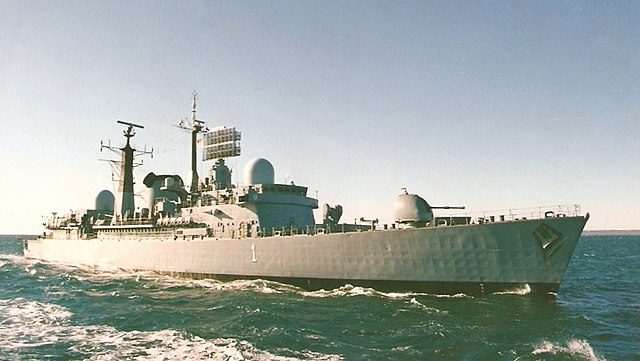
ARA Hercules: Before the MEKO 360H2 (Brown class) they were the most modern, powerful guided missile destroyers in the Argentinian fleet by 1982, otherwise composed of Sumner and Gearing FRAM, vintage WW2 destroyers.
More were on order when it was decided to invade the Islands: Indeed, given its plans for the Islands, still revendicated by Argentina in the late 1970s and perceived by the new authoritarian government as a way to ciment national unity, it was clear the Navy would not be able to depend on Britain for any supplies in case the invasion plans were carried out so Germany was contacted in 1977 already to provide new ships for the upcoming engagement. Blohm & Voss shipyard was very active in international naval tradeshows like Euronaval (since 1968) to market its new MEKO brand and family from 1976. The latter meant “Mehrzweck-Kombination” (multi-purpose-combination) highlighting the very modular aspect of these ships. Under this brand Blohm & Voss were able to deliver a remarkable 82 ships from 1981.
However launching a new brand on the international market at the time was risky. The double oil crisis of 1973 and 1979 plunged the collective West in a near-recession, and the economic bounce of the eighties was faster in the US but not in Europe. So this limited market opportunities. And in fact, despite active effort for still unproven ships, not even by the German Government, Blohm & Voss only managed a single sell, to Nigeria of all countries, with a single vessel of their high-end ship, the 360H. H1 “Aradu” was delivered in 1981 after a contract signed on 3 November 1977. This first signing was a mark of confidence vital on the market, easing doubts about the brand, albeit this was still a modest contract for a single ship, of an austere version of the 360H. So negociations with Argentina went on after a commission contacted Blohm & Voss for a new 360H design, that would be larger. “360” refers to the tonnage, 3600 tonnes as a base, standard.

NMS Aradu of the MEKO 360H1 in UK. It took 5 years for Blohm & Voss and was the blueprint for the Brown class (360H2)
The new design was called H2 and retrospectively Aradu became H1. The Argentines in 1978 were convinced the modular design would allow quick changes in armament depending on mission requirements and to be modernized or refitted with ease. So after protracted negociation on costs, and despite the obvious reluctance of the Bundestag to authorize the sale to Argentina, with an authoritarian military Junta at the head after their coup from March 24, 1976, eventually six vessels were initially ordered in 1979. However later the last two ships were cancelled, replaced with orders for MEKO 140 type hulls, that arrived on the company’s catalogue in between and were smaller, cheaper. One great cause of concerns were their British gas Turbines. At the time, Germany and still unable to provide equivalents, and tried to propose a diesel-based powerplant (CODAD), but the Argentine, based on their experience on the Type 42 stuck to Gas Turbines.
Of course, as soon as the ship were started, classed as destroyers (pennants D-10 to D-15) from September 1980, March, August, 1981 and March 1982 for the last, the Junta was well underway for their invasion. Certainly not wanting to believe the British answer would be so vigorous, a first limited operation was launched on New Georgia. Indeed, there had been signs it would be this way when in 1977 the Argentines occupied Southern Thule, only raising some diplomatic noise and Operation Journeyman was launched in secret. In 1980 Foreign P. Minister Nicholas Ridley tried to warn about the Islands but no reinforcements were sent. In 1982 the Junta also changed heads, and the matter of the invasion regained importance as a diversion while the country entered devastating economic stagnation and large-scale civil unrest. So after South Georgia fell on 19 March 1982 without much reactions apart sending HMS Endurance, a patrol vessel, the Junta pressed on for the Falklands next and setup a date for 2 April. Operation Rosario proceeded. Overwhelmed, the garrison surrendered and Operation Corporate was launched, the largest naval mobilization and intervention of the RN since Suez in 1956.
In between, Blohm & Voss was proceeding to build the destroyers. When the invasion was launched, the Junta doubted it could receive she ships on time, but it seemed not an issue, apart for the Gas Turbines, only if Britain declared war. As the war became formal, usual rules prevented any delivery to a belligerent. France, not concerned, until then delivered aircraft and Exocet missiles to Argentina and also stopped. Under PM M. Thatcher all the British industrial sector was instructed to stop deliveries to Argentina, now condemned by a UN resolution. Rolls-Royce had been ordered the gas turbines before the invasion, they had been scheduled for delivery in 1982, and so ended frozen in storage until the conflict resolved. It happened to take much longer than expected. Operation Corporate went on until 20 June 1982 but the war was already over on the 14th. Meanwhile, Blohm & Voss was stuck, not able to completed the ship, launched without them, until the gas turbines were received, which was greenlighted latter this summer.
Construction then proceeded: ARA Amirante brown was commissioned at last by January 1983, six months off schedule, La Argentina in May, Heroina in October, and Sarandi in April 1984. She was the only one launched after the war, given delivery of the gas turbines on time when launched in August 1982. Some newspapers of the time in Germany had been vocal against the ship’s delivery and there was a consensus, that even besides the gas turbines, the ships would not be delivered until the war was over. In replacement of the last two ships cancelled, sporting famous names for former battleships, Rivadavia and Moreno, six MEKO 140 frigates were ordered. The latter were 1400 tonnes vessels (hence the type name) to be built at Río Santiago Shipyards (AFNE) near La Plata. The Argentines completed them as the Espora-class corvette in 1985-87. The double order of Argentina for these type 360 and 140 really quickstated the success of Blohm & Voss on the International Market.
Design of the class
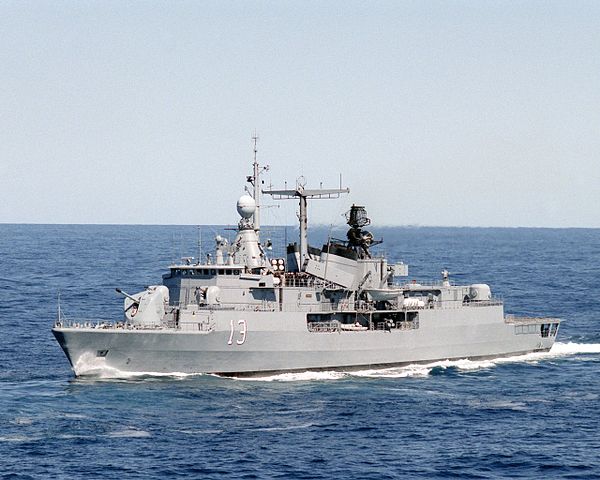
ARA Sarandi (D13) underway in the 2000s
The MEKO 360H2 were enlarged versions of the H1 design for Nigeria, all were to be provided by Blohm+Voss shipyard in Hamburg, and they were intended for anti-submarine warfare (ASW) likely to hunt down British and Chilean submarines in the waters around the Falklands and the Tierra del Fuego, the Beagle channel. Key to this design was the initial order for Westland Lynx helicopters made to complement the ships. Like the Gas Turbines, it assumed partly the lack of will of Britain to answer the invasion. Understandably, the order was cancelled in 1982. The planned replacement ended on the Italian Agusta-Bell AB 212 helicopters. However funding was lacking postwar.
By default, the ships received Aérospatiale Alouette SA 319 helicopters, until replaced by AS 555 Fennec helicopters in 1996, both lacking substantial ASW capabilities (see later). One key requirement was their powerful main gun, an Italian 5 in (127 mm) Oto Melara Otobreda 127/54 Compatto, dual purpose compatible with US ammunitions of the same caliber. However one of the key asset of the design was their added anti-ship capability, made of eight MM-40 exocet SSMs. If the ships would have been provided sooner (perhaps if powered with a CODAD) they could have been a game changer in the war.
They completed this by an Italian dual purpose missile, here used primarily for anti-air defence, the Selenia Aspide, produced from 1973. This was completed by an old-school arrangement of four twin 40 mm anti-aircraft OTO Melara 40L70 DARDO compatto. Beside the lack of helicopter they only had two triple ILAS tubes for US standard 324mm torpedoes for ASW. The large size of the ships and modular approach however left room for future improvements. The Almirante Brown the last MEKO 360s. Next would be the smaller MEKO 200 Frigates. The ships had a complement of 200, including 26 officers.
Hull and general design

The Almirante Brown class had a standard displacement of 2,900 long tons (2,900 t) and 3,360 long tons (3,410 t) at full load. The vessels are 125.9 metres (413 ft 1 in) long overall and 119.0 metres (390 ft 5 in) between perpendiculars with a beam of 15 metres (49 ft 3 in) and a draught of 5.8 metres (19 ft). The general layout was the same as the 360H1, the hull was flush deck, but bulky, with its max beam reached past the bridge, and almost constant towards the stern, which was a rounded transom, open below the helideck, for rhibs but only modular space for a VDS that was never purchased. The hull had a knuckele for most its lenght, a clipper bow, and cuouts in the upper beam-wide structure with sloped flanks, for the TT banks.
There was another structure above, which ended with the single hangar aft. The forward block bridge was preceded by the two formward 40mm mounts “superfiring” over the 127mm main gun. The ships had a foremast and antennaes there, and forward of the famously split funnels amidship, then an antenna mast on a block behind it, followed by the main Selenia SAM space. The last two 40 mm mounts were placed either side of the hangar so they were unable to do cross fire. The exocets were placed in front of the funnels, angled up inwards and forward which was unusual.
Powerplant
The MEKO 360H2 were powered by a COGOG system as seen above, with two shafts (2×3-bladed variable pitch props). The most powerful, made for high speed, were a pair of Olympus TM 3B gas turbines, rated at 51,800 shaft horsepower (38,600 kW). This was completed by two Tyne RM-IC gas turbines rated at 10,200 shaft horsepower (7,600 kW) for cruising. They could be clutched together in case to combine power, but were generally used separately. Total theoretical power was 62,000 shp. This made for a top speed of 30.5 knots (56.5 km/h; 35.1 mph) on the Olympus gas turbines alone, or 18 knots (33 km/h; 21 mph) max when switching on their Tyne cruising turbines. Maximum range was 4,500 nautical miles (8,300 km; 5,200 mi) at 18 knots based on their own oil bunkerage (unknown data).
Armament
The Almirante Brown had the armament described above, and in the tables below. Despite their modular construction, they remained in service unchanged for all their career, apart for the helicopter. Neither the electronics or armament were altered due to budget restrictions. By the 2010s this made them far les relevant, being 27 years old in technology.
Otobreda 127/54 Compact
 The 127/54C is a dual purpose naval artillery, largest from Oto Melara using a caliber compatible with the US 5 inch/ 54 gun. It is bulky due to its automatic loading system for sixty-six 127mm ready rounds of various kinds stored in three loader drums (each 22 rounds) and has a water-cooled barrel. Replaced nowadays by the 127/64 like those of the F125-class frigate and Italian FREMM. The large caliber makes it usable for A/S as well as AA fire and naval bombardment.
Specs:
Barrel lenght 270 in (6.9 m), remote controlled.
Shell 127x835mmR 29-31 kg (64 to 68 lb).
Elevation −15°/+83° and traverse at 40°/s.
Rate of fire 40 rounds/min.
Effective firing range ±30 km.
Exocet MM-40
 The main striking asset against ships, located forward of the funnels, angled up and inwards. The tubes were initiallt stacked on a gimbled but later it was modernized for canisters protected against shrapnel.
Specs:
875 kg (Block 1/2) for 5.8 m long with booster, 350 mm (0.35 m) diameter.
Solid rocket booster at launch with a turbojet sustainer engine
Speed: High subsonic (approx. Mach 0.93/1,148 km/h).
Range: 72 km (Block 2), sea-skimming.
Warhead: 165 kg high-explosive pre-fragmented.
Guidance: Inertial nav. mid-course with active radar terminal homing seeker/radar altimeter.
40mm Breda-Bofors (Dardo)
 Turreted systems made in Italy, licenced from the model 1958 Bofors. Distributed as the Dardo. Needs no presentation, two twin automated mounts forwad, two aft. Only the forward mount can cross fire but they have a massive blind spot behind. These 40 mm guns are controlled by two HSA LIROD optronic/radar directors.
Specs:
Mass 2,400 kg (5,300 lb), for 4 m (13 ft 1 in), barrel 2,800 mm (9 ft 2 in)
Cartridge 40 × 365 mm R 0.96 kg (2.1 lb) 40 mm L/70
Rate of fire: 330 rounds/min. Muzzle velocity 1,000 m/s (3,300 ft/s).
Maximum range: 12,500 m (41,000 ft).
Feed system: 26 round hopper. Automated with manual backup.
Selenia Aspide SAM
 The type was launched in 1977. Air-to-air and surface-to-air missile. Production continued withing MDBA today with modernized variants. The Mark 1 ws installed, with Selenia monopulse semi-active seeker and SNIA-Viscosa solid-propellant rocket motor. It has been compared to the AIM-7E Sea Sparrow at first, but now is closer to the Standard SM family in range and capacities. On the Brown class, the octuple (2×4) launcher is located past the hangar aft with a good 360° field of fire. Its associated radar and FCS are close by, on the blockhouse behind the funnels.
Specs (Mark 1):
220 kg (490 lb) for 3.7 m (12 ft), 203 mm (8 in) diameter, wingspan 80 cm (31 in).
Effective firing range: 15 km (9.3 mi)
Warhead 35 kg (77 lb), Mach 5, semi-active radar homing.
324 mm TTs
 The ships also comes with two triple usual 324 mm or 13 inches Italian ILAS-3 torpedo tubes. They can fire the compatible Mark 46 acoustic torpedoes. The B515/ILAS-3 (international designation) are trainable surface vessel torpedo tubes (SVTT) torpedo launching system similar to the Mk.32, manufactured by WASS (Whitehead Alenia Sistemi Subacquei) in Livorno, associated with Finmeccanica, now Leonardo and EuroTorp.
The B515 is an upgraded version of the former ILAS-3 variant, measuring 3.40 meters and able to fire the MU90/Impact LWT and A244/S LWT in addition to the Mk.46 Torpedo.
One source states they also carried a Depth Charge Rack with 9 DCs but it might be a typo.
Specs Mark 46
8 ft 6 in (2.59 m), 508 lb (231 kg)
2-speed, recip. external combustion Otto fuel II for 40 knots (46 mph, 74 km/h)
Range: 12,000 yd (11 km), Depth: > 1,200 ft (365 m)
Warhead: 96.8 lb (44 kg) PBXN-103 high explosive
Guidance: Homing Active/passive homing, Snake or circle search
Sensors
-Signaal DA08A air/surface search radar (F band)
-Signaal ZW06 surface search radar (I band)
-Decca 1226 navigational radar (I band)
-Signaal SEWACO Link 10/11 Fire Control system (main gun)
-Signaal STIR radar (I/J and K bands) SAM Fire Control
-Signaal WM25 (I and J band)
-LIRODA radar system for the 40 mm gun mounts (one on each).
-Atlas Elektronik 80 hull-mounted active search sonar.
The ships also had the SEWACO CCS.
Active Protection
-Graseby G1738 towed decoy countermeasure system
-Two Breda 105 mm (4 in) SCLAR chaff rocket launchers (20 tubes each).
-Electronic support: Sphinx system, Scimitar system.
Air Group
 All had an helicopter deck and hangar but no helicopters at first as the Lynx planned were cancelled*. Instead they were planned to have Agusta-Bell 212 models postwar but this was never funded and instead they ended with older Alouette SA 319 (Alouette III). The Argentine Naval Aviation operated a total of 14 Alouette III helicopters. One SA316B was on board ARA General Belgrano when sunk and another was used in the Invasion of South Georgia. The last was decommissioned in December 2010. Albeit they might carry torpedoes, they lacked proper ASW systems, used instead for liaison and SAR. Eventually in 1996 were replaced by AS 555 Fennec helicopters. Only the AS 555SN Fennec has anti-submarine warfare (ASW) capabilities, carrying lightweight 324mm homing torpedoes and it was indeed acquired by Argentina.
ARA La Argentina and Sarandí however were modified to carry and operate the SH-3D Sea King helicopter, which has proper ASW capabilities including a full suite of VDS and sonobuoys.
*For the anecdote, the Argentines acquired two of ten Lynx helicopters ordered, the first one was accidentally decommissioned during the 1982 conflict and the second one was sold to Denmark after being unable to acquire parts to keep it operational.

Fennec-2 555SN: 4 Delivered in 1996.
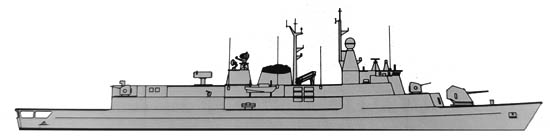
Conway’s rendition
⚙ MEKO 360H2 specifications |
|
| Displacement | 2,900 long tons (2,900 t) standard, 3,360 long tons (3,410 t) FL |
| Dimensions | 119/125.9 x 15 x 5.8 m (413 ft 1 in x 49 ft 3 in x 19 ft) |
| Propulsion | 2-shaft COGAG Olympus, Tyne RM-IC TM3B 51,800+ 10,200 shp |
| Speed | 30.5 knots (56.5 km/h; 35.1 mph) |
| Range | 4,500 nmi (8,300 km; 5,200 mi)/18 knots |
| Armament | 2×4 Exocet MM-40, 1×8 Aspide SAM, 127mm/54 in Oto, 4×2 40 mm AA, 2×3 324 mm TTs |
| Protection | Sphinx, Scimitar ECM, 2x SCLAR decoy RL, G1738 torpedo decoy |
| Sensors | Decca 1226, ZW-06, DA-08A, WM-25, STIR, 2x LIROD radars, KAE 80 (DSQS-21BZ) sonar |
| Air Group | 1 helicopter, see notes |
| Crew | c200 |
Career of the Almirante Brown class
They formed from the start the 2nd Destroyer Squadron, based at Puerto Belgrano Naval Base. Maintenance and training remained problematic due to huge financial problems as well import restrictions at first. The Almirante Brown class lacked spares and made less and less sorties as they had gas turbine issues due to the lack of proper maintenance. Some reports by the 2000s pointed out all their ammunitions long past their expiration date and it might be the same for their chaff rockets and torpedoes. By 2020, work of maintainenance was done seriously, but they still never received a proper modernization, with their Exocet and Aspide systems now completely obsolete and long superseded by far better versions. So far, only Heroina had been decommissioned, seemingly in 2024, formally retired from service “after prolonged inactivity”. The status of the other three is still active officially. In the next decade if maintained, they would approach 40 years service, provided they are not replaced. The most active ships seems to be the current recent Gowind class OPVs (2019-2022).
Almirante Brown D-10 (1981)

Almiante Brown was the first in class ordered in 1979 and laid down on 8 September 1980 at Blohm + Voss in Hamburg, launched on 28 March 1981 and commissioned on 26 January 1983. With the corvette ARA Spiro, she proceeded to the Persian Gulf on September 25, 1990, taking part in the international, UN-mandated naval blockade of Iraq after the invasion of Kuwait. She was present for Operations Desert Shield and Desert Storm, and back on on April 25, 1991. On April 16, 1996, she made the first Argentinian trans-horizon MM-40 missile launch since the Falklands war.
Like her sisters she remained at Puerto Belgrano, 2nd Destroyer Division, but experienced machinery issues due to the lack of spares and maintenance.
La Argentina D-11 (1981)

La Argentina (named after a famous British-built cruiser remained in service for many decades) was ordered on 1979 and laid down also at Blohm & Voss on 30 March 1981, launched on 25 September 1981 and commissioned on 4 May 1983. No records for her career until 2006. That year, La Argentina entered a two-year refit seeing the extension and reinforcement of the flight deck, to accommodate the SH-3 Sea King helicopter. Sarandí underwent a similar refit in 2008–2010. This overhaul did ot included her powerplant apparently as she duffered a major breakdown in 2012. On 30 June 2017, she accidentally collided with a jetty while departing Punta Alta Naval Base for an international naval exercise in the Pacific. Her bow needed repair, but while undergoing these, she suffered a fire broke, trigerring more repairs. Eventually she departed for Peru on 5 July 2017.
In May 2024, with Sarandí, ARA Espora and Rosales, Bartolomé Cordero, Piedrabuena and Almirante Storni, she took part in joint exercises with the USS George Washington and its carrier task group.
This was her last important sortie. No news as of 2026.

Heroína D-12 (1982)

Heroina was laid down on 24 August 1981, launched on 17 February 1982 and commissioned on 31 October 1983. She started service at Puerto Belgrano Naval Base on 21 December. She was scheduled a major engine and structural overhaul in 2008 after a collision with a whale but it seems it was limited to the essentials. She was at Puerto Belgrano, 2nd Destroyer Division like her sisters but saw little activity. In 2021, she was reported berthed since 2011 without any activity, awaiting a key component sent to the UK for repair, seized end never delivered. Having no spare, she was formally retired in 2024 and in 2019 she was reported sold to be scrapped.
Sarandí D-13 (1982)
Sarandí was laid down on 9 March 1982, launched on 31 August 1982 and commissioned on 16 April 1984. She started service from Puerto Belgrano Naval Base on 21 June 1984 after her trip to Argentina and second, official commission. In 2003, she joined the USS Enterprise carrier strike group plus Destroyer Squadron 18 for the exercise Solid Step while making a tour in the Mediterranean. On 29 November 2004 at the annual FRATERNO naval exercise with the Brazilian Navy in gunnery practice against target drones, a malfunction made her firing on the Brazilian frigate Rademaker. Four Brazilians and an Argentine naval observer were injured. By 2021 given she was in the best general shape, she became flagship of the 2nd Destroyer Division. By September she was an exercise with ARA Espora, Robinson, Gómez Roca and Spiro. In 2022, she was in another off Mar del Plata with ARA Espora, Robinson, Rosales and “Canal Beagle”. In 2023 she escorted the Bartolomé Cordero with a S2T-Turbo Tracker aircraft for joint exercises with Brazil, Independência and União, Tikuna.
In May 2024 Sarandí and La Argentina sortied with Espora and Rosales, the new OPVs Bartolomé Cordero, Piedrabuena and Almirante Storni, for a joint exercises with USS George Washington carrier task group
In August the same yar she took part in the joint exercise Fraterno XXXVII in the South Atlantic with the OPV Almirante Storni and the corvette Espora, and the Brazilian Liberal and Tikuna. Next, Sarandí and Liberal sailed to Valparaíso for UNITAS LXV and performed exercises with the Chilean frigate Almirante Lynch.
Read More/Src
Books
Bourdette, Ignacio Amendolara. Guia de los buques de la Armada Argentina 2005-2006
Scheina, Robert L. & Smigielski, Adam (1995). “Argentina”. In Chumbley, Stephen (ed.). Conway’s All the World’s Fighting Ships, 1947–1995
Links
web.archive.org/ navypedia.org/ almirante_brown
web.archive.org hercules.htm
web.archive.org/ navypedia.org/ Argie destroyers
Falklands_War order of battle
web.archive.org/ helis.com
News
en.mercopress.com
zona-militar.com
defensa.com/
defensa.com/
List_of_active_Argentine_Navy_ships
Videos
https://youtu.be/SI0lPRqYU-I
more on youtube.com/