
 Armada – 6 Corvettes: Descubierta, Diana, Infanta Elena, Infanta Cristina, Cazadora, Vencedora. + 3 Exports
The Descubierta-class corvettes were built for the Spanish Navy at Cartagena and ferrol in 1974-84, and in service until the 2000s before a new carrer as OPVs (P-75 to 79) and discarded in 2009-2024. Three more were built for the Egyptian and Moroccan Navies. They were designed by Blohm & Voss in Germany, based on the João Coutinho-class of the late 1960s for the Portuguese Navy, by naval engineer Rogério de Oliveira. After the Descubierta, a larger version was proposed for a second batch but instead, Spain built Oliver Hazard Perry-class frigates under licence. These 1200-1400 tonnes vessels were already on the large extreme for a “corvette” and heavily armed to deal with sea, air and undersea threats at nearly all ranges. A fairly useful and efficient design perfect to replace maintenance-heavy vintage destroyers of the 1960s. The Descubierta also used a lot of automation to reduce the crew.
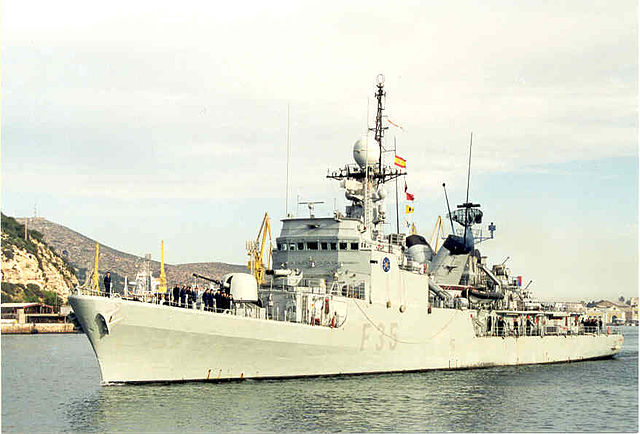
Cazadora F35
Development: The F30 Project
The Descubierta-class corvettes were Spanish-designed in a secondary cooperation with Blohm & Voss of Germany, albeit this type was not part of the “MEKO” catalog of the time. Local experience came from Bazán (now Navantia) expertise already gained from constructing the João Coutinho-class corvettes for the Portuguese Navy, as designed by Portuguese engineer Rogério de Oliveira, with B&V technical collaboration.
They bolstered Bazán’s international expansion as their first modern combat vessel that was designed and built in Spain for export. The “Atomic Ants” (they were quire powerful for their size) were also known as the F-30 project. MEKO/Blohm & Voss proposed Bazàn at some point a larger, 1,879t full load, 100m overall corvette, with helicopter and hangar, gas turbine propulsion for 30+ kts, but it was rejected for US patented Frigates.
Their origin was in the second phase of the Naval 1968 Plan calling for a large series of 12 units “coastal escorts”. After the usual budgetary arbitration this was reduced to eight plus one additional ordered by Morocco. The final two never entered service and instead were transferred to Egypt in exchange for a government commitment to replace them with two more F-80 class frigates, with just one delivered. The first four emerged from Bazán shipyards in Cartagena, the remaining ones from El Ferrol. Despite their heavy armament, their specific mission was convoy escort in coastal or restricted waters.
The greatest issue was the lack of a helicopter, variable-depth sonar or data link systems for coordination with NATO. In reality they were frequently deployed for more demanding missions, notably to the Red Sea to take part in the UN embargo against Iraq. They were limited when joining NATO task groups albeit taking part in STANAVFORMED operations and many NATO exercises.
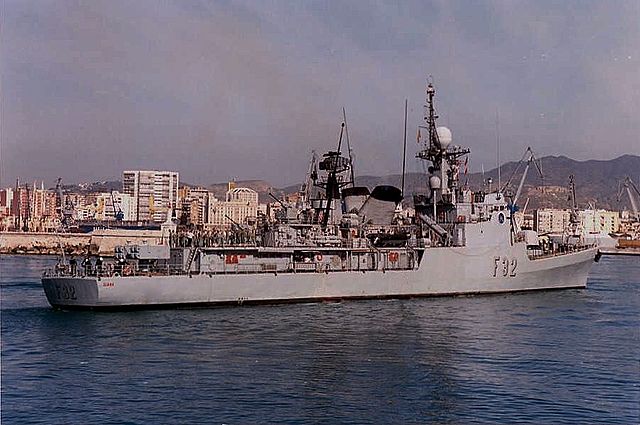
The ASW Frigate Diana (F-32)
The Descubierta class had been designed first and foremost for anti-surface warfare like any SSM armed frigates at the time and their anti-air warfare capability was similar to those of the much larger Baleares and Santa María class frigates (respectively licenced built Knox and OH perry) albeit the latter were superior thanks to their medium-range Standard missile system. The coastal design is clear by their heavy anti-submarine warfare equipment, despite the lack of helicopter or VDS, albeit limited to short range, with a twin mortar Bofors 375 mm and the usual US Mark 46 triple torpedo tubes 325 mm (12.75 inches). In conclusion, the Descubierta were perfectly fine for their missions through the Strait of Gibraltar, Western Mediterranean, and Red Sea or Adriatic as it happened in service, the waters of the Canary Islands, and this, despite having a far lesser capable electronic to match the Baleares, Santa María or modern F-100 class. Given their armament, under NATO classification, they are designated as “light frigates”.
Design of the class
Hull and general design
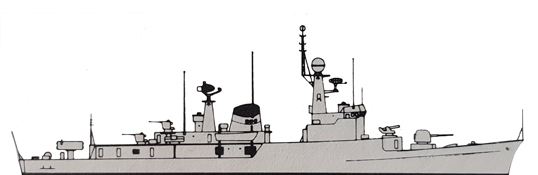
The Decubierta class are indeed relatively small, but balanced and not overweight vessels, displacing 1,233 tons standard and 1,482 tons full load for an overall length of 88.8 m (291 ft), a beam of 10.4 m (34 ft) and a draught of 3.8 m (12 ft). The hull was flush deck and relatively low, adapted to coastal waters or the Mediterranean, with a clipper bow and a lot of flare, a knucke, and a well profiled hull, constant beam amidship, then finer lines down to the transom stern.
There was a “mid-castle” forward as customary for MEKO designs, for the superfiring Bofors ASWRL above the main classic OTM Melara turret on deck, followed by the signature MEKO 3-faceted bridge, crowned by an open bridge. Then came the foremast, taller, supporting the main aerials, but the bridge was moderate in size. Behind were the Harpoon missiles, then the characteristic pair of funnels at angles forming a “V”, two cutters under davits, the aft mast and its sensors, the two triple TT banks on either side, followed by the two Bofors AA mounts in an aft superfiring and centerline position and on the aft deck, the two quad launcher canister Sea Sparrow. This made for a small but “busy” warship.
Powerplant
Propulsion consisted in two 2 shaft propellers (5 bladed, fixed pitch) driven by common crankshafts each linked to two MTU-Bazán 16V 956 TB91 diesel engines. With these four diesels, total power was 16,000 hp (12,000 kW). This was ideal for space economy, redundancy, reliablity and range. They traded a top speed of 25 knots (46 km/h; 29 mph), inferior to full speed SSNs, for a good range for their mission of 4,000 nautical miles (7,400 km) at 18 knots (33 km/h) and more at 10 knots.
Protection
Passive is unknown, but classic: Double hull and heavy compartimentation to deal with underwater blasts, bulkheads, full separation of the diesels pairs fore and aft, forward and aft bulkheads and side saferty compartments, pumps. The usual fire protection systems as well with automatic sprinklers in the ammunition magazines, machinery, and CiC, fire posts with hoses at several points and hand-held halon fire extinguishers across all levels. No apparent NBC protection however.
Active (most added late 1980s):
• Elsag Mk-1000 EW protection system
• Ceselsa DENEB y ELNATH EW jammer
• Ceselsa CANOPUS intereception and EW system
• SLQ-25 Nixie torpedo decoy system
• FMC SRBOC Mk.36 chaff launcher, the well known US system
Armament
Harpoon SSM RGM-84A/C
The Descubierta were armed (before retired in the 2000s) by two sets of four canisters for the American Harpoon SSM RGM-84A when completed, located on the deck space between the funnels and bridge, angled up either port and starboard. No need for more info, these are well known systems capable of 0.85 Mach, sea-skimming with a range of 111 kilometers or 77 nmi (143 km) for the Block IC after upgrade. Quite a formidable capacity for a 1500t corvette. They were replaced by Exocets on the Moroccan ship.
Albatros/Aspide SAM
Aspide is an Italian medium range surface-to-air missile from Selenia, then Alenia Aeronautica, then MBDA developed in the 1970s to replace license built AIM-7 Sparrow. It has the same capabilities, size and is compatible with the same canisters, of which the Descubierta have one aft deck-mounted two-armed octuple launcher. The Aspide I is 220 kg (490 lb), 3.7 m (12 ft) long for 203 mm (8.0 in) diameter (8 inches) and a wingspan of 80 cm (31 in), 15 km (9.3 mi) range with a Warhead of 35 kg (77 lb) at Mach 5 and semi-active radar homing.
OTO Melara 76 mm
The ‘compatto’ forward is of the classic type of the 1980s with its dome, both usable against air and missile targets as well as ships with the right ammunitions. Supposedly it’s the compatto, not the super-rapido, which gave us 85 rounds/min at 915 m/s (3,000 ft/s) for a 76×636mmR 6.3 kilograms (14 lb)+ 2.35 kilograms (5.2 lb) for 12.4 kg (27 lb) HE-PFF round with a range of 16,000 m.
Twin Bofors 375 mm
The classic ASW mortar developed by Bofors in 2,3, and 4 tubes variants, widely exported. It is located on the superfiring position at the foot of the bridge. It fired a rocket with HE warhead and Acoustic Proximity Fuse, powered by Solid fuel at 3,625 m (11,893 ft) range. Still in service in some navies.
Triple 324 mm Mark 32 TT
Classic system, 12.75 inches, with hand-held and reloaded short torpedoes mark 46 from the US. 11 km range and acoustic with Otto fuel capable of 50 knots and great depths.
Bofors 40mm AA
Classic Bofors L/70 AA gun working by gravity but with integrated fire control and automated. They are still useful today to deal with drone, provided that have a HE round with proximity fuse.
These were swapped later to 20 mm 120-caliber Oerlikon AA guns, a late installation for conversions as patrol vessels.
Sensors
• Thales DA-05/2 E/F band Main Air Search Radar
• Thales ZW-06 surface radar
• Kelvin Hughes Type 1007 I band Navigation Radar
• Koden MD 3721 navigation and collision avoidance radar
• Thales WM-25 fire control radar
• DE-1160B casco hull sonar
Modernizations/Conversion as OPVs
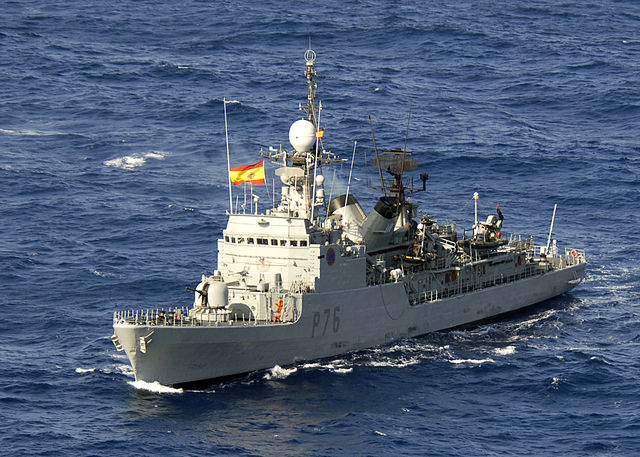
Infanta Elena (P-76).
By the late 1980s they all received the Beta ECM suite as well as a Furuno radar, the Deneb Mk 1600, and Canopus Mk 1600 ECM suites, as well as two Mk 36 SRBOC decoy RL, SLQ-25 Nixie torpedo decoy, and a Tritan IV CCS. But by the 2000s they were recycled as OPVs and partially disarmed: In 2000, Diana lost her Harpoon SSM, Albatros SAM, Bofors AA and ASWRL, even the 324mm TT and most of her electronics suite for a second versatile Furuno radar, a decompression chamber, and foundations for four portable mine countermeasures repair shop modules. Descubierta herself was modified that way but receoved two 20mm/70 Mk 10 AA gun as well as a type 1007 radar, Compass e/o IR detector, and two Panda e/o directors. In 2004-06, Cazadora Vencedora, then Infanta Cristina and Infanta Elena had the same, with installation of two 20mm/70 Mk 10, type 1007 radar, Compass e/o IR detector, and Panda e/o directors. However in their new roles they operated two rhibs located where the cutters were previously installed under davits, and up to 30 Spanish Marines or commandos.
⚙ specifications |
|
| Displacement | 1,233 tons standard, 1,482 tons full load |
| Dimensions | 88.8 x 10.4 x 3.8 m (291 x 34 x 12 ft) |
| Propulsion | 2 shaft 4 MTU-Bazán 16V 956 TB91 diesels 16,000 hp (12,000 kW) |
| Speed | 25 knots (46 km/h; 29 mph) |
| Range | 4,000 nautical miles (7,400 km) at 18 knots (33 km/h) |
| Armament | 2×4 Harpoon SSM (2×4), 1×8 Aspide SAM, 76 mm, 2x 40 mm, 2x Bofors 375mm ASWRL, 2×3 12.75mm ASWTTs |
| Protection | Beta ECM as completed, See notes |
| Sensors | DA-05/2, ZW-06/2, WM22/41 radars, DE1160C sonar |
| Crew | 118 |
Career of the Descubierta class
The Descubierta class were far better overall compared to the 1950s Artevida class they replaced (Atrevida, Descubierta, Diana, Nautilus, Princesa, Villa de Bilbao) which were glorified Gabbiano class in appearance, armed with one 3-in/50 DP, three 40mm/70 AA, two 20 mm AA, depth charges, and mines. They had a Radar SPS-5B, Sonar QHBa and still a large crew of 132. They were gradually were discarded, Decubierta and Diana when replaced in 1978 and 1973, the others after being refitted in 1978 for patrol and fishery protection and a new life until 1991-92. The 1980s Descubierta were far more capable, as seen above, and made far more jobs in distant waters they were originally designed for.
The current status of the Egyptian ships is unknown. Last seen on June 24, 2020 operating with Santa María. This was El Suez (F-946) transiting the Red Sea from Rota to Djibouti for Operation Atalanta. For the Moroccan ship, she was modernized in Spain, at Navantia shipyard of Cartagena from October 2017 for major overhaul and maintenance, but was retained as flagship before the adoption of French Floréal-class frigates. The Spanish vessels became OPVs, but without the benefit of an helicopter in the 2000s. With the end of the cold war and sratic budget cuts, it was decided to practically disarm these ships.
Post Cold War Conversions
F-32 Diana became a command ship for the Mine Countermeasures (MCM) flotilla, new pennant M-11—until decommissioned in June 2015. See below for details.
F-31, F-33, F-34, F-35, and F-36 were converted as OPVs under the new designations P-75, P-76, P-77, P-78, and P-79, respectively.
Displacement: 1,233 t standard, 1,666 t full load, Dimensions: 88.8 × 10.4 × 4.5 m, Crew: 89
Radars: ASR Thales DA 05/2, E/F band, SSR Thales ZW 06, NAVR Kelvin Hughes Type 1007, I-band, Koden MD 3721, Thales WM 25 FCR, Sonar DE-1160B hull-mounted.
Armament: Optionally 4 RGM-84 Harpoon SSMs, Oto Melara 76 mm/62 Compact gun, one Oerlikon 20 mm/120 gun, two Browning M2 12.7 mm machine guns and two 7.62 mm machine guns
Countermeasures: Decoys: 2 FMC SRBOC Mk 36; ESM: Ceselsa Deneb; ECM: Ceselsa Canopus
Command and control systems: Tritan IV combat system: 2 MFC, 1 CRETA, LINK-11, 2 ANDU
Communications: 3 HF TX, 8 HF RX, 2 HF TR, 6 UHF TR (2 HQ), 2 VHF TR, INMARSAT B
Internal communications: UWT.
Boats carried: 3 RHIBs for boarding parties, one Valiant 750, 2 Zodiac Mk5. Accomodation for 30 Marines, Police or Spec ops.
Descubierta (P-75, ex-F-31), Vencedora (P-79, ex-F-36), and Cazadora (P-78, ex-F-35) were decommissioned in 2009, 2017, and 2018, eventually, far too large and costly to maintain as OPVs with new ships entering service. The last in service was Infanta Cristina, later P-77, decommissioned two years ago on 20 March 2024 and likely in the mothballs. Their replacements, the Serviola class Corvettes (1990, Atalaya, Centinela, Serviola, Vigia) are far smaller vessels, closer to an OPV, and this time equipped with an helicopter.
Descubierta F31

Descubierta F31 was ordered from Cartagena, laid down on 16 November 1974, launched on 8 July 1975 and commissioned on 18 November 1978. She was the first to enter the 21st Escort Squadron based in Cartagena.
“Discoverer” from October 9, 1989 became the first Spanish ship to participate in a NATO force, included in an activation of non-permanent NATO Naval Force in the Mediterranean (NAVOCFORMED). In 1990, she was sent to the Persian Gulf along with the frigate Santa María and corvette Cazadora after the invasion of Kuwait by Iraq under UN mandate. In 1991, during maneuvers, she became the first Spanish ship to fire a Harpoon missile against the former destroyer Churruca (D-61). Her pennant was changed from F-31 to P-75 on June 5, 2000, at which time she was reclassified as an OPV.
Together with the Civil Guard patrol boat Río Pisuerga, and with the support of two rhibs with agents she intercepted and seized the Odyssey Explorer on October 17, 2007 when leaving Gibraltar heading to the Alboran Sea, suspected of carrying drugs. She was decommissioned on June 6, 2009 by resolution 600/03695/09 on March 10, 2009, scrapped at Recoverciones Submarinas company, Astillero of Santander from March 2011.
Diana F32
Diana F32 was ordered from Cartagena, Laid down on July 8, 1975, Launched on January 26, 1976 and commissioned on June 30, 1979.
She joined the 21st Escort Squadron, based in Cartagena. On October 31, 1990, she was deployed to the Persian Gulf with Numancia and her sister Infanta Cristina after the invasion of Kuwait under UN mandate. At some point she fired warning shots at the Iraqi freighter Khawla Bint Al Zawra in the Red Sea to stop and board her. Singer Marta Sánchez performed a concert aboard in Safaga, Egypt. Diana served as the command ship for the Mine Countermeasures flotilla:
Transformed to MCM support ship M-11 (2000):
Displacement: 1,233 t standard, 1,666 t full load, Dimensions: 88.8 × 10.4 × 3.8 meters
Crew: 118, plus accommodation for 30 special operations personnel
Radar: Air/Surface: Signaal DA 05/2, E/F bands, Navigation: Signaal ZW 06, Sonar: Raytheon 1160B
Armament: 1 Oto Melara 76mm/62 Compact gun.
Decoys: 2 Loral Hycor SRBOC Mk 36; ESM: Elsag Mk 1000; ECM: Ceselsa Canopus
Hyperbaric chamber for divers, as well as containers holding various equipment for diving operations.
She was scheduled for replacement by a Maritime Action Vessel (BAM) modified the same way. On June 15, 2011, she intercepted two migrant boats in the Alboran Sea, 55 miles off Cape Gata, transferred to the salvage vessel Denebola. She was decommissioned on May 28, 2015, although inoperative since 2012 due to budget cuts. By mid-September 2016, she was sold for BU with a starting price of €245,312.78, sold at the Curra basin in July 2017, scrapped.
Infanta Elena F33
Infanta Elena (F33) was ordered from Cartagena, laid down on January 26, 1976, launched on September 14, 1976 and commissioned on April 12, 1980 and based at the 21st Escort Squadron, Cartagena.
In 1991, she was deployed to the Persian Gulf with Victoria and Vencedora for UN mandated blockade of Iraq. In 2003, she participated in Exercise Gruflex ’03 near Rota, her final maneuvers as a corvette. She also took part in Operation Romeo-Sierra, Perejil Island crisis. On January 13, 2004 she was disarmed and became P-76 OPV. In 2008, she was deployed to Lebanese waters for three months under Operation UNIFIL. On February 15, 2011, she sailed for the Indian Ocean to join the EuroForce tasked with protecting merchant shipping and fishing in the area against pirates, back on June 3, 2011, after 91 days at sea. She boarded 28 vessels, detained 12 suspected pirates, freed 12 hostages for 15,500 nautical miles.
On February 14, 2012, she left Cartagena for Operation Atalanta, a new counter-piracy mission in Indian Ocean waters. On March 28, 2012, she helped an adrift “fishing boat” with a broken engine, and escorted back to Mogadishu. She spotted another and provided water and food. On April 18, 2012, she freed the fishing vessel Nimesha Duwa (Sri Lanka), held captive for six months. She was back home on June 3, 2012.
On October 18, 2012, with a Guadia Civil vessel, she thwarted a drug-trafficking operation near the Alborán Island, catching a speedboat. On May 26, with Serviola she intercepted the Togo-flagged “Endeavour” off the coast of Málaga, posing as an oceanographic research vessel but pillaging archaeological sites in Spanish waters. She was escorted back to Algeciras, placed under Civil Guard control.
On February 25, 2014, she left Cartagena for a long deployment off Africa with the Partnership Station initiative, via Dakar, Porto Grande, Douala, Lobito, Lagos and Nouakchott. By late June 2014, she escorted the MV Cape Ray tasked with destroying the Syrian chemical weapons arsenal in the Strait of Gibraltar.
In November 2017, she rescued 68 migrants from six small boat from Algeria in a joint operation with Civil Guard ships. Between March 1 and June 27, 2018 she combated piracy as well as illegal immigration, and illegal fishing in the Gulf of Guinea. By October, November, and December 2018 she was in Maritime Surveillance and Security in Spanish Mediterranean waters for the same missions. On May 14, 2022, she rescued migrants in a critical condition 30 nm from the Chafarinas Islands, brought to Almería. She was decommissioned at the Cartagena Naval Base on March 17, 2023, simple ceremony with her flag lowered under Lieutenant Commander Jose Antonio Gallardo Vozmediano to Admiral Vice Admiral Pedro Luis de la Puente García-Ganges.
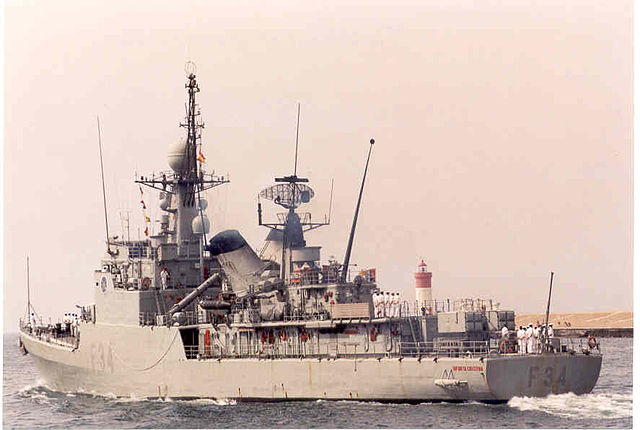
Infanta Cristina F34
Infanta Cristina was laid down on 11 September 1974, launched on 8 July 1976 and commissioned on 24 November 1980, assigned to the 21st Escort Squadron in Cartagena. On October 31, 1990, she took part in the UN embargo aagainst Iraq in the Persian Gulf alongside Numancia and the Diana. She was tasked of surveillance and blockade duties under UN mandate and stopped the cargo Khawla Bint Al Zawra in the Red Sea and she hosted the singer Marta Sánchez for a concert on board in Safaga. She took part in the exercise CALOPCO by May 1994 off Rota. On January 13, 2004 she became P-77 as an OPV. By late 2008, she was sent to Lebanon for UNIFIL and bacl to base on February 11, 2009. On July 20, 2010, she sailed from Cartagena, off Somalia and up to 4-5 months. Then there was Operation Atalanta, an anti-piracy mission. On September 10-14, 2010, she escorted the Alpha Kirawira chartered by the African Union Mission in Somalia to Mombasa. By November 6, she escorted MV Petra 1 when attacked by pirates from MV Izumi and she interposed between the tow. Ultimately, there were no casualties or material damage and she was back in the Indian Ocean on December 18, 2010.
On August 17, 2011, she sailed from Cartagena to Somalia and joined the EU’s Operation Atalanta for a second time. By November 2011, she freed the Al Talal under the Comoros flag which Paki crew was hijacked 12 days earlier. She was back home on December 5, 2011. By December 2012, she boarded a Panamanian-flagged treasure-hunting ship in the Alboran Sea. On February 20, 2014, she took part in Operation Atalanta again, a counter-piracy mission off Somalia and gulf of Aden. On February 18, 2015,she left Cartagena for the EU standing naval group in the Gulf of Aden, conducting c2,000 inspections and 72 boardings, pressuring for the release of fishing vessels, held off the coast, near a pirate camp and back to Cartagena on July 17, 2015. On March 21, 2024 she was decommissioned. Later sold for BU.
Cazadora F35
Cazadora (“huntress”) was ordered from Ferrol and laid down on 14 December 1977, launched on 17 October 1978 and commissioned on 20 July 1982. After this she joined the 21st Escort Squadron in Cartagena with her sisters. In June 1982, she detected a British submarine crossing the Strait of Gibraltar while submerged, in violation of international agreements requiring a surface transit. This was signalled to the RN.
In 1990, after the invasion of Kuwait, she was sent to the Persian Gulf with Santa María and Descubierta and was present duting the Perejil Island incident, and was sent to Melilla. In 2003, she participated in final maneuvers and the Exercise Gruflex ’03 near Rota. From January 13, 2004, she was reclassified P-78, based in Las Palmas, involved in many counter-narcotics, search and rescue missions or comabing immigration. She took part in many peacekeeping missions such as 2007 Operation Active Endeavour (maritime patrol and surveillance with boardings done with a Marine Corps detachment) off the coasts of Syria, Greece, and Turkey. In 2008, she was sent to Lebanon for UNIFIL. In May 2010, she took part in the exercise “Phoenix Express 2010” in the central Mediterranean. On October 9, 2011 she sailed to Las Palmas de Gran Canaria for security training in bilateral exercises, between Mauritania, Senegal, Benin, Cameroon, Gabon, Ghana, and Guinea-Conakry, and Dakar or Cotonou, Douala, and ending at Praia, Cape Verde in December 2011, and back to Las Palmas.
On June 25, 2012, she was reassigned to Cartagena, prior to conversion as OPV. On October 3 2013 she entered Gibraltar amidst tensions and later took part in the “Cartago 2013” maneuvers, on SAR exercises, with also the submarine Galerna and minehunter Segura and other vessels.
On October 13, 2014, she intercepted migrant boat in the Alboran Sea. On January 19, 2016 she rescued 23 migrants. On October 25 she shadowed a Russian Task force led by Admiral Kuznetsov passing through Spanish waters to the Mediterranean.
On December 11, 2016, she rescued 55 migrants south of the Alborán Island, 13 miles from Morocco. In January 2017, she continued tracing the Russian carrier group for her return trip. She was decommissioned at Cartagena on April 26, 2018, and sold for BU, started in 2020 at Escombreras.
Vencedora F36
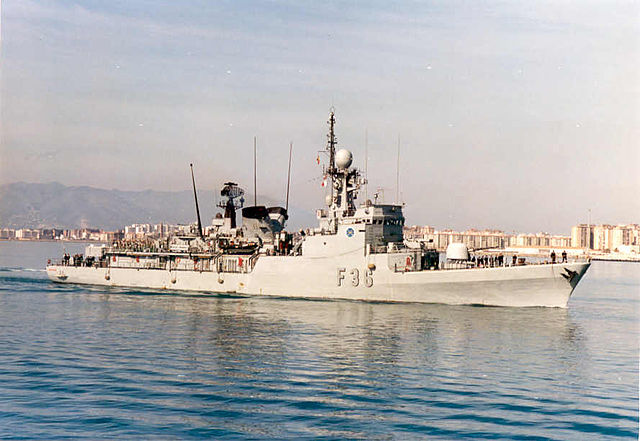
Vencedora was ordered from Ferrol. She was laid down on 1 January 1978, launched on 27 April 1979, and commissioned on 27 March 1982. She was assigned to the 21st Escort Squadron in Cartagena. In 1991, she joined like all her sisters the Persian Gulf with Infanta Elena for a full rotation. In 2003, she took part in the corvette—Exercise Gruflex 03 near Rota. On January 13, 2004, her pennant was changed from F-36 to P-79, as an OPV. On January 31, 2009, she was sent in Lebanese waters for UNIFIL. On March 6, 2010, she departed Las Palmas for Cartagena to Somalia for Operation Atalanta, and back on June 12, 2010 (14,000 nautical miles). On February 13, 2012, she was involve din a large maritime security training and sailed to many African ports along the way, notably the exercise Obangame Express 2012 in the Gulf of Guinea with the USN.
On July 2, she was homeported to Cartagena and was converted as an OPV, new pennant. By November 2012, she was involved in a diplomatic incident off Gibraltar with both ambassadors recalled as she trained in contested waters for both sides. On March 19, 2014 she assisted 53 migrants on a inflatable boat near the Alboran Island. On March 3, 2015 she left to West Africa for naval exercises and ports visits; in Mauritania, Gabon, Ghana, Senegal, Cape Verde and back on June 6. March 20-26, saw her in Exercise Obangame Express in the Gulf of Guinea (22 countries). On November 25, 2016, she was saluted by all ships participating in GRUFLEX-61 exercises, before her decommissionin for January 2017 but pushed to May 27. She as later sold for BU.
Exports
 El Suez class (F946)

El Suez was ordered in 1980 and built at Bazan, Ferrol, commissioned on 21 August 1984.
Abo Qir (Aboukir) was her sister ship, F941 also ordered from Bazan, Ferrol, and commissioned on 27 October 1984. Like her sister, currently In service.
These were the ex-F-37 Centinela from Bazán Ferrol (LD October 8, 1979) and F-38 Serviola (LD August 18, 1980), both sold at completion.
 Lieutenant Colonel Errhamani (F501)

Atlantic Ocean (July 12, 2004) — The Moroccan frigate RMNS Lieutenant Colonel Errhamani (F 501) steams through the Atlantic Ocean while participating in Majestic Eagle 2004. Majestic Eagle is a multinational exercise being conducted off the coast of Morocco. The exercise demonstrates the combined force capabilities and quick response times of the participating naval, air, undersea and surface warfare groups. Countries involved in the NATO led exercise include the United Kingdom, Morocco, France, Italy, Portugal, Spain, and Turkey. Truman’s participation in Majestic Eagle is part of her scheduled deployment supporting the Navy’s new fleet response plan (FRP) Summer Pulse 2004, the simultaneous deployment of seven carrier strike groups (CSGs), demonstrating the ability of the Navy to provide credible combat across the globe, in five theaters with other U.S., allied, and coalition military forces. U.S. Navy photo by Photographer’s Mate Airman Rob Gaston (RELEASED) For more information go to: http://www.cffc.navy.mil/summerpulse04.htm
Lieutenant Colonel Errhamani was ordered at Bazan, Ferrol and commissioned on 28 March 1983. Currenty in service.
Gallery
Read More/Src
Links
https://www.navypedia.org/
seaforces.org/
web.archive.org/ navypedia.org/
es.wikipedia.org/
en.wikipedia.org Descubierta-class_corvette
sakhalianet.x10.mx/ descubierta class