
 All ships, submarines, assets and organization: 50,800 personnel, 160 ships, 346 aircraft.
The modern Japan Maritime Self-Defense Force (JMSDF) has evolved since 1990 from a Cold War anti-submarine force into one of the world’s most technologically advanced navies. While Japan’s constitution limits it to self-defense, the JMSDF possesses capabilities comparable to those of many major naval powers. Following the end of the Cold War, Japan shifted its focus from defending against Soviet submarines in the North Pacific to broader regional security. There was Continued emphasis on anti-submarine warfare (ASW), participation in international peacekeeping and humanitarian missions, support for coalition operations after the 1991 Gulf War through minesweeping deployments and modernization of destroyers and submarines rather than fleet expansion.
The fleet remained centered on escort destroyers, diesel-electric submarines, maritime patrol aircraft, and minesweepers.
However form the 2000s it expanded overseas operations. After the September 11 attacks, Japan gradually assumed a more active international role.
The JMSDF supported coalition forces in the Indian Ocean with replenishment ships, Expanded anti-piracy patrols near the Horn of Africa, improved interoperability with the U.S. Navy and introduced new classes of destroyers with advanced Aegis combat systems. Japan increasingly viewed China’s growing naval power and North Korea’s missile programs as major security concerns.
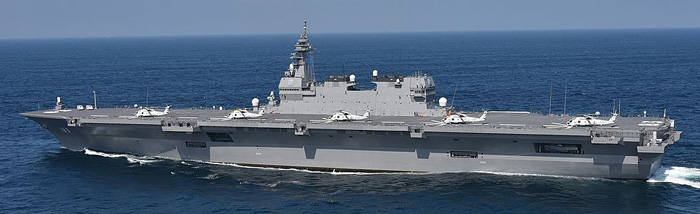
Izumo class carriers “helicopter destroyers”, symbolic of this new direction. They are now capable of operating the F35 Lightning II so aircraft carriers in all but name.
From the 2010s Japan started to respond to China’s rise in a more acute way, fundamentally changing its naval planning.
Major developments included:
-Commissioning the Izumo-class helicopter destroyers
-Expansion of ballistic missile defense
-Entry into service of highly capable Sōryū-class submarine submarines
-Construction of Maya-class destroyer Aegis destroyers
-Increased joint exercises with the United States, Australia, India, and European navies
A major policy shift allowed the Izumo-class ships to be modified for operation of the F-35B Lightning II, giving Japan a fixed-wing carrier capability for the first time since World War II.
2020s saw Japan transitoning to a more capable maritime force, continuing expanding its naval capabilities amid increasing regional tensions.
Recent priorities include building the stealthy Mogami-class frigate (with export successes), developing next-generation submarines, integrating unmanned surface and underwater vehicles as well as strengthening missile defense, improving long-range strike support and logistics and expanding cooperation with allies through the Quad and other partnerships.
The JMSDF regularly conducted operations with the navies of the United States, Australia, the United Kingdom, France, Canada, and other partners in the Indo-Pacific.
Today the Japanese Navy is regarded as one of the world’s premier naval forces because of its excellent anti-submarine warfare capabilities, advanced Aegis-equipped destroyers, quiet diesel-electric submarine fleet, a rival for other manufacturers like Thyssenkrupp Marine, Naval Group, Navantia, BAe and others, a modern maritime patrol aviation including the Kawasaki P-1 and a seaplane, a large and capable mine warfare force, high level of training and readiness and a very capable and reinforced amphibious force presented as a rapid reaction force for a possible takeover by China of its southernmost islands.
Limitations exists however: Japan’s navy is designed primarily for defense rather than global power projection.
It has no nuclear-powered submarines (albeit this might change), operates still relatively few large amphibious ships, relies heavily on cooperation with the U.S. Navy for extended operations, and there are still constitutional and political constraints, though these have gradually become more flexible.
For a regional naval force focused mainly on defending Japanese waters against Soviet submarines the modern Japanese Navy morphed into a sophisticated, blue-water navy capable of protecting Japan’s sea lanes, contributing to regional stability, and operating alongside allied fleets throughout the Indo-Pacific. Today, it is generally considered among the top five most capable conventional (non-nuclear) navies in the world, particularly excelling in anti-submarine warfare, air defense, and fleet integration with allied forces, a worthy opponent to the Chinese PLAN in these waters.
In 2026, the Self Defence Naval Force becomes the “Fleet Surface Force” as part of a major reorganization of all armed forces in Japan.
Current Assets
- 1934 Type Destroyers
- 1934A type destroyers
- 1936 type destroyers
- 1936A type destroyers
- 1936B type destroyers
- 1st Battle of Heligoland (28 August 1914)
- 2026
- 26-Knotters
- 27-knotters
- 2nd Battle of the Atlantic (1940-44)
- 30 Knotters
- 33 Knotters
- 3D Naval Repository
- 600/630 Tonnes Type Submersibles (1925-38)
- 7 de Agosto class Destroyer
- A class submarines (1902)
- A-90 Orlyonok
- A/B class destroyers (1929)
- Abdiel class minelayers (1940)
- Acasta class Destroyer (1912)
- Acciaio class Submersible (1941)
- Acheron class destroyers (1911)
- Acorn class destroyers (1910)
- Active class Cruisers
- Admiral Souchon’s Escape (3-8 August 1914)
- Admiral Spaun & Novara class cruisers
- Admiralen class destroyers (1925)
- Admirals of WW2
- Admiralty M-class destroyers
- Admiralty type (Scott class) flotilla leaders (1917)
- Affondatore (1866)
- Agano class cruisers (1941)
- Agordat class cruisers (1899)
- Aichi D1A (1934)
- Aichi D3A “Val” (1936)
- Aichi E13A Reisu “Jake”
- Aigle class destroyer (1931)
- Aircraft carrier Aquila
- Aircraft Carrier Béarn (1923)
- Aircraft Carrier Giuseppe Garibaldi (1983)
- Aircraft Carrier IJN Sōryū (1935)
- Akitsushima class Seaplane Tenders (1941)
- Akizuki class Destroyer (1941)
- Akizuki class destroyer (1959)
- Akron class Airship Aircraft Carrier (1931)
- Akula class submarine
- Alaska class heavy cruisers (1943)
- Albany class (CG) Missile Cruisers (1962)
- Alberto di Giussano class cruisers
- Alessandro Poerio class scouts (1914)
- Alfa class submarine (1969)
- Alfonso XII class cruisers (1887)
- Algérie (1930)
- Allen M. Sumner class destroyers (1943)
- Almirante Brown class Destroyer (1981)
- Almirante Latorre class battleships
- Almirante Tamandaré (1890)
- Amatsukaze (1963)
- Ameer (Ruler) class Aircraft Carriers
- America class Amphibious Assault Ship (2012)
- American Torpedo Boats (1885-1901)
- Amiraglio Di St Bon class Battleships (1897)
- Amiral Charner class armoured cruisers (1892)
- Amiral Duperre (1879)
- Amphion class submersibles (1945)
- Annapolis class destroyers (1963)
- Ansaldo Idro SVA (1918)
- Aoba class heavy cruisers (1926)
- Apollo class cruisers
- Aquila class cruisers (scouts) (1916)
- ARA Buenos Aires (1895)
- ARA Garibaldi class armoured cruisers (1898)
- ARA Independencia (1958)
- ARA Nueve de Julio (1892)
- ARA Patagonia (1886)
- ARA Veinticinco de Mayo (1890)
- ARA Veinticinco de Mayo (1969)
- Arado 196 (1937)
- Aragon class cruisers (1879)
- Arapiles (1964)
- Archimede class submarine (1933)
- Arethusa class cruisers (1934)
- Arethuse class submarines (1956)
- Ariete class Torpedo Boat (1943)
- Arleigh Burke class destroyer (1989)
- Armistice and consequences
- Armored Cruiser Pothuau (1895)
- Armoured Cruiser Dupuy de Lôme (1890)
- Armoured Cruiser Rurik (1906)
- Asama class Armoured Cruisers (1898)
- Asar-i Şevket-class ironclad
- Askold (1900)
- Assar i Tewfik (1868)
- Astraea class protected cruisers (1893)
- Atlanta class cruisers (1883)
- Atlanta class light cruisers (1941)
- Atrevida class Corvettes (1952)
- Attacker class Escort Aircraft Carriers (1941)
- Audace (ii) 1916
- Audace class destroyers (1913)
-
Helicopter Destroyer
- Hyūga-class DDH (2009)
- Izumo class (2012)
- Kongo class (1991)
- Murasame class (1994)
- Atago class (2000)
- Maya class (2002)
- Takanami-class (2003)
- Akizuki-class (2012)
- Asahi-class (2018)
- ASEV (2030)
- Mogami-class (2022)
- Oyashio-class (2000)
- Sōryū-class (2009)
- Taigei-class (2022)
- Ōsumi-class LSTs (1998)
- Uraga-class MCV (1997)
- Sugashima-class Ms (2001)
- Hirashima-class Ms (2008)
- Enoshima-class Ms (2012)
- Awaji-class Ms (2017)
- Hayabusa-class OPVs (2002)
- Hibiki-class ASWV (1991)
Destroyers
Frigates
Submarines
Misc.
For Context: Japan from 1990 to this day
(in redaction)
The JMSDF Today
As of today, what is now currently known as the “Japanese Navy” by simplification could barely stand as “defensive” as its ships numbers and quality tends towards a regional blue water navy. As of particular interest are the latest “helicopter cruisers” like the izumo class (Izumo and Kaga), capable of operating the F-35 and succeeding to the Hyūga class. The main reasons are two folds: The new Abe government’s own policy, encouraged by the Pentagon and of course the rapid rise of PLAN and regional ambitions of China. But this was the development of 31 years, from 1991 to 2022:

Following the end of the Cold War, the JMSDF role changed, and by 1991 Japan exceptionally broke its basic self-defence policy by allowing four minesweepers, a fleet oiler and a minesweeping tender to the Persian Gulf as part of Operation Gulf Dawn, clear mines left by Saddam Hussein and help resume merchant traffic in the area. It was followed by a mission in Cambodia in 1993, supported by JDS Towada and from there, Japan took part in a dozen UN-led peacekeeping operations in Asia.
In recoignition also of this change of polocy, Japan was granted in 1993 acquisition of the US top secret, state of the art Aegis system with Kongō. Thus, it took part in FTM exercizes after FTM-10. JFTM-1 started in December 2007. Japan took part in more multinational naval exercises led by the United States or India. U.S. Navy officials claimed in fact to have a much closer daily relationship to the Japanese Navy than any other, as shown in its systematic inclusion, into RIMPAC near Hawaii. Also Japan took part in the United States Navy’s Personnel Exchange Program (PEP), a full integration of JMSDF personal into the USN for exchanges, and exercizes such as Keen Sword around Japan.
But also Pacific Shield by 2004, 2007, hosting it that last year. Pacific Reach, a bi-annual submarine rescue exercise since 2000 and hosted in 2002. The naval staff also took part to Navy to Navy Talks, conferences with syaffs from Indonesia, Malaysia, Australia, UK in addition to the US, which had been more frequent and extended to discuss about the rapid rise of PLAN.

There has been in fact even a rotating schedule of destroyers in the Indian Ocean as part of Operation Enduring Freedom. Some also even took part in the growing threat of piracy in the region, between the horn of africa and red sea. In May 2010 decision was made for Japan to have a permanent naval base in Djibouti to operated its share of protection of merchant shipping from Somali pirates. This had been now ongoing for eleven years.
Today the JMSDF boast a fleet of 154 ships and 346 aircraft manned by 45,800 personnel. Main missions are still to protect Japanese sea lanes and patrol territorial waters, also taking part in UN-led peacekeeping operations and Maritime Interdiction Operations. This naval force is one of the strongest in the world, with some of the largest and most powerful destroyers ever built, including some hybrids like the Hyūga and Izumo class helicopter destroyers and AEGIS-capable Kongo class DDs. Japan started early a policy of building standard destroyers assisted by a couple of helicopter destroyers of various capacities. These modern ships are just aircraft carriers in all but name, a considerable leap forward in blue water capabilities, well beyond a strict defensive framework. Indeed to this day Article 9 of the Japanese Constitution still forbid Japan to built any aircraft carrier.
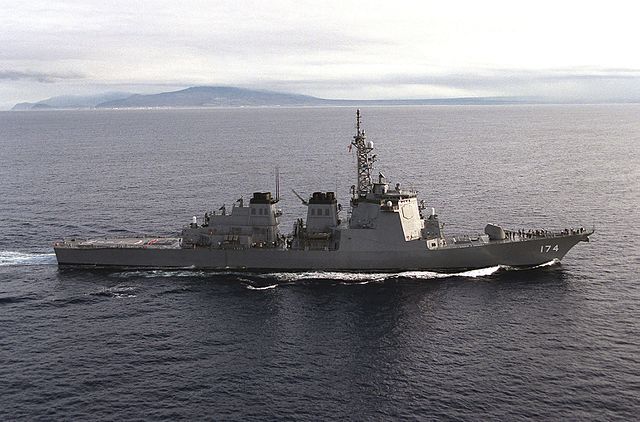
JDS Kirishima, of the Kongo class AEGIS DDs
Japanese Naval Air Service
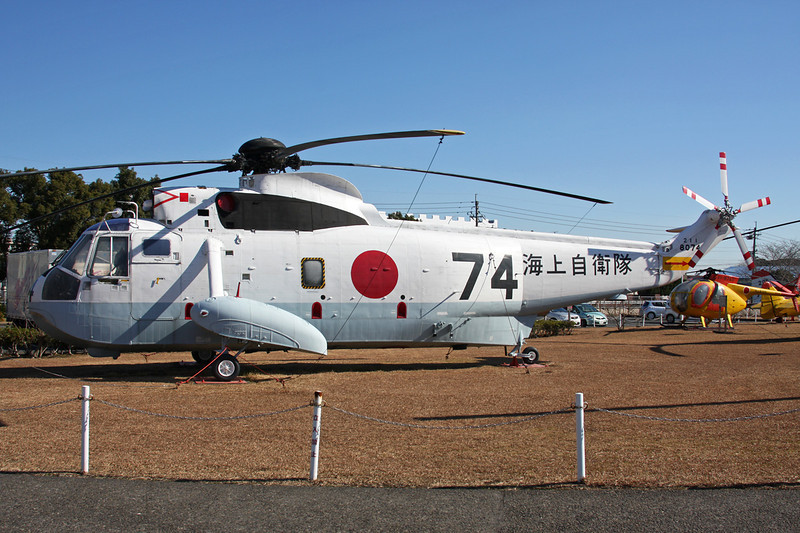
Japanese Mitsubishi HSS-2 ASW and SAR helicopter (Licenced Sikorski S61).
(To be completed)
Japanese Marines
(To be completed)
Japanese Coast Guard

Prime minister Shinzo Abe and admiral Ishii reviews the Coast Guard.
The Japan Coast Guard (海上保安庁, Kaijō Hoan-chō) consists of about 13,700 personnel today, ensuring the protection of the coastline and part of the Ministry of Land, Infrastructure, Transport and Tourism. It was founded in 1948 as the Maritime Safety Agency, largely by the work from March 1946 of USCG Captain Frank M. Meals, but renamed as the coast guard for better international standardization in 2000. Its first tasks including preventing smuggling and illegal trade, black market and even piracy and illegal immigration. But also to clean up the numerous aerial mines laid by the US military in the waters around Japan in the summer of 1945. It became an important mission justifiying a large fleet of minesweepers, notably those of the former IJN as part of the MSA. In 1950, two flotillas also were sent to secure the Korean Peninsula waters under UN flag during the Korean War.

Its task today is to secure Japan’s extensive EEZ, one of the world’s largest, made of an Archipelago of 6,852 islands, including:
-The Ryukyu Islands: 1,394,676 km2 538,487 sqm2
-The Pacific Ocean waters around Japan: 1,162,334 km2, 448,780 Sqm2
-Nanpō Islands: 862,782 km2 333,122 Sqm2
-Sea of Japan: 630,721 Km2 243,523 Sqm2
-Minami-Tori-shima: 428,875 Km2, 165,590 Sqm2
-Sea of Okhotsk: 235 Km2, 91 Sqm2 (Claimed by Russia)
-Daitō Islands: 44 Km2 17 Sqm2
-Senkaku Islands: 7 Km2 2.7 Sqm2 (Claimed by China)
Its assets comprises today some 455 vessels:
-121 Patrol vessels
-234 Patrol craft
-63 Special guard and rescue craft
-13 Hydrographic survey vessels
-18 Aids to navigation tenders
-1 Aid to navigation evaluation vessel, 2 Buoy tenders, 3 training boats.
The Japanese Navy as of 2025

Note: This is going to be moved soon in a new dedicated page on the Modern JMSDF.
 Hyūga-class DDH (2009)
JS Hyūga DDH-181, JS Ise DDH-182

The JMSDF was forbade to have any aricraft carrier by treaty. However with the rapid bulding up of the Chinese PLAN, the US and in general international instances are now more flexible arbout the type of ship that Japan can order. The Hyuga class are a perfect example of this. Until then, DDH or helicopter destroyers are not new. They were built aready in the late 1960s as a distinct type from standard destroyers. But they were also hybrid ship with only and aft deck.
The Hyuga class when announced were clearly in rupture with these earlier designs. They are de facto helicopter carriers and the DDH designation fools noone. On paper, they still have a powerful missile armament to act as destroyers, but having nothing like the standard sensors and structure asked for a true destroyers, they are less capable, a sacrifice made for a full deck and island. They are, with the next Izumo class a symbol of the new Japanese military buildup these recent years.
They are essentially small aircraft carriers designed to support anti-submarine warfare (ASW), disaster relief, and amphibious operations.
JS Hyūga (DDH-181) was commissioned on 18 March 2009 and is homeported at Yokosuka and JS Ise (DDH-182) on 16 March 2011, in Kure.
Their assets for ASW the capacity to deploy multiple helicopters, far more than all previous DDH. They are still also equipped with advanced sonar and radar systems. They could function as a fleet command center with advanced communication systems. To make the “pill” esier swallow in a clear infringement to pas limitations, she was presented also as optimized for disaster Relief & Humanitarian Aid with her large flight deck and spacious hangars easing these relief operations across the world, transport of personnel, extra accomodations, medical supplies and vehicles and eas to power any site from shore.
They are also meant to support amphibious & Logistics Support, the first beong also an encroachment on past limitations, however it is presented as a way to recapture contested islands. The carrier thus could operate army helicopters of all sizes and supports Marine Corps-style operations as well as transport ground forces.
Specs:
Displacement: c19,000 tons full load
Dimensions: Length: 197 x 33 x 7 (646 x 108 x 23 ft)
Propulsion: COGAG: 4× IHI LM2500 gas turbines. 30 knots (56 km/h)
Crew: 360 personnel without air group
Aircraft: 11 helicopters, SH-60K Seahawk, MCH-101, UH-60J
Armament: 1x 16 VLS (RIM-162 ESSM, RUM-139 VL-ASROC), 2 × Phalanx CIWS, 2 × Type 90 3-in naval guns, 2×3 Mk 32 TTs.
Izumo class (2012)
Izumo (DDH-183), Kaga (DDH-184)

If the Hyuga class was already a serious breach to past limitations, the reaction of the international community was such in its leniency that it drove a clear path towards further, even larger “DDHs”. There is no international laws to prevent a destroyer to carry aircraft, so were ordered two DDHs with much larger dimensions and capacity and a reinforced deck plus extra facilities in order to operate the Joint Fighter F-35, as proposed by the US. However this was done by steps, by the deployment of helicopters only in a first move, then F-35s, albeit the whole program has suffered such delays it aroused controversy.
The Izumo-class helicopter destroyers are the largest warships in the Japan Maritime Self-Defense Force (JMSDF) today, officially designated as helicopter destroyers but effectively light aircraft carriers in all but name and only rising concerns and complaints by China. They are modified to operate F-35B stealth fighters, and thus became, without even trying to hide it, the first carriers since World War II. There is just a stretch before more are built with more evocative names such as Akagi or Shokaku, since “Kaga” is already out. The new symbol of the Navy, featuring the Imperial Chrysantemum, is also a symbol of this “revival”. JS Izumo was commissioned on 25 March 2015 and is now based at Yokosuka, whereas JS Kaga was operational on 22 March 2017 and is now based at Kure.
The follow-up class is not official yet. But a class will likely be called in the late 2040s to replace the current Hyuga class, and it will certainly be larger. However the only brake to this expansion would be the diet (parliament) and public opinion, as China or not, taxpayers could be vocal about these extra spendings when other issues are at hand already like an ageing population. However about the size and nature of these new ships, one revealation is that Japan expressed interest recently on EMALS (electromagnetic catapults). That gives a clue on a much larger design.
Specs:
Displacement: c27,000 tons full load
Dimensions: 248 x 38 x 7.5m (814 x 125 x 25 ft)
Propulsion: COGAG, 4 × IHI LM2500 gas turbines. 30 knots (56 km/h)
Crew: c520 personnel wt air group
Aircraft Capacity: 28 aircraft, including F-35B Lightning II, V-22 Osprey and same as Hyuga.
Armament: 1×16 VLS (RIM-162 ESSM, RUM-139 VL-ASROC), 2 × Phalanx CIWS, 2 × Mark 32 TTs
Kongo class missile destroyers (1991)
Kongō, Kirishima, Myōkō, Chōkai
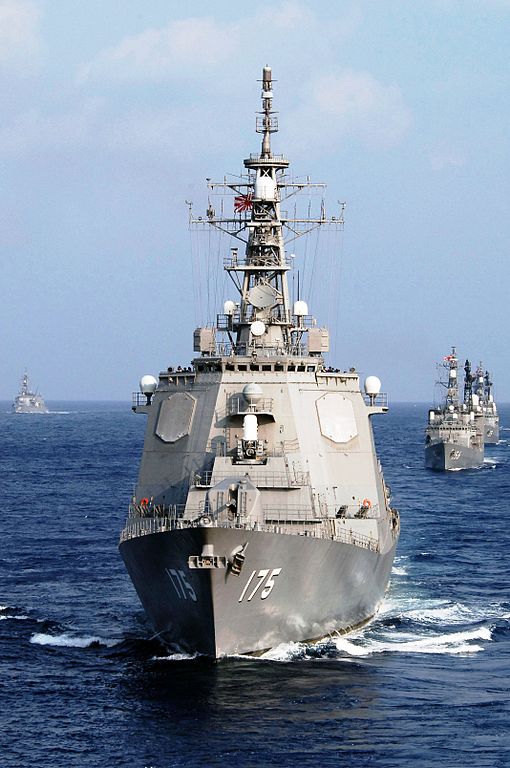
The Kongō class marked a clear new generation of large missile destroyers, symbolic of the rapid rise in capabilities of the JMSDF. This was reflected in their electronics capabilities with a local variants of the USN AEGIS system, new looks and size, and new names, those of capital ships and heavy cruisers of the IJN. Quite a symbol. But they were also started at the very end of the cold war, started in 1990-95 and completed in 1993-98.
Not off-topic since the first was indeed laid down before of “official” end of the cold war in December 1991 and they were studied from 1986 as a replacement for the earlier 1970s DDs. The main start of their design was that the JMSDF estimated its fleets would not survive against airborne strikes from Tupolev Tu-22M bombers with the new AS-4 missile. This conducting the government to ask some help from the US, to acquire the Aegis Weapon System (AWS). In 1984, concrete implementation plans started, agreements were signed, an full replication in Japan also. Construction of the first Japanese Aegis-equipped ships was under the FY1988 program.
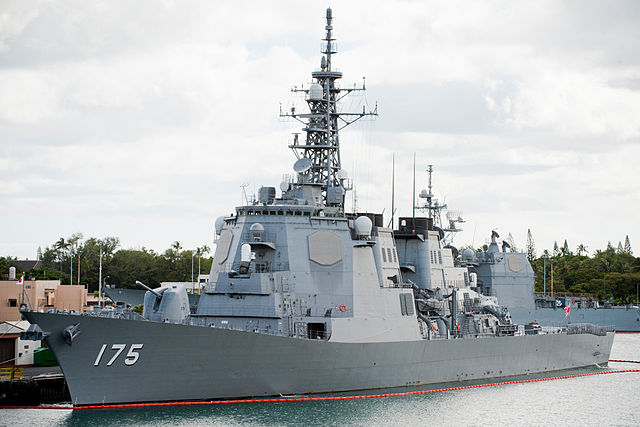
IJ Myoko of the Kongō-class (Kongō, Kirishima, Myōkō, Chōkai) in the 1990s
The overall design followed the Arleigh Burke-class with a shelter deck design widened to support a brand new, much taller superstructure, with four PESA antennas and inclined hull outer panels to reduce waterline lines, also reducing radar cross section, hence improving stealth as well. They were also to carry extra commanding equipment. They had a vertical mast and enlarged superstructur for headquarters equipments as flagship. The propulsion system was also a replica of the Arleigh Burke class with four Ishikawajima-Harima LM2500 gas turbines for 30 knots.
The Kongo class were the first Japanese modern warships to nearly reach the treshold of 10,000 tonnes fully loaded.
These were also the first Japanese destroyers equipped with a versatile Mk41 vertical launching system, operating the following:
-SM-2MR Surface-to-air missile
-SM-3 Anti-ballistic missile
-RUM-139 Anti-Submarine Rocket
-RIM-162 Surface-to-air missile
Also their triple HOS-302 torpedo tubes banks were able to operate either the Mark 46 torpedo or the Type 73, both acoustic for ASW warfare.
Each could operate a SH-60J/K helicopter, but without hangar.
With the rapid rise of the Chinese PLAN, this was quickly outdone by the next classes, the 2005 Atago, and 2018 Maya class. Plans for a larger replacement, possibly a cruiser class (to rival the Chinese Type 055 notably), is currently studied for the FY2023 program. As of today, the JMSDF possesses eight AEGIS destroyer and Japan was the first nation to obtain this technology outside the US, followed by Spain and South Korea.
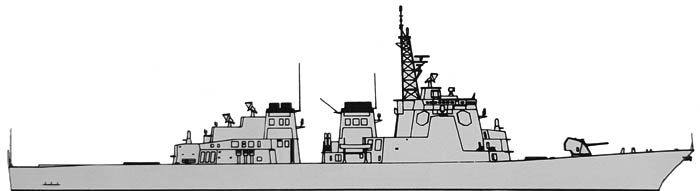
Kongo profile, Conways
Specs
Displacement: 7,250 tonnes standard, 9,500 tonnes FL
Dimensions: 161 x 21 x 6.2 m (528 x 69 x 20 ft)
Machinery: 2 shafts, 4 Ishikawajima Harima/GE LM2500-30 gas turbines, 100,000 bhp. 30 knots, range 5,200 nm/20kts
Sensors: AEGIS, NOLQ-2, OQS-102 sonar
Armament: 1× 5 in/54 Oto,2×4 Harpoon, 2x CIWS, 2× HOS-302 TTs, 90-cell Mk 41 VLS, 1 helicopter
Crew: 300
Murasame class missile destroyers (1994)
Murasame, Harusame, Yūdachi, Kirisam, Inazuma, Samidare, Ikazuchi, Akebono, Ariake
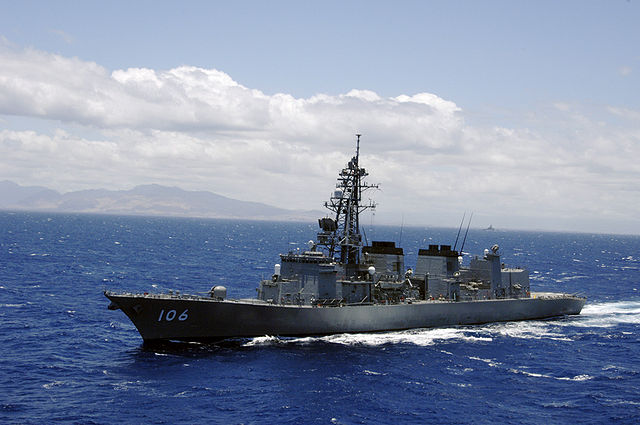
Following their FY1977 policy of having a fleet of general-purpose destroyers under the ‘8-8’ helicopters concept, FY1986 planned twenty 1st gen of these, twelve Hatsuyuki, eight Asagiri class to fill all four flotillas. It was planned long term to shift to destroyer escorts for local District Forces but performance obsolescence became a concern and it was decided to advance a second generation of these versatile DDs. As many former, they were named after WW2 sunken IJN destroyers.
They were also much larger in size, reaching 6,200 tonnes fully loaded. In all, 14 were planned, but just 9 were completed are are currently active at least until 2040. With the 2008 financial crisis the next five were cancelled. They were laid down in 1993-99 so truly post-cold war vessels, completed in 1996-2002. The five cancelled were replanned with a completely new design in mind, of the third generation, the Takanami class (launched 2001-2004), followed by four AEGI equipped, stealthy Akizuki-class destroyers (2010) and the two Asahi-class destroyers (2016), all of the 3rd gen. It is planned to return to a slightly larger class in numbers by the 2020s.
They were also the first of that type fitted with two Vertical launcher systems (VLS) to fire the Evolved Sea Sparrow SAM and the VL-ASROC.
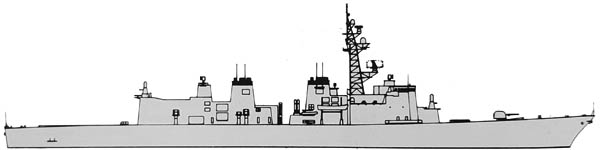
Murasame profile, Conways
Specs
Displacement: 4,450 tonnes standard, 6,200 tonnes FL
Dimensions: 151 x 17.4 x 7.2 m (495 x 57 x 1 ft7)
Machinery: 2 shafts COGAG, 2x IHI-GE LM2500, 2x KHI-RR SM1C 60,000 bhp. 30 knots
Sensors: OYQ-9 CDS, OYQ-103 ASWCS, FCS-2-31, OPS-24B, OPS-28, sonars OQS-5 OQR-2 TASS
EW: NOLQ-3 suite, Mk 36 SRBOC, AN/SLQ-25 torpedo decoys
Armament: 1× OTO Melara 76 mm, 2x CIWS, 2×4 Harpoon, 2×3 324 mm TTs, 2x 16-cell Mk 48/Mk 41 VLS.
Crew: 165
Atago class missile destroyers (2000)
Atago, Ashigara, 2000s
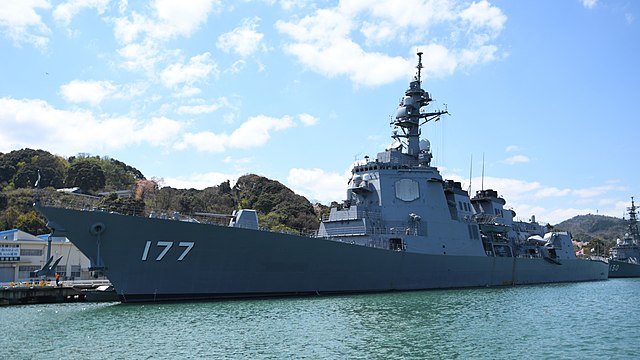
IJ Atago, of the namesake class.
(To come in 2026)
Maya class missile destroyers (2000)
Maya, Haguro
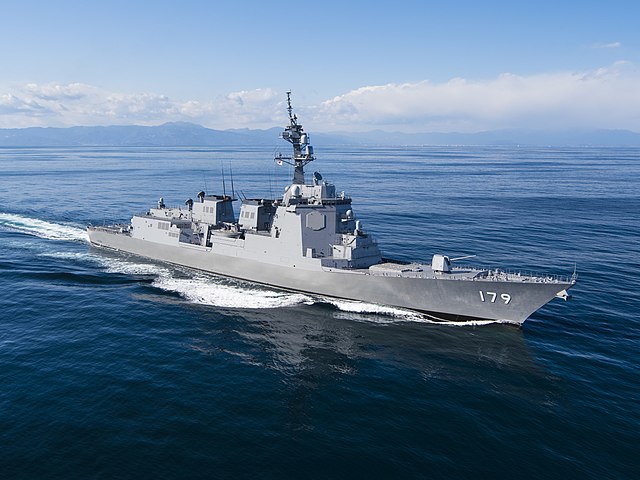
(To come in 2026)
Takanami-class destroyer (2003)
JS Takanami, Onami, Makinami, Sazanami, Suzunami

Improved Murasame design. Second-generation, general-purpose (3W) destroyers. The Murasam had been generally satisfactory for the fleet, but many issues were raised, so from FY1998 a slightly modified version corrected these, the Takanami class. First laid down in 2000, last commissioned in 2006.
(To come in 2026)
Akizuki-class destroyer (2012)
JS Akizuki, Teruzuki, Suzutsuki, Fuyuzuki

Designed to escort the Hyūga-class and Izumo-class helicopter destroyers as well as Aegis-capable Kongō-Atago class. 3W defence. 5,000/6,800t.
(To come in 2026)
Asahi-class destroyer (2018)
JS Asahi, Shiranui

5100/6800t ASW destroyer.
(To come in 2026)
Mogami-class Frigate (2022)
Mogami, Niyodo, Kumano, Noshiro, Mikuma, Yahagi, Agano
5500 tonnes multirole frigates. Successor of the Asagiri-class and Abukuma-class, for 3W, surveillance and minesweeping with IJ Niyodo, Yūbetsu, Natori to be commissioned late 2025, 22 planned total and a “kai” (new design) for the next 10 ships.
(To come in 2026)
Oyashio-class Submarine (2000)
JS Uzushio, Isoshio, Narushio, Kuroshio, Takashio, Yaeshio, Setoshio, Mochishio
2,750 tonnes (surfaced), 4,000 tonnes (submerged), 2 of 11 built converted to training ships (see Training Vessels below) and Uzushio decommissioned.
(To come in 2026)
Sōryū-class submarine (2009)
JS Sōryū, Unryū, Hakuryū, Kenryū, Zuiryū, Kokuryū, Jinryū, Sekiryū, Seiryū, Shōryū, Ōryū*, Tōryū*
10 attack subs with AIP (Sterling), 2,900 tonnes (surfaced) 4,200 tonnes (submerged).
*The Ōryū sub-class (2020) are the world’s first submarine powered by lithium-ion batteries as AIP.
(To come in 2026)
Taigei-class submarine (2022)
JS Taigei, Hakugei, Jingei +4 in construction
Latest Japanese conventional Attack subs, 3 built, 2 order, 2 planned, enlarged Ōryū class, 3,000 tonnes surfaced, 4,500t submerged.
All the class above features a mix of torpedoes (Type 18) and encapsulated Harpoon SSMs.
(To come in 2026)
Ōsumi-class LSTs (1998)
JS Ōsumi, Shimokita, Kunisaki

8,900t standard, 13,000 tonnes FL, built 1998-2003, upgraded to land Boeing MV-22s on their large flight deck and carry the AAV7A1 Amphibious Assault Vehicles. Their helicopter capacity is of 8, tied topside on their spot. They are lightly armed, with two Phalanx and 2 HMGs, plus a Mk.36 SBROC decoy launcher.
Note that the modern Amphibious capacity of the JMSDF also comprises the following:
-1-Go-class: 6x 182t LCAC hovercraft
-YL-09 class: 7x 50 tons LCM
-1 LCU-2001 50t LCU, decom. 2022.
-1 YL-119 200t LCL
(To come in 2026)
Uraga-class Mine countermeasure vessel (1997)
Uraga, Bungo
The Uraga-class mine countermeasure vessels (MCMVs) are specialized minelayers and minesweepers operated by the Japan Maritime Self-Defense Force (JMSDF). They are designed for mine warfare operations, including both laying mines and clearing enemy mines to ensure safe passage for naval and commercial vessels.
They are interesting ships, with a large aft flight deck. It is strong enough to support the MH-53E helicopter. The rear part of the superstructure is a maintenance hangar for air-cushioned minesweepers. The helicopter deck and well deck are connected by an elevator.
Specs:
5700t standard, 6,850 tonnes FL, 141m long by 22m.
(To come in 2026)
Sugashima-class minesweepers (2001)
JS Naoshima, Toyoshima, Izushima, Aishima, Aoshima, Miyajima, Shishijima, Kuroshima

Three decommissioned, one after collision in 2019, one sunk after a fire in 2024.
(To come in 2026)
Hirashima-class minesweeper (2008)
JS Hirashima, Yakushima, Takashima
(To come in 2026)
Enoshima-class minesweepers (2012)
JS Enoshima, Chichijima, Hatsushima
Like the previous classes above, evolution of a 650t design.
(To come in 2026)
Awaji-class minesweepers (2017)
Awaji, Hirado, Etajima
First of an evolution, larger design at 290t tonnes. More planned.
(To come in 2026)
Hayabusa-class OPVs (2002)
JS Hayabusa, Wakataka, Otaka, Kumataka, Umitaka, Shirataka

Small 240 OPVs to patrol Japanese distant waters, such as west of cape Irizaki (Okinotorishima, Yonaguni, Okinawa islands). FAC/M, gun and missile armed.
(To come in 2026)
Hibiki-class (1991)
Hibiki, Harima, Aki

2,896–3,861 tonnes catamaran design, equipped with a AN/UQQ-2 Surveillance Towed Array Sensor System and large helideck.
(To come in 2026)