
 O 9, 10, 11: Patrol submarines (1926-1944)
Within the cycle of Dutch submarines, from the beginning to the end of the cold war we start with the second branch of the lineage, the ones designed for the Dutch home waters. They were caracterized by the letter “O” for “Onderzeeboot” (“submarines”), and arabic numerals instead of roman numerals and “K” for “Koloniën” for the ones used by the KNIL in the East Indies. The O classes were generally smaller, shorter range than their East Asian cousins, but not less capable. The earliest class in this group were the O 9. 526/656 tonnes boats of a proper Dutch design, they were the first with 2 propellers and a double hull, five torpedo tubes and Sulzer diesels. Like most of the O class caught in the Netherlands, two were captured, one was scuttled, refloated by the Germans, repairs ordered but never completed. All three were sunk or decommissioned in 1944.
Genesis of the O class
Dutch submarines until 1923
Left: HrMs O2. The first Dutch submarines, as already mentioned months ago for the K class, were Holland types. However even though in 1900 the USN adopted its first, France had some since a while, Russia also experimented in the field, the Netherlands’s powerful neighbour, Germany, was not interested at all. Thus, the Dutch “admiralty” roaming the corridors and offices of the Ministerie van Marine were dubious about the new type. Thus, the very first Dutch submarine was a private venture, from to De Schelde shipyard, using Victor & Energo plans from Electric Boat Co. What became O 1 for “onderzeeboot 1” was laid down in June 1904, launched in July 1905, completed in July 1906 and tests performed were relayed by the press, apparently successful, so the Navy paid attention. O 1 was officially funded for and purchased by the Koninklijke Marine on 20 December.
When tested by the Navy however, they found this design lacking in surface speed and range. It was assumed good enough for harbour defence or blockades and a single 25 cm torpedo was not impressive. Later was proposed the Hay-Whitehead type developed by Marley Fotheringham Hay of East Jewett, N. Y., architect and builder. Associated with Whitehead & Co from Fiume he designed for the Netherlands a boat twice as fast, thrice the range, two bow 450 mm Whitehead torpedoes and two reloads. The O2 class was at last funded for and four ordered from De Schelde. Launched in 1911-13, the last was completed when WWI broke out. Soon after the would received K.I, launched on 1913. Next would be the O6 launched in 1916. They don’t belongs to out story, as none of these were operational in 1939, considered completely obsolete. Post-WWI they took training roles only.
The most recent O type, one that was actuallt still around in 1939, was O 8. This was the former HMS H6, a Holland type built by Canadian Vickers & Co. during World War I for the RN. But on 19 January 1916, she ran aground near Schiermonnikoog Is., in Dutch waters, was interned by neutral Netherlands and on 4 May 1917 after an agreement was reached to sell her, integrated in the fleet. HNLMS O 8 was refitted in part with elements from the interned UC-8, later bought from Germany and she received UC-8’s Zeiss stroke periscope. She took part in a major exercises in the summer of 1925. In May 1940 she was under maintenance and was scuttled as she could not escape, raised by the Kriegsmarine, she became UD-1, a training boat for U-Boat crews in Kiel until decommissioned in 1943, sunk 1945.
Development of the O 9 class
These were planned long before they were built, the O 9 had been registered under the 1917 programme. They were first imagined as essentially smaller version of K XI class. They had nothing in common with earlier Holland designs, including those of Marley Fotheringham Hay and were truly a Dutch design through and through, with the experience of WW1, elements from the recent Canadian-built interned H6, now O 6, and the also interned UC-8. The new Dutch submarines would innovate in many ways and again the mast designed and builder was De Schelde in Vlissingen under the supervision of J.J. van der Struyff, B.Sc.. The great novelty of the design was their double-hull, and their German-inspired hydraulically-driven periscopes with a stroke of 4.25 m, diameter 150 mm.
Propulsion-wise for agility they would be the first designed with a twin-shaft arrangement, and the first with a central operation by all ballast tank valves. They were authorized in 1921, laid down in 1922 at De Schelde in Vlissingen. Construction went on until 1925-26, so overall three-four years, with extra care.
This was in complete contrast to the last Dutch-made submarine, HrMs O 7. Single in class, she was started on 12 May 1914 at Fijenoord, Rotterdam, first from that yard. O 7 was still a fairly small, Holland design: She displacement 179 tonnes surfaced, 209 tonnes submerged for 34.2 x 3.9 x 2.9 meters, a crew of 15 personnel, two 350 hp Sulzer diesel for 11.5 knots surfaced (single propeller), 8.5 knots submerged and three 45.7 cm torpedo tubes plus a deck machine gun. O 7 was in fact still around in 1939 as training vessel until replaced O 8 and in May 1940, mothballed at Den Helder, never used and sank in 1944 due to leakage in her hull receiving no maintenance.
Design of the O 9 class
Hull and general design
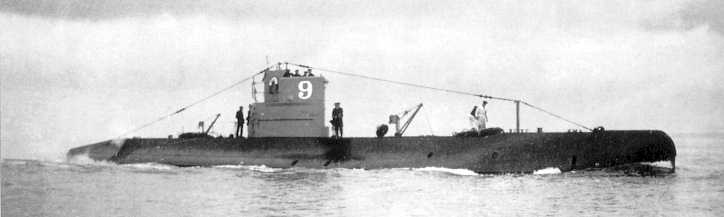
Mixing different elements from Britain the US and Germany in their design, the O 9 as seen above were characterized by their double hull and measured 54.66 meters, for a beam of 5.70 meters and a draught of 3.53 meters, for a displacement of 526 ton surfaced and 656 ton underwater. This meant they were thrice as larger than O 7. The hull was no longer cigar-shaped but had a short bow, rounded but with a straight stem, constant deck height all the way to the tail, and the outer hull widened for form ballasts either sides, merging into the pressure hull forward and aft. The conning tower was of the open style, which was common to British and German boats, rather than having an enclosed helsman’s post like French, Italian or Japanese boats. There were two deck hatches fore and aft corresponding to their respective compartments, enclosed behind bulkheads. The Kingstons grouped in the control room.
They had two recessed anchors, two deck hatches for reloads, 533 mm torpedo forward and 450 mm aft, wkth respective cranes. They had to hydraulic powered periscopesn attack and watch, in a Cinning Tower surrounded by a fairing, open at the rear for the platform to be equipped with pintle mount for a machine gun. None was planned at the start, it was installed later (see below). She had no net cutting abilities but a gard cable running from the prow to the stern anchored on a portico above the CT. The outer hull had a limited number of water scoops, hence a relatively slow diving time. She had also two hydraulic-powered underwater diving planed and two either side of the propellers aft, which were protected by guard bars. Unfortunately were are missing plans so far.
Powerplant
The Dutch wanted prior to WWI German MAN diesels for their submarines, but with the war breaking up delivery never came and instead, some were re-equipped with Swiss Sulzer diesels. This became soon a trademark of Dutch as well as French submarines of the interwar. The O 9-class in that occurences had two 6-cylinder two-stroke diesel engines from Sulzer in Winterthur. The venerable company exist since 1834 and specialized in all sorts of engines. The company was also one of the pioeneers that improved on Rudolf Diesel patterns. These engines were able to develop an output each of 450 bhp (336 kW) for a total of 900 hp (672 KW). This enabled her to run at 12 knots (22 km/h; 14 mph) surfaced, for a range of 3,500 nmi (6,500 km; 4,000 mi) at 8 kn (15 km/h; 9.2 mph).
When diving, she swapped to two 250 bhp (186 kW) electric motors (provider uncertain) to feed a 120 cells battery which had a global capacity of 4350 Ah, enabling a run at 8 kn (15 km/h; 9.2 mph) and a range at that speed of 25 nmi (46 km; 29 mi) at 8 kn (15 km/h; 9.2 mph) or just to operate submerge for 3 hours. The diving depth of the O 9 class was 60 meters.
Armament
Like contemporary K class of the early 1920s she had an interesting torpedo mix: She would have five torpedo tubes totwal, but in the bow were two 53.3 cm torpedo tubes and two more 45 cm torpedo tubes below. The upper ones were for the “big preys”, warships, generally better protected, and the lower ones for merchant vessels, unprotected. This allowed a dual role against an enemy fleet or as blockade runners depending on the mission, but on paper. The last and third 45 cm torpedo tube was in the stern.
They had a total of ten torpedoes, two reloads for the 533 mm tubes and six for the 450 cm tubes, likely all four forward. The stern tubes, as often at the time, was likely a defensive “one trick pony”. But this mix was unusual, as the choice of keeping 450 mm torpedoes, now considered obsolete and only kept for light vessels (like MTBs) and aircraft. This was completed by a 8.8 cm cannon on deck, more potent that the usual 75 mm of the K class. There was at some point also a heavy 12.7 mm or 0.5 inches Browning machine gun for AA defence. The debates is when they were installed, assumed to be the late 1920s.
533mm Whitehead Torpedoes
They were likely British-designed 533 mm (21-inch) Whitehead torpedoes—manufactured at Weymouth. There were four carried by the O 9 class: Two in tubes, two in reloads. It could have been the Whitehead Mark III*, since the submarine-tailored Mark VIII was not available before 1927. It was a burner cycle design torpedo, still used in its later version Mark 8 Mod 4 in the 1980s in the RN (Courtesy of Gral Belgrano). Without more information on this topic, in research. Other sources mentions the XIIa, older standard interwar surface and coastal battery torpedo type phased out or supplemented.
450mm Whitehead Torpedoes

Whatever the launch mode, these were of the British class 18-inches type Mark III (In Dutch service called the “Type III”). Other sources points instead the Mark II. The latter model was developed from the Holland type submarines and wa smass-produced both in the US and Britain for them. It weghted 845 pounds for 140 inches (3.55 meters) in lenght, 17.7 inches (45 centimeters) diameter, and an effective firing range of 800 yards.
The Warhead carried 118 Ibs of wet guncotton, activated by a Mk 1 contact exploder. It was powered by a 3-cylinder reciprocating engine to 27 knots with a depth control system and gyroscope to remain on course. In all, these submarines carried 12 of them. The Mark III or in Dutch “Typ III45” wa smanufactured at the torpedo factories in Weymouth and Saint Tropez and used from 1922 to 1946 with 129 purchased. It weighted 785 kilograms for 5.43 meters and carried 165 kilograms of TNT for a range of 2,000 meters at 40 knots and 6,000 meters at 26 knots based on its 4-cylinder pneumatic radial engine.
It’s unclear if the last boat had been modernized close to WW2, receiving later 45 cm types, notably importing the more advanced III** H HB. This was the latest evolution. One unlikely candidate however was the 1913 Mark VIII designed for submarines but also used on naval aircraft. The RGF Mark VIII* (1914) had indeed a Wet heater, weighting 1,425 lb (646 kg) for 16 ft 8 in (5.08 m) long and carrying a 320 lb (150 kg) TNT warhead, for a range and speed of 1,500 yd (1,400 m) at 41 knots (76 km/h), 2,000 yd (1,800 m) at 39 kn (72 km/h), 3,500 yd (3,200 m) at 29 knots (54 km/h) or 4,000 yd (3,700 m) at 28 kn (52 km/h). The issue was to procure them after the war. 1.
88 mm/42 Bofors deck gun
These 88 mm (3.5 in) were considered dual-purpose and common to the K VIII, K XI, O 9, O 12, K XIV, O 16, O 19, and O 21. Given the caliber we can assume they were German Krupp submarine deck guns. The Dutch specifically for example used on O 21 class the 8.8 cm/45 (3.46″) SK C/35 shared with Type VII u-boats. The earlier model was however unlikely to be the 8.8 cm/30 (3.46″) Ubts + Tbts Flak L/30 as it was decribed in some sources as a 8.8cm/42 Bofors No.2. This was the result of an interwar collaboration between Krupp and the Swedish manufacturer Bofors. Following the end of World War I, the Treaty of Versailles strictly prohibited Germany from designing, manufacturing, or importing high-caliber artillery or anti-aircraft weapons. To circumvent these restrictions, German arms manufacturer Krupp acquired a major financial stake in Bofors in 1921. German designers and engineers were secretly sent to Sweden to collaborate on heavy anti-aircraft and naval artillery. The “8.8cm/42 No.2” was a follow-up of export models such as the 7.5 cm Model 1929 and various 76mm variants. This secret engineering pipeline eventually culminated back in Germany as the legendary 8.8 cm Flak 18/36/37. In Sweden the semi-automatic breech mechanisms and cruciform carriage layouts were refined during this Swedish interwar period.
Bore: The Calibre was 88 mm (3.46 inches) with a barrel Length of L/42 (or 3.69 metres (12.1 feet).
The designation No.2 was for the mounting, single pedestal deck mount with open wet-mount layout. For Surface-to-surface engagement and low-angle defense, liklely c30° elevation.
It fired fixed QF (Quick Firing) ammunition, optimized for rapid deck handling in rolling seas.
Roughly 9 to 10 kg (approx. 20–22 lbs) depending on high-explosive (HE) or armor-piercing (AP) round variations.
Muzzle Velocity is estimated between 700 to 790 m/s (approx. 2,300–2,600 ft/s). The shorter 42-caliber barrel traded raw velocity for decreased weight and better handling profiles on narrow submarine casings.
12.7 mm AA HMG
Likely the Browning M1920 Cal. 0.5 or 12.7 mm was adopted on all Dutch submarines for AA defence in 1927 or 1928, and installed from then on. It’s inclear if they were of the air-cooled or liquid-colled variant, the latter being much more cumbersome to install. In both cases it was, when not in use, stored inside a waterproof leather bag on the platform deck to avoid extracting it from inside the pressure hull each time the submarine surfaced for combat. This formula was the same for most submarines using HMGs or LMGs at the time. It was located aft of the fairing but had a massive blind spot forward. The 8.8 cm Bofors L/42 had eneough
Sensors
The use of hydrophones evolved and Dutch submarines were equipped with modern German hydrophones in 1919. Based on its traditional preference for German technique, an inheritance from the cooperation on the development of submarine technique in the interwar period, the Netherlands bought advanced hydrophone systems from the German firm Electroacoustic in 1930. This cutting-edge equipment enabled the Dutch submarines to find and follow enemy vessels. The Dutch also introduced enhanced versions of hydrophone from the firm Atlas Werke. These active sonars, called periphons, of the C type, enabled Dutch submarines to identify enemy convoys at 10 miles. This technique further enabled the Dutch to employ their preferred roedel tactics: a submerged approach of an enemy transport fleet over long distances, to a launching position, most preferable at 90 feet deep. 1
⚙ specifications |
|
| Displacement | 526 tons surfaced, 656 tons submerged |
| Dimensions | 54.66 x 5.7 x 3.53m (179 fr 4 in x 18 ft 8 in x 11 ft 7 in) |
| Propulsion | 2x Sulzer diesels 450 bhp (336 kW), 2 EM 250 hp (186 Kw). |
| Speed | 12 knots surfaced and 8 knots submerged |
| Range | 3,500 nmi (6,500 km)/11 kts surfaced, 25 nmi (46 km)/8 knots sub |
| Armament | 2x 533mm, 3x 450 mm (+6 spares) TTs, 88 mm (3.5 in) deck gun, 1 HMG |
| Sensors | Atlas Hydrophones |
| Max depth | 60 m (200 ft) |
| Crew | 29 |
Career of the O 9 class
 O 9 (1925)

On 30 Aug 1921, O 9 is ordered and on 1 Dec 1923 or 23 Sep 1922 she laid down at the K.M. De Schelde shipyard in Vlissingen. On 7 Apr 1925 she is launched and commissioned on 18 Jan 1926 in the Royal Netherlands Navy. From 18 Jan 1926 she starts qualification training under her new commander, and on 10 Mar she hosts the Dutch Royal Family for a short demonstration trip. From 21 Jun to 30 Jul 1926 with her sister O 11, Maarten Harpertszoon Tromp, Jacob van Heemskerck, the toprpedo boats Z 7 and Z 8 she made a training cruise from Nieuwediep (Den Helder) to the Baltic, stopping at Kiel, Göteborg and Drontheim. From 8 July to 8 August 1929 with her sister O 10, Jacob van Heemskerck, Z 5 and Z 6 she has another training cruise in the Baltic. On 30 Jul 1930 with O 10, Jacob van Heemskerck and Witte de With she visit Antwerp in Belgium. From 1st July to 7 Aug 1931 with O 8 and O 10, Jacob van Heemskerck, Z 7 and Z 8 she left Nieuwediep for another Baltic cruise. From 4 May to 20 Jun 1936 all three sisters are reunited with HrMs Hertog Hendrik and Z 5 for another cruise in the Baltic.
On 29 August 1939 the Dutch armed forces mobilized and the three submarines are attached to the “coastal division”, part of the coastal defence. On 6 March 1940 O 9 and O 10 are close enough to see O 11 colliding with the tugboat BV 3 after which she sank, they rushed for assistance but could not do much. On 10 May wiht the attack, O 9 and O 10 are patrolling off the Dutch coast. O 9 is attacked by Stukas but not destroyed. The war patrol started on 9 May 1940 in the evening from Den Helder with orfers to patrol between Egmond and Bergen aan Zee. At 06:00 the next morning, O 9 raise the periscope to recoignize her position, spot smoke columns. Soon after she is informed the country is now at war with Germany. She remained surfaced during the night and remained mostly submerged during the day and on 10 May 1940 next morning she is off Bergen aan Zee having just reloaded batteries before dawn and now submerging.
She spots no target of opportunity and on 11 May 1940 with her sister she returns to Den Helder. The next night she is ordered to return to Den Helder, and her commander takes a rout along the ‘Franse bankje’ to avoid the German mines of the ‘Schulpengat’.
On 12 May 1940 she arrives off Den Helder, enters the port, reloads batteries, compressed air, takes supplies, and witrh her sister and the tugboat Witte Zee received orders to sail to Portsmouth to escape capture, but the crew continue to load the submarine when the Luftwaffe this morning attacks the port. These are 2-engine ME 110s. The O 9 crew is on deck manning the main gun and HMG, and they are strafed. By the afternoon the crew pick up their personal gear from the barracks and all three departs around 23:30 hrs Den Helder.
13 and 14 May are uneventful, they are not spotted and on 15 May they arrives off Deal, berthing, after which civilians and Naval personnel comes on board for a debriefing. Other sources sugest it was in Portsmouth but it possible they were rerouted there, and in any case, O9 is ordered to sail to Gosport, Portsmouth, having to dive underway due to Luftwaffe patrols. On the 16th she hosts Admiral Furstner and Queen Wilhelmina during their visit. Until June she is under British operational control, receiving modern British hydrophones and new antenna. She started patrols the Channel to cover the evacuation of Dunkirk and Bordeaux but reports batteries issues. In Portland the O 9 also has to dive during an air attack. She is joined by O 10, O 21 and O 22. On 9 July at 17:00 hrs she depart Portland with her sister and O 23, Z 6 for Rothesay in Scotland, far from the Luftwaffe. Some sources states this was Dundee. In any case, they sails to Milford Haven and then Rothesay where O 9 strats a new career as ASDIC piggy boat, to train RN ships in ASW detection until March 1944, attached to the 7th Training Flotilla. Her deficient batteries prevents patrols.
Sehe still makes a short transit from 23/25 March 1941 and later under Dartmouth always under escort to avoid friendly fire. In ealry Apr she left Dartmouth for at last a patrol in the Bay of Biscay, trying to catch German ships, notably blockade runners from Bordeaux, Italian and German submarines as well. She also ventured north and patrols the ‘Iron Ring’ off Brest in Britanny in interception of a possible sortie by KMS Gneisenau, Scharnhorst and Prinz Eugen. She returned on 7 April due to a shortage of distilled water for the batteries, arrives on the 9th in Falmouth, then sails to Devonport. On the 13th she head for Holyhead in Wales) and had maintenance and exercise before returning to Rothesay for exercises. By 15 Nov 1941 her commander is Ltz. II H.A.W. Goossens. On 20 Dec. 1941 she is in Irish Sea when ordered back to port and made another patrol off Brest but it is cancelled off Milford Haven due to engine issues. On 23 Dec. she Rothesay again but then developed gearbox trouble and returns to port. On Xmas she is at Milford Haven. She is ordered to return to the ‘Iron Ring’ off Brest. At last on 31 Dec. her gearbox is fixed and a sprocket replaced.
On 2 January 1942: O 9 joins her sister O 10, as well as the TB Z 5 and Otway from Wolf Rock to Rothesay. On 13 June she is inspected by the First Lord of Admiralty Mr. A.V. Alexander and Sir Max Horton at the head of the RN sub force. Between Marche and June 1944 she remains at Londonderry in Northern Ireland, still acting as ASDIC piggy boat, in waters more realistic of U-Boat patrol areas.
Until 28 Sept. she is under command of Ltz. II Baron and until October she is based at Campbeltown in Scotland. On 2 Oct. she left for Dundee for repairs. On the 27th she returns in her role.
Until 16 Nov. she had exercises the Tay Sanctuary off Dundee but thay day her dive planes are badly damaged. On 1st Dec 1944 the command decides she is just too old and worn out to be viable anymore, and O 9 is decommissioned. Her crew is tranferred on more modern British subs for the remainder of the war. In June 1945 after the country is freed, she arrives in Rotterdam and is stricken on September 1945. She is sold for BU on October 1946, to Hendrik Ido Ambacht.
O 10 (1925)

O 10 is ordered on 9 August 1921 and she is laid down on 24 December 1923 at Scheepsbouw Mij. shipyard, launched on 30 July 1925, commissioned on 1st Sept. 1926. From 9 May to 1 June 1927 with O 11, Hertog Hendrik, Z 5-8 she makes a cruiser from Nieuwediep, Den Helder to Norway.
She makes a Baltic cruise from 12 July to 8 Aug. 1927 via the Kattegat. She taked part n a sortie to Scotland from 16-28 Jul 1928 with Hertog Hendrik, also from Nieuwediep in the North Sea and stopped at Edinburgh. From 8 July to 8 August 1929 with Jacob van Heemskerck to the Baltic. In the Winter 1929-1930 at N.V Werkspoor Amsterdam she received a brand new German torpedo-launch installation for a bubble-less launch, but its unsatisfactory on tests and removed. On 30 Jul 1930: with Jacob van Heemskerck and Witte de With she visits Antwerp.
On 1 July to 7 August 1931 all three sisters plus Jacob van Heemskerck left Nieuwediep for the Baltic and exercises. Same from 4 May to 20 June 1936, back in April 1937.
O 10 is mobilized on 29 August, joins the ‘coastal division. On 6 March 1940 she is present when O 11 collides with the tugboat BV 3 and sinks.
On 14 Apr O 10 is misdentified and attack by British aircraft off Noordwijk. O 10 and 9 were on patrol from 9 May when the Germans attacked (see above) on a line between Egmond and Bergen and she is back on 11 May to Den Helder. On 15 May after supplying she arrives in Portsmouth, passed under British operational control but still manned with her original crew and officers. Until June she patrols the English Channel then headed for Portland and is used there for ASW exercises but she is not selected for patrols due to to her issues with reloading batteries in thee summer nights. From 19 to 29 July she is overhauled in dry-dock at Glasgow. She is later sent to Rothesay via Milford Haven to be used as ASDIC piggy boat like her sister, attached to the 9th Flotilla in Dundee.
She still made a crew between 23 and 26 March 1941 from Londonderry to Falmouth and on the 27th she was inspected by Vice Admiral J.T. Fürstner, commander of the Free Netherlands Navy. She made a patrol still between 29 March and 5 April in the Bay of Biscay and later joined the ‘Iron Ring’ off Brest. On 29 March she left Falmouth with HMS H 44 and H 50 and arrived on 1st Apr at the southernmost point of her war patrol in the Bay of Biscay but had to return due to her short range, back on 5 April. She transited vua Devonport to Rothesay, then Holyhead (Wales) in the same role. She made another sortie in the Bay of Biscaye from 16 to 24 December 1941 and back to Rothesay. She also made another deployment on the ‘Iron Ring’ off Brest but returned on 22 December due to engine trouble.
She was docked at Milford Haven alongside O 21 and after fixes, returned for another war patrol from 26 December 1941 to 3 January 1942 in the Bay of Biscay. Completes her patrol with a short stay at the ‘Iron Ring’ off Brest. On 2 January 1942 she was back to Rothesay but on 10 February 1942 returned to the Bay of Biscay and ‘Iron Ring’ but two days later she is in Falmouth as her potetial preys, Gneisenau, Scharnhorst and Prinz Eugen famously escaped from Brest. She returned to Rothesay but on 13 May she was deployed to Lerwick in the Shetland Islands and between 18 May and 1 June 1942 made an Atlantic patrols, and protection of the Russian convoy PQ 16 from Iceland. On 18/19 May her port diesel engine was stopped for repairs. She ended her escort and returned on 28 May to Lerwick, had repairs and by June she was back to Rothesay. Like her sister she was inspected by the First Lord of Admiralty Mr. A.V. Alexander and Flag Officer Submarines Sir Max Horton.
She made another Atlantic patorl from 4 to 16 May 1942 from Lerwick. Later at her return it is established she is just not suitable for war patrols in the summer and in 1943 suffered from Engine trouble, notably a Clutch stuck, then the Compressor of port diesel broke down. On 15 May 1943 still in patrol her speed fell to 4 kts. A day after off the Shetland Islands she was towed by steam drifters but she regained battery power and arrived at Lerwick. The lack of spare parts forced her back to Rothesay for more repairs but she resumes exercises from 26 June. She is also relocated at Campbeltown and Tobermory as well as Dundee, the latter in October 1944, but she is eventually decommissioned on 11 October. He returned to a freed Netherlands by June 1945, entered the Rotterdam submarine base to be stricken later in Sept. 1946: and sold for BU the next month to an Amsterdam firm.
O 11 (1925)

O 11, las in class, is ordered on 30 August 1921, laid down on 24 Dec. 1922 at Fijenoord shipyard in Schiedam, launched on 19 March 1925, commissioned on 18 January 1926. From 21 June to 30 July 1926 she made a training cruise in the Baltic Sea, stopping at Kiel, Göteborg and Drontheim. From 9 May to 1 June 1927 same but to Norway. From 12 July to 8 August 1927 same to the Baltic via the Kattegat when back. Same between 4 May and 20 June 1936. From 29 August 1939 she is attached to the coastal division. On 6 March 1940 at c10 hrs she collides with the tugboat Hr.Ms. BV 3, rammed just forward of her conning tower. There was no fog. There are 3 Officers and 27 crew members on board, three men die and she sank in the harbour entrance of Willemsoord, Den Helder. 14 mem on deck when it happened jumped into the sea. The emergency telephone buoy is launched but unfortunately failed to work and no communication could be established.
When it happened all three sisters were underway for the production of a promotional movie “Somewhere in The Netherlands”. One cameraman was on board O 11, others were posted at the “Old Harbour” entrance some 150 yards wide. Just as cleared the entrance, the auxiliary guard ship (Bewakingsvaartuig) BV 3, militarized 368 ton former seagoing tug “Amsterdam” of bureau Wijsmuller arriving from the West was proceeding to enter the harbour but as the high pier prevented mutual sighting, and due to inadequate traffic control the small submarines havng no voice radios was unseen until close to collision. BV 3 manoeuver to avoid her upon rounding the pier, but to not running aground she made an emergency turn to port which brough her right on O 9. O 11 made an “emergency astern” manoeuver but it is too late and BV 3 cut deeply in her port side at her forward torpedo room. Albeit its watertight doors were securely closed, there was still one between the forward torpedo room and forward battery that was only blocked by a clamp. It fell over to the wrong side by impact. The BV 3 skipper than decided to go astern, instead of keeping his bow inside O 11 and prevent flooding or push her gently toward the eastern bank to be run aground. Soon with both forward compartments flooded O 11 lost baalanced and sank beyond recovery.
The staff present in the CT managed to jump out, the last securely closing the conning-tower hatch. All men were quickly rescued. The sub sank with the remainder of the men, and three Petty officers. One man trapped forward latter managed to find an issue and swam out free without even being injured. The remainder took refuge in the control room aft and tried to blow of all non-fuel tanks and then No. 3 main (fuel) tank, so at last her periscope broached surface, then the stern and conning tower appeared but her bow remained on the seabed. Her captain directed rescue effort from a boat launched by the cruiser Sumatra, climbed back to the CT, tapped on the hatch, opened from below, so 14 crew members still in the central and stern emerged in a single file with their swimming belts on. However O 11 sank for good later. Effort to save possible survivors forward continued, with the scene lighted up by Sumatra’s projectors. She was probably raised on the 9th, moved to a shallow bank to remove bodies of three trapped crew men. A cofferdam was built around. Later she was repaired enough to be towed, but on 10 May 1940 she was in drydock at the Rijkswerf shipyard in Den Helder after being disarmed. Order is given to scuttle her to avoid capture, the yard is flooded.
The Germans later raised her, but given the level of damage and her age, repairs proceeded without emergency, until September 1944 when she left incomplete to be sunk in the Buitenhaven to block the entrance of Den Helder by the Germans as they evacuate the city before the allied advance. O 11 is finally raised on 10 Dec. 1947 and scrapped, completed in 1948.
Read More/Src
Books
Jalhay, P.C. (1982). Nederlandse Onderzeedienst 75 jaar (in Dutch). Bussum: De Boer Maritiem.
Bosscher, Ph.M.; Bussemaker, H.O. (2007). Gelouterd door strijd: De Nederlandse Onderzeedienst tot de val van Java, 1942. De Bataafsche Leeuw.
Mark, Chris (1997). Schepen van de Koninklijke Marine in W.O. II (in Dutch). Alkmaar: De Alk.
Bosscher, Ph.M. (1984). De Koninklijke Marine in de Tweede Wereldoorlog (in Dutch). Vol. 1
von Münching, L.L. (1978). Schepen van de Koninklijke Marine in de Tweede Wereldoorlog (in Dutch). Alkmaar: Alk.
Raven, G.J.A., ed. (1988). De kroon op het anker: 175 jaar Koninklijke Marine (in Dutch). Amsterdam: De Bataafsche Leeuw.
Jalhay, P.C.; Wijn, J.J.A. (1997). Ik nader ongezien! De onderzeeboten van de Koninklijke Marine. Amsterdam: De Bataafsche Leeuw.
Links
Navypedia full subs list
Navypedia O 9 class
Dutch underwater service
nl.wikipedia.org list subs
dutchsubmarines.com/classes/class_o9
wiki O class
dutchsubmarines.com O7
dutchsubmarines.com O9
dutchsubmarines.com O10
dutchsubmarines.com O11
navweaps.com
Model Kits
None found