
 ASW Escorts (1956 to 1985): F 765-778: Le Normand, Le Picard, Le Gascon, Le Lorrain, Le Bourguignon, Le Champenois, Le Savoyard, Le Breton, Le Basque, L’Agenais, Le Bearnais, L’Alsacien, Le Provençal, Le Vendeen
 Second entry for French Cold War (true) Frigates: The “Le Normand” class or E52 type escort were a followed up of the Le Corse (E50) partly financed under MDAP and designed as battle group ASW fast escorts. These first four escort ships inspired from WW2 US Navy destroyer escorts showed an heavy emphasis on heavy ASW torpedoes (twelve tubes, 12 spares) and a Bofors AA gun defence and Bofors ASWRL. They were a pre-serie for the “real deal” the fourteen E52 escorts built in 1953-60. The latter were still partly paid by MDAP (first half) and ordered in 1952, the second batch was ordered 1853-55 and paid by France. Compared to the E50, the E52 had their armament reshuffled to reduce topweight and improved stability.

Le Gascon in Bayonne, France, July 1967. One of the early E52 batch with its tall open bridge and 3-tiered structure.
Development

In this context, France planned separate Frigates and destroyers for their roles and in addition to few River class frigate that were not returned as Flower class corvette the fleet gained the addition of six recent, modern British Frigates and six US Destroyer Escorts. However technology advanced in submarines, notably the successors of the mass-produced Soviet Project 613 “Whiskey”, led to the design of a new generation of frigates, the E50 which served as blueprints for their successors the E52.

Le Lorrain F768 of the early batch (pinterest)
Genesis of the E52 Project (1949-51)
The Marine Nationale (French Navy) took a prudent approach to the design of its new ASW frigates, at the time called destroyer escorts. It was understood the first class would be modest in scope in order to serve as pre-serie, for a large class. And given the economic context of post-occupation France (Founding member of NATO by April 4, 1949) the US aid programe MDAP was to finance most of these, in order to take their place into NATO areas or responsibilities. Expecting to have most of its shipyards ready to build new ships FY1949, the naval staff planned their new escorts under project code E50 (“E” standing for Escort) followed by their approval date (1950) as part of the 1949 naval plan passed on the revised 1947 plan. Albeit its escorts in the frame of NATO had to join allied battle groups, they would also join newly formed carrier battlegroups, formed around Jean Bart, Dixmude, Arromanches and the two Lafayette class carriers this time to defend the Empire, starying with Indochina.
In 1949, three types of escorts were planned 600 to 2500 ton escorts. Eventually the 1,500t fast escorts. The E50 project was presented already by March 17, 1948 on the latter basis. Only four were ordered essentially prototypes for the future E52, testing the waters on the base requirements of a good enough range, speed aligned to escort work (28 knots versus destroyers at 33 knots), good AA defence, and powerful ASW suite on a reasonable 1,200 tonnes standard. They lacked an helicopter capability at this stage. The ships were built 1952-53 and so trialled 1955-56. However the next design, E52 was planned just two years after the decision to build them in 1952, hence the name, and thus trials results were not there to appreciate the validity of the concept, stability, seawhortiness, performances…
The E52, just an E50 improvement ?
The next class was decided as a follow-on E 50 design, but incorporating a number of improvements, not from trials experience, but continuation of the R&D on the design over two years in 1950-52. The first batch of seven units would be ordered in 1952, approved for financing under MDAP. The remaining ships were paid for by France, with two ordered in 1953, two in 1954, three in 1955. Like their predecessors E50/Corse they recalled in their great lines the USN Dealey class DEs, with a flush deck and transom stern. The E52 class would continue the dame naming tradition of their precedessors, named after inhabitants of important regions and cities. Le lead ship “Le Normand” was after Normandie residents. They would be as first ship laid down in July 1953, a few in 1954 for the first batch, but the next batch would be ordered in later dates and construction slowed down with the last ship laid down in 1957 and completed in 1960.

Le Basque F773 of the latter batch, testing Otomat Missiles, note the canister forward of the 57mm twin AA mount.
The last two extra ships, of the new E52 sub-class, were planned FY1957 naval estimates but cancelled due budgetary issues and a more modern class being planned instead.
In 1954 it was planned to also build an even more austere convoy escorts, 89 m long for 9.5m wide, and displacing only 1000t standard. ASW armament was like for the E 50, but AA armament was down to just four defensive 40mm Bofors. The first three were planned to be laid down at Lorient but they were never voted and the program cancelled. A class of “aviso” would be built instead: The A69 Estienne D’Orves instead.
Given that long span, R&D and technology progresses well in between, so that the last three underwent significant changes. The major difference was at first in layou: With the relocation of the ASW torpedo tubes together with their ready-use lockers. For the sake of rocking stability they were relocated from 01 deck forward to the upper deck amidships. In general topweight was reduced and this freed the forward position to now be occupied by the Bofors ASWRL now with a far better fire arc. Electronics was also overhauled and if the first in class had a similar radar fit to the E 50, later ships integrated the Frencn DRBV-22A air search radar, but it was relocated at a lower level than the DRBV-20A radar. Earlier ships would be later retrofitted to the same standard.
L’Agenais and Le Béarnais also went with different tiered bridge structure redesigned as a large single block extending well forward. This allowed the fire control position to be relocated on top and benefit from a better arc.
The last three as seen above, L’Alsacien, le Provencal and Le Vendéen of the class incorporated so much important modifications they became the Type E 52B, a sub-class. Here are the modifications:
-The ‘X’ 57mm mounting was replaced by a new quad 305mm ASW mortar (Bofors ASWRL removed).
-The forward 57mm mounting was relocated to improve its arc.
-Reload magazines for the ASW torpedoes were removed to further reduce excessive topweight.
-A larger bridge structure received the Strombos-Velensi funnel cap.
Construction
The E52 when ordered were not specified to be “escorteurs océaniques” (ocean escort) but “escorteurs de 2e classe” (2nd class escorts) in 1952 like the E50. However in 1954 as contruction was just getting started, they became “escorteurs rapides” (fast escorts). NATO then applied to them the “F” classification for frigates, also covering all ships planned as destroyer escorts. The E52 thus would receive the pennants F765 to F778. Construction spanned between 4 yards:
F C de la Méditerranée, La Seyne: Le Normand, Le Lorrain, Le Savoyard, Le Vendéen (E52B)
A C de la Loire, Nantes: Le Picard, Le Gascon, Le Champenois
Penhoët, St-Nazaire: Le Bourguignon
Arsenal de Lorient: Le Breton, Le Basque, L’Agenais, Le Bearnais, L’Alsacien (E52B), Le Provencal (E52B)
Design of the class


Note: Chatellerault archives plans of E52B Agenais.
Hull and general design
The E52 frigates were the same small ships as the E50, with flush deck hull, raised prow, split transom stern and an even more susbtantial displacement of 1295 ton standard, 1795 ton full load versus 1,250/1,520t on the E50. Like their predecessors they were just under 100 meters in overall Length at 99.3 m (326 ft) overall in lenght (a tad shorter than E50 ships), 95.1 meters between parallels, for an identical beam of 10.3 m (34 ft) and reduced draught of 4.1 (13ft 5in) versus 4.3 m (14 ft). There were counterkeels but no active stabilizers. They also kept the previous “full” lines, with a well flared bow, and a flatter section starting at the height of the bridge, perfectly flat all the way to the transom stern. The superstructure was extensive. It was for the first ships identical to the E50, but no longer three-tiered, but with as said above a reshuffled armament, both the ASWRL Bofors and forward Bofirs 57mm AA were at the same level, with an upper deck aft for the fire control, followed by the bridge.
The latter was an open bridge. Past it was the mainmast, lattice supporting the optical pointer DMAA, navigation and air surveillance, early warning radars. Right aft of it a separate single funnel made of truncated exhausts of the two boilers. There was also a long aft structure with a short aft mast, relocated torped tube banks and reloads, main fire control tower and its radar for the AA, followed by the two superfiring twin mount as in the previous design. Like the vious design, not provision was made for DCR or DCTs, completely obsolete features. The crew it was of 13 officers and 185 ratings on the E50, but it was down to 175 total on the E52 and later on average 175 peace, but 200 planned for wartime. For them, the Le Normand class carried at first 7-meter whaleboat, one 6-person inflatable boat. From 1972 she received a second 6-person inflatable boat.
As netmarine put it: “The design of the bridge will also evolve, transitioning gradually from the open E 50 type to the enclosed, widened version found on the Agenais and Béarnais models.”
This structure was modified on next batches: L’Agenais and Béarnais for example showed the new single bridge block and its fire control position being relocated on top. The open bridge was now relegated well behind the bridge, on the roof. Anf there was the 52B design. In that case, the funnel was modified with a new capped top that was supposed to massively reduced the exhuast heat and thus, thermal signature. The other major change was the new ASWR located aft, deletion of the forward Bofors ASWRL so that the twin AA was no alone forward, lowing the metacentric height. The torpedo tubes banks were still at the same location on deck amidship but now without reloads, and the bridge was modified a third time, now fully enclosed but panoramic and standardized with modernized French 1950s destroyers and the A69 aviso escorts. The aft mas was also modified and beefed up. The fire control radar was raised as well and the derrick mast taller and stronger for heavier electronics.
Overall the French sources tends to separate the “E52A (3 types)” from the “E52B” as four sub-classes:
E52A: All ships but the last three, including the ones with a modified, enclosed bridge from F772 Breton onwards.
-> E52A type 1/3: F765 to F771, 3-tiered structure and open bridge
-> E52A type 2/3: F772 and F773, enclosed bridge, 1st type
-> E52A type 3/3: F774 and 775; same but enlarged enclosed bridge, 2nd type.
E52B: Last three from F776 to F778 (Aslacien, Provencal, Vendeen): Same bridge of the 2nd 52A type plus many other mods.
Powerplant

F769 at speed (pinterest)
The machinery was all made in France and same as the E50, with two sets of Rateau geared steam turbines, fed by two Indret boilers, for a total of 14,914 kW (20,000 hp). The propellers were classic 3-bladed bronze types, fixed pitch. The Indret boilers were dissymetrical types rated for 35 kg/cm² working at max 385° temperature. This made for a top speed of 27 knots (50 km/h; 31 mph) and based on 390 tonnes fuel oil (one source 310t), they had a range of 4,500 nmi (8,300 km; 5,200 mi) at 15 knots. They also had a secondary power for on-board systems when the machinery was not in use, 4 Renault diesel-driven alternators, 180 kW each (720 kW total), as the E50. On trials, they averaged 28 knots, some reached even 29 knots light. From the E52B onwards the funnel was modified with a Strombos-Velensi funnel cap, already tested by Bordelais on the E50 class. These featured and airplane-wing shape and were painted entirely in hull gray. Funnels of division flagship units were marked with a black band.
Protection
The hull was divided into bulkheads, with a stronger plating (yet not armoured) above the waterline to protect the machinery spaces and ammunition magazines and lighter plating for the structure above in order to manage stability. No armour. They had fire-fighting systems with halon exitinguishers in the ammunition magazines plus emergency rapid-filling cocks, fire points with hoses in the machinery spaces. Other fire fighting posts and bottles were spread thoughout the ship. No NBC protection or washout system for the ealry batch but proper sealing of all doors and hatches. The second batch, E52 2/3 and 3/3 and E52B hopwever had new enclosed bridges, which offered better protection against the elements for watch personnel, as well as in the event of an NBC attack. NBC protection overall was taken more into consideration on the E52B.
Armament

Le Savoyard, F771 (pinterest)

Le Provencal F777, reduced to two twin 57mm and a rear French 305mm ASWRL


Le Vendéen F778 at sea and in drydock (pinterest)

Le Champenois F770
The E52 escorts were well armed for their size, like the E50, but ASW was “close and personal”, lacking long range weaponry: No missiles not helicopters. The Le Normand class used the same torpedo launchers as the E50 Le Corse, quite large at 550 mm, classic French standard torpedo caliber, but usable moslty against submarines thanks to the K2 acoustic torpedoes developed for them. The medium range armament was the trusted 375 mm model 1954 (licenced Bofors) anti-submarine rocket launcher was designed to create a pattern of three charges around the submarine at a distance. It was relocated forward on “A” position on the E50. There were also armaments tests in the latter years (see modernizations).
57mm m1951 Turrets
These models were ubiquitous across the fleet. These three twin 57mm/60 guns modele 1951 were called also 57 mm/60 (2.25″) SAK Model 1950 in Sweden and 57 mm/60 (2.25″) Modèle 1951 in France. Indeed, it was orignally a new Bofors water-cooled design, used by Netherlands, France and Sweden. Bofors introduced this weapon a scaled-up version of the highly successful 40 mm/70 Model 1948. Unlike the latter, the four-round clip (main critic of the operations) was dropped, since the much larger ammunition would have made the clips way too heavy. The E52 carried three of them on “B”, “X-Y” positions but the E52B only retained “A” and “X”.
Loaders were asked to drop individual rounds into ammunition boxes, feeding in turn quadrant-shaped hoppers mounted at the gun’s trunnions, working by gravity at all angles. After reviewing weapons in 1946, the French Navy Conseil Superieur decided the 40 mm Bofors was now inadequate against upcoming jets and decided to adopt the Bofors 57 mm AA gun. They were mated to a French-designed twin turret, ending on the Jean Bart and T47 destroyers. Still, their effectiveness against jets was questionable. More on these on navweaps.com
Specs:
Mount weight 17 tonnes. Barrel length 60 calibers.
Shells: The 2.96 kg HE/prox. fuse, muzzle velocity 956 m/s.
Rate of fire 60 rounds per minute.
Effective range 3,000 m (9,800 ft).
20mm/70 Mark IV Oerlikon AA
This was completed by two 20 mm Oerlikon AA guns located on the structure’s wings amidship, between the funnel and aft mast. No need to present this ordnance, kept to deal with “asymetric threats” and any helicopter. Range was 900 m, they fired a 120g shell at 830 m/sec. up to 450 rpm practical. No stabilization whatsoever, this was the “last recourse”.
550 mm (21.7 in) torpedo tubes
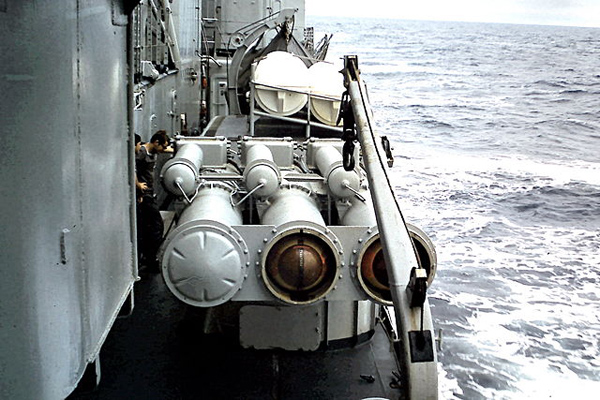 The Corse class had four banks of triple 550 mm torpedo tubes located forward, two on the forward structure, two further out in recesses in the structure, close to the bridge. They were all reloadable. Back in 1955 when completed, the French worked out their first acoustic torpedo of that caliber, recycling bodies of interwar torpredoes with better propulsion systems and an acoustic system. The first models adopted were the K2 weighting 1100 kg, until replaced from 1962 onwards by the L3 model. By any standard this was still a very heavy ASW torpedo armament, quite unique for this French design. This was repeated on the E52 escorts, and still with a total of 24 torpedoes. It was only toned down in the 1960s T. Riviere class which adopted an equivalent to the weapon alfa.
K2 550mm ASWT
The K2 (1956) was essentially similar to the American Weapon Alfa, British Limbo and Italian Menon, but using a torpedo body rather than a rocket. It was made for speed, powered by an Oxygen-alcohol turbine, carrying a 617 lbs. (280 kg) HBX-3 or TNT warhead at 1,000 yards (900 m) at 50 knots.
In case the mission changed dramatically and they needed some anti-ship capability, there was still a stock of interwar 23DT models…
L3 550mm ASWT
The L3 was an electric acoustic-homing anti-submarine torpedo designed in the 1950s and in service in 1960. About 600 has been manufactured. Powered by a Nickel-cadmium Battery, they carried a warhead of 440 lbs. (200 kg) with Tolite A1, and can reach 5,500 yards (5,000 m) at 25 knots.
375mm Mark 54 ASWRL
Another Swedish-designed weapon (with the 57 mm) aboard was the 324 mm anti-submarine rocket launcher. This was a postwar derivative of British and US Hedgehog types. The six-barrel 375 Bofors Mk 54 launched M/50 rockets (caliber 14.8 in) at 3,625 m (11,893 ft) range with a High explosive warhead using Acoustic Proximity Fuse for detonation. It was installed aft amidship, a poor position changed fopr the E52 escorrts. The number of reloads carried is unknown. The French derivative was called modele 1954, measuring 2.15 m for 302 kg and the mount elevated to +8° to 90° for a useful range of 3,100 m at 180 m/s. See also.
305mm quad ASWRL (E52B)
This French 12-inches or 305mm quad ASW rocket launcher was unique to the E52B sub-class. The Bofors 375mm forward was removed and this new system took the place of “X” mount aft. The Creusot-Loire four-barrel 305mm ASW mortar is a heavy, automated anti-submarine weapon built to replace legacy systems like the Bofors 375mm rocket launcher. It combined massive explosive payload capability with rapid, automated firing to target maneuvering submarines at long ranges.
There was a single elevating mount with a salvo capability of one round per second, all four in sequence. Reloading was an Automated muzzle-loading system. The barrels depressed completely below the horizontal line to couple directly with four internal ammunition carousels. It could sustain a continuous fire rate of four rounds every 25 seconds. The projectiles used time-fuzes that were electronically programed inside the launch tube right before firing. While primarily designed to throw heavy depth charges against submerged targets, it could also fire specialized demolition rounds to support shore bombardment. The system saw very exclusive use, mounted primarily on the E52B, Commandant Rivière-class frigates and destoryer FS Aconit. They were replaced by the ASROC-like Malafon on other vessels.
ASW DCs
Some sources states at the stern they had one depth charge rack (in french “grenadeur de sillage”) and two projectors. By default of better data we can assume these were WW2 models, as they might be the Guiraud Model 1922: Weight 573 lbs. (260 kg) for a 441 lbs. (200 kg) charge for 50 x 88 cm (19.7 x 34.6 in). Sink Rate or terminal velocity 10 fps (3 meters per sec.) with 100, 165, 250 and 330 feet (30, 50, 75 and 100 m) settings, later augmented to 120m. They were likely removed at some point.
Sensors
DRBV 20A
This was called a “1 radar de veille combiné”, meaning a air and sea surveillance radar. Mainmast, top position. No data.
DRBV 31
French Navigation radar. Mainmast, lower position. No more data.
DRBC 31 radar
Main “radars de conduite de tir DRBC-31” mounted aft for the 57mm and setup for AA fire. Called télépointeurs (rangefinders) they were equipped with a DMAA optical telemeter located atop the bridge.
Radar detector, likely installed on top of the mainmast.
DUBV 1/DUBA 1 sonar
For “sonar de veille (V) directif à haute fréquence/d’attaque (A) directif à haute fréquence” DUBA 1B. This was a combo between a high-frequency directional surveillance sonar and high-frequency directional attack sonar.
Late batch: Only change, replacement of the DRBV 20A for a 22A.
E52B sub-class:
In addition to the DRBV-22A, they had the DUBV-24 instead of DUBV-1, but same DUBA-1 sonars.
This was modernized over the years (see below).
Modernizations
In 1958-59, first batch ships saw their DRBV-20A radar replaced by the 22A.
In 1964-67, Le Savoyard, Le Breton, Le Basqu had their bridge modified like for later ships and their “X” 57mm/60 aft mount was replaced by MSBS tracking equipment.
By the late 1970s, Le Basque had the same with an MSBS tracking equipment installed aft plus tested the Otomat SSM with a dedicated fire control equipment.
In 1979 L’Agenais lost her X mount aft plys two forward amidship 550 mm torpedo tube banks for the addition of a new VDS sonar.
In 1981, Le Vendéen lost ots X 57mm/60 aft AA mount for a single experimental 550mm TT stern single tube firing aft new wire-guided torpedoes.
One photo shows the replacement of “A” mount for missile canisters as well, possibly the Basque.

Variants, E52A 1/1 and 1/3, E52B
⚙ Le Normand 1955 specifications |
|
| Displacement | 1250 ton standard, 1702 ton full load |
| Dimensions | 99.8 x 10.3 x 4.3 m (327 x 34 x 14 ft) |
| Propulsion | 2 shaft geared turbines, 2 boilers, 14,914 kW (20,000 hp) |
| Speed | 27 knots (50 km/h; 31 mph) |
| Range | 4,500 nmi (8,300 km; 5,200 mi) |
| Armament | 3×2 57mm/60 M1951, 2× 20 mm Oerlikon, 4×3 550 mm (22 in) TTs, 6× Bofors 375 mm ASWRL, 2× DCT, 1× DCR |
| Sensors | DRBV 20A/22A, DRBV/BC 31 radar, DUBV 1/24, DUBA 1 sonar |
| Crew | 198 originally, 170 later |
Career of Le Normand class Frigate

These vessels were commanded by a capitaine de corvette, while the division flagship, or flotilla leader, was commanded by a capitaine de frégate. A black band painted on the funnel identified the division flagship. As an organic formation, a fast escort division (DER) consisted of three to six units of the same type. The 12 ships enabled the creation of three divisions.
Note that French ships in the cold war, at the end of their active life were not decommissioned, placed in reserve and then stricken. Instead they were placed in reserve first (the crew is vacated but could be recalled), then “disarmed” (the crew was disbanded), then decommissioned, which was an official ceremony that also including to be stricken from the list. They took a hull number to be disposed of by various ways. Half of the Normand class (E52A ships) were sent back to the US as they had been paid for by the US Gvt. and had USN designations. They were most often sunk as targets and a few BU locally. The last to survived (1990s) had been used for trials or ended as breakwater. They had 30+ years careers, covering most of the cold war, missing Indochina but active in Suez crisis, the Algerian War and the development of the French SSBNs (missile testings). They also tested new systems, sonars, radars, and the Otomat missile with Italy.
 F 765 Le Normand

Le Normand (“Normandie man”) was laid down at FC. de la Méditerranée (FCM) La Seyne, Toulon, on July 1953, launched on 13 February 1954 and commissioned on 3 November 1956. She is assigned to the 3rd Fast Escort Division wit Le Normand, Le Brestois, and Le Picard on the day of its formation. On December 7, 1956, she joined the Intervention Force, aking part in the Franco-British intervention in Suez since November. She returned to Toulon on December 27, 1956. Between 1959 and 1961, Le Normand conducted maritime surveillance of the Algerian coast during operations in North Africa. On January 28, 1968, alongside Le Brestois, L’Agenais, and Le Béarnais, she took part in search operations following the loss of the submarine Minerve off Toulon. Between September and October 1972, she carried out a deployment in the West Indies. From September to December 1977, she took part alongside the destroyer Guépratte in the “Sargasses 5” task group in the South Atlantic and the West Indies.
After a final port call in London (November 17, 1980), she returned to Brest to be decommissioned. The final decommission ceremony took place on December 31, 1980. While awaiting disposal in Brest, she was stricken from the naval register on October 29, 1983, returned to the United States (as paid by MDAP) but instead of BU she was used as target, sunk by the US 6th Fleet in the Mediterranean, date unclear.
F 766 Le Picard

Le Picard (Picardie Man) was laid down at A C de la Loire on November 1953, launched on 31 May 1954 and commissioned on 20 September 1956. She was built with American funding under the Mutual Defense Assistance Program (MDAP) under the designation DE.1009 in US Navy’s classification system. She was based in Toulon until 1965, and subsequently in Brest for the remainder of her service life. Assigned to the 3rd Fast Escort Division on November 3, 1956, she joined the squadron in the Eastern Mediterranean days later to take part in the Franco-British intervention at Suez, Operation Musketeer. On January 1, 1957, she left the 3rd DER, replaced by Le Lorrain upon commissioning.
On March 1, 1960, while making a port call in Santa Cruz (Canary Islands) alongside Le Gascon, Le Basque, and Le Lorrain, she was present when the Agadir earthquake struck Morocco. She was immediately dispatched along with all other available vessels, including the aircraft carrier La Fayette and the cruiser Colbert to assist survivors. Between 1959 and 1961, she patrolled North Africa trying to prevent weapons smuggling to Algerian FLA insurgents. From October to December 1963, she escorted alongside Le Gascon and Le Provençal the aircraft carrier Foch just commissioned and cruiser De Grasse during the “Mousson” (Monsoon) exercise.
On March 4, 1970, Le Picard joined Le Vendéen in the search for the submarine Eurydice missing off the coast of Toulon. From April to September 1972, operating out Diego Suarez (off Madagascar) she maintained a French naval presence in the Indian Ocean alongside Le Provençal. She cruised to the West Indies in November/December 1973. From February to May 1976, she took part in the “Sargasses 2” task group exercise in the South Atlantic and the West Indies, operating alongside La Bourdonnais. She was placed in reserve on November 5, 1979. The decommission took place on December 21 of the same year. After awaiting disposal in Brest in 1980, she was returned to the United States in 1981, leaving on June 19, to be scuttled (sunk as target) in the Atlantic by the US Navy.
F 767 Le Gascon

Le Gascon (Gascony Man) was laid down at A C de la Loire on February 1954, launched on 23 October 1954 and commissioned 29 March 1957. Like the first seven E-52A ships she was built under US funding as DE.1010.
She was assigned to the 5th Fast Escort Division, based in Toulon until 1965, and subsequently in Brest for the remainder of her career. In May and June 1957, Le Gascon and Le Lorrain accompanied the aircraft carrier Bois Belleau and cruiser De Grasse to the West Indies and took part in a naval review at Hampton Roads, USA, on June 13. Between January 5, 1959, and December 27, 1961, Le Gascon took part in the Alergian war coastal patrols and anti-arms smuggling operations. On March 1, 1960, while making a port call in Santa Cruz she was sent in emergency to assist the population after the earthquake in Agadir, Morocco.
From October to December 1963 she escorted the aircraft carrier Foch and cruiser De Grasse for the Monsoon cruise. Between 1969 and 1970, Le Gascon escorted the trials and training of the new ballistic missile submarine (SSBN) Le Redoutable between the Bay of Biscay, Brest, and Cherbourg. She made later an Atlantic cruise, visiting Coruña and Vigo in Spain, Plymouth all between February 16 to March 14, 1970, Lisbon May 4 to 15, in very rough seas. She made a northern cruise to Rotterdam, Gothenburg on June 2 to 21, and autumn cruise to West Africa via San Pedro and Abidjan, Douala, and Dakar from October 3 to December 14, 1971, then the West Indies, USA, Canada from May and June 1972 and a deployment in the Indian Ocean with Le Béarnais from February to July 1973. She took part in “Sargasses 3” exercize with the destroyer Tartu from August to November 1976. She was placed in reserve on September 5, 1977, shortly before the final decommission on September 26. In 1980 she was returned to the USA at Brest and scuttled/sunk as target. Her career covered 471,315 nautical miles.
F 768 Le Lorrain
Le Lorrain (Lorraine Man) was laid down at F C de la Méditerranée in Toulon on February 1954, launched on 19 June 1954 and commissioned on 1 January 1957. She was built with American funding under MDAP as DE.1008. She was assigned to the 3rd Fast Escort Squadron (DER) in Toulon, replacing Le Picard. In her first mission, in May-June 1957, with Le Gascon she escorted the aircraft carrier Bois Belleau and cruiser De Grasse to the West Indies. On June 13, she was in the naval review at Hampton Roads. Between January 5, 1959, and November 21, 1961, she patrolled off Algeria in support of the war. On March 1, 1960, while in the Canary Islands she was sent to assist the survivors of an earthquake in Morocco. She had a major refit in Lorient in 1965, standardized to the latest type, assigned to the Atlantic Squadron based in Brest from December. From October 1971 to January 1972, Le Lorrain operated in the West Indies and off Dakar. From October 1972 to March 1973, she was deployed to the Indian Ocean. She was placed in reserve on December 31, 1975, decommissioned on March 6, 1976. Returned to the USA in 1978, sold for BU on November 16, departed Brest to be scrapped in the Guixar basin in Vigo, Spain.
F 769 Le Bourguignon

Le Bourguignon (Bourgundy Man) was laid down at Ateliers et Chantiers de Penhoët in January 1954, launched on 28 January 1956, commissioned on 11 July 1957. Built under MDAP, she was designated DE.1013 in the US Navy nomenclature. Christened on June 21, 1957, in Cannes by the Chevaliers du Tastevin (led by Canon Kir), she started service in July 11, 1957 at Toulon with the 3rd Fast Escort Division of the GAASM (Anti-Submarine Action Group). From January 1959, she was deployed with L’Agenais for the Algerian war, patrolling off North Africa. In May and June 1963, she was part of the Algonkin Exercise to the West Indies and Bermuda. In February and March 1964, with the 7th Fast Escort Division and destroyer Chevalier Paul she cruised to the West Indies and West Africa.

Le Bourguignon at the Kiel Week 1957
Based in Brest from 1965, she joined the Atlantic Squadron. She underwent modernization in 1966 notably obtaining the new DUBV-24 sonar, re-commissioned in Toulon. From August to December 1972, she maintained a French presence in the Indian Ocean. In May and June 1973, she cruised to the West Indies and Canada. From February to May 1975, she was part in the “Sargasses 1” group with Le Vendéen in the South Atlantic and the West Indies. She was placed in reserve on June 25, 1976, decommissioned on September 24, awaiting disposal in Brest, scuttled at sea by the USN. She covered inher career 450,000 nautical miles.
F 770 Le Champenois
Le Champenois (Champagne Man) was laid down at A C de la Loire in May 1954, launched on 12 March 1955 and commissioned 1 June 1957. Built under the MDAP she received the USN designation DE.1011 and initially based in Toulon with the GAASM (Anti-Submarine Action Group). She was assigned to Brest on September 13, 1961, as part of the 3rd Fast Escort Division (Light Squadron). She was the last escort ship patrolling off Algeria for North African operations, until November 21, 1961. She was placed in reserve at Brest for a few months in 1970 before being recommissioned. In the spring of 1972, she escorted the aviso Commandant Bory from Cape Town (South Africa) to Cherbourg and returned to France for a refit. Next she was deployed to the West Indies (February and March 1973) and later escorted the helicopter cruiser Jeanne d’Arc, replacing Victor-Schoelcher for a trip from Cartagena (Colombia) back to Brest, arriving on April 12, 1973. In May and June 1974, she was in the West Indies. On October 7, 1974, Le Champenois blew up and sank the Ammersee, a coastal freighter now powerless, evacuated by its crew and drifting in the English Channel carrying 150 tons of dynamite, by firing 160 rounds of 57 mm ammunition.
On July 8, 1975, she made her final port call at Le Havre before being decommissioned at Brest. She was placed in reserve in August 1975 and returned to the US in 1976. She was scuttled as a target by the US Navy in the Atlantic in November 1978.
F 771 Le Savoyard

Le Savoyard (Savoy Man) was laid down on F C de la Méditerranée in November 1953, launched on 7 May 1955 and commissioned in 14 June 1956. Financed by MDAP she bore the designation DE.1012 in the US Navy. After a long training and qualifications, shakedown period, she entered service on June 14 at Toulon, assigned first to the 3rd and later to 5th Fast Escort Division. In June 1960, she escorted Colbert to the centenary celebrations marking the incorporation of the County of Nice into France. Between January 1959 and December 1961, she was deployed for patrols as part of the Algerian War. On October 28, 1961, L’Agenais and Le Savoyard intercepted the Panamanian cargo ship Irigito carrying 300 Spanish light machine guns destined for FLN guerrilla forces. On December 14, 1966, the Naval Missile Testing Group (Groupe M) was formed at Brest, supporting ballistic missile trials at the Landes Test Center. The observing fleet (detecting and recuperating the test missile splash) comprised the DD Guépratte, escort Le Savoyard (which joined Groupe M on January 13, 1967), Le Basque (later replaced by Le Breton), and the 24th Minesweeper Division. She also took part in the Ushant Traffic Separation Scheme and conducting training sorties for the Naval Academy. Placed in reserve on January 1, 1980, she was decommissioned on February 29, 1980. Returned to the United States, she left France on March 5, 1982, and was scuttled as target by the US Navy in the Mediterranean later that same year.
F 772 Le Breton
 Le Breton (Britanny Man) was the lead ship of the second batch (paid by France, ordered FY 1954) laid down at Arsenal de Lorient in June 1954, launched on 2 April 1955 and commissioned on 20 August 1957. She is assigned to Toulon as part of the GAASM (Anti-Submarine Action Group). Between January 5, 1959, and November 21, 1961, Le Breton was deployed off North Africa watching over arms smugglers to Algeria supporting the FLN. On October 9, 1961, she was assigned to Brest as part of the Light Squadron and 3rd DER. From June to July 1962, she became the Light Squadron’s flagship following the decommissioning of the ex-Italian Capitani Romani, war reparation ocean escort Châteaurenault, pending the arrival of Chevalier Paul. From February to March 1964, Le Breton operated with the 7th DER in the West Indies and West Africa. After the 7th DER was disbanded, she sortied with cadets of the training schools, 2nd Naval Region.
In 1968, she joined the Naval Missile Testing Group (Groupe M) relieving Le Basque in charge of tracking newly tested ballistic missiles from the Landes center. She was part also of the Ushant Traffic Separation Scheme and took cadets from the Naval Academy. In July 1975, she stopped in Halifax while ecorting Henri Poincaré. Placed in reserve in April 2, 1976 she was decommissioned on November 29, 1977, becale hull number Q579, used as a breakwater in Brest. She was sunk as target with Le Vendéen in the “Suroit-Nominex” exercise on May 9, 1995, last remaining afloat E52 escort.
F 773 Le Basque
Le Basque (Basque Man) was laid down at Arsenal de Lorient on December 1954, launched on 25 February 1956 and commissioned on 18 October 1957. She was assigned to Toulon with the GAASM and started career in operations off North Africa from January 1959 to December 1961 trying to stop arms smugglers to the FLN (Algerian war). On March 1, 1960 while in Santa Cruz, Canary Islands she assisted the population after the Agadir earthquake. She supplied material, men, food and fresh water to the rescue teams ashore.
From December 1964, she was reassigned to Brest Naval Base. The final 11 years of her career were marked by her service for the Naval Missile Testing Group (Groupe M), probably the most highly active member. In July 1978, off the coast of Toulon, she conducted qualifications as trials ships for the Italian Otomat long-range anti-ship missile, pending its possible adoption by France. Canisters were installed forward instead of her “A” 57mm mount. It was paired with a Clio fire-control system. This experimentation was a collaboration between Oto Melara in Italy and Matra in France on a possible bi-national antiship missil that was larger than the Exocet and featured a dual propulsion system comprising boosters and a small turbojet engine. While this significantly increased the range, it also drove up the cost. Eventuall the French Navy did not purchase this “Matra Otomat”. She was disarmed on December 27, 1979 after covering 498,287 nautical miles, 2,069 days at sea. Decommissioned on October 23, 1980, assigned hull number Q609 she ended as target, sunk on July 11, 1984 by the submarine Galatée.
F 774 L’Agenais

L’Agenais (Agen Man) was laid down at Arsenal de Lorient in August 1955, launched on 23 June 1956 and commissioned on 14 May 1958. She was assigned to Toulon. As early as January 1959, Le Bourguignon and L’Agenais were the first fast escorts detached to take part in patrols off Algeria. So on October 28, 1961, alongside Le Savoyard she intercepted the Panamanian cargo vessel Irigito carrying 300 Spanish light machine guns destined for FLN guerrilla forces. On January 28, 1968, L’Agenais joined Le Brestois, Le Normand, and Le Béarnais in the search operations after the loss of La Minerve off the coast of Toulon. Her career also included a modernization refit in January 1972, her high-frequency sonar replaced by a low-frequency one and she took part after trials and shakedown, to a Black Sea cruise alongside fleet escort Guépratte in May–June 1976 and the “Sargasses 4” mission in the South Atlantic and west indies with the DD Casabianca from February to May 1977.
In late 1978, L’Agenais became an experimental ship for the CEPM (Naval Equipment Practical Study Center) in Toulon under the hull number A784. She was used for trials of the SOREL (light towed sonar) system, the first French advanced VDS, losing her aft 57mm gun in the process. In 1980, she replaced FS Aunis by testing the ETBF (Very Low Frequency passive listening) linear array antenna until decommissioned, loosing her second aft 57mm turret. After a final sortie on November 28, 1985 via Nice she was disarmed on November 30, last fast escort still in service. Decommissioned on April 21, 1986 (hull number Q644) she wa sused as a breakwater at Saint-Mandrier. On October 19, 1988, L’Agenais was sunk in the Mediterranean by an Exocet AM39 missile fired from a Super Étendard aircraft based on Foch. She is now resting under 2,500 meters.
F 775 Le Bearnais
Le Bearnais (Bearn Man) was laid down at Arsenal de Lorient in December 1955, launched on 23 June 1956 and commissioned on 14 October 1958. She was assigned to Toulon-based GAASM (Anti-Submarine Action Group).
On June 14, 1959, Le Béarnais took part in a fleet gathering at Mers-el-Kébir before taking part in Algerian patrols from January 1959 to December 27, 1961, and on April 7, 1959 she intercepted the Czech cargo vessel Lidice carrying 580 tons of weapons. Most of the time, the ships intercepted hads no suspicious cargo. All these escorts boarded close to a hundred ships sailing to Algerian ports.
From March to late May 1960, Le Béarnais sailed to Singapore via Djibouti and Colombo, accompanied by the DD Cassard to take part in combined exercises with the RN. Le Béarnais returned to France via Saigon and the Indian Ocean. On February 4, 1965, she collided with an Italian coastal freighter in the Mediterranean (light damage, easily repaired).
She was part of the searhc party for the La Minerve off Toulon on January 28, 1968 and made a long cruise in the Indian Ocean from February to July 1973 alongside Le Gascon, round Africa to reach Diego-Suarez, as the Suez Canal had been closed since June 1967. With the Mediterranean squadron she took part in the naval review of July 1976, an the “Sargasses 6” mission in the South Atlantic from February to May 1978 with the DD Vauquelin. On June 1, 1979 she was disarmed, placed in special reserve, decommissioned on April 24, 1980 (hull number Q602), and sunk in the Mediterranean as a target ship on November 18, 1985.
F 776 L’Alsacien
L’Alsacien (Alsace Man) was the first of the E52B sub-class. She was laid down at Arsenal de Lorient in July 1956, launched on 26 January 1957 and commissioned on 27 August 1960. She was assigned to the 3rd Fast Escort Flotilla (FER) based in Toulon. She underwent modernization in Toulon in 1962 and 1967 regarding anti-submarine detection capabilities and made long-range deployments, to the Indian Ocean from April to August 1966, West Indies from March and April 1972. In 1975, while docked in Toulon, she collided with the Italian destroyer Audace during her departure maneuver, rammed by the latter in her stern. No injuries, but damage was significant as the aft compartment was badly damaged, and her bow struck the quay, sonar dome mushed.
On October 14, 1980, she had to scuttle by gunfire and torpedoed the drifting, disabled Greek gas carrier Gas East in distress off Toulon. On August 19, 1981, she towed the Iranian missile patrol boat Tabarzin, hijacked by a defector crew opposed to the Islamic Revolution, from Marseille to Toulon. On August 31, 1981 just before being disarmed, L’Alsacien made one last high-speed run at max power. Such speeds were normally prohibited in peacetime to preserve machinery, but on that day, both the CO and chief engineer were determined to push her to the limit and she cranked the obsolute class record, especially after so late in hr career, at 29 knots. The disarmament ceremony was on September 1, 1981 and she was decommissioned and stricken from the naval register on January 22, 1982, hull number Q627. She was used for spare parts for other escort until disposed of as target on October 21 1986, torpedoed by the submarine Flore.
F 777 Le Provençal
Le Provençal (Provence Man), a 52B type, was laid down at Arsenal de Lorient in February 1957, launched on 5 October 1957 and completed on 6 November 1960. She entered active service on November 6, 1959, and was assigned to the GAASM in Toulon, which remained true for all her career, apart brief missions from advanced base Diego Suarez in 1961–62 and 1972.
Between January 1959 and December 1961, she was deployed for patrols in the Algerian war. From October to December 1963, she joined the carrier battle group center around FS Foch and cruiser De Grasse during the Mousson deployment. She made a first Indian Ocean deployment from September to December 1964, and from April to September 1972 and with Le Picard maintained a presence there from Diego Suarez. From October to December 1974, Le Provençal and L’Enjoué started a circumnavigation of Africa, calling Madeira, Dakar, Abidjan, Lomé, Douala, Port-Gentil, and Pointe-Noire. In March 1976, she visited Greece, Crete and Thessaloniki as well as Turkey, in Izmir. From December 20 to 29, 1977, she monitored the Russian squadron in the Eastern Mediterranean, and watch over its port call at Piraeus.
She was placed in reserve on September 1, 1980, disarmed on December, Decommissioned on March 11, 1981, assigned hull number Q 613 and briefly acting as a source of spare parts. On November 4, 1992 Le Provençal was sunk in a live-fire exercise in the Mediterranean.
F 778 Le Vendeen
Le Vendeen (Vendee Man) a 52B type, was laid down at F C de la Méditerranée in March 1957, launched on 27 July 1957 and commissioned on 1 October 1960. She was assigned to the 3rd Fast Escort Flotilla (5th DER), based in Toulon throughout her career. In 1960–61, she took part in patrols in support of the Algerian war operations. On October 17, 1964 off the Maddalena Islands, north of Sardinia her steering motor failed just after the anchor had broken free from the seabed so she drifted until running aground on a reef. It took ten days to refloat her and she was drydocked. She was deployed in the Indian Ocean from August to November 1966 relieving L’Alsacien and with Le Picard looking for the missing submarine Eurydice off Toulon, March 4, 1970. She took also part in the “Sargasses” group with Le Bourguignon from February to May 1975 and took part in a naval parade in the Mediterranean with L’Agenais and Le Béarnais from July 12, 1976.
On January 1, 1981, she was reclassified as an experimental vessel (A778) fitted with a single 550 mm torpedo tube on the aft deck to test a new acoustic torpedo. A few months later, she was placed in reserve, on September 13, 1981, disarmed on December 1, decommissoned stricken from the naval register on June 3, 1982, under hull number Q629. She had cranked up 385,000 nautical miles, her engines rank 32,000 hours. Her hull became a breakwater in Brest and she ended years later in an aerial and naval exercise, with Le Breton, sunk in “Suroit-Nominex” exercise on May 9, 1995.
Read More/Src
Books
Robert Dumas et Bertrand Magueur, Les Escorteurs Rapides, Lela Presse, 31 octobre 2018
Gardiner, Robert; Chumbley, Stephen (1995), Conway’s all the world’s fighting ships 1947-95
Blackman, Raymond V.B., ed. (1962). Jane’s Fighting Ships 1962–63. London: Sampson Low, Marston.
Blackman, Raymond V.B., ed. (1971). Jane’s Fighting Ships 1971–72. London: Sampson Low.
Links
web.archive.org/ navypedia.org/ le_Normand
On users.skynet.be/
web.archive.org/ netmarine.net
commons.wikimedia.org/
fr.wikipedia.org
forum.warthunder.com/ E52 destroyer Lagenais
alabordache.fr/
en.wikipedia.org/
fr.wikipedia.org/ Classe_Le_Normand
seaforces.org/ Le-Normand-class
servicehistorique.sga.defense.gouv.fr

Concernant l’Alsacien, vous dites que celui-ci a heurté l’Audace lors d’une manœuvre d’appareillage à Toulon. C’est exactement l’inverse : c’est l’audace qui a éperonné l’alsacien. j’étais à bord ce jour là dans le poste OM arrière. Imaginez le choc et ma tête quand je suis monté sur la plage arrière . L’étrave de l’Audace était enfoncée de plusieurs mètres dans la poupe de l’Alsacien . Résultat : plusieurs mois en cale sèche. J’ai encore chez moi des photos de cet événement.
Duly noted, it was unclear in the sources… Now it’s clearer, thanks, and also for your service and all the best;