
 DEG/FF-1 to 7: Brooke, Ramsey, Schofield, Talbot, Richard L. Page, Julius A. Furer
The Brooke-class were near sisters of the Garcia class, except for their second 5-inch/38 gun was replaced with a Mk.22 launcher for the Mk.74 Tartar SAM for air defence. The single arm missile launcher had afire control assisted by the AN/SPS-52 3D air search radar replacing the AN/SPS-40. Also the powerplant was the same, elbeit some used Westinghouse and others General Electric turbines. Some also inaugurated an angled base for the bridge structure behind the ASROC for automatic reloading instead a loading crane at that became standard. Their DASH drone was replaced by a LAMPS SH-2 Seasprite after the hangar was enlarged. They were the only ones classed as guided missile destroyer escorts (DEG), and in 1975 (FFG). The first of these six ships was authorized FY1962 and the plan for ten more was cancelled given the cost was $11 million higher compared to a Garcia (DE).

Development
The Garcia class had been an interesting way to bring additional firepower (instead of the usual 3-in/70 Mark 33 mounts of past designs) for a more versatile package, with now surplus 5-in/38 Mark 12 turrets from decommissioned Fletcher ww2 class destoyers in addition to the great combo that was new new and excellent AN/SQS-26 AX(R) sonar coupled with ASROC, DASH and torpedoes. However many were aware back in 1964 that the 5-in/38 was no longer the deadlies asset against modern jets, and high altitide bombers. For this, the only way to adequately protect the ship itself and the task group escorted was a SAM, a guided missile for AA defence, capable of adressing these threats. At the time, the USN did not lacked guided missile platforms: The Belknap class conventional “ocean escort” (cruisers) were in construction, the nuclear-powered California class in preparation as well as the Mitscher class being reconverted as many WW2 Baltimore and Cleveland clas hulls, and the Charles F Adams GMDs being already delivered. All these ships featrures of of the fampous “three T”, the first generation of USN guided missiles (Talos, Tartar and Terrier).
Engineers were asked if that was possible to install one of these on the Garcia hull. Obviously the choice was quick: Both the Talos (RIM-8) and Terrier (RIM-2) were way too large, and had an enormous and heavy reload system to boot for the awesome capabilities they brought to the table (50 nautical miles (57 miles/92 km) for Talos, 10 nautical miles (11.5 miles/19 km) for Terrier). The Tartar (RIM-24) was the only one which came out with a small single arm launcher and also small barillet reload system. This short-to-medium range system was capable of 8.7 nautical miles (10 miles/16 km) still, almost like the Terrier, so a point defence system with fleet protection level. This seemed the perfect match. So the choice was made to basically take the Garcia hull and replace one of the two guns by a Tartar system, the smallest one that could be fitted. Britain at the time also looked to install an even shorter missile system to replace Bofors mounts on its frigates (seacat).
Thus the design of a “DEG” for “guided missile destroyer escorts or Destroyer, Escort, Guided(missile)” was approved in 1961 a the same time was approved the Knox class, to be armed with another, smaller point defence missile system (the MIM-46 Sea Mauler). Both would be be started and build simultanously. Eventually the Sea Mauler was cancelled and if the Sea Chaparral was only installed for export ships, there was no interim before gradually the BPDMS utilizing the RIM-7 Sea Sparrow became standard on part of thse ships from 1975 onwards. So for about a decade, the Brooke class would become the only guided missile destroyer escort (later frigates) in the USN.
The design was approved in 1962 so FFG-1 through FFG-3 were authorized in FY1962, FFG-4 through FFG-6 authorized in FY1963. But it stopped there. There were plans for ten more to be authorized FY1964 and possibly three more FY1965 and 1966, but the Congress revised costs with the ongoing VIETNAM WAR, and the ships were rated at $11 million higher compared to a regular Garcia class or DE. The Tartar missile was indeed several fold costier than surplus WW2 5-in/38 turrets as one can imagine. Initially they were classified as guided missile destroyer escorts (DEG), and like the rest of the escort fleet, redesignated as guided missile frigates (FFG) under the USN 1975 ship reclassification. In the end only six ships built, of a design seemingly too small and with a one-trick pony defensive system that was too costly for its advantages. This made the Brooke a footnote in a development, largely eclipsed by the larger and more capable Knox. Like previous and later design, this was a single-shaft powerplant design, criticized for its lack or redundancy.
Design of the class
Hull and general design

The launch of USS Julius A Furer at Bath Iron Works in 1966
The Brooke class were about the same size as the Garcia but a bit heavier: 2,640 tons standard and 3,426 tons fully loaded, for an overall lenght of 390 ft (118.87 m) between parallels and 415 ft 1.5 in (126.53 m) overall, a beam of 44 ft 2.875 in (13.48 m) and a draft of 14 ft 6 in (4.42 m) (keel, full load) and 24 ft 5.75 in (7.46 m) (sonar, full load).
The Brooke-class ships were nearly identical to the Garcia (no need to goo deep then, see the previous class for layout details) with the only visible change of the aft, to structure 5-inch/38 caliber gun replaced with a Mk.22 single arm Tartar missile launcher and space made for a Mk.74 Guided Missile Fire Control System. Revisions in sensors for this same system obliged engineers to replace the 2D (two dimension) AN/SPS-40 Air search for a 3D AN/SPS-52 and this also changed the outlook of the mack (combo mast and funnel).
FFG-4 through FFG-6 also had a new angled base at the bridge, behind the ASROC launcher for for its automatic reloading system from inside the hull, below the bridge, making this procedure safer and infinitely faster than having a loading crane (Garcia and previous classes).
This became standard on all frigates, like the Knox class. On the aft position the 5-in/38 gun was placed on top of the structure, before the hangar but the Tartar missile launcher replacing it needed the most modificaitons to the structure. The mount was at the same level, but the reloading system below was significantly different from the 5-in/38 reloading “basket” and the whole well structure was completely tailored. Like the previous class, they had a crew of 14 officers and 214 ratings.
USS Talbot also had the disticntion of testing the later Oliver Hazard Perry class 3-in(76 mm)Mk.75 gun, as well as the new AN/SQS-56 sonar and other systems. She became a prototype.
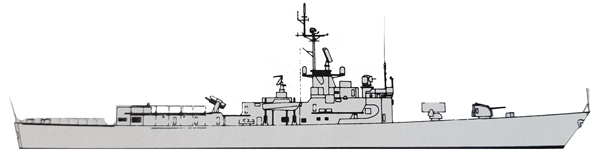
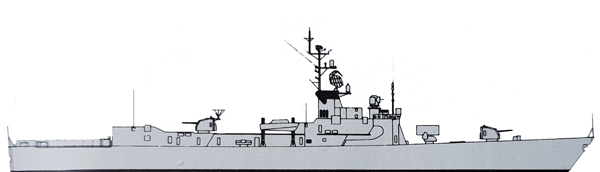
Garcia and Brooke class designs compared.
Powerplant

USS Schofield in a high speed turn
The Brooke class powered by the same new system of overpressuring steam boilers as the Garcia class. It was made for a single shaft, single geared turbine (with HP and LP stages), and FFG-1 through FFG-3 had a Westinghouse geared steam turbine while FFG-4 through FFG-6 employed a General Electric turbine. They were fed by the same two Foster Wheeler PF boilers, and for same output of 35,000 hp (26,000 kW), for roughly 27.2 knots (50.4 km/h; 31.3 mph) versus 27 knots (50 km/h; 31 mph) on the Garcias. This was enlough to chase a very noisy November class SSN as later the Alfa class were both only capable of escaping very loudly and very deep their pursuer. But after the introduction of an helicopter, this became much more difficult. The Brooke would have excellent results at the 6th fleet “Hook ‘Em Award”. Range was the same as well with 4,000 nmi (7,400 km; 4,600 mi) at 20 knots (37 km/h; 23 mph). However this steam powerplant was less flexible than diesels. There was an auxiliary power as well,
Armament

USS Talbot showing its ASROC and the new reloading system below the bridge.
The Garcia class armament was repeated on the Brooke (5-in/38, ASROC, 324mm Mark 32 and Mark 25 ASW torpedoes plus DASH) albeit the aft admiship turret was swapped for a Tartar SAM system and the fire control and aerial radar were modified. But the ASW suite remained the same, albeit “short range” and after cancellation of DASH, the hangar was modified to accept the very capable LAMPS SH-2 Kaman Seaspray helicopter, that demultiplied the striking range of these ships, well served by their excellent sonar, with a range of 70 km plus.
RIM-24 Tartar
 The RIM-24 Tartar was the final, smallest, and most lightweight addition to the U.S. Navy’s “Three Ts” fleet defense initiative. Developed by General Dynamics (Convair), it entered active fleet service in 1962 to bring supersonic surface-to-air protection to smaller combat ships like destroyers. Before Tartar, navy destroyers lacked the physical space to carry bulky Project Bumblebee systems like the long-range Talos or heavily boosted Terrier.The “No-Booster” Solution: Engineers essentially took the main stage of a RIM-2C Terrier, stripped away its large secondary booster package, and added a brand-new radar-homing seeker head. To make up for having no separate booster stage, it featured an innovative dual-thrust solid-fuel rocket motor. It fired with high thrust initially to clear the ship and rapidly reach supersonic speeds (Mach 1.8), then settled into a lower-thrust sustain burn. Before 1963’s unified designation system named it the RIM-24, the Navy simply called it the Missile Mk 15.
Specs
Length: 15 feet (4.57 meters).
Diameter: 13.5 inches (34.3 cm)
Weight: 1,310 lbs (590 kg)
Speed: Mach 1.8
Guidance: Semi-Active Radar Homing (SARH)
Altitude Ceiling: 65,000 feet (19,800 meters)
Initial range: 7.5 nautical mile.
Likely upgraded to the RIM-24B with a better electronic-scan antenna seeker, warhead, redesigned motor doubling range to 16 nautical miles.
It was perhaps retrofitted in the 1980s to the RIM-24C (Improved Tartar Retrofit) capable of 17.5 nautical miles
Warhead: 130 lb (59 kg) continuous-rod warhead: Upon detonation, interconnected steel rods expanded outward like a lethal, high-velocity circular saw to shred target airframes.
Mount: Mk 22 “One-Armed Bandit”: The Mark 22 guided missile launching system (GMLS) is a variation of the Mark 13 launcher which has only the inner 16 round storage ring of the Mk-13 launcher.
5-in/38 Mark 12
The new Brooke class adopted like the Garcia the same vintage 5-in/38 turrets. This was a reasonable choice given the base armament was already excellent, shared ammunitions with the Sumners and Gearings still in service, and were largely available after decommissioned of many Benson/Gleaves/Fletcher class destroyers. These were the latest turrets, if the gun was unchanged, being the good old 5-in/38 first used on USS Farragut (DD-348) in the interwar (1934). The turret was the latest single Mark 30 enclosed turret.
The Brooke class only had the foredeck mount left. The aft amidship one was replaced by the Tartar.
Specs:
Gun Weight 3,990 lbs. (1,810 kg) wt breech, 223.8 in (5.683 m), bore 190 in (4.826 m).
ROF with integral hoists: 15-22 rounds per minute.
Shells 55.18 lbs.(25.0 kg) average, many types. Proximity fuse. MV 2,500-2,600 fps (792 mps)
Both the Garcia (FF-1040) and Brooke (FFG-1) carried 350 rounds. Barrel life 4,600 rounds.
The Brooke and Garcia shared the same Mark 30 with USS Long Beach and USCG Hamilton.
Mark 30 Mod 1 turret weight: 33,500 lbs. (15,195 kg). Mod 0 40,900 lbs. (18,552 kg), Mod 41 41,400 lbs. (18,779 kg).
The Mark 30 Mod 51 had a -5/+85 degrees elevation and could train at 34°/sec. with Ford controls.
324mm Mark 32 Torpedo Tubes
In service from 1960, they were universally adopted for all escort ships and cruisers in the USN, made to launch ASW acoustic torpedoes of numerous marks. Recoignizable as a triple set with an upper tube and two lower tubes. Easy to reload and train manually, albeit the torpedo needed to be brought on a chariot. Full mass was 2,230 lb (1,010 kg). They fired back in 1960 the first generation torpedo with likely the Mark 37 acoustic model. Caliber was 12.75 in (324 mm).
The Mark 37 Mod 0 appeared in 1957 and the Mod 1 in 1960 and were likely adopted.
Specs: 1,430 lbs. (649 kg) for 11 ft 3 in (3.429 m) 330 lbs. (150 kg) HBX payload, 10,000 yards (9,140 m) at 26 knots or 23,500 yards (21,490 m) at 17 knots. Powered by Electric-Battery with Active and passive acoustic guidance for the Mod 0 but wire-guided for the Mod 1. More
RUR-5 ASROC
 Note that this system had no reloads. When all eight missiles were fired, the ship was forced back to base. The RUR-5 ASROC (“Anti-Submarine ROCket”) is the proverbial all-weather, all sea-conditions anti-submarine missile developed for the USN in the 1950s, as a natural evolution of the Hedgehog of WW2n then the Weapon alpha and British ASW mortars such as a the Squid. It offered the possibility to not send a depht charge but a far more potent acoustic torpedo on target, with a low-speed, moderate-range missile carrier. Australia developed such a weapon also with the Ikara. ASROC was deployed in the 1960s, was updated in the 1990s, and installed on over 200 USN surface ships from cruisers, to frigates and was of course all-important for the FRAM II program. It was at its core. Note that with the new reloading system, DEG4-6 carried sixteen instead of the eight missiles in spare.
Specs
Missile Mass: 1,073 pounds (487 kg), length 14.75 ft (4.50 m), diam. 16.6 inches (420 mm), Wingspan 26+7⁄8 inches (680 mm)
Warhead: Mark 46 torpedo, 96.8 pounds (43.9 kg) of PBXN-103 high explosive, 10 kt (42 TJ) W44 nuclear warhead
Detonation mechanism: Payload specific
Engine: Solid propellant rocket motor, range 6 mi (9.7 km) subsonic.
Mk 25 twin torpedo tubes
 The Garcia introduced the Mk 25 twin torpedo tubes. They were fixed at the stern, in the transom, with 8 torpedoed total. The Mark 37 acoustic torpedo entered service in the early 1950s, with over 3,300 produced. Retired in the 1970s, stockpiles were sold to foreign navies. The Mark 25 was omitted from DE1047 to 1051. This also helped reclaim space for more useful systems.
Specs:
Weight 1,430 pounds (650 kg), length 135 inches (3.4 m) x 19 inches (480 mm). Fired from 21-inch surplus tubes with guide rails.
Effective firing range: 23,000 yards (21 km) at 17 knots, 10,000 yards (9.1 km) at 26 knots.
Warhead: Mk 37 Mod 0, HBX-3 330 pounds with Mk 19 contact exploder
Engine Electric for 17 knots (31 km/h), 26 knots (48 km/h).
Guidance: Gyroscope (initial), passive sonar (cruise) and Doppler active sonar homing (terminal).
Sensors

The Brooke and Garcia kept the excellent sonar (upgraded to the BX), but added the Mark 35 FC radar for their 5-in/38 guns. They had the LN-66, SPS-10, SPS-40, WLR-1, WLR-3, ULQ-6 ECM suites. The latter was modernized in the early 1980s to keep them relevant. The major change was of course the adoption of a better 3D radar and associated fire control system for the Tartar.
AN/SPS-52 3D radar
The AN/SPS-52 3D air search radar was the great nively of the design, alongside the SPG-51 control radar. This long-range air search 3D radar was a prefect match for the Tartar. It could provide contact bearing, range and altitude. The same was also installed on the Knox and the derived Spanish Baleares class, but also the Charles F. Adams and Hatakaze-class destroyers among others, recoignizable for its squarish shape. It was mechanically rotated for azimuth, electronically scanned for elevation. Frequency was 2.9–3.1 GHz (10.3–9.7 cm), Range 300 mi (260 nmi; 480 km) for an Azimuth of 0-360° and output of 1 MW.

SPS-52 on USS ramsay (FFG-2)
AN/SPG-51
The AN/SPG-51 missile fire control radar recoignizable for its dish-like antenna was also widespread in the USN and most NATO navies. This tracking/illumination fire-control radar was a match for the RIM-24 Tartar and later RIM-66 Standard, for target tracking and guidance as part of the Mk. 73 gun and missile director system (Tartar Guided Missile Fire Control System). Aircraft tracking is based on monopulse with a Pulse-Doppler radar signal processing in MK 74 MOD 14 and MK 74 MOD 15. This combiend continuous-wave radar tracking on top of pulse-Doppler tracking, perfect for bistatic radar guidance of the missile itself.
Specs:
Frequency Illuminator: 10.25-10.5 GHz, Tracking: 5.45 GHz – 5.825 GHz.
PRF 4100 pps surface, 9600-16700 pps air.
Beamwidth 0.9°/0.9° and for tracking 1.6°/1.6° with a pulsewidth in tracking of 2.1-3.2 μs
Range in tracking is 100 nmi (190 km) with a full 360° at 12°/s, elevating -30° to 83°
For precision it depends of the 3D data.
Power in Illumination 4000 W and in tracking 1600 W average and 81 kW peak.
SPS-10F
2D radar from 1959. FRQ 5.45 to 5.825 GHz (5.50 to 5.15 cm) C-band, PRF 650 Hz, Beamwidth 1.9° × 16° vertical, 12° horizontal. Pulsewidth 1.3 μs. RPM 15 rpm fixed, Range 50 miles (43 nmi; 80 km) and Power 190 kW peak (short pulse) or 280 kW peak (long pulse).
AN/SQS-26 AX(R)

Instead of the SQS-29/32 hull-mounted sonar of the previous ships, former SQS-4 updated to the EDT, the Brooke and Garcia shared the heavier and bulkier AN/SQS-26 AX(R) sonar system. It was very much the peak bow sonar type ever developed so far in the USN and the core asset of the new ship. The AN/SQS-26 was a low frequency, active/passive sonar developed from the Naval Underwater Sound Laboratory, built by General Electric and EDO and later installed on 87 US Navy warships until the 1990s, still in use on foreign now foreign transfers.
Under JETDS its was 26th design of an Army-Navy electronic device for surface ship sonar search system. It weighed 27 tonnes and 215 kg (60,000 lb) and could be operated as a passive sonar on the 1.5 kHz frequency or active sonar at 3–4 kHz. Maximum output was 240 kW for a range between 18 to 64 km (11 to 40 mi) and a direct path, bottom reflected, passive and convergence zone (CZ) capabilities. It was considered the world’s best sonar at the time, also adopted by the new frigates of the Garcia and Brooke class. Later designs had the BX and CX versions. The Bronstein kept their AX version until the end of their service, never updated.
Electronic Warfare
It rested on these elements:
-WLR-1 ECM suite
-WLR-3 ECM suite
-ULQ-6 ECM suite
-2x Mk 33 RBOC decoy RL
Modernizations
In 1972-1975, all ships had their QH-50 DASH drone removed and instead an ASW helicopter SH-2D Sea Sprite (LAMPS) with the hangar and helicopter deck enlarged.
In the early 1980 they all had the new SLQ-32(v)2 ECM suite, and two Mk 36 SRBOC decoy launchers. The armament remained the same.
Air Group
DASH
 The Brooke class originally carried the DASH drone, but later the LAMPS SH-2 Seasprite replaced it, after the hangar was enlarged. The Gyrodyne QH-50 DASH (Drone Anti-Submarine Helicopter) naval drone was planned on this class to perform SAR missions. It was introduced in 1962, see former posts for more. The model to be carried was powered by Porsche YO-95-6 engines and could carry a single Mk 43 homing torpedo. There was plenty of space between the larger helideck and hangar for a full-fledge helicopter however. And it came in handy when the program was scrapped in 1969. The model used from completion was likely the QH-50D variant of DASH which cured unreliability issues of the first model.

USS Talbot port quarter view showing the reworked helideck and hangar for the Seaspray Helicopter
LAMPS I SH-2 Seasprite
LAMPS was the helicopter program on USN ships (Light Airborne Multi-Purpose System). The Kaman SH-2 Seasprite was an interim helicopter (before the arrival of the Seahawk, LAMPS III). Kaman Aircraft Corporation created a compact and fast-moving rotorcraft for ASW missions. Early on this modest sized single-engined naval utility helicopter progressed to twin-engine ASW and SAR and was exported. The Kaman HU2K-1/UH-2 Seasprite family originated in the Kaman’s K-20 developed for a 1956 U.S. Navy requirement for a compact, all-weather utility helicopter. The prototype first flew on 2 July 1959, and the type entered U.S. Navy service in December 1962. It had a single main rotor, tail rotor, the Main rotor was 4-bladed as the tail rotor and it was powered by a General Electric T58-GE-8F initially 1,250 shp class 2–3 and it was classed as a utility / transport / SAR Shipboard utility helicopter. But original design was substantially smaller and simpler than the later specialized ASW Seasprites. It’s possible that’s the UH-2 replaced DASH in 1968-69. The more mature SH-2F had two GE T58-GE-8F engines producing 1,350 shp each, a maximum speed of roughly 143 kt, and a range around 366 nmi.
POSTER
⚙ Brooke class specifications |
|
| Displacement | 2,640 tons standard, 3,426t full load |
| Dimensions | 415 ft 2 in x 44 ft 3 in x 24 ft 5.7 in (126.53 x 13.48 x 7.46 m oa) |
| Propulsion | 2 shaft 1 steam turbine, 2x FW Boilers: 35,000 shp (26,000 kW) |
| Speed | 27.2 knots (50.4 km/h; 31.3 mph) |
| Range | 480t fuel oil, 4,000 nm/15 kts (7,400 km; 4,600 mi) |
| Armament | 1× 5-in/38, Mk22 Tartar SAM, ASROC, 2×3 12.75-in, 2x Mk25 ASW TTs |
| Sensors | SPS-40, 10, 26, Mk.56 FCS, SQS-26 sonar |
| Air Group | DASH, SH-2 LAMPS |
| Crew | 14 officers, 214 men |
Exports: The Pakistani Khaibar class

USS Brooke and O’Callahan being transferred to Pakistan
in 1982, the Reagan administration approved a US$3.2 billion military and economic aid package to Pakistan. As part of that package, Pakistan four ships:
-Brooke was transferred to Pakistan on 1 February 1989. Renamed Khaibar, she was returned to the United States on 14 November 1993 and sold for scrap on 29 March 1994.
-Talbot was leased to Pakistan from April 1989 as PNS Hunain (D-164). Returned at Singapore to the USN, stricken 29 November 1993, sold for scrap 29 March 1994.
-Richard L. Page was leased for five-year from 31 March 1989, to Pakistan, recommissioned as PNS Tabuk (D-163). Stricken January 1994, sold for scrap 29 March 1994.
-Julius A. Furer was leased as PNS Badr (D-161) and returned on 11 December 1993. Struck 2 February 1994, disposed of 28 March.
As a result of the Soviet troop withdrawal from Afghanistan in February 1989, President George H. W. Bush was advised to no longer certify that Pakistan could be involved in the development of nuclear weapons (Pressler Amendment) and MDAP ended. The Pressler Amendment was invoked on 1 October 1990 the lease was terminated on March 1994, all ships to be returned. Most were struck from 12 January 1994 onwards and disposed of by March 1994.
Brooke class Career
USS Brooke (DEG1/FFG1)

 Brooke was ordered under hull n°115, and laid down at Lockheed, Seattle on 19.12.1962, launched on 19.7.1963, completed on 12.3.1966.
She served in the Pacific Fleet and was homeported in San Diego, California. Following decommissioning in 1988, she was transferred to Pakistan on 1 February 1989 and renamed PNS Khaibar, in service until returned to the United States on 14 November 1993 and sold for scrap on 29 March 1994.
USS Ramsey (DEG2/FFG2)

Ramsey was ordered under hull n°116, and laid down at Lockheed, Seattle on 4.2.1963 launched on 15.10.1963, commissioned on 3.6.1967. After shakedown off the west coast, she sailed for Long Beach as HP in California, and on 1 May 1968 made her first western Pacific deplopyment (WestPac). She was also mobilized for several tours in Vietnam, escorting carrier battle groups. After her first, she returned to NS Long Beach on 9 November. She made another Westpac on 8 October 1969, and again was sent on the gunline off Vietnam, back at Long Beach 18 April 1970. From January 1970 and January 1974, she alternated two more WestPac cruises, not with Vietnam rours but with operations off the west coast. In all she would earn five battle stars for Vietnam service. From Guided Missile Escort (DEG-2) she became Guided Missile (Fighting) Frigate, (FFG-2) from 30 June 1975. She made many more Pacific deployments, no logs (so far). She was decommissioned on 1 September 1988, mothballed, until stricken and spent as target on 15 June 2000, sinking under 16,200 ft north of Hawaii. She would be the only USN vessel under that name.
USS Schofield (DEG3/FFG3)

Schofield was ordered under hull n°117, and laid down at Lockheed, Seattle on 15.4.1963 launched on 7.12.1963, commissioned on 11.5.1968. After shakedown, Schofield had exercises with and without Destroyer Squadron 23, homeported to Long Beach, Cal. In 1969, she had her 1st Fleet exercises. By March, she started her first WestPac deployment. From 24 April, she operated the 7th Fleet. From 7 May, she joined USS Bon Homme Richard Carrier Group in the Gulf of Tonkin. She had supply and R&R at Subic Bay and returned for Operation Sea Spirit, a combined SEATO exercise until 3 June, shortened by the collision of USS Frank E. Evans and HMAS Melbourne.
On 17 June, Schofield returned to the Gulf of Tonkin until July. On the 6th, she headed for Japan for a joint exercise and returned to the South China Sea, Gulf of Tonkin on the 27th and for two weeks, operated with USS Kearsarge. She had R&R at Hong Kong. On 22 August, she was in Subic Bay and by September, was ordered north for patrol in the Taiwan Strait. On the night of the 8th she assisted USS Warbler damaged in heavy seas 70 nm (130 km) away and short of fuel, dead in the water. At daybreak, she was towed to Kaohsiung and later returned to patrol duty. Back in Japan she was part of an Hunter-killer Group exercise. She had R&R at Hong Kong for two weeks and station ship. On 23 October she was inJapan. On 6 November, she returned home.
She was back at Long Beach on 21 October for a long maintenance schedule and crew’s leave. In January 1970, she was in exercises off the California coast when on the 9th, as part of USS Hornet CBG she was dispatch to assist the tanker SS Connecticut, reported sinking 200 nautical miles (370 km) away. En route she refuelled Hornet helicopters which started to rescue personnel. Later she sent EMCS P. L. Kidd and BT1 A. E. Personette on board to try saving the ship, adn eventually the situation was brought under control. Later back at Long she was overhauled into March. Exercises, and a reservist training cruise followed. In July she had boiler overhaul work. In October, she returned training with the 1st Fleet.
On 7 January 1971, Schofield departed for Hawaiian waters, back then to the west coast for Operation Admixture, with Canada, watching over tests from the experimental hydrofoil USS High Point among others until 4 March. On the 11th, she had another WestPac with Group 3, 7th Fleet and from 4 April, Vietnam. Later she went to Singapore, and proceeded to the Indian Ocean for ASW exercises. She had R&R at Hong Kong and sailed to Japan for a refit at Yokosuka, then a joint exercise in the Sea of Japan. From 17 June, she sailed for home via Alaska and exercises at Attu and Kamchatka. Back in July she was prepared for her frst major overhaul. On 1 September she was homeported to San Diego. From 8 September, she entered Long Beach Naval Shipyard for overhaul until 1972 (6 June). Next she had three months refresher training life fire of her TARTAR missiles. By September, she departed for her third tour with the 7th Fleet in Vietnam via Pearl Harbor, Midway, Guam, Subic Bay as part of TU 77.0.1 in the Tonkin Gulf from October. She had a bombardment mission. On 30 October, she left for R&R at Kaohsiung, back to the Tonkin Gulf from 9 November to 8 December and stops at Hong Kong and Sasebo and the gunline again by 1973.
She was also a picket ship until mid-January and returned to fire support until the 26th January, then Subic Bay, and back to Yankee Station on 13 February. The war ended and from 15 February, she proceeded to Yokosuka and San Diego, back on 9 March. To be continued.
After restricted availability in April-September, Schofield received her helicopter pad and hangar, and had sea trials in October followed by firing exercises. On the 23rd she started her WestPac, had exercises at Pearl Harbor and Midway and arrived in the Philippines by 18 December. 4 days later, she was in Singapore, leaving for the Indian Ocean for surveillance operations and bacl to San Diego on 6 June 1974.
She started her newt deployment from March 28, 1975: Hawaii in April, Guam and by May she took part in Operation New Life, refugees evacuation to the Philippines. She arrived at Sattahip, Thailand on May 22 for a “call liberty” and returned to Subic Bay. This was her last Westpac. Back home she was decommissioned on 8 September 1988, stricken on 25 January 1992, sunk as target on 2 November 1999 NW of San Miguel Island.
USS Talbot (DEG4/FFG4)

 Talbot was ordered under hull n°348, and laid down at Bath Iron Wks on 4.5.1964 launched on 6.1.1966, commissioned on 22.4.1967.
To be completed. On 8 July, she departed Hampton Roads in Virginia, for Puerto Rico (shakedown/missile trials) before being homeported to Newport (Rhode Island) on 16 September. She was in “spec. operations” off the Virginia Capes (16 October-18 November) followed by a post-shakedown availability. She had all her armaments qualif. for the Atlantic Fleet by April but also looked for the missing USS Scorpion (SSN-589) in May. On 31 January 1969 she left Newport for her first Mediterranean Tour of Duty (Med Tod) with the 6th Fleet until back on 11 July and an overhaul at Boston until 1 April 1970. She was back at the missile range off Puerto Rico in May, had a refresher training. On 28 October she made a 2nd Med Tod until back on 2 May 1971. The remainder of the year was on the east coast.
In 1972 she tested the MK-48 torpedo in the Bahamas and off the New England coast. Next she was at Naval Station Roosevelt Roads with USS Farragut (DLG-6) and USS Forrest Sherman (DD-931) and USS Remora (SS-487) for combined operations and circumnavigation of South America (Venezuela, Brazil, Uruguay, Argentina, Chile, Peru, Panama, Colombia, Newport) back on 3 December 1972. She was overhauled at Boston from 15 February 1973 to 14 December.
On 5 January 1974, she left Newport for Norfolk and from 13 February to 29 April had training exercises off Jacksonville, including Vieques in Puerto Rico. She cruised to Newport in May, and at Norfolk from 17 June had the Oto Melara Mk 75 3-in gun mount and Mk 92 fire-control system installed for tests. They would be later installed on the new USS Oliver Hazard Perry (FFG-7) and USS Pegasus (PHM-1). She tested it at the Atlantic Fleet Weapons Range in Culebra, Puerto Rico into 1975, alternating Culebra with tender availability with USS Puget Sound (AD-38) at Norfolk and local operations. Back in Norfolk on 22 June she entered Norfolk Naval Shipyard on 15 September for a three-month overhaul (gun removed, replaced by her normal 5 in/38 and FCS).
After a refresher training, spring 1976, she left Norfolk on 22 June for a 3rd Med Tod, but had a ruptured fuel tank while refueling underway. She was repaired at La Maddalena, Sardinia. She took part in NATO exercises and had port visits, back on 10 January 1977. She started a new overhaul at Philadelphia from 9 June 77 to 7 April 78, followed by Fleet exercises off the east coast/Caribbean. On 6 December she made a 4th Med Tod, this time to the Middle East after the Revoluton in Iran. She also received her LAMPS Helicopter Detachment (Det-6) HSL-34 from NAS Norfolk (LCDR Jon Cook). She qualified with her KAMAN SH-2F after 60 days landing. She was leased to Pakistan in April 1989, renamed to PNS Hunain (D-164). Returned to the US at Singapore she was stricken 29 November 1993, sold for scrap on 29 March 1994 to Trusha Investments Ltd.
USS Richard L. Page (DEG5/FFG5)

Richard L. Page was ordered under hull n°349, and laid down at Bath Iron Wks on 4.1.1965, launched on 4.4.1966, commissioned on 5.8.1967. To be completed. By mid-October 1967, Richard L. Page was homeported to NS Newport and proceeded to her shakedown exercises in the Caribbean. On 21 December 1967 after post-shakedown availability she joined Escort Squadron SIX (CORTRON 6) and by 1968, was in the western Atlantic and her first Med Tod with the 6th fleet, until 10 February 1969. Back to Newport on 18 February she resumed operations by March 1969 with the 2nd Fleet. On 1 July 1969 she relieved USS Brumby (DE-1044) as flagship of DESRON 12. She spent 1971 and early 1972 at Newport and for local operations. From mid-August 1972, she had a 2nd Med Tod with the 6th fleet. 1973-1975, saw her forward deployed to Athens. From 30 June she became FFG-5. She had a long modernization overhaul until back to the Atlantic Fleet, HP Norfolk by 1976. The next years she alternated with Mediterranean, Middle East, East Africa, Northern Europe and each time back to Norfolk.
In 1979, Richard L. Page she won the Battle Efficiency “E” for her Commander and the Battenberg Cup (highest operational excellence, Atlantic Fleet). In early 1980, she was relocated to Philadelphia to be upgraded (sonar and electronic warfare system) until August 1980. After independent operations and Refresher Training at Guantanamo Bay, she was off Norfolk for Exercise SOLID SHIELD 81 and Standing Naval Force Atlantic. By late late 1983, she joined USS John F. Kennedy (CV-67) carrier battle group to the Mediterranean (Lebanon campaign) and North Atlantic/Norway as deterrent force to the Northern Fleet. Back in Norfolk in 1984, she had an overhaul at Bath Iron Work and was back in 1986. In 1987, it was decided to retire her and sje was earmarked for transfer but eventually this was cancelled and she remained in reduced service until decommissioned on 30 September 1988, later sold for BU.
Julius A. Furer (DEG6/FFG6)

Julius A. Furer was ordered under hull n°350, and laid down at Bath Iron Wks on 12.7.1965 launched on 22.7.1966, commissioned on 11.11.1967. She was named after Rear Admiral Julius A. Furer. No career data so far. She remained in the area of responsibility of the 6th fleet, making many deployment in the Mediterranean over her long career. For this, she earned a Navy Meritorious Unit Commendation, Navy Expeditionary Medal, National Defense Service Medal, Navy Sea Service Deployment Ribbon and Coast Guard Special Operations Service Ribbon for her late anti-drug operations in the Carribean and Mexican Gulf. She was decommissioned on 31 January 1989.
Read More/Src
Books
Polmar, Norman “The U.S. Navy: Sonars, Part 1” United States Naval Institute Proceedings July 1981 p.119
Blackman, Raymond V. B. (1971). Jane’s Fighting Ships 1971–72. London: Sampson Low Marston & Co. Ltd.
Friedman, Norman (1982). U.S. Destroyers: An Illustrated Design History. NIP
Gardiner, Robert; Chumbley, Stephen, eds. (1995). Conway’s All The World’s Fighting Ships 1947–1995.
Links
destroyerhistory.org/
navweaps.com
navweaps.com/ 5-in/38 mk12
destroyerhistory.org/
globalsecurity.org/
gyrodynehelicopters.com
navypedia.org/
en.wikipedia.org
The space and cost trade-off with the Garcia class is an interesting example of what adding air defence actually required: launcher, magazine, radar and fire control, rather than just a different missile. One clarification would help readers: the introduction and hull section identify a Mk 22 launcher, whereas the Tartar subsection names Mk 13. Could you distinguish the Brooke installation from the general Tartar-system description? Separating magazine capacity from fire-control capacity would also make comparisons with later VLS frigates clearer.
Disclosure: I am commenting for Gefechtsklar. The website field links to our English-language upgraded-Mogami overview as a modern comparison of frigate capacity and integration, not as a source on the Brooke class.
Page updated, “The Mark 22 guided missile launching system (GMLS) is a variation of the Mark 13 launcher which has only the inner 16 round storage ring of the Mk-13 launcher.”