
 Frigates: F81-86 (1986-today):
Santa María, Victoria, Numancia, Reina Sofía, Navarra, Canarias
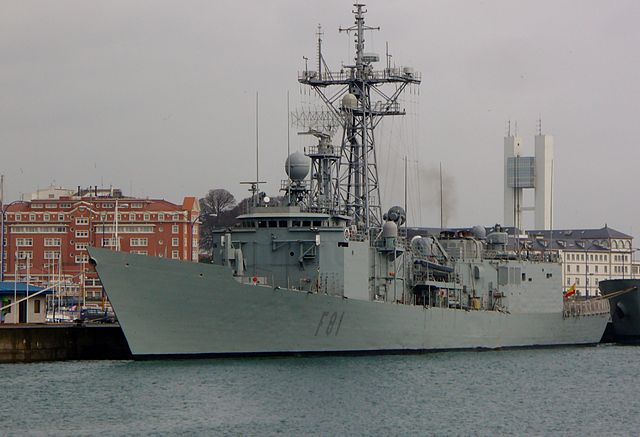
After building Knox class frigates on a modified design in Spain in the seventies, after the agreements of 1966, another important step towards the integration of the Armada into NATO was the choice of the OH Perry as model to replace the ageing Churucca class destroyers (FRAM II). The first three of the Santa Maria class were ordered 29 June 1977, but construction was deferred to give priority to the new carrier, Pirincipe de Asturias. Reina Sofía was approved in 1985, ordered 19 June 1986, the last pair on 26 December 1989, both being of the Long-hulled FFG7 type, with extra beam to allow more top-weight. Their twin hangars could accommodate two SH-60B, but for budgetary reasons, only one per ship is carried. They took part in many operations since the Gulf War, either under UN or European Mandate, gradually more deeply integrated into NATO structures. They are still active today, modernized, having a few differences with the original O.H. Perry, now long retired from the USN without replacement. The Santa Maria were superseded themselves by the new AEGIS frigates of the Alvaro de Bazan class.
Development of the Santa Maria class
Context
 We can go back to The Armada in 1966 and a not pretty picture, with a surface fleet composed essentially of prewar designs completed after very long and rocky development, redesigns and rearmaments, such as the Liniers, Oquendo, Audaz class. If at first Franco’s government entered negotiations with the United Kingdom for the acquisition of four Leander-class frigate, similar negotiation went better with the USA. And this time an agreement to acquire the ex-Independence class USS Cabot bore fruit as she was acquired in 1967. To protect her an escort class was necessary so after negotiations failed with the British Government, the US came back with a new proposal under MDAP provisions. Despite hostility from the European Community, strong US anti-communism commitment saw a rapprochement of the Armada with NATO, starting to gather its procedures and tactics, still withiout the proper means for its extension. However with this opening in the 1970s came the “Spanish Miracle”.
After important agreements on 31 March 1966, for technical support, to have US Navy hulls and machinery built in Spain, at Ferrol (especially after De Gaulle withrew from NATO and expelled US forces from France). Then, more complex weapons and sensors started to be also produced, albeit the ships to be built in Spain would still be fitted out in the US.
Under this new agreement, after the lease, and then purchase of the Churruca class, transferred FRAM II in 1972 as fleet destroyers.
But the next most important move was the construction in spain, as a test of interoperability with the USN for repair and maintenance standards, notably from Rota Naval Base, of the Baleares class Frigates (1970): The Baleares, Cataluna, Andalucia, Asturias, Extremadura (F71-75) received from NATO numbers in the “70” series to reflect their era. They were Spanish-built, modified Knox class Frigate. The swap from the Leanders to the Knox was important at more than one title. The Knox class were certainly larger and had extra room for improvement, and were the best ASW Frigate the US had to offer at the time, well adapted to the new generation of Soviet SSNs. These large ship had been tailored for the Atlantic and Pacific and so guaranteed Spain’s implication in international operations if needs be. They were the largest ships also built in spain (and the most complex) since decades.
1970s Policy Changes
 However by the late 1970s the design started already to be dated. The lead ship, USS Knox had been indeed laid down as FF-1052 at Todd, Seattle in 5 October 1965 and the Spanish deal was signed in November 1964. Construciton was covered mostly by MDAP funds provided the Armada funded maintenance and crews. From Washington’s point of view it delegated five of its latest and best frigate’s operation from Spain to the Spaniards in their ASW watch on the Atlantic and Med. But as the years went on, the Baleares class proved not that ideal for ASW warfare as crucially they lacked an helicopter. They still possessed a good SAM system but for limited self-defence making them versatile surface combatants to escort the new Dédalo. But for the future carrier planned (based also on a US design, Principe de Asturias) with the retirement of the old cruiser Canarias as flagship and the Liniers and Audaz class destroyers, the Baleares class commissioned in 1973-76, later modernized post Cold War and retired in 2004-2009.
But they needed a backup. Discussions with the US based on similar principles and now under much more limited MDAP funding, successfully concluded with the current Santa Maria class Frigates. For the same reason of providing a way to support the latest and best US Frigates and Destroyers in Spain, notably at Rota, but if needed at Bazan in Ferrol, Galicia. This time the next O.H. Perry class was chosen. Back in the 1970s it was believed that keeping ASW warfare “close and personal” between the ASROC and torpedoes when Soviet SSNs had now better long range anti-ship missiles was no longer adapted and whatever new ASW ships would be buillt, it necessary needed to have an ASW helicopter permanently on board. The failure of the small DASH drone, closed the door to the possiblility of having a smaller substitute than can be fitted on all ships in the US inventory. It proved useful in FRAM I conversions, but by the 1970s it was obvious a proper helicopter was now mandatory to extend this ASW bubble.

The U.S. Navy guided missile destroyer USS Scott (DDG-995), second from the top, steams in battle group formation with four Spanish ships during joint operations. The Spanish ships are, from top to bottom; the fleet tanker Marques de la Ensenada (A-11), the aircraft carrier Principe de Asturias (R11), and guided missile frigates Asturias (F-74) and Reina Sofía (F84).
Based around these principles, the USN turned into a new frigate design to be also built en masse: The Oliver Hazard Perry. Their development around a new LAMPS helcopter started in 1972 and the FFG-7 (commonly “fig seven”) class was eventually approved in 1974 or a constrtuction FY1975. The initial ship was laid down in June 1975, completed in December 1977. No less than sixty-one vessels would follow, the last, USS Ingraham FFG-61 a late “long hull” type being commissioned in 1989, close to the end of the cold war. And the Spanish were not the last either. Taiwan had the very last of the OH perry, made at Kaohiung from 1993 onwards. Given their recent mishaps with naval construction and the lack of frigates, this even opened the possibility of ordered modernized OH Perry designs in Taiwan for the USN, before the Constellation program went and died.
Back to Spain, the choice of the OH Perry to replace its ageing Churucca class destroyers (FRAM II) seemed the logical one. The only question remaining was how much these would be tailored to panish needs. The first three were ordered 29 June 1977, but construction was deferred to give priority to the new carrier, Pirincipe de Asturias. Reina Sofía was approved in 1985, ordered 19 June 1986, the last pair on 26 December 1989, both being of the Long-hulled FFG7 type, with extra beam to allow more top-weight. Their twin hangars could accommodate two SH-60B, but for budget reasons, only one per ship is carried.
Construction
The first three were ordered on 29 June 1977 but delays in construction as all priority was given to the new aircraft carrier (Principe de Asturias). The first, Santa Maria, was built between 1982 and 1986, the next laid down 1983, 86, and a fourth ordered on 19 June 1986, final two on 26 December 1989, started over the new long Hull FFG-7 type, in April 1991 and 1992 si actually after the cold war ended and production stopped in the US (the last was completed as seen above in 1989). Santa María was the first to enter service hence the class name, and they were soon symbolic of Spain’s international operations involvements: In August 1991 Santa María was deployed to the Persian Gulf and Red Sea after the invasion of Kuwait by Iraq, then relieved by Numancia and in 1994 all six vessels were based at Rota as the 41st Escort Squadron.
The Santa María class featured reinforced protection with an aluminum-alloy for the ammunition magazines, steel for the engine spaces, Kevlar for the electronic and command stations and its defensive systems included the Dutch Mk 92 fire-control system, to launch and guide two missiles if needed on the same target instead of the US FCS. Their rapid-fire 3-inch (76mm) gun was to be however the same US stabndad 62 caliber Mk 75 and not an OTO Melara model, but the Spanish-made 20mm Meroka replaced the CIWS. With this configuration, the frigate was primarily designed for anti-air and anti-ship warfare as its missile launcher was compatible with the RGM-84 Harpoon. ASW was not forgotten and counted on the SQR-19 TACTASS towed-array sonar plus two hangars so the option for two excellent SH-60 Seahawk helicopters.
Initially, an order was placed for three units: F-81, F-82 and F-83. Another two units were added in exchange for the two Discobierta class corvettes sold to Egypt. Of these two however, only F-84 was ever built. But there was a Second batch. After the cancellation of the NFR-90 program, judged too costly with greater delays than anticipated, two more frigates of the Santa maria class were ordered, making up a second batch F-85 and F-86, incorporating in the 1990s a series of modifications: The installation of stabilizing fins at the stern for better stability, a new Meroka CIWS type, and wholesale modification of the electronics. Specifically they had a much improved combat data system, better air surveillance radar with the new AN/SPS-49(V)5 replacing the (V)4, new sonar SRQ-19(V)2 instead of the (V) and new firing director Mk.92 Mod6 CORT instead of the Mod4. The previous Nettunel electronic warfare system was replaced by the Mk.3000. Mid-life modernization brought the four ships of the earlier batch to the same standard.
These Spanish frigates were part of a larger ecosystem also comprising also the Australian Adelaide class, Taiwanese Cheng Kung class ensuring shared resources and maintenance on the long run even after the US stopped production and furthermore, several decommissioned OH Perry of the first batches were later exported to Turkey, Poland, Egypt, and Bahrain. Exerience with the Santa Maria class, which usually only carried one helicopter at all times, not two, led to the fully Spanish design Álvaro de Bazán class, featuring only one hangar door. In some way, and ironically, the latter were what an alternative replacement of the OH Perry could have been for the USN, albeit they are considered by anybody in NATO as destroyers, not frigates, closer to the Burke than a Constellation. Anyway, this will be our next stop.
Design of the class

The blueprints, MConrads & Colosseum shipbucket profile src
Hull and general design
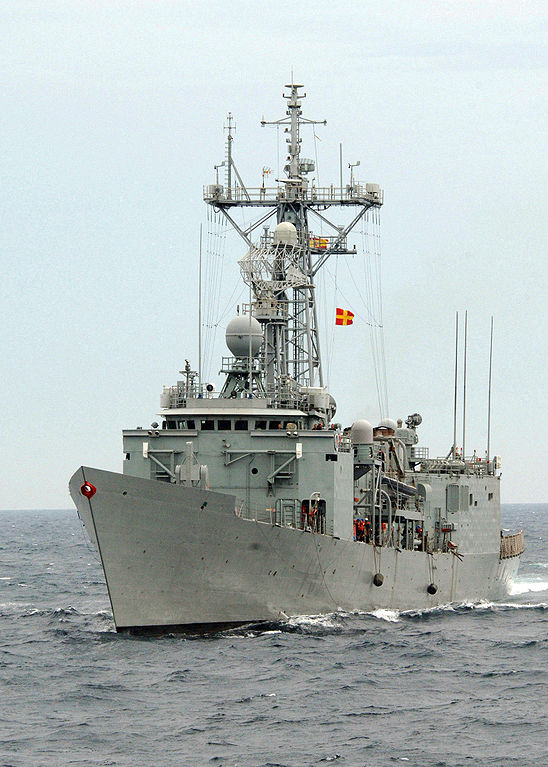 This will be short as the Santa Maria were even closer to the original OH perry than the Baleares from the Knox. These frigates, all made at Bazan, Ferrol, now Navantia, in the industrial Spanish Northern region of Galicia, are registered as 3,160 t (3,110 long tons) standard, with the first batch with a light displacement of 2,851 tonnes (2,806 long tons), 4,017 t (3,954 long tons) at full load. The second batch had a full load displacement of 4,107 t (4,042 long tons) however. They all measure 138.8 metres (455 ft 5 in) long overall and 125.9 m (413 ft 1 in) at the waterline, 14.3 m (46 ft 11 in) in beam with a standard draught of 4.52 m (14 ft 10 in), maximum draught at the sonar dome of 6.6 m (21 ft 8 in).
The general layout is the same. The OH Perry are quite different from the Knox, and really unique. They reflect the same tendancy of the Spruance class destroyers to build an overly large, roomy superstructure for future upgrades. This proved very handy to modernized the foreign-built or exported ships in class on the long run (new upgrades planned FY2030 and beyond) on a design dating back from 1971 essentially.
They have a distinctive 3-faceted bridge, same style of clipper prow as the Knox and a bulwark to deal with heavy weather, a minimalist foredeck with no ASROC and instead the universal SM1 launcher. The ling structure is dotted by the fire controlm radar, the main aerial on a lattife and then the large amidship lattice mainmast with other aerials.
Utilitarian assets are ion the “recesse” formed amidship between the hangar and bridge, notably there are rhibs plus containers, the two TT banks on deck either beam. The hangar and associated helideck occupies About 1/3 of the of aft section. The stern is a flat transom. Now, the Spanish ships diverges, albeit this is not externally visible from afar, by their dual purpose SM-1 launcher (SAM and Harpoon SSM), replacement of the Mark 75 by an OTO Melara, and Meroka 20 mm CIWS on top of the hangar deck aft. The main funnel had been mushed back between the two hangar spaces for the helicopters. Automation rezduced the crew compared to a Knox class, down to 223 sailors including 13 officers, so between this and the extra space, liveability is far better.
Powerplant

On this topic, the Santa Maria class are a bit modernized compared to a regular OH perry class. They share the same single propeller, but it is a fully controllable, pitch propeller with hooked blades for more silnet operation and fitted with a prairie marker system. Connected to a single gearbox, it is powered by two super-standard General Electric LM2500 gas turbines, for a total output of creating 41,000 shaft horsepower (31,000 kW), and top speed of 29 knots (54 km/h; 33 mph). They had enough internal bunkarge space for 587 t (578 long tons; 647 short tons) of fuel. This gives them a range of 5,000 nautical miles (9,300 km; 5,800 mi) at 18 knots (33 km/h; 21 mph), 4,500 nmi (8,300 km; 5,200 mi) at 20 knots (37 km/h; 23 mph).
In case the gas turbines would be hit and disabled, they still have four 1,000 kW Kato-Allison 114-DOOL diesel generator sets. Together they produced an outpit of 4,000 kW.
For manouvering in a finer way, including in harbours, the ships are fitted with two 260 kW (350 shp) retractable, rotatable auxiliary propulsion motors.
The last two ships in class, the improperly named “long hull” had fin stabilisers fitted, which was later retrofitted on the first four in the 2010s.
Armament
Mk 75 3-inch/62 gun
Like the original OH Perry, the Santa Maria class originally has a 76mm/62 caliber Mark 75 installed on the exact same location of the structure’s roof, close to the hangar.
However it seems after the upgrade it was changed for a, OTO Melara 76 mm gun (OTO 76/62 Gun Mount) autocannon, based on the OTO Melara 76/62C and evolved toward 76/62 SR and 76/62 Strales.
It is thus fully compatible with the range of US 3-in ammunitions as well as NATO OTO Melara compatible guns, widely used across Europe. In fact Spain uses it on its Santa María-class frigate, Descubierta-class corvettes and Meteoro-class offshore patrol vessel.
Specs:
Weighting c7.5 tons, this system fired automatically a 76×636mmR 6.3 kilograms (14 lb) shell (12.4 kg (27 lb) full). The barrel can elevate to +85°, turn on all axis at 35°/s at 85 rounds/min
Tius Super Rapido type is capable of 120 rounds/min for a muzzle velocity of 915 m/s (3,000 ft/s) and max firing range with the of HE-PFF 16,000 m
The Feed system is a drum Magazine below decks, with 80 ready rounds in the gun mount.
SM-1 MR Standard SAM
The SM-1 MR standard was based on the 1969 SM-1 replacing the Tartar, using the same launcher and Fire Control System:
Weight 562 kg, Dimensions 4.22 m x 0.34 m x wp 1.07 m
Propulsion: Solid propellant rocket motor, Aerojet MK 27 Mod 4 dual thrust to Mach 2 and range 32 km
Guidance: Semi-active radar homing: Conical scan passive radar
Ceiling 19.8 km.
Payload MK 51 warhead 62 kg Continuous rod.
Mk 141 for 8 Harpoon
The Santa Maria class, thanks to their SM1-MR standard SAM launcher could alternatively fire the RGM/UGM-84A or Block I Harpoon. This is a subsonic, sea-skimming, over-the-horizon, using Midcourse inertial navigation with active radar homing in the terminal phase; sea-skimming profile (radar altimeter) and selectable terminal modes (pop-up or sea-skimming depending on variant/mission).
It was powered by a Teledyne/CAE J402 turbojet sustainer (plus a solid booster for ship/sub launched versions). Typical maximum cruise speed around Mach 0.8–0.85.
Diameter 34.3 cm (13.5 in) x 4.6 m with booster and 540–690 kg (1,200–1,520 lb).
Warhead: 220–225 kg (488 lb) WDU-18/B HE.
Range RGM/UGM-84A with booster 60–77 nmi (110–140 km).
This was criticized as being slower to fire with this system than the quad launchers installed on the Knox-based Baleares class.
Mark 46 torpedoes
Four single tube launchers instea dof the usual triple bank. Same acoustic torpedoes used by the ASROC launcher.
The Mark 46 is a dependable short range acoustic model, a beast of burden of the 1960s.
Diameter: 12.75 in (324 mm) x 102.4 in (≈8.5 ft) in tube-launch configuration, Weight 508–518 lb (230 kg).
Warhead: 96–100 lb (≈44–45 kg) high-explosive (PBXN-103 or similar).
Propulsion: Otto fuel II monopropellant powering a two-speed reciprocating external-combustion engine.
Speed: commonly cited 40 knots (final run 45 knots reported).
Range: Around 8,000 yd (official), up to 11,000–12,000 yd (reported depending on speed profile and source).
Operating depth: 1,200 ft plus capability depending on Mod.
Guidance: active or passive/active acoustic homing with search patterns (snake/circle searches) and counter-countermeasure improvements on later Mods.
20 mm Meroka CIWS (From 1988 onwards)

The Meroka (MeRoKa) is a Spanish close-in weapon system (CIWS) using twelve 20-mm Oerlikon L/120 guns arranged in two staggered rows of six barrels for a dense spread against incoming missiles, aircraft and small surface threats. It was developed by FABA/Bazán for the Spanish Navy and fitted when ready on the Baleares class, the first to use it. The two mountes were located abaft the mack on either side.
The Meroka fires groups/salvos from multiple single-barrel guns with the barrels skewed to widen the lethal cone. The firing sequence (timed salvoes) both spreads shot and limits recoil.
Fire control is by radar (originally an off-mount unit; definitive fit typically the Lockheed PVS-2 “Sharpshooter” I-band radar) with optronic/IR trackers on later fits for jamming resilience. Acquisition range is quoted at roughly 4–5 km; first impact is around 1.5 km and assured destruction cited at 0.5 km in many sources.
The 12 × Oerlikon 20 mm/120 had a cyclic combined rate of 1,440 rounds/min (all barrels combined), typically fires two salvoes/sec.
The ammunition magazine contains 720 rounds (60 rounds/barrel).
Effective range (APDS-T) is 1.5–2 km (practical terminal effectiveness much shorter 0.5 km).
Muzzle velocity: 1,290 m/s. Elevation −15° to +85°, 360° traverse. Weight of system 4.5 t (varies by mount/configuration).
On the long run, the fixed-barrel salvo design and legacy sensors make it less effective against high-speed modern anti-ship missiles and saturated attacks compared with modern radar-guided Gatling CIWS (e.g., Phalanx) or missile-based point defenses.
Sensors
Raytheon 1650/9xR
Data in research, kept for future update
SPS-55
Data in research, kept for future update.
Replaced 2010s, by the SPS-64 or Vision Master radar.
SPS-49(v)4
Data in research, kept for future update
SPS-67
Data in research, kept for future update
STIR Mk 54 Mod. 0
Data in research, kept for future update
Mk 92 Mod. 2 fire control system
Data in research, kept for future update
RAN-12L/X
Data in research, kept for future update.
Modernized in 2007-2010: Replaced by the RAN-30L/X radar.
VPS-2 radar
Data in research, kept for future update
SQR-19(v) TASS variable depth sonar system
Thus Variable Depth Sonar (VDS) system. Data in research, kept for future update
Active Protection
Ceselsa Elnath/Rigel EW
The ships were fitted with the Elnath, Rigel ECM suites. However from the 4th ship onwards, the Nettunel Mk 3000 ECM suite replaced the Rigel system. It was the same on the last pair. Both were made in Spain, provided by Indra Sistemas.
Mk36 SBROC decoy launchers
Mk 36 SRBOC (Super‑Rapid Bloom Offboard Countermeasures). Ship‑mounted short‑range decoy/chaff and flare launcher used to defeat radar‑ and infrared‑guided anti‑ship missiles by creating false targets and clutter. Each vessel in class had four of these placed at strategic points. Two Mk 137 launcher with six fixed 130 mm mortar tubes each arranged in two staggered rows (different mounts fitted depending on Mod). Tubes fire disposable cartridges (ballistic chaff or IR flares) at ~75 m/s to create clouds or flares away from the ship.
Include Mk 158 master/bridge launcher controls and Mk 160 power supply units (440 VAC shipboard input; emergency battery backup available). Launch commands may be manual or automatic when coupled to an EW suite (e.g., AN/SLQ‑32). Common cartridges and decoys: Chaff/RF decoys: Mk 182 Mod 1/2, Mk 214 Sea Gnat, Mk 216 Sea Gnat distraction, Super Chaffstar, Super LOROC (long‑range offboard chaff), Super Gemini hybrid RF/IR. IR decoys/flares: Mk 186 TORCH, Mk 245 GIANT, Super Hiram III/IV.
SLQ-25 Nixie Torpedo Decoy
Well known US system, consisting of a towed decoy device (TB-14A) and a shipboard signal generator. The Nixie is capable of defeating wake-homing, acoustic-homing, and wire-guided torpedoes. The decoy emits signals to draw a torpedo away from its intended target. It was modernized as the SQL-25A Enhanced Nixie by Lockheed Martin.
C3R
The ships are provided with the US pattern NTDS CCS, protected well withing the ship by kevlar panelling. On the last two ships it was replaced by the SYS-2 CCS. Inrtegrated from 2010 with Spanish systems designed and provided by FABA Sistemas: The Sistema Integrado de Control de Plataforma (SICP) for the main missile launcher, Sistema de combate (SCOMBA) coordinating all systems, and Sistema de control de tiro (DORNA) for the main gun. Sainsel provided the consoleds (Consolas multifunción (CONAM)).
SH-60B Seahawk

They were purchased by pairs for the class, so twelve in all, with remaining SH-60Fs machines for SAR and training, making for twenty back in the 1980s. However half was used from Rota and other bases, only one was deployed on each ship at all times. In October 2023, Lockheed Martin was awarded a contract to deliver eight of the new MH-60Rs to the Spanish Navy as part of their replacement. The initial models are the S-70B-1 anti-submarine variant for the Spanish Navy configured with the LAMPS (Light Airborne Multipurpose System). Today there are SH-60B/Fs in service, eight SH-60R awaited on order (partly delivered as of 2026).
The SH-60B has 5 passengers in cabin, with a slung load of 6,000 lb (2,700 kg), internal load of 4,100 lb (1,900 kg).
It weights 15,200 lb (6,895 kg) empty, max 21,884 lb (9,926 kg) powered by two General Electric T700-GE-401C turboshaft engines, 1,890 shp (1,410 kW) for a 53 ft 8 in (16.36 m) quad prop 2,262.3 sq ft (210.17 m2) overall, top speed 146 kn (168 mph, 270 km/h), Range 450 nmi (520 mi, 830 km), ceiling 12,000 ft (3,700 m). In addition to sonibuoay and a VDS, they could carry two Mark 46 torpedoes.

General appearance, author’s rendition
⚙ specifications |
|
| Displacement | 3,160 t (3,110 long tons) standard, c3900 FL |
| Dimensions | 138.8 x 14.3 x 6.6 m (455 ft 5 in x 46 ft 11 in x 21 ft 8 in) |
| Propulsion | 1 shafts, 2× GE LM2500-30 gas turbines 41,000 shp (31 MW), 2x 350 hp (260 kW) aux. + thrusters. |
| Speed | 29 knots (54 km/h; 33 mph) |
| Range | Fuel oil 587t, 5000 nm/ 18 kts est. |
| Armament | Harpoon SSM/Standard SM-1MR, 76mm/62 Mk 75, 20mm/120 Meroka CIWS, 2×3 324mm Mk 32 |
| Active Protection | Ceselsa Deneb/Canopus, Mk36 SBROC decoy launchers |
| Sensors | SPS-55, SPS-49(v)4, SPS-67, Mk 92 M2, STIR Mk 54, RAN-12L/X, VPS-2, DE1160B, SQR-19(v) TASS |
| Air Group | 2 helicopters SH-60B |
| Crew | 223 |
Modernizations
The ships had been built in two batches, with the second comprising F-85 and 86 receiving already an improved combat-data system and updated SPS-49 and SQR-19 radars and sonars, plus the semi-local Meroka CIWS and Mk92 Mod 6 COR and upgraded electronic warfare suite. The Spanish version of the FG-07 had a slightly broader beam, a Meroka CIWS, RAN-12L air search radar, Nettunel EW suite in place of SLQ-32.
In the late 2010s the ships were modernized with a mid-life update (MLU) comprising a new EW suite and improved combat-data system, upgraded Mk92 FCS and new electrical generators and better habitability, at least for the first batch. The second was planned and realized in 2022-2025.
In 2003, indeed was a first wave of modernizations for the F-80 class but it only commenced by October 2005 at Navantia, Cádiz on Victoria (F-82) and Numancia (F-83) with full replacement of the four electric engines, removal of TACTASS, upgrade of the Mk.92 FCS, new EW equipment, replacement of the navigation radar with an LPI (Low Probability of Intercept) model, and in general, closing on the last two ships standards. A Mode 5 IFF system was installed, new Combat Information Center (CIC) consolesand the main gun control console replaced, habitability improved ad adapted to women. Between late 2007 and early 2010, the same was performed on Santa María (F-81) and Reina Sofía (F-84), now called mid-life upgrade, bringing all four to the same level as the last two.
Pros and Cons of the Santa Maria design
The design adopted prioritized low acquisition and maintenance costs to maximize the number of available escorts, but this drew some criticism:
They had only a single propeller, in line with previous “cheap” US Frigate designs, lacking redundancy and agility.
They had a single missile launcher, singlearmed for the Standard SM-1MR and Harpoon, limiting response to any combined threats.
Their 76 mm was badly positioned with blind spots, limited firing arcs.
The launcher atop the hangar also created large blind spots and proved vulnerable from threats approaching from the stern, a path chosen by an Iraqi Exocet on USS Stark.
Still, the Armada also recoignized what it brough to the navy: Two separate radars, providing redundancy for the guidance system, two auxiliary engines able to power the ship at 6 knots in case of a main propulsion failure and the excellent Standard SM-1MR could engage aerial targets at a range sufficient to minimize the threat to the battle group. One such threat were Moroccan Mirage F-1s armed with Exocet against Príncipe de Asturias. The SM-1MR could shoot them down before they could even launch their missiles.
Career of the Santa Maria class
These frigates were the first Spanish ships deployed for Operation Desert Shield in 1990, F81) being the first in the Persian Gulf soon joined by the corvettes Cazadora (F-35) and Descubierta (F-31) under UN mandate. A famous band played on board Numancia (F83) which relieved her at Christmas 1990, TV-broadcasted in Spain. These Frigates served in the North Atlantic, protecting Spanish deep-sea fishing boats off Canada, the RCAN indeed previous seized Estai in the mid-1990s, accusing it of depleting marine resources and overfishing halibut, while the Spaniards protested it was in international waters and keeping the assigned catch quota. From 1992 to 1995, these frigates took part in Operation Sharp Guard in the Balkans. From March 2002 to May 2003, they took part in Operation Enduring Freedom in the Gulf of Aden/Arabian Sea. They also operated later in Operation Atalanta, combating piracy in the Indian Ocean. After their second upgrade completed in 2025-2026 they are expected to serve another five years at least.
F81 Santa María (1984)
Santa María wa slaid down as all her sisters, and built at Izar, Ferrol, Spain (now Navantia), on 23 May 1982. She was launched on on 24 November 1984 and commissioned on 12 October 1986. Initially assigned to patrol the Strait of Gibraltar. With the 1990 Iraq’s invasion of Kuwait, she was deployed to the Persian Gulf with Descubierta (F-31) and Cazadora (F-35) blockading the Iraqi under UN mandate. On June 15, 2002, Corporal First Class Antonio Rois Pérez died in Kenya while deployed for Operation Enduring Freedom. In 2003 she evacuated an injured man from the German merchant vessel Conti Shanghai in the Gulf of Aden. She was later relieved by Reina Sofía (F-84) and was back at HP Rota on November 12.
She took part in UNITAS 2007, with the Argentine Navy, and the US, Brazil, Chile, and Peru, sole European vessel invited for this annual exercise. She departed on April 5. By May 2005 she was approved for a major upgrade for serviceability until 2030. On April 20, 2011, she departed Rota for the Gulf of Aden, relieving Canarias in EU Operation Atalanta, combating piracy in the region, and back on September 21, 2011. In September 2012, she took part in Seaborder-2012, a maritime security cooperation in the Bay of Cádiz with Algeria, Italy, Libya, Morocco, Portugal and Tunisia.
From April 29 to November 7, 2016, she was in the Indian Ocean and the Gulf of Aden for Operation Atalanta, deploying drones from the 11th Aircraft Squadron.
On June 24, 2020, in the same operations she trained with the Egyptian corvette El Suez (F-946) transiting the Red Sea to Djibouti.
While moored at Rota in October 2022, a hangar broke up, bu there were no casualties. On December 15, 2023, while underway she tracked a Russian Kilo-class, the Ufa going through Spain’s Atlantic EEZ. Back to Operation Atalanta, she shadowed a Chinese fishing vessel hijacked in the Gulf of Aden and after the owner refused to pay the ransom, negociations went on in Puntland to mediate a peaceful resolution. No news since the, believed in upgrade since 2024.
F82 Victoria (1986)
 Victoria was laid down on 16 August 1983, launched on 23 July 1986 and commissioned on 11 November 1987.
On May 27, 1989, King Juan Carlos I reviewed the fleet from the frigate Vitoria off Barcelona. Also were present the French aircraft carrier Foch, Italian Giuseppe Garibaldi, USS Belknap, and Portuguese frigate Comandante Hermenegildo Capelo.
In 1991 she was deployed to the Persian Gulf with Infanta Elena and Vencedora after the invasion of Kuwait for surveillance and blockade duties. In 1992 accompanied with the RFA Mar del Norte in the embargo against Serbia under STANAVFORLMED. In 1997, she took part in UNITAS in Argentine waters. In 1999 under STANAVFORLMED, she joined Operation Strong Resolve.
From January and June 2001, Vitoria was part of STANAVFORLANT, conducted torpedo launch tests, AA interception and ASW drills against a Los Angeles-class SSN. She took part in a mock amphibious landing and natural disaster relief drills. She stopped at NS São Miguel in Puerto Rico as well as Aruba, Curaçao, Cape Canaveral, Jacksonville, Plymouth, and Lisbon..
By mid-2002, alongside the fleet RFA Marqués de la Ensenada and her sister Santa María, she took part in Operation Enduring Freedom in the Persian Gulf. On June 2, 2002 she hosted MoD Federico Trillo. In STANAVFORLANT, she was in Operation Active Endeavour in 2003, supporting Operation Enduring Freedom in the Strait of Gibraltar. In 2004 with Patiño, she took part in Unitas 2004.
In 2008, with Numancia and the LST Pizarro, she took part in the 2008 Naval Military Academy training cruise and NATO exercise Swordfish 08 in Portuguese waters.
She left Rota on January 23, 2009 for Somalian waters to join Operation Atalanta counter-piracy campaign, modified for asymmetric warfare (5-in/127mm-thick armored plating, extra Browning HMGs) and intercepted a skiff with seven Somali pirates which attacked the German Navy tanker Spessart. On April 6, she was relieved by Numancia and the RFA Marqués de la Ensenada. On November 7-8 with Numancia she took part in AA exercises in the Gulf of Cádiz with live-fire tests against Chukar III target drones.
On March 26, 2010, she left again Rota to relieve the Navarra in Operation Atalanta. By mid-April, she intercepted a whaler used by pirates as mothership. The crew was landed on the coast of Somalia and the whaler was destroyed. On April 25, she destroyed another whaler/mothership. On May 7, 2010, she escorted the Gallion replica “Andalucía” chartered by the Nao Victoria Foundation and Andalusia region for her transit to the Gulf of Aden. On August 3, she thwarted an attack by Somali pirates on a Norwegian vessel. She was back home on August 22, 2010. By mid-October 2014, she took part in NATO exercise Noble Mariner-14 off Cartagena. On October 6, she made another tour in Operation Atalanta relieving Galicia until February 22, 2016, relieved by Tornado.
In late 2019, her Browning M2 machine guns were replaced by Escribano Sentinel 2.0 RWS, testing them before a procurement of 34. By December 2023, she monitored the Bulgarian merchant vessel MV Ruen, hijacked by pirates in the Indian Ocean. To be updated.
F83 Numancia (1987)
 Numancia was laid down on 8 January 1986, launched on 30 January 1987 and commissioned on 8 November 1988. The new Numancia was named in honor of the ironclad of the same name, in service until WW1. On September 20, 1867, she completed her circumnavigation of the globe from and to Cádiz. She also commemorated the resistance of the Numantians against the Romans. In March 1989 Numancia completed her operational qualification and joined “Group A” in Rota, 41st Escort Squadron. She regularly took turns in STANAVFORLANT and STANAVFORMED albeit not fully integrated into the command structure. By October 1990 she joined Task Force Bravo with the corvettes Infanta Cristina and Diana in the Persian Gulf for the Gulf War. She carried out many maritime interdiction operations under UN mandate. She also took part in initial air strikes against Iraq and covered amphibious groups off the coast of Kuwait.
Back home she was reassigned to the NATO fleet. She made the first visit of the Spanish Navy to Sevastopol.
In late 1993, she took part Operation Sharp Guard agains Serbia but suffered from a serious engine failure in the Adriatic forcing her back to Rota for repairs until August 1994 and backl to Sharp Guard. Up to September 1995 she identified over 1,500 merchant vesselsn boarded more than a hundred. She later took part in multinational exercises. After September 11, 2001 until Article 5 of the NATO treaty she took part in Operation Enduring Freedom in the Indian Ocean with Santa María and Patiño, five months at sea until relieved in the Indian Ocean. With Navarra she was later deployed off Ceuta on July 15, 2002, for the Perejil Island crisis. She took part in Operation Romeo-Sierra in July 2002. She was then back for Ops in the Iraq War and Indian Ocean for counter-terrorism efforts and patrolling the Strait of Gibraltar.
In 2008 with Victoria and the LST Pizarro she took part in the 2008 Naval Military Academy training cruise and NATO exercise Swordfish 08 in Portuguese waters. On April 6, 2009 with the RFA Marqués de la Ensenada she relieved Victoria off Somalia. On April 10, 2009 she repelled an attack by a skiff against the Panamanian-flagged cruise ship MSC Lucia. She was back on August 24, 2009, relieved by Canarias. On November 7-8 she had live fire exercises in the Gulf of Cádiz against Chukar III targets. On March 28-29, 2010, she had again exercises in the Gulf of Cádiz as escort for the Charles de Gaulle Battle Group alongside Cassard, Forbin, and the Portuguese Corte-Real, Bartolomeu Dias, and Berrio. On June 14-25 she took part in the joint MAES 2010 exercises with the frigate Mohammed V in the Gulf of Cádiz. On June 17-22, 2012, she wa sin the exercise MARFIBEX off Rota, with Galicia and Juan Carlos I. On Friday, March 22 she departed for another tour in Operation Atalanta off Somalia in which she evacuated two sailors from MT Perla after burns following an engine room fire. She was back on August 21, 2013.
In October 2015, she took part in Trident Juncture 2015 exercises between Spain, Italy, and Portugal. On January 18, 2016, she relieved Canarias to combat human trafficking off the coast of Libya. On January 27, she rescued 113 migrants. By mid-March, she rescued 350.On March 20, with the frigate Ludwigshafen (F-264) she rescued 650 (422 by herself). On April 28, she rescued 116 off Libya. More to come.
F84 Reina Sofía (1989)
 Reina Sofía was laid down on 12 December 1987, lauched on 19 July 1989 and commissioned on 18 October 1990.
In 2003, she was deployed to the Persian Gulf with RFA Marqués de la Ensenada (A-11). With Galicia she ventured to the Iraqi port of Umm Qasr after the 2003 invasion of Iraq and set up a field hospital to treat both combat casualties and civilian refugees. In November 2005, she rescued 31 immigrants from a small boat in the Gulf of Cádiz. On March 22, 2012, she left Rota to join Operation Atalanta for the first time, relieving Patiño. On April 14, 2012 she boarded a Yemeni-flagged dhow suspected of piracy. She was back on August 31, 2012 after 33,800 nautical miles over 140 days at sea, three boarding operations, 13 inspection approaches, three escorts. On October 15, 2014 she joined NATO Maritime Group 2 (SNMG-2) and exercise Noble Mariner-14 off Cartagena. She was back at Rota on December 2, 2014. On May 24, she was integrated into Operation Sophia. By early July 2016, over 48 hours, she rescued a total of 1,252 migrants off the coast of Libya. On July 13, she rescued another 120 then 362 and arrested two traffickers handed over to Italian authorities. In early August, she rescued another 397 then 1,048 on August 30, 419 on September 10. She was relieved by Navarra. From October 2, 2020, to February 27, 2021 she made another tour in Operation Atalanta counter-piracy mission in the Gulf of Aden and coast of Somalia. In COVID-19 her crew was confined aboard all for this 5-month deployment. More to come.
F85 Navarra (1992)
 Navarra was laid down on 15 April 1991, launched on 23 October 1992 and commissioned on 30 May 1994.
Based in Rota (Cádiz), the frigate *Navarra* is a veteran of surveillance and control operations. From December 1995 to March 1996, she took part in the embargo and blockade of former Yugoslavia in the Adriatic. Later alongside Numancia she was deployed to the waters off Ceuta on July 15, 2002, for the Perejil Island crisis and Operation Romeo-Sierra. On December 9, 2002, alongside Patiño, Navarra provided cover for a boarding southeast of Yemen of the North KoreanSo San attempting to evade capture, forcing her to fire warning shots across her bow followed by an assault by Special Forces by helicopter and small boats as part of Operation Enduring Freedom. She was carrying 15 Scud missiles, 15 conventional warheads containing 250 kg of high explosives, 23 nitric acid fuel tanks, and 85 drums of chemicals. On October 2, 2009 she rescued the 23 crew members of the Comoros-flagged merchant vessel Nadi attacked by pirates and sank off Somalia. On December 26, 2002, she saved eight Indian nationals in the Gulf of Aden from the Nabi Maher 100 miles east of Djibouti after severe weather and risk of sinking.
On September 11 with Álvaro de Bazán and Méndez Núñez she took part in exercises in the Pontevedra estuary with cadets from the Naval Academy. On November 25, 2009, she departed Rota for Somalia to relieve Canarias in Operation Atalanta. It was done off Djibouti on December 8, 2009. She rescued the Iranian fishing vessel UAID 400 adrift after Somali pirates stole its provisions and fuel. She was back to Rota on April 22, 2010. She had an overhaul in Navantia shipyard San Fernando from November 26, 2012. By next July 2013 she relieved Relámpago in Djibouti for Operation Atalanta until December 10, 2014, relieved by Rayo.
In 2016 she took part in Operation SOPHIA, the rescue of migrants in the central Mediterranean off the coast of Libya, from September 22, relieving Reina Sofía. On October 4, she rescued 522, assisted in the rescue of another 1,136. On October 25, she rescued another 703, on November 6, 578, on November 22, 227, then 217 in late December and being relieved by Canarias on January 22. She had another tout in Operation ATALANTA by 2019, freeing a Yemeni fishing vessel. On April 21, 2019, she rescued the Adria, Korean-flagged fishing vessel and Spanish fishing vessel Txori Argi. She managed to catch the skiff that attacked them by a German P-3C maritime patrol aircraft and a Spanish P-3M. The Yemeni dhow towing several skiffs was boarded and neutralized by a special force team from Navarra. The pirates were handed over to Seychelles authorities and trialled by October 2020. More to come.
F86 Canarias (1993)
 Canarias was laid down on 15 April 1992, launched on 21 June 1993 and commissioned on 14 December 1994.
Canarias with the French frigate Aconit and Italian destroyer Mimbelli took part in Operation Resolute Behaviour operation off the Horn of Africa, part of Operation Enduring Freedom. On August 1, 2008, as she left Rota, the boom of a mobile crane collapsed onto her aft deck and other frigates at Pier 2, delaying the departure by seven hours (minor damage, broken stanchion and paintwork). On August 10, 2009 she relieved Numancia in Larnaca, Cyprus for Operation Atalanta. She had a port call in Djibouti on August 23-25. She rescued a man in the Spanish fishing vessel Intertuna-1 bitten by a shark. On October 5, 2009 she captured two pirates who hijacked the Basque tuna vessel Alakrana on October 2. In late October 2009, afetr a tour in Operation Active Endeavour in the Eastern Mediterranean, she was relieved by Méndez Núñez in Operation Atalanta. By October 29, one of her helicopters assisted the German Karlsruhe capturing seven pirates trying to board a French fishing vessel. She repelled pirates attacking Playa de Bakio. Later in Djibouti she was relieved by Navarra by December 8, 2009, back to base on December 19 after a 30,000 miles run. On December 22, 2010, she relieved the Patiño as flagship of the European Naval Force in the Gulf of Aden and off Somalia. On March 30, 2011, she detained 11 suspected pirates in a skiff and whaler mothship after their attack on Draco, Seychelles-flagged fishing vessel. On April 4, they were handed over to Seychelles authorities for trial. She later freed an Iranian fishing vessel 150 miles east of Garacad. On May 5, 2011, she was relieved in Djibouti by Santa María and back home on May 19, 2011. By mid-October 2014, she took part in Noble Mariner-14 off Cartagena. On March 6, 2015, she assisted 4 shipwreck victims off the Strait of Gibraltar. In early September 2015, she took part in NATO exercise Dynamic Guard in the Gulf of Cádiz.
On October 5, 2015, she joined EUNAVFOR Sophia combating illegal migrant smuggling from Augusta. On November 5, she rescued 517 migrants on a drifting barge, on November 12, 112 migrants from Guinea-Conakry and was back in Rota on January 28, 2016. By January 18, 2017, she made another tout in Operation Sophia relieving Navarra on January 22. On June 29, 2023, she took part in Sinkex-23 exercises, sinking Martín Posadillo alongside Méndez Núñez and aircraft from the 10th Squadron. On October 24, 2025, she arrived at Norfolk Naval Base to join the Expeditionary Strike Group Dédalo 25-3 with with LPD Galicia and the frigate Almirante Juan de Borbón for the 66th edition of Unitas with 25 other countries. More to come.
Read More/Src
Books
Gardiner, Robert; Chumbley, Stephen, eds. (1995). Conway’s All the World’s Fighting Ships 1947–1995.
Couhat, Jean Labayle, ed. (1976). Combat Fleets of the World 1976/77: Their Ships, Aircraft, and Armament. NIP
Prézelin, Bernard, ed. (1990). The Naval Institute Guide to Combat Fleets of the World 1990/1991: Their Ships, Aircraft and Armament. NIP
Saunders, Stephen, ed. (2004). Jane’s Fighting Ships 2004–2005 (107 ed.). Alexandria, Virginia: Jane’s Information Group Inc.
Saunders, Stephen, ed. (2009). Jane’s Fighting Ships 2009–2010 (112 ed.). Alexandria, Virginia: Jane’s Information Group Inc.
Moore, John, ed. (1979). Jane’s Fighting Ships 1979–80. London: Jane’s Yearbooks.
Links
web.archive.org navypedia.org
weaponsystems.net/
seaforces.org/
buquesdeguerra.com/
es.wikipedia.org/ Clase_Santa_Maria
en.wikipedia.org/ Santa_Maria-class
buquesdeguerra.tk/
maritimequest.com/
more cc photos
Model Kits
Get a Perry kit!
3D
