
 Japanese Self Defence Naval Force General Purpose Guided Missile Destroyers built 1979-86, active until 2021 (DD-123-133).
Hatsuyuki, Shirayuki, Mineyuki, Sawayuki, Hamayuki, Isoyuki, Haruyuki, Yamayuki, Matsuyuki, Setoyuki, Asayuki, Shimayuki
 The Hatsuyuki-class destroyer (はつゆき型護衛艦, Hatsuyuki-gata-goei-kan) were a new class initiated for the Japan Maritime Self-Defense Force (JMSDF) as its first class of first generation of general-purpose vessels. Until then, they had been divided into two series, anti-aircraft gunfire-oriented destroyers (DDA) and ASW-oriented destroyers (DDK). But the 1970s review needed to keep pace with the latest Soviet submarines and also a reinfrcement of the Soviet Pacific fleet which urged the adoption of more anti-ship missiles. The concept of 8/8 was adopted as a new organization with each flotillas composed of one helicopter destroyer (DDH), 5 general-purpose destroyers (DD), and 2 guided-missile destroyers (DDG). Thus, the Hatsuyuki-class were the first to combining the DDA and DDK, while also capable of operating antiship missiles and having helicopters and a substantial ASW defence. This was the first class, many would follow and includes the first Japanese AEGIS destroyers at the very end of the cold war.
Development
These new destroyers already at development stage were highly regarded as destroyers, especially compared to the older Spruance class as possible Western counterpart of the era. They featured Japan’s first all-gas-turbine (COGOG) propulsion system and were caracterized by a well balanced suite not only having a full armament but helicopters and this was completed by a modern C4I system. Twelve would be ordered as the first generation of JMSDF general-purpose destroyers under the new “8-DDK, 8-DDH” formation doctrine as the backbone of the Escort Fleet for two opr hopefully three decades. The last three had extensive life extension refits, the final remaining Matsuyuki was decommissioned on April 7, 2021 making for a 40-year operational history. They witnessed the arrival of AEGIS destroyers from 1989 in the jleet and for this new generation, acted as training vessels, making the bulk of the Training Fleet as the “Shimayuki class”. However, due to their age and conversion of Hatakaze-classinto training vessels in turn, the last remaining one, Setoyuki, was decommissioned on December 24, 2021.

But how it came to be ?
Following the completion of the 4th Defense Build-up Plan, the Japanese Maritime Self-Defense Force faced the need to develop a new class of destroyer for the next generation under the FY1977 procurement plan. At the time, earlier vessels like the Harukaze (28DD), Ayanami (30–33DDK), and Murasame (31/32DDA) were nearing retirement, creating a legitimate requirement for replacement towards the diet.
Prior to the 4th Defense Build-up Plan, the JMSDF had been maintaining two distinct lines of destroyers, on one hand a more high-end multi-purpose destroyers but rather SAM oriented guided missile one (DDA) and more specialized anti-submarine destroyer (DDK). They operated in the older “8-DDK, 6-DDH” formation concept.
However, studies of intel on the new generation of Soviet submarines, the same that motivated in the US the creation of the large Spruance class, also prompting a change of the strategic conditions, leading to the adoption of the “8-DDK, 8-DDH” formation concept (or “New 8-8 Fleet”), requiring a comprehensive suite of equipment between the DDA and DDK types. So under the 4th Defense Buildup Plan, the JMSDF staff drew a proposal for a 3,600-ton DDA (SAM/GMD destroyer) that would feature a new tactical information processing system as well anti-ship missiles tp play its role better when facing a rapidlmy reionforcing Soviet Pacific fleet, as well as a 2,500-ton DDK (ASW destroyer) featuring a gas turbine propulsion system, as well as the same tactical information processing system (TDS) with the resuiored links to communicate with the DDA, as well as short-range surface-to-air missiles (SAMs) for self defence.
However, Japan having no oil extraction sites was hit hard by the 1973 oil crisis, so the former plan was cancelled. The DDK was modified during design phase and became the Yūgumo class, the the final continuation of ASW destroyers started with the Aokumo class, a late variant of the Yamagumo class. A new class was subsequently planned to incorporate all these capabilities and serve as a core component of the “New 8-8 Fleet” force structure. This formed the basis for the new and more ambitious Hatsuyuki class, a solid cpinterpoint to the specialized DDH of the Haruna and Shirane class. They would be rather large destroyers indeed, and better armed, given less space was kept hostage by a generous helicopter space for heavy models such as the Sea King.
Design of E109
In terms of design under the E109 programme, the new Hatusyuki incorporated numerous innovations: They bad a well balancing and extensive armament still in a moderately large hull size, and adopting an all-gas-turbine propulsion system.
Hull and general design
In short: The hull structure was based on the shelter deck style of the the Isuzu class, with a long forecastle and rear end truncated. Underwater they were inspired by JDS Amatsukaze. In order to reduce noise, US Navy Prairie-Masker systems were installed after the third ship in class, then retrofitted to the first two. From DD-129 onward, steel also replaced aluminium for key superstructure framing like the bridge for better resistance and durability in heavy weather. Ballast needed to be installed to compensate the top weight and the displacement increased while speed decreased.
Anchors:
The Yamagumo class (37DDK) had large bow domes due to new and more powerful sonars with some room for future upgrades. Consequently, the standard arrangement involved a main anchor at the bow and a slightly smaller spare anchor to the port side instead of the traditional port and starboard anchors. In contrast, the new class had a new sonar dome and yet returned to conventional main anchors of equal size port and starboard, causing some confusion among crew members.
Overwater Hull shape:
Regarding the hull shape, it was based on the flush-deck design used since the Isuzu class (34DE) but there, a long-forecastle configuration was adopted wit the aftmost section along 7.5 meters lowered by one deck level—to optimize the helideck relative to the missile launcher and lower the center of gravity. In fact, same solution as on the Spruance class, except it was inverted. This resulted in a three-tiered aft deck arrangement, and a rather distinctive profile. The passageway connecting the aft deck to the internal second deck also featured a double-door structure that could prevent seawater ingress. However it proved largely ineffective. The constantly wetting in rough weather later in service proved to be a source of frustration for the crew. The aft deck in particular, was frequently awash presenting challenges regarding the prevention of equipment loss such as mooring gear and corrosion. Thie became a part that was maintenance-heavy.
Underwater hull shape:
It is generally similar to that of the Amatsukaze (35DDG) but modified to go to a rather passive anti-submarine warfare, with the greater need to mask underwater radiated noise. So from the 3rd unit onwards they received the already proved new type of Masker system on the hull as well as the USN “Prairie” system on the propellers (which essentially cut cavitation noise by bubbling out the tip of the propeller’s blades). This “Prairie-Masker” system was later retrofitted to the first pair as well. Because the bubbling required air to be generated by compressors, themselves radiated noise and presumably needed the same type of suspension system in later retrofits as in submarines.
Superstructure
For the earlier ships in class, aluminum alloy was used for most of superstructure like the bridge structure, masts, funnels, hangars in order to reduce top-weight and reduce the center of gravity, and less material also allowed to cut construction costs down as required by fiscal budget constraints. Large structural elements were still made in steel however. Concerns were raised regarding the high thermal conductivity of aluminum alloy (in short the danger of fire as shown by some USN ships) as its potential interference with some electronic equipment due to solar heat: The 1975 accident seeing USS Belknap burning out after a collision, the use of aluminum alloy for the superstructure was stopped from the 8th in class onwards, JDS Yamayuki (56DD). The superstructure was then made entirely of steel, albeit what replaced the alloy was now a very thin low-grade, “flexible” steel (lower carbon grade).
Still, the weight was superior to the aluminium and required ballasting the bottom (in the double hull so it changed nothing for the internal arrangements) no less than 100-ton. Standard displacement increase leading to a slight performances drop. At this stage in the 1980s it was still believed that manoeuvering a ship to present the smallest surface to an incoming AS missile was a matter of survival as much as CIWS, EW and chaffs. For speed, speed and agility was still required, in addition to the speed required at formation level against the latest Soviet submarines, such as the dreaded Alfa class (said to be 40+ knots).
Crew and Boats:
The crew was ranging from 170 to 200 on average. For these, shipboard boat were dispense from, at least the traditional cutter and instead adopted two 7.9-meter motorboats carried on gravity davits located on both sides of the hangar. Later inflatables were also installed. Of course the bulk of rescue inflatable boats were in standard canisters around the hull.
Powerplant
In short:
The Amatsukaze were the first Japanese destroyer to use combined gas or gas (COGOG) as a propulsion system. This was combination of gas-turbines comprised two Kawasaki-Rolls-Royce Tyne RM1C gas turbines for cruising and two Kawasaki-Rolls-Royce Olympus TM3B for high-speed operation. In that, they reflected the British Type 21 frigates, RN and this allowed an alternating engine room arrangement for more safety against damage, albeit the lack of redundancy was pointed out. They were capable of 30 knots, range is estimated to be 5,590 nm at 20 knots (10,352 km), but the diesel oil bunkerage is unknown.
Fin Stabilizers
As they were helicopter platforms, this class was equipped with fin stabilizers and various new fittings loke sliding pad-eyes to receive dry cargo during underway replenishment. While the fin stabilizers were initially manufactured by Vosper in Britain a licence was soon acquired for the later sets by Mitsubishi Heavy Industries, starting with JDS Yamayuki.
Combined Gas or Gas:
The most distinctive feature of this class was the adoption of an all-gas-turbine propulsion system of COGOG. This was a first and not that all assured by the late 1970s. These aircraft-derived gas turbines were brand new tech, valued for their light weight, rapid response, ease of maintenance. This was a global trend. Ishikari prior to that used gas turbines but in a CODOG (Combined Diesel or Gas) configuration. So the Hatsuyuku were truly the first adoptiong the COGOG setup.
The first stage was a pair of Rolls-Royce Olympus TM3B engines for high-speed operations, completed by a second stage of Tyne RM1C engines for cruising. This design was modeled after the British Type 42 Shefield class destroyer, mirroring this new configuration and even turbine models. Indeed the usual source of inspiration, the USN, with their new Spruance class, also had a COGOG, but wiorth no less than four identcal General Electric LM2500 marine gas turbine engines instead, leavingless flaxibility but more redundancy.
Consequences of COGOG on speed
The Royal Navy continued to employ this COGOG arrangement originally adopted for the Type 21 (Amazon class frigate) up to the Type 42 destroyer and the Type 22 frigate (Batch 2). A consequence of this choice for the Japanese was maximum speed capped at 30 knots instead of 33 knots for the Spruance class. It was also slower than the 32-knot of the preceding Ayanami class. It was considered the minimum acceptable speed for operational requirements in the 8-8 flotilla formation.
Regarding cruising speed, the target was 22 knots, actual performance was 20 knots at full power, leaving also concerns. The british style COGOG arrangement also presented a dilemma for the commanding officer (CO) in anti-submarine warfare, engaging an enemy while relying on cruising Tyne engines for silence means falling behind. Yet switching too early to the high-speed Olympus engines taxed the engineering crew, wasted fuel and raised the noise level, so risking revealing the ship.
Variable Pitch Hooked Propellers:
The hatsuyuki class had 5-bladed, 3.9-meter diameter controllable-pitch propellers. This 5-bladed arrangement was chosen to reduce noise by allowing a lower revolution (further enchanced in flexibility by the incidence of the blades towards cavitation levels). The new slightly “hooked” blade design was inspired by what was done for submarines to further reduce noise. Later ships in class adopted even more skewed blades to reduce radiated noise.
Speed control was managed by fixing the main engine speed at 100 rpm, then adjusting blade pitch at low speeds. At 14 knots or higher, the blade pitch is set to maximum but speed is controlled by varying the engine rpm. The transition point between the cruising gas turbines engine and high-speed gas turbines are generally at at 160 rpm and 24 knots, with a top engine speed of 260 rpm at full power. Note that the sound is similar to that of a jet engine, yet it could be muffled better than, traditional piston-based engines or even steam turbines.
The adoption of these variable pitch props allowed for much greater flexibility compared to conventional powerplants. The CO even had a new speed setting, the “ultra-slow” (or “dead slow”) established below the standard “slow” setting, unique to thesre ships and very convenient However, for sonar passive search. The noise generated in pitch changes however, despite the prairie masker, proved louder than anticipated.
Engine Room Arrangement
While conventional steam turbine and CODAD-powered vessels has a “shift arrangement” staggering port and starboard engines fore and aft for better survivability, space constraints led to the adoption of a “parallel arrangement” for this class: The turbines were placed side-by-side on both port and starboard. Specifically, two Olympus engines forward in No. 1 engine room, Reduction gears in the midship No. 2 engine room, the two Tyne cruise turbines in the aft No. 3 engine room.
Power Supply & APU
Regarding the electrical power supply, there was a single extra Kawasaki M1A-02 gas turbine main generator rated for 1,000 kW in one room, and two diesel main generators rated for 600 kW plus a diesel emergency generator rated for 300 kW for a global output of 2,200 kW. The gas turbine main generator shared the No. 1 engine room, the diesel main generators were in the No. 3 engine room, but the diesel emergency generator was well separated, in the aft generator room for redundancy.
Protection
Passive
Albeit there are no details for this, we can assume the “usual suspects”: Bulkheads to stop flooding between the three machine rooms, two more separating the forward and aft section, plus a double bottom running all the lenght but to the start of the sonar section forward and elevated under-keel to the shaft levels. There was likely extra protection for the ammunition magazine, extra plating aroud the “boxes” they formed, plus internal rapid-flooding cocks. There was the redundancy of the power supply as well in case of a hit disabling either of the turbines. Same for fire protection, there were min fire control stations across the ship, spinklers with detectors in the ammuunition and machinery rooms and for the crew halon fire extinguiser posts in living quarters and at many places across decks. There was also an NBC protection with external detectors or all NBC threats, full sealing of all external doors and hatches and overpressure by the air conditioner, a feature well appreciated anyway given the wide diferences of climates and temperatures from the north of Hokkaido to the southernmost islands close to Taiwan in the Japanese extensive EEZ.
Active
It consists in four systems, in addition to the CIWS:
NOLR-6C intercept
: An electronic support measures system used in the Japanese Navy since a decade and incrementally improved. From the outset, the NOLR-6 series Electronic Support Measures (ESM) system installed featured built-in connectivity for ECM from the beginning but not the new OLT-3 system, not fitted until the 54DD class albeit it was retrofitted to earlier ships in the class. Additionally, the ESM system upgraded to the NOLR-6C separating signal analysis and direction-finding functions.
OLT-3 jammer: The latest in electronic jamming systems, from Hitachi and other providers, retofitted latter as seen above.
Mark 36 SRBOC:
The classic US and allied standard decoy launcher system, using standard 5-inches rockets of all types, remotelly launched. Two installations. They fired the OLR-9 missile warning system (RWR) and Mk.36 Mod.6 SRBOC. The two Mk.137 were six-cell decoy launchers for anti-missile soft-kill capability.
Type 3 Towed torpedo decoys:
It was a dometic variant of the US Fanfare (T Mk.6) towed decoy installed for torpedo defense and launched from the stern.
Armament
The Hatsuyuki class was designed to combine for the first time the role of a multi-purpose destroyer (DDA) and anti-submarine destroyer (DDK) into a single platform. The “general purpose” came from its targeted mastery in handling equally and simultaneously anti-submarine, anti-air, and anti-surface missions. This was a trends among Western nations due to the growing cost of these ships. To meet these requirements, the class became “system ship” integrating all sensors and weaponry with a tactical information processing system (TDS), into a unified combat system. This was not yet equivalent to USN AEGIS developed for the contemporary Ticonderoga class cruiser, yet it was more advanced in Japan than anything that came before. The configuration would remained fundamentally unchanged in later classes until adption of a Japanese version of AEGIS. The Takanami class (10–13DD) effectively was the original prototype.
C4I: OYQ-5 TDPS

The core of the combat system is the OYQ-5 Tactical Data Processing System, composed of the AN/UYK-20 computer plus five OJ-194B workstations, capable of receiving data automatically from other ships via the Link-14 (STANAG 5514). The OYQ-5 TDS Target Designation System was a domestically produced unit installed as the core of the combat system for anti-air warfare and magnifying the use of the Sea Sparrow. Although initially planned as a simple target designation system (TDS) for weapon control like the TDS-2 used for the Shirane-class (50DDH) it was greatly expanded in response to the growing threat of the latest Soviet anti-ship missiles, aligning with the target designation systems of the Tachikaze-class (46DDG).
To ensure compatibility with the existing training and maintenance framework, the hardware was standardized with all systems used by DDGs and DDHs. Its acting core was the AN/UYK-20 computer, same as for the TDS-2 plus four OJ-194/UYA-4 consoles for the operators. The software was entirely developed in Japan by a sivision of Mitsubishi Electric, in collaboration with the JMSDF’s Program Service Group.
This system evaluates target threats based on sensor data, recommending appropriate weapon aiming for the Sea Sparrow and 76mm. Performance is comparable to the system of dedicated guided-missile destroyers but it is more compact while possessing the minimum functionality for a destroyer. Due to computer limitations, no upgrades were possible but only by tweaking the software. Constraints on cost and power output prevented the installation of Link 11 as new standard tactical data link. Instead, it used Link 14, originally for radio teletype/RTTY reception. This caseud the class to be unable to take part in fleet-wide information sharing in later decades.
The Combat Information Center (CIC) housing these systems was located on the second deck, within the main hull to ensure survivability, a first for Japanese DDs. It was located in the aft superstructure to facilitate communication with the bridge. This was reassessed with the latest Soviet anti-ship missiles. The commanding officer was tasked to direct operations from the CIC within the hull, delegating his XO to the bridge for combat direction.
Sea Sparrow SAM IBPDMS
 The class had a RIM-17 Improved basic point defense missile system (IBPDMS): The octuple launcher (2 arms, 4-canisters) reloadable twice (18 total) located on the aft end of the main deck, just below the cut. Regarding the missiles themselves, these were of the E (Mod.) and F types initially, later upgraded to the F and M types. They used the licenced Italian Albatros launcher.
The earlier Shirane-class DDH used the SAM System Type 1, and the Hatsuyuku had the Type 2 with fire-control systems domestically produced: The FCS-2-12 was installed on the first and second ships, and FCS-2-12A on the 3rd and 9th ships, then FCS-2-12C on the 10th through 12fth ships. The first five had he U.S. made Mk. 29 instead of the Albatros launcher.
The Sea Sparrow weights 510 lb (230 kg) for 12 ft (3.64 m to 3.66 m) long and 8 in (20.3 cm) in diameter, for a wingspan of 3.4 ft (1.02 m).
Operational Range is 10 nmi (approx. 19 km) for Mach 2.5+. It carries a Warhead 90 lb (40.5 kg) with annular blast fragmentation.
Engine: Solid-propellant rocket motor.
Guidance: Semi-active radar homing.
76 mm OTO Melara Compatto

Classic multirole fully automated, fast naval gun, located here on the foredeck which needs no presentation. It is commonplace in NATO and still used today. But thazt was the first tipe it was adopted against the traditional US 76mm and 127mm systems. The Italian 76mm gun was adopted for the first time as well on the Ishikari class (52DE) built under the same fiscal year’s program. The 76mm is associated with the FCS-2-21A gun fire-control system (GFCS).
Empty Weight 7.5 tonnes (17,000 lbs). Elevation -15° to +85°. Muzzle Velocity: 915 m/s (3,000 ft/s). 85 rounds per minute.
Magazine Capacity 80 ready rounds (below-deck drum) and max Range 16 km for standard HE rounds. Capability against large Soviet antiship-missiles.
Harpoon SSM
One of the defining characteristics of this class was the addition of long-range anti-surface strike capability. The Harpoon ship-to-ship missiles were introduced concurrently with the Ishikari-class frigates, part of the FY1977 procurement plan. These were standard US Block I housed in two quadruple Mk.141 launchers mounted amidships, beside the funnel, controlled by the SWG-1 HSCLCS fire-control system.
Weight 1,500–1,523 lb (680–691 kg) with booster. Length: 15.2 ft (4.6 m), diameter 13.5 in (34.3 cm), wingspan: 3 ft (0.91 m).
Performance: 67-70 nmi (124 km), 150 nmi (278 km) depending on launch altitude and configuration.
Speed High subsonic Mach 0.85 (855 km/h), 488 lb (221 kg) penetration high-explosive blast fragmentation warhead.
Propulsion: Teledyne J402 turbojet engine (sustainer) +booster
ASROC
For active anti-submarine warfare in immediate vicinity, the 8-cell ASROC launcher (Type 74) or Mk.112 (J) Mod.2N was positioned immediately forward of the bridge. Instead of a ram-loading crane, the ASROC launcher has a direct-loading mechanism feeding missiles from a magazine located beneath the bridge structure. For safety there were circular blow-out hatches on the side walls of the bridge in case of an ammunition magazine explosion.
The RUR-5 are similar to their US counterparts: 1,073 pounds (487 kg) for 14.75 ft (4.50 m) long, 16.6 inches (420 mm) in diameter and wingspan of 26+7/8 inches (680 mm) and carrying a Mark 46 torpedo, with 96.8 pounds (43.9 kg) of PBXN-103 HE. It is powered by a Solid propellant rocket motor for a max range of 6 mi (9.7 km), subsonic.
324mm type 68 ASW TT
 Classic US licenced triple torpedo tubes for the acoustic torpedo installed on both sides amidships. The HOS-301 could be reloaded by hand. The Mark 46 torpedo, also used by the ASROC system is powered by a 2-speed, reciprocating external combustion using Otto fuel II to 12,000 yd (11,000 m) and at a max. depth of 1,200 ft (370 m), top speed 40 kn (74 km/h; 46 mph) and using Active or passive/active acoustic homing. The warhead, as seen above, is the 96.8 pounds (43.9 kg) of PBXN-103 HE. They were modified for cold-weather operations and to adjust the center of gravity, later upgraded to the HOS-301(D) specification, which supported Mk.46 torpedoes.
The underwater attack fire-control system for these was the SFCS-6A for the early 9 ships, based on the Shirane-class system but with an inter-computer link to the Tactical Data System (TDS) and SFCS-6B for the last three ships in class, which had fire-control capabilities for the new Mk.46 torpedo. The SFCS-6A systems on early ships were retrofitted to the SFCS-6A-1 standard, so that they could also control the new Mk.46 torpedo FY1985-1994.
20mm Vulcan-Phalanx CIWS
 Not fitted on the first two ships but all their ten sisters, and then retrofitted in the 1990s. The six barrels gatling 20mm/76 Mk 15 Phalanx CIWS were installed high-up in the amidship structure for a potential cross-fire and have in some angles, the two firing on the same incoming targets. Each weights 12,500 lb (5,700 kg) for a barrel length of 59.8 in (1,520 mm) for the L76 gun (Block 0), height of 15.5 ft (4.7 m). They fired a 20×102 mm tungsten armor-piercing discarding sabot (CIWS) or high-explosive incendiary tracer (C-RAM) 20 mm (0.79 in) in diameter, across 6-barrel with progressive RH parabolic twist, 9 grooves up to +80° elevation ad -6° depression on Block 0. Later blocks were modified to asymetric surface warfare, with a −20° and layer −25° depression. Their Rate of fire is legendary at 4,500 rounds/minute (75 rounds/second) for a muzzle velocity of 3,600 ft/s (1,100 m/s) and range of 1,625 yd (1,486 m) max. effective but on paper up to 6,000 yd (5,500 m). Before chaffs and EW and after the sea sparrow (which have an anti-missile vapacity) and the 5-in rounds they are the last line of active defence.
Sensors
The only change between the first ships SS-122 and 123 and the next ones is the absence of the two Mk 90 radars associated with the CIWS system.
In 1990 for JDS Matsuyuki and 1994 for JDS Hatsuyuki, as well as in the late 1990s fopr all others the OQR-1 sonar was installed.
In 1992 for JDS Shirayuki and JDS 1996 for Hatsuyuki, retrofit of two 20mm/76 Mk 15 Phalanx and their associated Mk 90 radars.
In the 1990s all also received the new OPS-20 radar. In the 2000s, the HSS-2B helicopter was replaced by a SH-60 made by Mitsubishi.
OPS-14B
The OPS-14B air-search radar previously on the Chikugo-class (42DE) frigates was also selected for this class. This choice was made considering budgetary constraints and the performance of the Sea Sparrow system. While its performance and stability satisfied operators, concerns remained regarding air-surveillance capabilities in independent operations away from the main force.
HSCLCS fire-control system
Used to control the Harpoon SSMs
OQS-4 hull sonar and OQR-1 TASS VDS
The OQS-4 was the Japanese equivalent of American AN/SQS-56. This class marked an attempt to shift toward passive anti-submarine warfare (ASW) methods, a hybrid approach with conventional active ASW for the immediate vicinity of the ship, combined with passive ASW at longer ranges using the domestically developed OQR-1 (TACTASS) towed passive sonar array and sonobuoys deployed by patrol helicopters (HS).
Since the 2nd Defense Plan ASW (DDK) and multi-purpose (DDA) destoryers had been provided low-frequency sonars such as the AN/SQS-23 and Type 66 (OQS-3). These offered detection ranges sufficient to exploit the full reach of the ASROC systemt. However, while low-frequency sonar promising long-range detection, their drawback was low resolution. This raised concerns in case of a submarine within the sonar’s detection range could slip and go undetected. Consequently it was decided for these to combine long-range detection with passive ASW methods. The hull-mounted sonar was selected for superior resolution, even at the cost of some reduction in maximum detection range. The Japanese VDS, the OQR-1 TASS was derived from the US AN/SQR-19.
Although the AN/SQS-56—adopted for the Oliver Hazard Perry-class was initially considered, they were ultimately equipped with the domestically developed OQS-4 based on the previous Type 75 OQS-101 sonar. However, the OQS-4 installed as a hull-mounted sonar forward of the engine room resulted in insufficient noise isolation. Its transducer array was located where bow waves broke during transit, causing also interference. The long-range detection capabilities became a critical issue as the development of the TASS was significantly delayed, only officially adopted in 1986 aznd deployed later. Patrol helicopter sonobuoys provided some long range passive detection. This sonar was coupled to receive and process data to the OQA-201, same as on the Shirane-class DDH. Additionally, an ASWCS (Anti-Submarine Warfare Control System) was retrofitted between 1992 and 1995.
Air Group

This class introduced a full shipboard helicopter capability (hangar + helideck) outside the Haruna-class DDH. As fitting to their nature as fully fledged general purpose destroyers. Although there is a small aviation deck, using the beartrap system helps. To prevent helicopter damage caused by waves, it was positioned on the 01 deck, with 6 meters above the waterline like for the DDHs. To accommodate HSS-2B operations, 25 meters by 13.6 meters was used for the helideck, 80% of its rotor diameter. Furthermore, to ensure flight safety, strict height restrictions were imposed on the Sea Sparrow on the lower fantail deck aft so that its protrusion in the helicopter evolution space remained within a 5-degree angle of elevation from the aft edge of the helideck.
The “Bear Trap” system installed on the helideck assisted takeoff and landings identical to the system adopted on the DDH. It was later upgraded to the RAST-J when switched to the SH-60J, see below.
The first model adopted was indeed the Mitsubishi HSS-2B anti-submarine helicopter. It is the Japanese licenced version of the SH-3 Sea King. It is heavy, but verstile and usable in a wider range of weather conditions. Later, the Seahawk licenced Mitsubishi SH-60J replaced it, however there was no room to install a large data link system and it had instead a simplified type.
They were initially planned to carry out passive operation with sonobuoys laid by helicopters and towed array sonar (TASS). The development of TASS was delayed, and only implemented on four ships. The hangar had space for some spares below the roof, and all the kit necessary for the maintenance and repair of a single helicopter but there was enough space for just one.
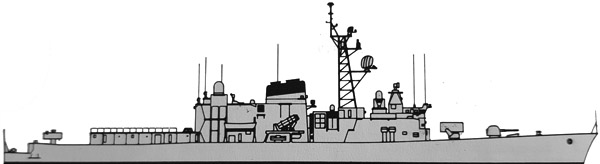
Conway’s profile – An HD profile is waited for 2027.
⚙ specifications |
|
| Displacement | 2,950 tons standard, 4,000 tons hull load |
| Dimensions | 130 x 13.6 x 4.2m (430 x 44 ft 7 in x 13 ft 9 in) |
| Propulsion | 2 shafts VPP KHI-RR TM3B + KHI-RR RM1C GT 45,000 shp/9,900 shp |
| Speed | 30 knots (35 mph; 56 km/h) |
| Range | 5,590 nm at 20 knots (10,352 km) |
| Armament | OTO 76 mm, 2× 20 mm CIWS, 2×4 Harpoon SSM, Sea Sparrow, ASROC, 2×3 324 mm TTs |
| Protection | NOLR-6C int. OLT-3 jammer, Mark 36 SRBOC, Towed decoys |
| Sensors | OYQ-5 TDS, FCS-2, OPS-14, OPS-18, OQS-4, OQR-1 TASS |
| Air Group | One HSS-2B or SH-60J |
| Crew | 200 |

 DD-122 Hatsuyuki