
 Garcia, Bradley, Ed. Mc Donnell, Brumby, Davidson, Voge, Sample, Koelsch, Albert David, O’Callahan, and Glover (AGDE-1).
With the new generation of Soviet submarines, started with the November class SSN, there was an urge to design faster escorts. The idea of the admiralty was therefore to keep the fundamentals of the previous semi-experimental Bronsteins in terms of armaments and sensors, while giving them a much more powerful set of turbines, able to reach 35,000 hp, for a speed up to 27 knots (at first 30 knots was hoped for). This traduced by a clear cut rise in tonnage. For the same speed, the Garcia were twice the tonnage of the latter. Originally these ocean escorts bore the hull classification DE until 1975.
This time the admiralty took the time to polish the design. First studies emerged in 1959, even before the construction of the Bronsteins, but the first ship, USS Garcia (DE 1040) was not laid down before October 1962, a year and 7 month after. The 17 ships that commprised this class were laid down between 1963 and 1964, launched 1964-66 (Talbot, Page, Furer) and completed in 1964-68 at the Bethlehem (San Francisco), Avondale, Defoe (Bay City), Lockheed (Seattle), and Bath Iron Works shipyards.
They were decommissioned from 1988, some sold to Brazil (Bradley as Pernambuco), Davidson (Paraiba), Sample (Parana), and Albert David (Para), and the others apparently leased to Pakistan, Garcia (Saif), Brumby (Harbah), O’Callahan (Alsat), and Koelsche (Siqqat). The only two not transferred, USS Mc Donnell and Voge, tested variable depth sonars and were stricken in 1992.
Development
 These new frigates represented a generational gap with the Bronsteins. The latter were designed in reaction to the vivid criticism met by the previous Claud Jones, and were a kind of return to the Dealey approach but with a new SQS 26 Sonar, ASROC and DASH systems which were also brand new. They only kept one of the original 3-in DP twin mounts, the other turret being a single mount. This strange arrangement was also meant to gain in ASW capabilities. There was a loss of speed though, despite a power back to 20,000 hp, at 26 knots (one knot less). Range also was the worst yet at 4000 nm at 15 knots.
The new Frigates had been designed to fulfill a Protection of Shipping (POS) mission as ASW combatants for amphibious expeditionary forces, as well as underway replenishment groups and merchant convoys.
Design-wise they were a larger version of the Bronstein and were closely followed by the very close Brooke class, with sole major difference the replacement of the aft gun with a Mark 22 missile launcher.
The Bronsteins already tried to answer the threat high speed nuclear submarines but they were simply not fast enough to keep pace. The Garcia class in response were the first to integrate pressure fired boilers, generating much more power without increase the size or weight of the machinery. By playing around with the hull shape not to loose much in speed, they also managed to be larger and in,tegrate a beffed-up arament, notably two large guns, Mk.30 5 inch/38 caliber guns for the first time. These old and trusted ordnance possessed plentyful ammunition inherited from WW2 and the turret itself was basically common to all Fletcher class destroyer, now going the way of the scrapyard. Her ASW suite was basically the same as before but with the improved SQS-26BX hull sonar, Mark 112 ASROC rocket launcher, QH-50 DASH armed drone, Mk.32 torpedo tubes.
In addition they also received a pair of Mk.25 torpedo tubes capable of launching the longer range Mark 37 torpedo. Both the ASROC and torpedoes still refined a “short” range of a dozen kilometers, so the failure of DASH led to gradual replacement by the LAMPS HS-2 helicopter which radically improved their ASW reach. Initially these ships were also given the postwar DE/DEG numbers, but were known as “ocean escorts” albeit registered as destroyer escorts confusingly enough. Anyway, all DEs, DEGs, and DERs were reclassified as FFs, FFGs, or FFRs (Frigates) on 30 June as per the Navy 1975 ship reclassification.
The end of service in the USN (in between the Knox and especially the OHP Perry arrived in large numbers) did not meant end of service ocerall as these capable ship went on under other flags in their majority: After decommissioning from the USN, Bradley, Davidson, Sample, and Albert David were transferred to the Brazilian Navy. They became Pernambuco (D 30), Paraíba (D 28), Paraná (D 29), and Pará (D 27). Pará (D 27) was still in reserve as far as 2015. Glover was modified for research use and recommissioned as AGDE-1 in 1965, then AGFF-1 in 1975, FF-1098 in 1979 (see below).
Design of the class
Hull and general design
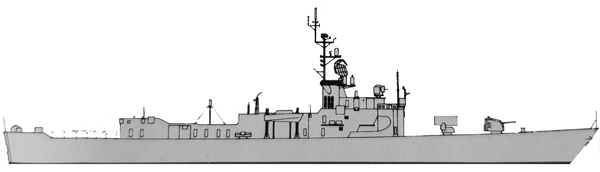
 The Garcia class was longer than Bronstein class at 118.9 meters at the waterline and 126.2 meters overall (414 ft 6 in) versus 113.40 meters overall. That was a significant difference in lenght enabling additional space aft. Initially there was indeed a secondary 5-in/38 turret, not aft of the DASH helideck and hangar but atop the rear structure. Later it was dropped and the hangar modified and helicdeck extended. In beam she was also a bit larger at 13.44 meters versus 12.5 meters (44 ft 1 in), making for an increased hull-beam ratio but without loosing much stability. Draught progressed as well to 7.30-7.47 meters mean or 24 ft 6 in versus 7 meters. The crew grew also, from 191 to 231 due to the second turret, both having less automation, and extra torpedo tubes and Electronic systems. Other sources states 209. 213 might be later in their career with the addition of an ASW helicopter and associated pilots, staff and mechanics.
The Forward section was the same, only swapping the former twin 3-in/50 by a single 5-in/38 which brought less AA acument but more heavy fighting capability, notably possibly for shore bombardment, or just extra flexibility. Behind was the ASROC launcher with its reload system, and behind was three faceted usual bridge; however the central face was extended much and the two side faxes were reduced. The hull was still flush deck all the way to the transom squat stern, there were bulwarks either side of the bridge to protect the aft deck from water spray. The bridge was followed by a mack (combo funnel/mast) with al sensors, and a longer superstructure aft compared to the Bronstein, plus no hull cut aft followed by the aft gun mount.
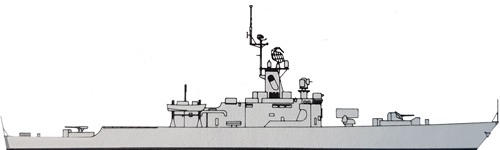
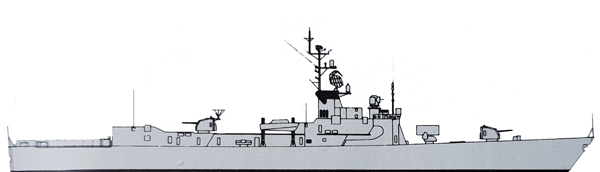
Bronstein and Garcia class designs compared.
Now the hangar was followed by a spacious helideck all the way to the stern. The ships still had two motor cutters under davits either side of the rear bridge block. The triple ASW tubes were aft amidship with enough space for a 300° traverse, and the ASW “heavy” torprdo tubes were fixed in the structure above water. Initially the aft 5-in/38 gun was placed on top of the structure, before the hangar. This configuration was not kept for the next Brooke, as it was replaced by a missile launcher instead. The Knox class went for the modern 5-in/45 instead, but the idea of a main gun on top of the struure returned with the 76mm DP gun of the OH Perry.
Powerplant

The Garcia class powered as seen above by a new system of overpressuring steam boilers, so despite the powerplant size was basically the same, and they kept the same single shaft, single Westinghouse geared turbine (HP and LP stages)* fed by two Foster Wheeler PF boilers, output grew from 20,000 to 35,000 hp (26,000 kW), for 27 knots (50 km/h; 31 mph) instead of 26 knots on the Bronstein. It did not made such difference, but to remind eveybody if the November class SSNs, fastest in Soviet inventory before the Alfa class were capable of 33 knots on paper, the acoustic level associated would betray them immediately to their bow sonar. Sure, this would allow them to try to escape, but several escorts and helicopter working together would have them anyway. As for the range, it stayed the same as before, 4,000 nmi (7,400 km; 4,600 mi) at 20 knots (37 km/h; 23 mph).
*DE1047-1051 General Electric turbine.
Armament
The new Garcia class dropped their 3-in/55 gun, good for AA defence but a bit limited for other tasks, for two vintage 5-in/38 turrets. This was a reasonable choice given the base armament was already excellent, shared ammunitions with the Sumners and Gearings still in service, and were largely available after decommissioned of Benson/Gleaves and Fletcher class destroyers. These were the latest turrets, if the gun was unchanged, being the good old 5-in/38 first used on USS Farragut (DD-348) in the interwar (1934). The turret was the latest single Mark 30 enclosed turret.
5-in/38 Mark 12, turret Mark
Specs:
Gun Weight 3,990 lbs. (1,810 kg) wt breech, 223.8 in (5.683 m), bore 190 in (4.826 m).
ROF with integral hoists: 15-22 rounds per minute.
Shells 55.18 lbs.(25.0 kg) average, many types. Proximity fuse. MV 2,500-2,600 fps (792 mps)
The Garcia (FF-1040) and Brooke (FFG-1) carried 350 rounds. Barrel life 4,600 rounds.
The Brooke and Garcia shared the same Mark 30 with USS Long Beach and USCG Hamilton.
Mark 30 Mod 1 turret weight: 33,500 lbs. (15,195 kg). Mod 0 40,900 lbs. (18,552 kg), Mod 41 41,400 lbs. (18,779 kg).
The Mark 30 Mod 51 had a -5/+85 degrees elevation and could train at 34°/sec. with Ford controls.
324mm Mark 32 Torpedo Tubes
In service from 1960, they were universally adopted for all escort ships and cruisers in the USN, made to launch ASW acoustic torpedoes of numerous marks. Recoignizable as a triple set with an upper tube and two lower tubes. Easy to reload and train manually, albeit the torpedo needed to be brought on a chariot. Full mass was 2,230 lb (1,010 kg). They fired back in 1960 the first generation torpedo with likely the Mark 37 acoustic model. Caliber was 12.75 in (324 mm).
The Mark 37 Mod 0 appeared in 1957 and the Mod 1 in 1960 and were likely adopted.
Specs: 1,430 lbs. (649 kg) for 11 ft 3 in (3.429 m) 330 lbs. (150 kg) HBX payload, 10,000 yards (9,140 m) at 26 knots or 23,500 yards (21,490 m) at 17 knots. Powered by Electric-Battery with Active and passive acoustic guidance for the Mod 0 but wire-guided for the Mod 1. More
RUR-5 ASROC
 Note that this system had no reloads. When all eight missiles were fired, the ship was forced back to base. The RUR-5 ASROC (“Anti-Submarine ROCket”) is the proverbial all-weather, all sea-conditions anti-submarine missile developed for the USN in the 1950s, as a natural evolution of the Hedgehog of WW2n then the Weapon alpha and British ASW mortars such as a the Squid. It offered the possibility to not send a depht charge but a far more potent acoustic torpedo on target, with a low-speed, moderate-range missile carrier. Australia developed such a weapon also with the Ikara. ASROC was deployed in the 1960s, was updated in the 1990s, and installed on over 200 USN surface ships from cruisers, to frigates and was of course all-important for the FRAM II program. It was at its core.
Specs
Missile Mass: 1,073 pounds (487 kg), length 14.75 ft (4.50 m), diam. 16.6 inches (420 mm), Wingspan 26+7⁄8 inches (680 mm)
Warhead: Mark 46 torpedo, 96.8 pounds (43.9 kg) of PBXN-103 high explosive, 10 kt (42 TJ) W44 nuclear warhead
Detonation mechanism: Payload specific
Engine: Solid propellant rocket motor, range 6 mi (9.7 km) subsonic.
Mk 25 twin torpedo tubes
 The Garcia introduced the Mk 25 twin torpedo tubes. They were fixed at the stern, in the transom, with 8 torpedoed total. The Mark 37 acoustic torpedo entered service in the early 1950s, with over 3,300 produced. Retired in the 1970s, stockpiles were sold to foreign navies. The Mark 25 was omitted from DE1047 to 1051. This also helped reclaim space for more useful systems.
Specs:
Weight 1,430 pounds (650 kg), length 135 inches (3.4 m) x 19 inches (480 mm). Fired from 21-inch surplus tubes with guide rails.
Effective firing range: 23,000 yards (21 km) at 17 knots, 10,000 yards (9.1 km) at 26 knots.
Warhead: Mk 37 Mod 0, HBX-3 330 pounds with Mk 19 contact exploder
Engine Electric for 17 knots (31 km/h), 26 knots (48 km/h).
Guidance: Gyroscope (initial), passive sonar (cruise) and Doppler active sonar homing (terminal).
Sensors
The previous Bronstein class were the most advanced for their time alerady, combining the AN/SPS-40 Air search radar, the AN/SPS-10 Surface search radar, fire control radar AN/SPG-35 and AN/SQS-26 AX(R) bow mounted sonar, plus the TASS Towed Array Sonar System, planned and MK 6 Fanfare torpedo decoy system. The Garcia kept the excellent sonar (upgraded to the BX), but added the Mark 35 FC radar for their 5-in/38 guns. They had the LN-66, SPS-10, SPS-40, WLR-1, WLR-3, ULQ-6 ECM suites. The later DE1047 to DE1051 however had the upgraded SQS-26AXR sonar.
AN/SPS-40D
The AN/SPS-40D is a two-dimensional (2D), long range air search radar providing contact bearing and range, replaced later by the AN/SPS-49. It was a vacuum tube design, notoriously sensitive to the vibration from shipboard gunfire. Introduced in 1961 its Frequency was between 400-450 MHz, in UHF band for 7.5 rpm (long-range mode) or 15 rpm (low flier detection mode), practical Range 250 nmi. The array measured 140″ x 214″, had a vertical beam width of 19° and horizontal beam width of 10.5°, peak power of 200-300 kW.
SPS-10F
2D radar from 1959. FRQ 5.45 to 5.825 GHz (5.50 to 5.15 cm) C-band, PRF 650 Hz, Beamwidth 1.9° × 16° vertical, 12° horizontal. Pulsewidth 1.3 μs. RPM 15 rpm fixed, Range 50 miles (43 nmi; 80 km) and Power 190 kW peak (short pulse) or 280 kW peak (long pulse).
SPG-35
Fire control radar for the Mark 33 mounts, improved compared to the SPG-34. They were placed on the mount itself, coupled with the Mark 57 gun director, and Mark 63 gunfire control system for AA fire, with a parabolic reflector 40-in wide, fed by cutler-feed. Working on X band for a peak power of 30 kW, range 23 km, beamwidth 2.4°. TO UPDATE
AN/SQS-26 AX(R)

Instead of the SQS-29/32 hull-mounted sonar of the previous ships, former SQS-4 updated to the EDT, the new ship had the fat better, but also heavier and bulkier AN/SQS-26 AX(R) sonar system. It was very much the peak bow sonar type ever developed so far in the USN and the core asset of the new ship. The AN/SQS-26 was a low frequency, active/passive sonar developed from the Naval Underwater Sound Laboratory, built by General Electric and EDO and later installed on 87 US Navy warships until the 1990s, still in use on foreign now foreign transfers.
Under JETDS its was 26th design of an Army-Navy electronic device for surface ship sonar search system. It weighed 27 tonnes and 215 kg (60,000 lb) and could be operated as a passive sonar on the 1.5 kHz frequency or active sonar at 3–4 kHz. Maximum output was 240 kW for a range between 18 to 64 km (11 to 40 mi) and a direct path, bottom reflected, passive and convergence zone (CZ) capabilities. It was considered the world’s best sonar at the time, also adopted by the new frigates of the Garcia and Brooke class. Later designs had the BX and CX versions. The Bronstein kept their AX version until the end of their service, never updated.
Electronic Warfare
It rested on three elements:
-The WLR-1 & WLR-3 EW systems
-The ULQ-6 ECM suite
-The MK 6 Fanfare torpedo decoy system.
They also had a OE-82 Satellite Antenna with SSR-1 receiver.
Modernizations
1967, Bradley: + 1 x 8 Sea Sparrow Mk 25 SAM (8 RIM-7), Mk 91 radar
1968, Bradley: – 1 x 8 Sea Sparrow Mk 25 SAM (8 RIM-7), Mk 91 radar
late 1960s, Garcia, Bradley, Edward McDonnell, Brumby, Davidson: – 2 – 533 TT
1972-1975, Garcia, Edward McDonnell: – QH-50 DASH drone ASW helicopter; + SQR-15 TACTASS sonar
1972-1975, Bradley, Brumby, Davidson, Voge, Sample, Koelsh, Albet David, O’Callahan: – QH-50 DASH drone ASW helicopter; + 1 SH-2D Sea Sprite ASW helicopter (LAMPS), hangar and helicopter deck were enlarged
late 1970s, Voge, Koelsh: + NTDS CCS
USS Voge in 1967 (conways)
USS Glover AGDE-1 (conways)
Air Group
DASH
 The Gyrodyne QH-50 DASH (Drone Anti-Submarine Helicopter) naval drone was planned on this class to perform SAR missions. It was introduced in 1962, see former posts for more. The model to be carried was powered by Porsche YO-95-6 engines and could carry a single Mk 43 homing torpedo. There was plenty of space between the larger helideck and hangar for a full-fledge helicopter however. And it cane handy when the program was scrapped in 1969. The model used from completion was likely the QH-50D variant of DASH which cured unreliability issues of the first model.
LAMPS I SH-2 Seasprite
LAMPS was the helicopter program on USN ships (Light Airborne Multi-Purpose System). The Kaman SH-2 Seasprite was an interim helicopter (before the arrival of the Seahawk, LAMPS III). Kaman Aircraft Corporation created a compact and fast-moving rotorcraft for ASW missions. Early on this modest sized single-engined naval utility helicopter progressed to twin-engine ASW and SAR and was exported. The Kaman HU2K-1/UH-2 Seasprite family originated in the Kaman’s K-20 developed for a 1956 U.S. Navy requirement for a compact, all-weather utility helicopter. The prototype first flew on 2 July 1959, and the type entered U.S. Navy service in December 1962. It had a single main rotor, tail rotor, the Main rotor was 4-bladed as the tail rotor and it was powered by a General Electric T58-GE-8F initially 1,250 shp class 2–3 and it was classed as a utility / transport / SAR Shipboard utility helicopter. But original design was substantially smaller and simpler than the later specialized ASW Seasprites. It’s possible that’s the UH-2 replaced DASH in 1968-69. The more mature SH-2F had two GE T58-GE-8F engines producing 1,350 shp each, a maximum speed of roughly 143 kt, and a range around 366 nmi.
⚙ Garcia specifications |
|
| Displacement | 2,624 tons standard, c3000t full load |
| Dimensions | 414 ft 6 in x 44 ft 1 in x 24 ft 6 in (126.34 x 13.44 x 7.47 m oa) |
| Propulsion | 2 shaft 1 steam turbine, 2x FW Boilers: 35,000 shp (26,000 kW) |
| Speed | 27 knots (50 km/h; 31 mph) |
| Range | 480t fuel oil, 4,000 nm/15 kts |
| Armament | 2× 5-in/38, ASROC, 2×3 12.75-in, 2x Mk25 ASW TTs |
| Sensors | SPS-40, 10, 26, Mk.56 FCS, SQS-26 sonar |
| Air Group | DASH, SH-2 LAMPS |
| Crew | 16 officers, 231 men |
USS Garcia FF-1040

Garcia was laid down at Bethlehem Steel, San Francisco in 1964. She was launched on 31 October 1963, acquired on 3 December 1964 and commissioned on 21 December 1964. Originally designated DE-1040, she became FF-1040 in 1975. She was assigned to the Atlantic Fleet, homeported in Newport, Rhode Island, and later Charleston, South Carolina. During her service she was awarded the Navy Unit Commendation (with one star), Navy “E” Ribbon, Navy Expeditionary Medal, National Defense Service Medal, Armed Forces Expeditionary Medal. Following her decommissioning on 31 January 1989, she was transferred to Pakistan, Renamed PNF Saif, commissioned until returned to the US on 13 January 1994 and sold for scrap on 29 March 1994.
USS Bradley FF-1041
 Bradley was laid down at Bethlehem Steel, San Francisco, launched on 26 March 1964 and commissioned on 15 May 1965.
Her first deployment (WestPac/Western Pacific) was from July and December 1966. She spent four months on the gunlinee of South Vietnam and acted as carrier escort in the Gulf of Tonkin. In February 1967 she was the prototype for the Sea Sparrow Basic Point Defense Missile System (BPDMS). Trials were performed from May and Septembera and was removed. She made second deployment to Vietnam from December 1967 but was diverted to the Sea of Japan after the North Koreans captured of USS Pueblo (Operation Formation Star). In March 1968 she returned in the Gulf of Tonkin, and by June she ws in the gunline spending 3,247 rounds in 10 days. She was back to HP San Diego by July 1968.
From October 1968 to May 1969 she received her AN/SQS 26AXR sonar. Her two temperamental pressure-fired boilers were overhauled. 3rd deployment in Vietnam started in January 1970, and she was detached to shadown the Soviet “Okean” exercise in April, then back to the gunline until June. The next five years saw more of the same, with an overhaul in 1971–72.In June 1975 she had major mid-life overhaul, with DASH removed, the helicopter hangar enlarge, second 5-in/38 removed and new helicopter embarked. She had trials by mid-1976, made two more deployments including in the Indian Ocean, and had another long overhaul by mid-1979. Next she made two deployments, off Korea and Malaysia, and a last major overhaul by mid-1983, again to cure her boilers. More Western Pacific deployments followed by 1986 and 1987 as a Northern Pacific cruise in May–June 1988. She was decommissioned on 30 September 1988. Sold to Brazil as Pernambuco (D 30), decommissioned 2004, scrapped 2013
USS Edward McDonnell FF-1043
 Edward McDonnell was laid down at Avondale Shipyard, Louisiana, launched on January 1964 and commissioned on 15 February 1965. She joined the Atlantic Fleet ASW Forces on 14 January 1966. By May she was transferred to the Escort Squadron VI (Cortron 6) at NS Rhode Island. 1966-1967 saw exercises in the Atlantic and Mediterranean. By February 1968, she entered the Boston Naval Shipyard for a 13-month overhaul and after shakedown in the Caribbean returned to Newport in June 1969. In 1975, she entered the Standing Naval Force Atlantic (STANAVFORLANT) with the Van Speijk-class frigate Van Nes West German Köln-class frigate Lübeck. She was decommissioned on 30 September 1988, struck 15 December 1992, moored in Philadelphia awaiting disposa until sold for scrap on 25 July 1995, completed by 21 August 2002.
USS Brumby FF-1044
 Brumby was laid down at Avondale Shipyard, Louisiana on 1 August 1963, launched on 6 June 1964, acquired 26 July 1965, and commissioned on 5 August 1965.
She was assigned to the Atlantic fleet, deployed to northern Europe and Mediterranean in 1967. She had boilers issue (a reccuring them for this class) and was towed to Portsmouth, Norfolk by January 1968 until they were repaired. Her homeport was Newport RI. In January 1969 she had a refresher training to Guantanamo where her sonar dome was damaged by the anchor chain. By March she was back at Boston for repairs.
She left Mayport on 28 November 1970 for the Mediterranean, back 3 May 1971. There in December she shadowed the Soviet helicopter carrier Leningrad.
In 1972, one boiler burrst out and she had a casualty, towed from Scotland by USS Preserver (ARS-8) to Charleston in 15 November. On of the 36 steam tubes had been improperly monitors and the engineering department was blamed. The level of chlorides in the system (causing stress corrosion in stainless steel components) had not been taken. She was sent to South America from 21 July 1975 to 8 December 1975 and receiced the Expeditionary Medal for her deployment in Iran-Indian Ocean, in 1980 and Navy Expeditionary Medal for Lebanon in 1983. In 1984, Brumby was agains deployed in the Mediterranean and Indian Ocean until November 1984. She entered NAVOCFORMED activated at Ancona, with Alpino (F 580), Piyalepasa, HMS Brazen (F91), Sachtouris (ex-USS Arnold J. Isbell (DD-869)) and transited the Suez Canal. She also won a Coast Guard Unit Commendation and Coast Guard Meritorious Unit Commendation. She was decommissioned on 31 March 1989 and leased to the Pakistan Navy, Sold for scrapping, 9 September 1994.
USS Davidson FF-1045
 Davidson was laid down at Avondale Shipyard, Louisiana on 30 September 1963, launched on 2 October 1964, acquired on 16 November 1965 and commissioned on 1 December 1965. Pacific Fleet. Her HP was Pearl Harbor for her first Western Pacific cruise on 18 April 1967 via Yokosuka, Chinhae, Sasebo, Subic Bay, Hong Kong, Bang Saen, and Bangkok and spent time on the gunline in Vietnam with carriers of the Yankee Station, back on 23 October 1967. She made another deployment from Pearl Harbor on 23 July 1982 via Maizuru, Sasebo, Pusan, Subic Bay, Tacloban, Sattihip, Hong Kong and Kagoshim, back on 28 January 1983. She received the Armed Forces Expeditionary Medal, Combat Action Ribbon, 2 Meritorious Unit Commendations, Republic of Vietnam Meritorious Unit Citation, and several Vietnam Service Medals, the Navy Expeditionary Medal and Navy “E” Ribbon. Decom. on 8 December 1988. Sold to Brazil as Paraiba (D28), decommissioned 2002, sank under tow 2005.
USS Voge FF-1047

USS Voge (after ww2 Rear Admiral Voge) was laid down at Defoe Shipbuilding Company, Michigan on 21 November 1963, launched on 4 February 1965, acquired on 15 November 1966 and commissioned on 25 November 1966.
She introduced a sloping bulkhead and the new Knox-class ASROC reload magazine. On 15 May, she departed Newport for her shakedown cruise until 24 June, and back to Newport for exercises until July. On 1 August she had fixes at Boston Naval Shipyard until early 1968. In March she was assigned to CortRon 6 at Newport started training in more sophisticated anti-submarine warfare tactics and related equipment. By February 1969 she was prepared to depart to northern Europe for a NATO exercise. She took part to the Spithead Royal Review for NATO Fleet celebration (20th anniversary) and stopped at Cherbourg, Edinburgh, Bremen. While back the detected a tracked a Soviet Yankee-class submarine, the latest Soviet SSBN for which she latter was awarded the Meritorious Unit Commendation. From August 1970 she was overhauled at Boston until Feb.1971. She had gunnery exercises in the Virginia Capes by March, and refresher cruiser from 12 March 1971 in Guantanamo Bay, thene exercises in Narragansett Bay. She later took part in US-Spanish ASW exercises and with the Portuguese Navy but returned home heavy weather on 24 April 1972.
From 1972, all but DE 1048 USS Sample and DE 1050 USS Albert David received a landing pad for a LAMPS Helicopter. Already they received extensive facilities for their DASH drone system. Originally they were fitted with long range torpedoes launched by the stern for Mk24/25 models. This was removed when the program ended, to the benefit of DASH and LAMPS. She joined the 6th Fleet (Mediterranean) from 13 June, via Rota, and spent six months in unilateral and bilateral exercises, port visits. One lanmark was the visit at the Turkish Naval War College on Heybeliada Island, Marmara in August, and NATO Exercise “Deep Furrow” in September. By November, she tracked SSBNs.
One was tracked for 300 miles into the Atlantic before breaking contact. By 10 December she was relieved by USS Du Pont in the Med. followed by post-deployment leave and repairs. From January 1973 she had exercises in March, bilateral exercises (French Navy in June), midshipman training cruise, and HP change to Naval Station (NS) Mayport in Florida on 16 August. She was back to the Mediterranean from January 1974, via Rota and relieving USS Claude V. Ricketts at TG 60.1 near Golfe Juan, France. Her deployment ended via Rota on 24 June, back for home. By September she started at Charleston Naval Shipyard a 10-month overhaul followed by trials until October, restricted availability and back in December to Mayport, remaining there until mid-February 1976. She was prepared for a 3rd deployment to the Med and departed South Carolina on 14 April for Rota (26th) making port visits, training exercises and Soviet subs trackind close to the Black sea.
On 28 August 1976, while with USS Moinester, Ionian Sea she spotted the periscope of the Echo II-class K-22 herself shadowing Moinester. She tracked her for two hours taking photos of her periscope. K-22’s CO eventually spotted USS Voge and realized he was about to collide, ordered an emergency dive, but her bow and sail rammed Voge’s port quarter. She was a SSGN and lost her missile container No.1 and had her fin structure damaged while Voge her stern damaged. She was later drydocked at Toulon, France. On 7 November she had sea trials, returned for Rota and back home on 2 December. She had more repairs and tests of her main propulsion plant. On 11 July 1977 she returned to Rota with USS Saratoga’s CBG, but detached back to Mayport due to contaminated potable water tanks on 13 July. On the 27th she departed again, to Rota on 3 August followed by port visits and exercises, then reassigned to the 2nd Fleet at Gibraltar, and Mayport before Christmas. She had an overhaul at Braswell Shipyard, Boston into 1979.
Back in 1967 she was also fitted the ASW Ships Command & Control System (ASWSC&CS). This was a new ASW Naval Tactical Data System (NTDS) also installed on Koelsch and USS Wasp, tested since 1967. The system used digital computers common in the hunter/killer group. In 1969 Voge detected a submerged Soviet submarine, using hold-down tactics to the point she was forced to surface and was awarded the Meritorious Unit Commendation. These tactics were also used until the ship ran out of power. Voge was decommissioned on 1 August 1989, mothballed at Philadelphia, sold for scrap on 25 July 1995, repossessed by the Navy and resold on 26 May 2000, completed 16 January 2001, the oldest Garcia class still around in the US.
USS Sample FF-1048

USS Sample (named after Rear Admiral Sample) was ordered from Lockheed Shipbuilding and Construction Company, Seattle, laid down on 19 July 1963, launched on 28 April 1964, acquired on 15 March 1968, commissioned 23 March 1968. After shakedown, USS Sample was assigned to DesRon 29, Long Beach Pacific, then she was assigned to Pearl Harbor with DesDiv 252, DesRon 25. She arrived at her HP on 18 October 1968, but was damaged by O’Bannon the following day. She had her sonar dome damaged and repaired at Puget Sound. From 21 January 1969, she left Bangor for Hawaii and by mid-April started her first WestPacific, sailed to Yokosuka, Okinawa, the Philippines and in May, Subic Bay, then to the Tonkin Gulf for her first Vietnam ToD.
In June, she patrolled Taiwan waters in July, back to Japan in August, then South China Sea and Taiwan Strait patrol, and back to Japan. By September, same, the the Philippines and “special operations” in the northeastern South China Sea, R&R at Hong Kong, and again Taiwan-Japan tours. On 18 October she left for Pearl Harbor, 1st Fleet. On 14 July, she left for anothher WestPac with the 7th Fleet, 28 July Subic Bay, 1 August saw her with USS Oriskany CBG at Yankee Station. Next, TG 77.5 in the Tonkin Gulf, the Taiwan (Kaohsiung) and in Subic and back with TG 77.5. On 29 September Subic for boiler repairs, Okinawa on 3 October, then Japan for 19-27 October joint exercises in the Sea of Japan. She went via Hong Kong for Taiwan on 13 November and returned to Sasebo, Sea of Japan, Yokosuka and by December, departed for Pearl.
After Xmas leave, she was ready for new Ops but stayed all 1971 in Hawaii (availability, trials, refresher training, exercises). On 27 January 1972, she made her 3rd WesPac and Vietnal ToD, between SAR, PIRAZ, the gunlines (fire-support off the coast) until she departed for Pearl on 10 August. She spent the reainder in standdown and in restricted availability, and COMTUEX 4-72 in December. She departed for a 4th Westpac on 14 May 1973, and back to Pearl Harbor on 8 December. From May 1974 she departed for another ones. No logs afterwards. She was decommissioned on 23 September 1988. In 1989 sold to Brazil as Paraná (D 29), sold for scrapping in 2004.
USS Koelsch FF-1049
 USS Koelsch was ordered from Defoe Shipbuilding Company, Michigan. She was laid down on 19 February 1964, launched on 8 June 1965 and acquired on 23 May 1967 and commissioned on 19 October 1968.
Sold for scrapping, 9 September 1994
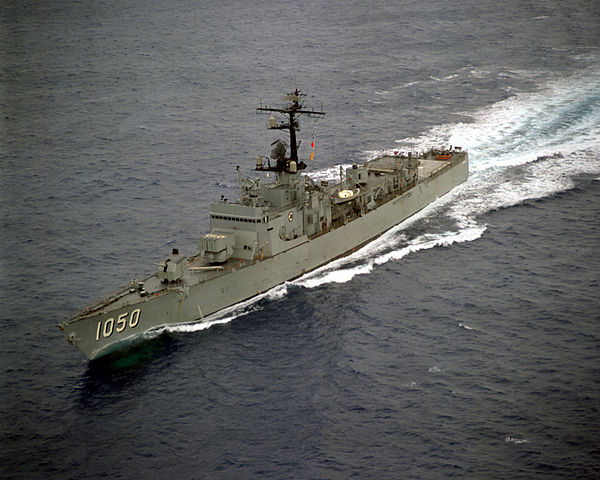
USS Albert David FF-1050

Albert David was ordered from Lockheed Shipbuilding and Construction Company Seattle. She was laid down on 29 April 1964, launched on 19 December 1964, acquire on 11 October 1968 and commissioned on 19 October 1968.
Albert David earned three battle stars for service in the Vietnam War.
1989 to Brazil as Pará (D 27), scrapped 2015
USS O’Callahan FF-1051
 O’Callahan was laid down at Defoe Shipbuilding Company, Michigan on 19 February 1964, launched on 20 October 1965, acquired on 1 July 1968 and commissioned on 13 July 1968. O’Callahan was commanded by Captain Robert L. Brown. On 16 August 1968, after her fitting-out at Boston she joined her HP at San Diego via Norfolk, Charleston, Fort Lauderdale and for 25 days she had electronics and weapons systems tests off the Pacific Northwest followed by a shakedown on 4 November. She trained in the Hawaiian Islands on 6-17 February 1969, entered Long Beach Naval Shipyard on 4 March for post-shakedown availabilit and was prepared for a first deployment to the Western Pacific. She made several, but logs logs available. She was sold for scrapping, 29 March 1994, after US decommisson on 31 May 1989, and lease to Pakistan, albeit it was never acted upon as Pakistan refused to stop its nuclear program.
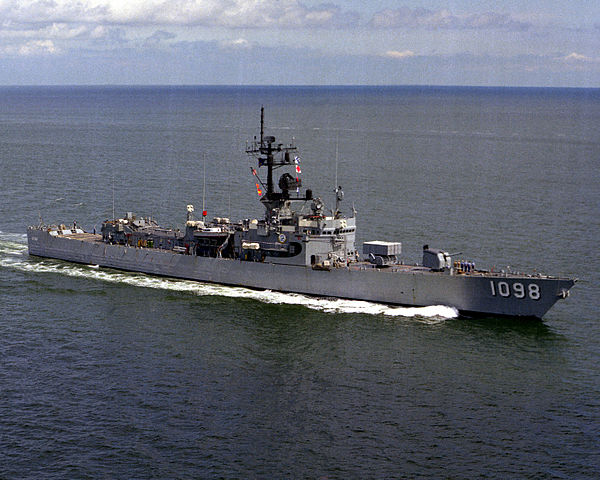
USS Glover FF-1098
 Glover was laid down at Bath Iron Works. She was laid down on 29 July 1963, launched 17 April 1965, commissioned on 13 November 1965. She entered the Cruiser-Destroyer Forces, Atlantic Coast/Caribbean. In 1966 Glover she was reclassified as AGDE, modified in the Boston Naval Shipyard with electronic testing and data recording hardware. In 1968 f=after trials she returned to Boston Naval Shipyard for more modifications and addition of a VDS. In 1970, she her her first Atlantic crossing/Mediterranean cruise between Spain, France, Italy, and Greece. While performing sonar tests in the Mediterranean, she was closed and shadowned by Soviet Navy vessels. One closed dangerously from her stern. In September 1974 she entered Boston for further modifications. She was redesignated (AGFF-1) in 1975, FF-1098 in 1979. She had a major overhaul at South Boston by 1988, new boiler refit and sonar overhaul. She was decommissioned on 15 June 1990, transferred to Military Sealift Command (MSC) as research vessel for EDO/NUSC as USNS Glover (T-AGFF 1). Sold for scrapping on 15 April 1994 at Philadelphia.
Read More/Src
Books
Polmar, Norman “The U.S. Navy: Sonars, Part 1” United States Naval Institute Proceedings July 1981 p.119
Blackman, Raymond V. B. (1971). Jane’s Fighting Ships 1971–72. London: Sampson Low Marston & Co. Ltd.
Friedman, Norman (1982). U.S. Destroyers: An Illustrated Design History. NIP
Gardiner, Robert; Chumbley, Stephen, eds. (1995). Conway’s All The World’s Fighting Ships 1947–1995.
Links
destroyerhistory.org/
navweaps.com
https://www.navweaps.com/Weapons/WNUS_5-38_mk12.php
gyrodynehelicopters.com
navypedia.org/
en.wikipedia.org