


 Marine Nationale (1933-1950):
La Melpomène, La Pomone, La Flore, L’Iphigénie, La Bayonnaise, Bombarde, L’Incomprise, La Poursuivante, La Cordelière, Branlebas, Baliste, Bouclier
Originally designed as escort vessels, later reclassified as torpedo boats, the “600-ton” class, and “Melpomène” for most authors, was the only class of French operational Torpedo Boats when WW2 broke out. Another class was in construction at the time, Le Fier class (1938) but none was completed. France like its Med. rival Italy, but also Germany and Japan looked at Torpedo Boats to go around the below 600t “no limit” warship bonanza of 1922, and yet only believed them useful for escort operations in the Mediterranean, and designed fast and highly manoeuvrable vessels usable for coastal areas. Built between the west and south coast between 1933 and 1938, six operated in the channel and ended in UK in June 1940, three were later managed by the Free French Naval Forces but the other six in the Vichy French Navy were partly scuttled in Toulon on November 1942, the other half interned in Bizerte and captured in December 8, 1942. The latter three served on the Regia Marina and German Kriegsmarine, sunk by the Allies or scuttled. The last were scrapped in 1950.

The TB Iphigénie in an interwar parade src forummarine.forumactif.com
Development
The driving force behind the story of the only French Torpedo Boat class of WW2 was partly the tonnage limitations inherited by the treaty of Washington French politician delegation signed in 6 février 1922. This limitation was confirmed in 1930 at London, so that’s free tonnage outside of destroyers for all nations to build various escorts. From Paris, the Regia Marina’s move started to look mildly worrying, when in 1929 it was decided to gradually reclassify as torpedo boats all former WW1 destroyers, from the oldest to the most recent Indomito to the Curtatone class in 1938, while at the same time, drawing on the experience of the 1929 sub-chaser Albatros, to decide on its first modern torpedo boats in 1930 also with the Spica class started in 1933. If Italy was freeing destroyer tonnage, by playing around the 600t limit, the Marine Nationale had to take this into consideration. The other point is that even the standard destroyers of the L’Adroit and Bourrasque class were not in unlimited numbers. There was an objective need for a coastal, rather than overseas escort for convoy, a task the “1500 tonnes” already filled well.
1930 “Escorteur” project
So in early 1930 work started on an “escorteur” compatible with the 600 tonne treaty limit in order, of needed, to be built in large quantities. They were intended to fill the role as merchant and troopship escorts along the French Riveria, up to the French west coast, along the North African and West African coast, as well as Indochina. For information, the French Navy had no experience in building light ships since WWI and its ASW gunboats. Its last torpedo boats were the Mistral class back in 1901, at Normand, Graville, and loire Naval Yard. Since then, warship design in that forgotten category somewhat progressed, through rare “light destroyer designs”. The French for example had a good example of this with the 1923 and 1924 Type Torpedo Boats of the Reichsmarine. The “birds/cats of prey” were above the 600t limit as they were around 800-900 tonnes but showed how to preserve enough seaworthiness for the North Sea and Baltic, speed, range and a good armament on a small package.
It was agreed also in 1930 that their primary mission was to be the protection of coastal convoys against submarines above all else. So torpedoes were not mandatory at this stage. The French initially dubbed the project “escorteurs” (“escorts”) and artillery was to be just enough to deal with surfaced submarines as well, AA was an afterthought. They needed to be fast enough to zip in and out of the convoy and with hydrophones, detect and depth charge submarines, so having a generous complement of racks and throwers. At that stage, the only “torpilleurs” in service were soon to be renamed “torpilleurs d’escadre” as the project or “escorteurs” was later reclassified as “torpilleur (cotier)”, or “coastal TB”.
Many lessons of WWI were integrated in the discussions: During the First World War, convoy escort and anti-submarine warfare was done with or without “ultrasonic detectors” by destroyers armed with depth charges, a tactic that proved highly effective in 1917-18, and after hastily building gunboats and sloops during the war, France neglected technical aspects of escort operations, despite having all the necessary resources in 1918 to develop a high-performance sonar system. Only the convoy tactic was retained.
Given this gap, as all most of the improvised WW1 gunboat escorts were gradually retired, newly built minesweepers (Elan class) were used for escort, albeit they weren’t really designed to merchant shipping. Another WWI class looked at for inspiration were the Scarpe class “sloops”, 600t, 21 kts and armed with four 100mm, two 65mm et ASW racks and throwers. They also looked at the ww1 450 tonnes Dubourdieu class that looked like merchant ships. But it’s really the Elan and Chamois class “sloops”, the latter versatile minesweepers/minelayers and escorts made for the colonies. The first of the Elan class were ordered FY1934. They had a transom stern, were capable 20 kts, had a twin 100m gun mount, some AA, 4 DCT and one DCR plus a sweeping gear. But they were too large to fit the treaty limuts at 895 tonnes FL, circa 750t standard. The French term used for them was “Avisos dragueur de mines”. This other issue was their low freeboard. This design was delayed however and none was launched before 1938 and improved with the next Chamois class that had a forecastle.
Final Design and Construction
So back to the “600 tonnes” escorts, the initial project was launched in early 1930, The armament also had to include a good artillery to counter enemy light ships as the escorted convoy passed off enemy coasts and for coastal defense, albeit the quesiton of carrying torpedoes was still undecided. The final design by late 1930 when approved called for a top speed of 30 knots, range of 1,500 nautical miles at 18 knots, 600 nautical miles at 30 knots, armament of two 100mm guns, four 13.2mm HMGs and to deal with enemy light surface ships, a pair of standard 550mm torpedo launchers plus for ASW operations a Ginocchio torpedo, a depth charge thrower with ten 100kg depth charges, two mortars with three charges each and an underwater “tracking net”, a early ww1 feature that seems out of place. The first four (Melpomène, Flore, Pomone, Iphigénie) were financed under the 1931 budget allocation (Finance Law of March 31, 1931), which also funded the construction of two submarine chasers. The next four (Bayonnaise, Cordelière, Poursuivante, Incomprise) were financed under the 1931 allocation (Law of July 10, 1931), along with Dunkerque. The last four (Branlebas, Bombarde, Bouclier, Baliste) were financed under the 1932 budget allocation (Finance Law of March 31, 1932).
On October 24, 1936, a memo from the General Staff officially abandoned the designation of “convoy escort” for “610-ton torpedo boat”. They would operate in three divisions of four ships each, Torpedo Boat Divisions (DTs) numbered 11, 12, and 13. Construction proceeded slowly between 1933 and 1938, with the following:
AC de Bretagne, Nantes: La Melpomène, La Flore.
AC de la Loire, Nantes: La Pomone, L’Iphigénie, Bombarde
Chantiers Maritimes du Sud Ouest, Bordeaux: La Bayonnaise
AC Seine Maritime, Le Trait: L’incomprise, Bouclier
AC de France, Dunkirk: La Poursuivante, Baliste
AC Augustin-Normand, Le Havre: La Cordelière, Branlebas
Note in that list, only Augustin Normand actually had experience in building torpedo boats, but 30+ years prior…
Design of the class
Aesthetically, these French “torpedo boats” were designed a bit as scaled down “1500t” destrouers and were undeniably elegant with a reasonable forecastle, a compact and streamlined bridge block, two raked funnels, a midships deckhouse and aft deckhouse. However to meet the 600 tonnes limit, engineers had to work around shortcuts and material economy, making in the end for a fragile hull and engine, making them ill-suited for extended missions…
Hull and general design
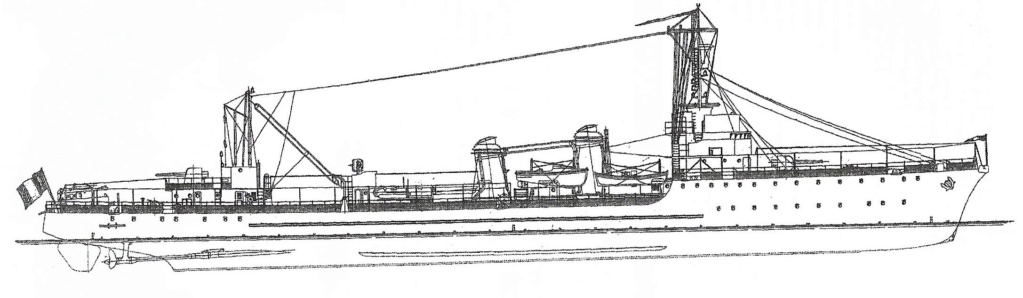
Their normal displacement is 680 tons for 610 tons standard, and 834 tons up to 895 tons fully loaded in late orders. This was for a length of 80.7 m (264 ft 9 in) overall and a and a beam of 7.96 m (26 ft 1 in) or almost 8 meters for nan ideal ratio of 1/10, plus an average draft of 3 meters or exaclty 3.07 m (10 ft 1 in). The crew consisted of 105 men, including 5 officers, 15 petty officers, and 85 quartermasters and seamen, with four utility boats under davits. Indeed, as the design evolved and they became proper torpedo boats, the machinery had to evolve also to go from 20 to 35 knots. This was an enormous challenge, dictating both a change in hull ratio, thinner framing and plating to stay light, and a much larger machinery space. Despite all of this, the final design was slightly above authorized tonnage, but it was no longer relevant in 1936 after Italy and Japan never attended the second London conference.
Now, there were significant design differences with the 1500 tonnes: The 600 tonnes torpilleurs indeed had a gradual draft at the keel, for a sloped, narrow and thin chin forward, a nicely curved clipper bow and some flare for their forecastle, about 1/3 of the lenght, two counter keels, a single trapezoidal rudder, two struts-supported classic propeelr shafts. The poop was shaped like the one of contemporary destroyers, but less marked. There was a cut down to the keel above the surface. The depht charges were not in internal conveyor belt systems but external on deck. The ships had an enclose bdige with short wings supported by pillars and an open bridge, a fire control post with telemeter, a pole mast with cross-yards and wireless radio cables anchores from there to an aft small pole mast at the quartedeck house aft close to the radio room. The two single guns were situated at the same height, as the aft one was place high up on the quarterdeck house. Now, the design only integrated a single dual torpedo tubes bank for weight concerns but there was extra space aft of it and the light structure that carried a seachlight, to go for another. It was not done because of stability concerns but remained an option in wartime.
Powerplant
The propulsion system consisted of an evaporation unit, with two boilers (types depends of builders, but most were of the Indret small tubes direct flame type) rated at 27 kg/cm² and a propulsion unit with two Parsons or Rateau geared turbines developing 22,000 horsepower total (16,000 kW). They have two fixed pitch bronze 3-bladed propellers for a top speed speed of 32 knots at full load (36.5 knots during trials for some, 34.5 knots (63.9 km/h; 39.7 mph) on average on trials). Their range however was limited by the space allocated to fuel oil bunkerage, which was restricted at 170 tons, for 1,000 nautical miles at 20 knots and 650 nautical miles at 25 knots. Power when the main machinery was cold, is supplied by two diesel engines driving two generator sets. Their very limited range was later widly criticized.
Armament
In 1930 their initial armament as escorts was to be two 75mm guns and four 400mm torped tubes. Their final accepted armament consisted of two 100 mm guns, shielded, one on the foredeck and the other on the aft deckhouse. Their anti-aircraft armament comprised in 1933 two twin 13.2 mm Hotchkiss anti-aircraft heavy machine guns on either side of the aft deckhouse. It was later beefed-up. A twin 550 mm torpedo tubes was located behind the second funnel. A depth charge thrower was installed aft with a reserve of 20 depth charges. There was also a light sweeping gear was used to cut mine moorings, but also until 1940, they carried a towed Ginocchio ASM towed torpedo and submarine-finding net. A new type of towing system for was tested in 1939 by “Bayonnaise”.
Schneider 100 mm (3.9 in)/40 modèle 1932
The 100 mm/45 (3.9″) Model 1927 was first developed for the seaplane carrier Commandant Teste, and later improved for the 600t TBs as the modèle 1932. They also equipped the Chevreuil and La Capricieuse sub-class of the Chamois class avisos.
Specs
Mass 3,629 lbs. (1,620 kg) bore lenght 177.2 in (4.500 m).
Fixed shell 53.2 lbs. (24.2 kg) HE: 29.7 lbs. (13.5 kg) or SAP 32.96 lbs. (14.95 kg)
Muzzle velocity 2,477 fps (755 mps) SAP or 2,575 fps (785 mps) HE
Rate Of Fire 10 rounds per minute
Elevation +34 degree, range 16,400 yards (15,000 m).
Single mount with rotating solidary platform ad shield.
See on navweaps
37 mm M1925 AA (1940+)
Vichy boats after 1940 were apparently rearmed with two single 37 mm AA mounts modèle 1925.
Mass: 300 kg (660 lb), Length 2 m (6 ft 7 in), barrel 1.8 m (5 ft 11 in).
Shell 0.72 kg (1.6 lb) 37 × 278 mm (1.5 in)
Elevation −15° to +80°, traverse 360°, 15-21 rpm, mv 810 m/s (2,700 ft/s)
Effective range: 5,400 m (5,900 yd) at +45°, max 7,000 m (7,700 yd).
13.2 mm Hotchkiss AA
 Initially they were located in the wings. This was a gas operated system fed by 30-round box magazine, or 15-round feed strips. It was copied by Japan and Italy and used by the axis in WW2. The round was peculiar in this it was a 12.7 × 99 mm Browning (.50 BMG) cartridge necked up to 13.2 mm caliber. A short round (96 mm) was introduced in 1935. It ws mostly adopted for fixing the barrel wear issue. Hotchkiss developed also single and quad mounts, one which was studied by the US.
Specifications
Mass 37.5 kg (83 lbs) per gun stripped.
Length: 1.67 m (5 ft 6 in), Barrel 1 m (3 ft 3 in)
Shell: 13.2×99mm Hotchkiss Long (1929).
Elevation -10° to +90°, traverse 360°, 450 rpm cyclic, 200-250 rpm sustained
Muzzle velocity: 800 m/s (2,625 ft/s)
Max range: 7.2 km (4.5 mi), Effective 4,200 m (13,800 ft)/45°
550mm 23DT torpedo Tubes

The French developed this new standard instead of 550 mm directly from WWI 450 mm standards back in 1919. The 23D was introduced in 1923 for destroyer.
Specifications 23D/DT TORPEDO
Weight: 4,560 lbs. (2,068 kg), for 27 ft. 2 in. (8.280 m) x 500 mm (21.7 inches).
Warhead: 683 lbs. (310 kg) TNT
Powered by a Schneider alcohol fed air heater, 4-cyl.
Speed settings: 9,840 yards/39 kts or 14,200 yards (13,000m)/35 kts
Depth Charges
Single depth charge rack for Guiraud Model 1922 200 KGs, 10 available, +10 in storage at the poop. Introduced in 1923, they Weighted 573 lbs. (260 kg) for a 441 lbs. (200 kg) charge for 50 x 88 cm (19.7 x 34.6 in). Sink Rate or terminal velocity was 10 fps (3 meters per sec.) with 100, 165, 250 and 330 feet (30, 50, 75 and 100 m) settings, later augmented to 120m.
The DC projectors when later fitted were Thornycroft derived 1930 by the French-built 100/250 M1928 mortar. It could project a lighter 100 kg DC at 820 feet (250 m).
Ginocchio towed torpedo
 Underwater Weapons Directorate of La Spezia, table dated September 1931, longitudinal section src
In the original design, the ships carried a Ginocchio “towing torpedo” GP1927/46 T. It was eliminated in 1940. Developed in the 1930s, it was a promising new device. These weapons were used during the First World War by light units such as MAS. It could be towed at variable speeds from 2 to 20 knots, could dive to depths ranging from 17 to 33 m. Depending on the length of the towing cable, maintaining a predetermined immersion, they were ready to explode due to the impact effect or thanks to an electrical ignition circuit.
Modified and improved after the WW2, the modello 46/1927 type GP (great depth) had a 46 kg charge, automatic trigger, and became widespread on torpedo boats and VAS ships. See also.
Other Equipments
The ships in French documentations are described with the following:
1 drague pour mines à orins (oar mine sweep) “Ronarc’h”. It worked by shearing mine oars.
1 “torpille remorquée” ASM et un “filet indicateur” de sous-marins.
The Ginocchio was supposed to work with an ASW net 1000 m long, 72 m wide.
They carried no paravanes however.
Modifications
In 1941, Branlebas in FFL service received twi single 40mm/39 QF Mk VIII pompom AA guns. In 1943, La Melpomène, L’Incomprise, Bouclier, La Flore, La Cordelière all in FFL service were standardized, they lost one 100mm/45 after for three 40mm/39 QF Mk VIII pompom, two single 20mm/70 Oerlikon Mk II/IV, and a modern light radar.
Sensors
The ship likely had basic French hydrophones of the same type used in the Elan and 1500t destroyer classes. However those operating in the channel were likely re-equipped in 1940 with a British 123 sonar.

New Meuse River, Rotterdam. Moored at the quay, two torpedo boats, probably French, of the La Melpomène class, belonging to the 11th Torpedo Boat Division of the French Navy.
⚙ specifications |
|
| Displacement | 610 tons standard, 834 tons FL |
| Dimensions | 80.7 x 7.96 x 3.07 m (264 ft 9 in x 26 ft 1 in x 10 ft 1 in) |
| Propulsion | 2 shafts geared turbines, 2 boilers 22,000 shp (16,000 kW) |
| Speed | 34.5 knots (63.9 km/h; 39.7 mph), 32 kts service |
| Range | oil 170t, 1000 nm/20 kts |
| Armament | 2x 100mm m1932, 2×2 13.2mm AA, 1×2 550mm TTs, 1 DCT, 1 Ginocchio AST, see notes |
| Crew | 105 |
Career of the La Melpomène class
In the FNFL
When WW2 broke out, the majority of these TBs were based in the Mediterranean, notably Toulon. But in 1940 seven were sent to asssist effort of the fleet along the channel and west coast. After the evacuation of Dunkirk and fall of French porrts and base to the German advance, Melpomène, Bouclier, Branlebas, Incomprise, Flore, and Cordelière took refuge in Plymouth. They were seized by the British Royal Navy during Operation Catapult on July 3, 1940. Melpomène was returned to the Free French Naval Forces (FNFL), escortinf allied coastal convoys in and out of the Channel for from September to November 1940 and earning a commendation, but she was placed in reserve due to her poor seaworthiness. Due to the lack of Free French crews she was recommissioned in the Royal Navy from October 1942 to September 1943, and rearmed, but soon decommissioned until the end of the war. Bouclier was transferred to the Dutch Navy and served from August 1940 to January 1941 in a static way for training. She was returned to the FNFL and took part in coastal convoys until decommissioned in 1944.
Branlebas was also confiscated and manned by a British crews for coastal escort, lost with all hands in a storm on December 14, 1940. That already arose suspicions the design was “rotten” as far as stability went and participated in their short service life. Incomprise, Flore, Cordelière were returned to the FNFL but never recommissioned, also due to a lack of French crews. Apart the loss of Branlebas, issues of maintenance and repairs condemned the class in allied use to irrelevance. Eventually as the war progressed, the FNFL would acquire many ships, but of British origin for escort work.
Vichy Service

Bombarde, Pomone, Iphigénie were still in the Mediterranean in 1939-40. They took part in a few Vichy French Navy sorties, notably to try to supply French Syrian forces. After the fall of Toulon in November and scuttling, they took refuge in Bizerte where they were captured on December 8. Others were at Toulon: Bayonnaise, Baliste, and Poursuivante were all scuttled on November 27, 1942, attributed to the Italians as they nominatively controlled the area.

 Axis Service
They were transferred to the Regia Marina as FR 41, FR 42, and FR 43. In April 1943, so before the Italian reddition, they lacked the crews to operate them, so they were returned to the Kriegsmarine, and were reclassified as “escorts”, then back to “torpedo boats” in May as TA 9, TA 10, and TA 11. Still, torpedo tubes were removed, radar installed, FLAK reinforced: 2x 37mm, a Flakvierling, ten 20mm FLAK guns.
-TA 9 (Bombarde) was in reserve at Toulon, from September 1943, sunk by an allied raid on August 23, 1944.
-TA 10 (La Pomone) took part in active escort operations but on September 23 she clashed with HMS Eclipse (H08) near Rhodesn escaped badly damaged, and was scuttled 4 days later.
-TA 11 (Iphigénie) was at anchor, without fuel when destroyed by Italian tanks and ships at Piombino, Elba in September 1943 when the Italian swapped sides after the armistice.
As for the ships scuttled in Toulon: Poursuivante was inspected and declared beyond repair. Bayonnaise, Baliste were refloated, inspected, foud repairable, refitted, put to Italian standards, then recommissioned into the Regia Marina as FR 44 (ex-Bayonnaise) and FR 45 (ex-Baliste). It seems they saw little service if any. When the September 9, Armistice of Cassibile came out, they were taken over by the Kriegsmarine as TA 12 (FR 44/Bayonnaise) and TA 13 (FR 45/Baliste) but due to the lack of crews, saw no action and were not even standardized to German needs. TA 12 bombed in an allied raid on Toulon on November 24, 1943 and TA 13 was scuttled by August 25, 1944.
 La Melpomène (1935)
La Melpomène AC de Bretagne, Nantes, she was laid down The Melpomène was laid down in December 1933 at the Ateliers et Chantiers de Bretagne shipyard in Nantes, launched on January 24, 1935, and commissioned in August 1936. She was in Brest in 1939 and started escoritng convoys in the Atlantic, Channel and North Sea. She wa salso present at Dunkirk for the evacuation of May 1940, Operation Dynamo. She then took refuge in Portsmouth as the Germans captured Brest, and on July 3 were captured (Operation Catapult). She was attributed to the Free French Naval Forces (FNFL) on August 31, under LtCdr. Favreau from September 7, 1940, to November 27, 1942, then Lt.Cdr Despreau from November 27, 1942, to September 1, 1943. In one mission in fog, she was accidentally rammed at low speed by HMS Whutshed (D77) on her forward port side. No injuries, but she was repaired for six weeks. For her sercvice she was awarded a commendation by the French Navy. Crews were however transferred to better British escorts. By September 1943, she was returned to the Royal Navy and ended in reserve at Hartpool. The loss of Branlebas and near impossible maintenance as said above (spare parts in occupied France) led to a prematurely decommission. She was towed to Cherbourg on September 16, 1945, returned to French control but condemned on May 15, 1950 and scrapped.
La Pomone (1935)
La Pomone was ordered from AC de la Loire, Nantes, laid down on 22 november 1933, launched on 25 january 1935 and commissioned on 1st Dec. 1936. Her sea trials revealed, like her sisters, serious stability and seaworthiness problems. Her 1939-40 service is linked to the activity in the Mediterranean. Until June 1940 she took part in many escort missions, notably for troopships in and out North Africa. She was based in Toulon, but in 1941 she took part in supply and escort missions to Syria among others. When Operation Anton was launched and Toulon was captured,she took refuge in Bizerte where she was captured On December 8, 1942 with her sisters Bombarde and Iphigéni. Transferred to the Regia Marina she was renamed FR 42, and modified: 2x 37 mm Breda guns added, 100 mm/45 replaced by Italian 100 mm/60 guns. However she only served a few months and never took part in major operations. On April 6, 1943 she was retransferred to the Kriegsmarine and initially renamed SG 47. On May 15, she became TA 10 and rearmed with two 37 mm FLAL C38 guns and fourteen 20 mm FLAK 38. In September for the Armistice of Cassibile, TA 10, was in the Aegean Sea under Lt.Cdr. Jobst Hahndorff. On September 22, the motor ship Donizetti and steamer Ditmarschen left Rhodes escorted by the TA 10, with Italian POWs to Piraeus, some 1,584 on Donizetti, but in the night of September 22–23 at 1:00 a.m. they were ambushed by HMS Eclipse. TA 10, hit by gunfire and completely anihilated. Her commander ran her aground off Prassoníssi (Prassos Bay) so save the crew and she sank, leaving the superstructure and funnel above water. But the two other ships were hit by gunfire and torpedoes as well, as the Destoryer was unaware of the presence of Italian POWs on board of Donizetti. The axis almost never marked their ships as such, in contradiction to Geneva convention. She capsized with all POWs and 220 German guards and crewmen. TA 10 was scuttled and completelty finished off by September 25 or 27.
La Flore (1935)
La Flore was ordered from Ateliers et Chantiers de Bretagne shipyard in Nantes, keel laid on March 26, 1934, launched on March 5, 1935 and she sarted her sea trials on June 13, 1936 without armament, showing the best speed so far. She was eventually commissioned on November 25, (January 27, 1937 in other sources) and joined the 12th Torpedo Boat Division (TBD) in Bizerte. She controlled neutral shipping in the Spanish Civil War, and patrolled Spanish ports. On June 10, 1939 she was reassigned to the Lorient’s 14th TBD along with Bouclier, tasked of escorting coastal convoys to the channel. She operated also off the Netherlands and Flushing, escorting troop transports, and was present for the evacuation of Dunkirk in May 1940. On June 17 she fired on German advanced elements during the defense of Carentan. She took refuge in Portsmouth after the fall of the coast. She was captured on July 3, returned to FNFL on August 31, but due to the lack of willing crews after Mers El Kebir, recommissioned by the Royal Navy in the 23rd Destroyer Flotilla (H63). It soon was apparent she was just dangerous to use in these waters and she ended as an auxiliary ship to HMS Osprey from April 1942. On September 11, 1943, she struck a wreck that ripped off her ASDIC dome. From July she ended as a training ship at Hartlepool. After the end of the war she was sent to Cherbourg on September 9, and was disarmed, then Condemned on August 31, 1950, hull Q 115, sold for scrap in Lorient, scrapped at Lanester in 1967.
L’Iphigénie (1935)
Iphigénie was ordered from AC de la Loire, Nantes on 14 dec. 1933, launched on 18 april 1935 and commissioned on 1st nov. 1936. She had the same story as her sister Pomone, based in Youlon and Biizerte and taking part in many operations until June 1940. She returned to Bizerte in 1941 and after toulon fell in November, she was captured at Bizerte by the Germans on December 8 and then handed over to the Regia Marina. Renamed FR 43 she was stabdardied and rearmed to Italian standards but took no part in any major operations. On April 6, 1943, she was retransferred to the Kriegsmarine (SG 46 then from May TA 11). She was rearmed again (see above) like Pomone, and by July 22, 1943, she left Pozzuoli to escort Adernò and Colleville to Civitavecchia with the TB Aliseo and two submarine chasers. On the morning of July 23, they were attacked y British aircraft, shot down one, Aliseo being damaged and separated. She towed back a damaged Italian seaplane to base. At 7:30 p.m., Adernò was torpedoed by HMS Torbay (N79) and sank quicky. She was hunted down by Aliseo while TA 11 stayed wit the submarine chasers and brought Colleville to her port.
On September 9 (Armistice of Cassibile) TA 11 (Kapitänleutnant Karl Wolf Albrand) was with TA 9 in Naples. She departed, escorting the former French steamer Hans Carbet to Piombino, in order to evacuate the 90th Panzergrenadier Division and Sturmbrigade Reichsführer-SS from Corsica and Sardinia. They also towed the captured ASW launches VAS 201, 214, 219, and 220. On September 10, at 4:30 a.m. they arrived off Piombino and requested the removal of obstacles. After an initial refusal, this was accepted. TA 11 moored at the south jetty, TA 9 moved to the north jetty to keep the port area under fire. German barges, motorboats and motorboats flocked to Piombino and in the night of September 10-11, Italian troops attacked. They engaged the German ships with coastal batteries and even a few Italian tanks joined in. Small vessels were sunk or damaged and the two torpedo boats were also badly damaged while attempting to leave the port. TA 11 sank in Piombino around 5 am on this 11 September.
La Bayonnaise (1936)
La Bayonnaise was ordered from C Maritimes du Sud Ouest, Bordeaux, laid down on 18 octobre 1934, launched on 28 janvier 1936 and commissioned on 1st july 1938. Four years for such a small vessel denoted serious delays and organizational issues customary of the yard. The 1936 general strikes after the popular front came to power also did not improved this. By September 1939, she entered the 13th Torpedo Boat Division (13th DT) in Lorient and started a serie of coastal convoys, also transporting 2 billion francs in banknotes from Toulon to Ajaccio, then transferred to Syria-Lebanon on the cruiser Emile Bertin. La Bayonnaise remained in Morocco from November 1939 to February 1940 and had escort missions between Casablanca and Gibraltar. She was in Oran on April 2. On June 25, she returned to Toulon. On September 3, 1941, she assisted the passenger ship “Gouverneur Général Tirman” which ran aground at Peñíscola, Spain. The lack of fuel oil constrained her to stay in Toulon were she was scuttled on November 27, 1942. Recovered and refloated by the Italians on April 28, 1943, she was repaired, renamed FR 44 but still not ready by September 9 (Armistice of Cassibile) and recaptured by the Germans, renamed TA 13. Disarmed, she became a breakwater. After Operation Anvil (Allied landings in Provence) she was scuttle again in the Bay of La Seyne near Toulon, on August 25, 1944. Scrapped in 1949 at Cozannet, Toulon.
Bombarde (1936)
Bombarde was laid down and ordered at AC de la Loire, Nantes on 18 feb. 1935, launched on 23 march 1936 and commissioned on 16 August 1937. No logs for her early service. During the Italian-German occupation of Vichy France and its territories of French North Africa, Operation Anton in November 1942 following the allied Operation Torch, Bombarde was captured by German troops at Bizerte, alongside her sister ships Pomone and Iphigénie. Unable to man them, they were transferred to the Regia Marina 20 days later. Bombarde became FR 41 and had modifications in armament, like two Breda 37 mm guns and the original French 100 mm/45 guns replaced by Italian 100 mm/60 guns. However they were only active a few months, mostly retained for training. On April 6, 1943, FR 41 and and sisters, were transferred to the Kriegsmarine, reclassified as fast escorts FR 41 SG 48 and on May 15, reclassified as torpedo boats again (TA 9), then modernized (torpedo tubes removed, radar, new AA with two more 37 mm FLAK 38 and fourteen 20 mm guns.
On September 9 and the Armistice of Cassibile, TA 9 (Kapitänleutnant Otto Reinhard) and TA 11 departed Naples with the captired French steamer Hans Carbet and sailed to Piombino, in order to help the evacuation of Corsica and Sardinia where the 90th Panzergrenadier Division and Reichsführer-SS Sturmbrigade resided. They also towed four VAS boats with them, and on September 10, arrived off Piombino, requested the removal of obstacles to refuel and entered. TA 9 moored at the north jetty. A while evacuation fleet flocked to Piombino but in the night of September 10-11, the Italians attacked by surprise, and rapidly destroyed many of the small vessels, sunk TA 11 and badly damaged TA 9, which was the only one to manage to leave the port around midnight and set sail for Livorno. Unable to repair her, the Kriegmarine command decided to decommission her in Toulon on September 27. On August 23, 1944, she was hit during an air raid and sunk, crapped postwar.
L’Incomprise (1936)
L’Incomprise was ordered from AC Seine Maritime, Le Trait, near Rouen, her keel laid on October 20, 1934, launched on April 14, 1936, commissioned on May 3, 1938 and assigned to the 11th Torpedo Boat Division in Cherbourg with Branlebas, La Cordelière and Bouclier. In the Polish campaign, they were in escort duties in the Channel, between Cherbourg and Dunkirk, and took part in joint exercises in the Channel and North Sea. In May 1940, she provided fire support at Flushing, delaying the German advance on the Scheldt River. She later took part in the evacuation of Dunkirk and defense of Carentan in June. As the coast was taken, she fled to Britain, Portsmouth, waiting for instructions. She was captured by British forces on July 3 (Operation Catapult) along with Branlebas, La Cordelière, La Flore, La Melpomène, and Le Bouclier. Next, she was recommissioned into the Royal Navy as most sailirs choosed to return to France. Her new service started on July 6, in the 23rd Destroyer Flotilla, until May 1944. By then there were enough FNFL volunteers to man her so she was returned to French Naval Forces, but still placed in reserve at Hartlepool. Crews were assigned to other, better and more modern frigates. She was returned to France in 1945, towed to Cherbourg, where she arrived on September 9. condemned in 1950, never recommissioned she was sold for BU on August 31, 1950, Brest, Lhermitte Co. Tristchler shipyard.
La Poursuivante (1936)
La Poursuivante was ordered from AC de France, Dunkirk, laid down in August 1934, launched on 4 august 1936 and completed and commissioned in August 1937. Career in research. Long story short, she was scuttled at Toulon on 27 NoV 1942, recuperated by the Regia Marina, and it seems never repaired nor put back into service. Scrapped postwar.
La Cordelière
La Cordelière was ordered from AC Augustin-Normand, Le Havre, laid down in August 1934, launched on 2 september 1936 and commissioned in August 1937. The Cordelière joined the 13th Torpedo Boat Division, then the 11th. By September 1939, she was based in Brest. In May-June 1940 with L’Incomprise and Branlebas she shelled German troops off the coasts of Holland, Flanders, and northern France and was attacked severalm times by German aircraft and ultimately severely damaged on May 19, when a bomb nearly hit, breaking frames and disabling a boiler. She limped to Cherbourg for repairs but with the armistice on June 22, she was towed to Portsmouth where she seized on July 3, returned to the Free French Naval Forces (FNFL) in August 1940 but lacking crews to man her, integrated in the RN as H25, assigned to the 23rd Destroyer Flotilla until placed in storage at Hartlepool given her poor seakeeping. She was returned to France in September 1945 in very poor condition, towed to Cherbourg, arrived on September 23, never repaired, decommissioned on February 17, 1950, sold for scrap with La Melpomène, La Flore, and L’Incompris, towed to Toulon in March 1951 to recover her turbines for the the Saint-Mandrier Mechanics school. She was sold for scrap on March 27, 1953, BU at La Seyne-sur-Mer.
Branlebas ()
Branlebas was ordered from AC Augustin-Normand, Le Havre Laid down on August 27, 1934, she was launched on April 12, 1937, started trials on May 1, 1937, and fully completed by November 15, 1937, Commissioned on March 16, 1938, and assigned to the 11th Torpedo Boat Division in Cherbourg. She had a refit until August 31, 1939 and was assigned to escort duties in the Channel between Cherbourg and Dunkirk plus exercises. She shelled the German advance in the Netherlands, Belgium and Northern France and too part in the evacuation of Dunkirk under constant Luiftwaffe attacks. On May 30, she rescued about a hundred survivors from the destroyer Bourrasque, sunk off Ostend after leaving Dunkirk. Branlebas was the last French ship to leave Dunkirk on June 3 and arrived in Cherbourg on June 4. She later followed the 11th Destroyer Division to Spithead Roads on June 20 and two days later with the armistice she was immobilized in portsmouth. She was captured on July 3n recommissioned by the Royal Navy with a mixed French-British crew and until October 1940, in cargo escort missions. She sank on December 13, during a storm in the Channel, off Lizard Point, southwest of Eddystone, breaking in two with most of her crew including Captain Hugh Charles James McRea. Three survivors were rescued four days later. The French knew about their fatal flaws, not the British. This even shirtened the ships in RN service. Her wreck now lies at 69 meters underwater.
Baliste (1937)
Baliste was ordered from AC de France, Dunkirk and laid down in 1934, launched on March 17, 1937 and commissioned on June 27, 1938. She was then assigned to the 13th Torpedo Boat Division, patrolled and making and convoy escorts between Toulon and Morocco. By June 1940, she sailed to Oran. Back to Toulon she was scuttled on November 27, 1942. Italy refloated her, she was then renamed FR45, but never really repaired and recommissioned, she was recovered by the Germans and renamed TA12, same, she remained in Toulon until sunk during an US bomber raid in November 1943.
Bouclier (1937)
Bouclier was ordered from AC Seine Maritime, Le Trait, Rouen, somewhere in 1934, she was launched on August 9, 1937 and commissioned in April 1938. She was seized by the British on July 3, 1940. Loaned to the Dutch then returned to the Free French Naval Forces in January 1941. Escort of coastal convoys. Sold for scrap in 1950. Precise logs in research.
Read More/Src
Books
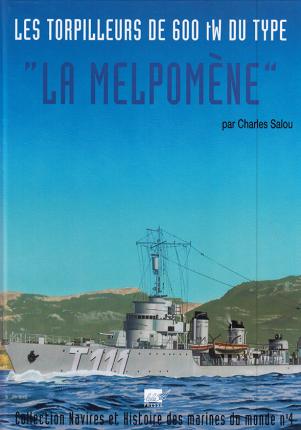
Charles Salou, Les Torpilleurs de 600 tW du type la Melpomène, Les Éditions LELA PRESSE, 2004, 112 p.
Pierre Vincent-Bréchignac et Henri Le Masson, Les Flottes de Combat 1940-42, Paris, Société d’éditions Géographiques, Maritimes et Coloniales, 1942
(en) Robert Gardiner et Roger Chesneau, Conway’s All the World’s Fighting Ships (1922-1946), 1980
Jean Meyer et Martine Acerra, Histoire de la marine française : des origines à nos jours, Rennes, Ouest-France, 1994, 427 p.
Michel Vergé-Franceschi (dir.), Dictionnaire d’Histoire maritime, Paris, éditions Robert Laffont, coll. « Bouquins », 2002
Alain Boulaire, La Marine française : De la Royale de Richelieu aux missions d’aujourd’hui, Quimper, éditions Palantines, 2011
Rémi Monaque, Une histoire de la marine de guerre française, Paris, éditions Perrin, 2016, 526 p.
Jean-Michel Roche, Dictionnaire des bâtiments de la flotte de guerre française de Colbert à nos jours, t. II : 1870-2006, Millau, Rezotel-Maury, 2005, 591 p.
Links
forummarine.forumactif.com/
navypedia.org/
alabordache.fr/
imagesdefense.gouv.fr/
secondeguerre.net/
en.wikipedia.org/
Model Kits
None. Want one ?
3D
None.